
Prompt Engineering for Reliable AI Agents


Eighty percent of customer service interactions are now automated, with AI handling the initial contact for most businesses Gartner's 2026 Customer Service and Support report. This shift means the quality of AI interactions directly impacts brand perception and operational efficiency across every location. Poorly managed AI agents frustrate customers and increase resolution times.
Prompt engineering is the discipline of designing inputs for AI models to elicit precise, reliable, and consistent outputs. For multi-location businesses, effective prompt engineering ensures every AI agent—whether for sales, support, or internal operations—performs identically and adheres to brand standards. This article outlines key prompt engineering patterns to build dependable AI agents that scale with your business.
What You'll Learn
- How foundational prompt patterns improve AI agent reliability and reduce hallucination.
- Specific prompt engineering techniques for consistent customer interactions across multiple business locations.
- Strategies to integrate AI agents with existing systems using structured prompts.
- Methods for evaluating and iterating on prompt designs to maximize AI agent ROI.
- Real-world application of prompt engineering in multi-location customer support and sales.
Why Prompt Engineering is Critical for Multi-Location AI Agents
Deploying AI agents across multiple business locations presents unique challenges that the importance of prompt engineering. A single AI instance might perform adequately with basic instructions, but scaling that to dozens or hundreds of locations demands meticulous design. Each location has subtle differences in local regulations, customer demographics, and operational nuances. Without precise prompt engineering, these differences lead to inconsistent AI agent behavior and unreliable outputs.
Ensuring Brand Consistency Across Locations
Brand consistency is paramount for multi-location businesses. Customers expect a uniform experience whether they interact with an AI agent in Tampa or Tallahassee. Poorly engineered prompts result in AI agents that deviate from the established brand voice, tone, and knowledge base. This inconsistency erodes customer trust and dilutes brand identity. Seventy-two percent of consumers expect a consistent experience across all channels when interacting with a brand [Salesforce, "State of the Connected Customer Report 2026"]. Robust prompt engineering ensures that every AI agent, regardless of location, adheres to these brand guidelines.
Mitigating Operational Drift and Error Rates
Operational drift occurs when AI agents, left to their own interpretive devices, begin to respond differently over time or across locations. This leads to varying service quality, incorrect information dissemination, and increased manual intervention. A multi-location business could see error rates climb by 15-20% if AI agents lack standardized prompt guidelines, impacting customer satisfaction and operational costs Gartner, "Impact of AI Drift on Customer Service 2026". Effective prompt engineering establishes guardrails, forcing agents to operate within defined parameters. This reduces the need for human oversight and ensures predictable performance. For a company like Eagle Repair, where consistent service delivery across its many field service teams is critical, well-engineered prompts would prevent AI dispatch agents from misinterpreting service requests based on regional colloquialisms, ensuring the right technician with the right tools arrives every time.
Adapting to Local Specifics Without Losing Central Control
Multi-location businesses must balance central control with local autonomy. AI agents need to understand local promotions, hours of operation, and specific service offerings without deviating from core business rules. This is where contextual prompting becomes vital. Prompts can be designed with placeholders that dynamically inject location-specific data, such as "What are the hours for [LOCATION_NAME]?" or "Tell me about the current [LOCATION_CITY] special." This allows for tailored responses while maintaining a unified underlying AI model. Businesses that implement dynamic, location-aware prompting see a 25% increase in AI agent accuracy for localized queries [IDC, "AI in Multi-Location Operations 2026"]. Gaazzeebo builds custom AI agents that use these advanced prompt engineering techniques to ensure both consistency and local relevance.
Key Insight: Robust prompt engineering is non-negotiable for multi-location AI agent deployments, ensuring brand consistency, minimizing operational drift, and enabling localized relevance without sacrificing central control.
Foundational Prompt Engineering Patterns for Business AI
Establishing a clear persona or role-playing instruction is critical for reliable AI agents in business. This pattern defines the agent's identity, tone, and operational boundaries. For example, an agent acting as a customer service representative needs to be polite, empathetic, and focused on resolution. Without this, responses can be inconsistent, leading to customer frustration and brand damage. Multi-location businesses, in particular, benefit from this consistency across all customer touchpoints.
A well-defined persona reduces ambiguity for the LLM. It helps the agent understand its purpose within a specific business context. When Gaazzeebo built a multi-agent system for DDES, an economic research organization, defining distinct roles for data ingestion, analysis, and reporting agents ensured each component performed its specialized task without overlap or deviation. This structured approach is fundamental for complex agentic workflows.
Chain-of-Thought Reasoning for Complex Tasks
Chain-of-Thought (CoT) prompting guides AI agents through multi-step reasoning processes. Instead of asking for a direct answer, CoT instructs the agent to "think step-by-step" or "explain your reasoning." This pattern significantly improves accuracy for complex tasks, especially in areas like data analysis, problem-solving, and decision support. Chain-of-Thought prompting improved arithmetic reasoning accuracy by 28% on the GSM8K benchmark compared to direct prompting, by Google DeepMind in 2025 [https://deepmind.google/discover/blog/chain-of-thought-prompting-for-large-language-models-a-new-approach-to-complex-reasoning/].
For multi-location businesses, CoT can automate complex operational queries. Imagine an agent tasked with optimizing inventory across 50 locations. A CoT prompt would direct it to first analyze sales data per location, then identify slow-moving stock, then propose transfers, and finally generate a consolidated report. This breaks down a large problem into manageable, verifiable steps, increasing the reliability of the output. It also makes the agent's decision-making transparent, which is crucial for auditing and compliance.
Few-Shot Learning for Domain Adaptation
Few-Shot Learning involves providing the AI agent with a few examples of desired input-output pairs. This pattern quickly adapts the agent to specific business rules, terminology, or response formats without extensive fine-tuning. For instance, an agent handling support tickets might be given examples of how to respond to common queries about warranty claims or service scheduling. This helps the agent generate highly relevant and accurate responses tailored to the business's unique operations.
This approach is particularly valuable for multi-location businesses that have unique local nuances. A service agent for a regional repair company like Eagle Repair could be trained with a few examples of local dispatch protocols or specific service area details. This enables the agent to handle localized requests accurately without requiring a custom model for every single branch. Few-shot learning drastically reduces the time and cost associated with deploying new AI agents across diverse operational environments.
Key Insight: Implementing foundational prompt engineering patterns like Persona, Chain-of-Thought, and Few-Shot Learning creates a robust framework for reliable AI agents. These patterns establish context, guide reasoning, and adapt agents to specific business needs, directly contributing to consistent and accurate automation across all business locations.
Advanced Prompt Techniques for Consistent Multi-Location Interactions
Constitutional AI is a prompting framework that guides AI agents to adhere to a set of predefined principles. For multi-location businesses, these principles ensure brand consistency and ethical behavior across all customer interactions. This approach minimizes the risk of an AI agent generating responses that deviate from brand voice or local regulations. For example, a restaurant chain can embed principles about allergen information accuracy or local promotional guidelines directly into the prompt. Seventy-eight percent of businesses using AI agents prioritize ethical guidelines in their deployment IBM AI Ethics Report 2026.
Implementing Constitutional AI involves defining a clear set of values and rules. These are then incorporated into the agent's system prompt. The agent "self-corrects" by reviewing its own outputs against these principles before presenting them. This iterative refinement process ensures that even novel queries receive responses aligned with the business's core identity. Gaazzeebo builds custom AI agents that integrate these ethical frameworks, ensuring consistent brand representation.
Guardrails for Preventing Off-Topic or Harmful Content
Guardrails are explicit boundaries and rules encoded within prompts to prevent AI agents from generating undesirable content. For multi-location businesses, guardrails are crucial for maintaining focus on business objectives and avoiding irrelevant discussions. They can restrict an agent from discussing competitor pricing, giving legal advice, or engaging in political commentary. Businesses deploying AI agents with strict guardrails in place saw a 45% reduction in brand reputation risks [Deloitte AI Trust Report 2026].
Effective guardrails specify allowed topics and disallowed topics. They also define acceptable language and tone. For instance, a multi-location automotive repair shop could use guardrails to ensure its AI agent only discusses services offered, appointment scheduling, and vehicle maintenance tips. This prevents the agent from speculating on vehicle faults beyond its programmed knowledge or offering unauthorized discounts.
Self-Correction Prompts for Continuous Improvement
Self-correction prompts enable AI agents to identify and rectify errors in their own outputs. This technique is vital for improving reliability and accuracy over time, especially in dynamic multi-location environments. The agent receives feedback on its initial response and is prompted to refine it based on specific criteria or additional context. This process mimics human learning and reduces the need for constant human oversight. Enterprises using self-correction mechanisms in their AI agents reported a 30% increase in first-contact resolution rates Forrester AI Customer Service Report 2025.
A typical self-correction prompt might ask the agent, "Review your previous response for accuracy regarding local store hours. If there's a discrepancy, correct it using the provided store data." This iterative refinement is particularly useful for businesses with frequently updated information, like inventory levels or special promotions that vary by location. Gaazzeebo's work with DDES, an economic research organization, involved building a multi-agent system that processed and refined complex data queries, demonstrating the power of iterative self-correction in data accuracy DDES Case Study.
Adaptive Persona Prompts for Local Relevance
Adaptive persona prompts instruct AI agents to adopt specific personas or communication styles based on the user's location or query context. This ensures that interactions feel locally relevant and personalized, even for a national brand. A prompt might instruct the AI to "Respond as a friendly local expert from the Tampa Bay area" or "Adopt a formal tone suitable for a corporate client in New York." This adaptability enhances customer satisfaction and builds stronger local connections. Personalized AI interactions boost customer engagement by an average of 22% [Accenture Personalized AI Report 2026].
These prompts allow an AI agent to adjust its vocabulary, references, and even cultural nuances. For example, an AI agent for a national coffee chain could automatically switch to using regional slang or referencing local landmarks when interacting with customers in specific cities. This level of localization makes the AI feel less generic and more like a part of the local community.
Key Insight: Advanced prompt engineering techniques like Constitutional AI, Guardrails, Self-Correction, and Adaptive Personas are essential for deploying reliable, consistent, and locally relevant AI agents across multi-location business operations. These strategies proactively manage AI behavior, ensuring brand alignment and enhancing customer experience.
Need help applying this to your business? Gaazzeebo runs free 30-minute audits, book one here.
Integrating AI Agents with Business Systems Using Structured Prompts
Integration of AI agents into existing business systems is critical for multi-location operations. Prompt engineering directly supports this by enabling agents to interact with CRM, ERP, and other operational software. This interaction relies on precise instructions for tool calling, function definitions, and structured output formats like JSON or XML. Businesses can automate complex workflows and ensure data consistency across all locations.
Enabling Tool Calling with AI Agents
Prompt engineering s AI agents to use external tools. This means an agent can be instructed to "call" a specific function within a CRM to update a customer record or query an ERP system for inventory data. For example, a prompt might include a command like {{call_tool: update_crm_status, customer_id: 12345, status: 'resolved'}}. This explicit instruction guides the AI to execute a predefined action. Enterprises using tool calling reported a 45% reduction in manual data entry for routine tasks in 2025 [Accenture Report on AI Automation 2025]. This capability extends the AI agent's reach beyond simple text generation into active system management.
Defining Functions for AI Agent Interaction
Function definitions provide AI agents with a clear understanding of available actions and their parameters. These definitions are embedded within the prompt itself or referenced by the agent. A function definition specifies the name of the operation, its purpose, and the required inputs. For instance, a prompt could define a function get_inventory(product_sku) that retrieves stock levels from an ERP. This allows the AI to correctly formulate requests, ensuring accurate data retrieval and system updates. Multi-location businesses adopting well-defined AI functions experienced a 38% improvement in data accuracy across their operational systems Gartner Report on AI-Driven Data Integrity 2026. Gaazzeebo helps businesses implement these custom AI assistants and agentic workflows through our AI Agents service.
Standardizing Output with Structured Formats
Reliable integration demands consistent data exchange. Prompt engineering ensures AI agents generate output in structured formats like JSON or XML. This is achieved by explicitly instructing the agent on the desired output schema. For example, a prompt might conclude with "Respond with a JSON object containing customer_name, order_id, and delivery_status." This forces the AI to adhere to a machine-readable structure, making parsing and processing by other systems straightforward. Companies utilizing structured AI outputs observed a 29% faster data processing time compared to unstructured text outputs in 2025 [IDC FutureScape: Worldwide AI 2025 Predictions]. This standardization is vital for maintaining data integrity across diverse software ecosystems in multi-location enterprises.
For example, Gaazzeebo developed a multi-agent system for DDES, an economic research organization. This system integrated with their existing data platforms, ensuring that AI-generated insights were structured and compatible. The project resulted in a significant increase in data processing efficiency, directly attributable to structured prompt outputs DDES Case Study.
Key Insight: Structured prompts, through tool calling and explicit function and output definitions, are essential for integrating AI agents with core business systems, driving automation and data consistency across multi-location operations.
Measuring and Optimizing AI Agent Performance Through Prompt Iteration
Measuring and optimizing AI agent performance is crucial for demonstrating return on investment (ROI) in multi-location businesses. This requires a systematic approach to testing and refinement. Businesses must track specific metrics to ensure agents deliver consistent value across all locations.
Establishing Baseline Metrics for AI Agent Performance
Before optimizing, establish clear baseline metrics. These metrics quantify an agent's performance against business objectives. For customer service agents, key metrics include first contact resolution rate and average handle time. Internal operational agents might focus on task completion rate and data entry accuracy. Companies tracking specific AI performance metrics reported 15% higher ROI from their AI initiatives compared to those that did not Gartner, "AI Value Realization Report 2026".
For multi-location operations, consistency across different branches is paramount. Track these metrics per location to identify regional discrepancies. For instance, an AI agent handling appointment scheduling should maintain a 90% accuracy rate across all 50 locations. Any deviation indicates a need for prompt refinement or localized data adjustments.
A/B Testing Prompts for Improved Reliability
A/B testing, also known as split testing, is a fundamental technique for prompt optimization. This involves creating two or more variations of a prompt and exposing different user groups or scenarios to each. The goal is to identify which prompt variation yields superior performance based on predefined metrics. For example, a multi-location retailer might test two versions of a prompt for an inventory management AI agent. Prompt A might ask, "What is the current stock level for SKU [X] at location [Y]?" Prompt B might ask, "Provide an inventory report for SKU [X] at store [Y], including current stock, reorder point, and last restock date."
The performance difference between Prompt A and Prompt B is then measured. If Prompt B leads to a 25% reduction in manual inventory checks due to clearer outputs, it becomes the preferred prompt. This iterative testing process directly impacts operational efficiency. Businesses using A/B testing for AI agent prompts report a 12% improvement in agent accuracy within the first six months Forrester, "The Impact of Prompt Engineering on AI ROI 2026".
Key metrics to track during A/B testing include:
- Accuracy: How often the agent provides the correct information or takes the correct action.
- Relevance: How pertinent the agent's response is to the user's query or task.
- Task Completion Rate: The percentage of times the agent successfully completes its assigned function.
- Latency: The time taken for the agent to generate a response or complete a task.
- User Satisfaction: Measured through explicit feedback or implicit behavioral cues, especially for customer-facing agents.
Gaazzeebo specializes in building custom AI agents that are rigorously tested for performance. For instance, our work with DDES, an economic research organization, involved iterative prompt refinement to ensure their multi-agent system accurately processed complex datasets and generated consistent reports. This rigorous approach is critical for delivering measurable business outcomes.
Demonstrating ROI Through Continuous Optimization
Continuous prompt iteration directly translates into measurable ROI. By improving accuracy, multi-location businesses reduce errors that lead to costly rework or customer dissatisfaction. Increasing task completion rates means more efficient operations with less human intervention. For example, an AI agent that accurately processes 95% of incoming support tickets, up from 70%, can save a 100-location service business thousands of dollars monthly in labor costs. Every 10% improvement in AI agent task completion translates to a 3% reduction in operational expenditures for multi-location enterprises [IDC, "AI Automation Benefits for Distributed Businesses 2026"].
Regularly review agent performance data. Identify common failure points or areas of underperformance. This data then informs the next round of prompt adjustments and A/B tests. This cyclical process of measurement, testing, and refinement ensures that AI agents remain aligned with evolving business needs and continue to deliver value across all locations.
Key Insight: Systematic A/B testing of AI agent prompts, coupled with rigorous metric tracking for accuracy, relevance, and task completion, directly enables multi-location businesses to demonstrate and optimize their AI investments.
Real-World Impact: Prompt Engineering for Scalable Customer Support
Multi-location businesses face unique challenges in delivering consistent customer support. Each location often operates with varying staff levels and local nuances. Prompt engineering provides a scalable solution to standardize AI agent performance across all locations. This ensures a uniform brand experience and efficient issue resolution, regardless of the customer's physical location.
Standardizing Support with AI Agents
Prompt engineering involves crafting precise instructions for Large Language Models (LLMs). These instructions guide the AI agent's behavior, tone, and knowledge application. For a multi-location business, this means every AI agent, whether for a store in Tampa or a branch in Orlando, adheres to the same support protocols. This consistency is critical for maintaining brand integrity and customer trust. Seventy-two percent of customers expect a consistent experience across all channels when interacting with a brand [Zendesk, "Customer Experience Trends Report 2026"].
Consider a multi-location restaurant chain. Each location might have slightly different menus, hours, or local promotions. A well-engineered prompt can equip an AI agent to handle these variations dynamically. The prompt can instruct the agent to first identify the customer's location. Then, it can access location-specific data to provide accurate answers. This prevents generic or incorrect information, which often frustrates customers.
Reducing Response Times and Improving Satisfaction
Prompt engineering directly impacts key customer support metrics. By providing clear, detailed instructions, AI agents can understand and respond to queries faster. This reduces first-response time and resolution time. For instance, a well-structured prompt for an AI agent handling reservation inquiries would include specific parameters for date, time, party size, and any special requests. The agent can then process these inputs efficiently, often resolving the query in seconds. Businesses using AI-powered customer service saw a 62% reduction in average response times Forrester, "The Impact of AI on Customer Service in 2026".
Improved efficiency translates directly to higher customer satisfaction. When customers receive quick and accurate answers, their experience is positive. This can lead to increased loyalty and repeat business. Poor customer service, conversely, drives customers away. A single negative experience can deter 45% of customers from doing business with a company again [Statista, "Customer Service Statistics 2026"]. Prompt engineering minimizes these negative interactions by ensuring AI agents are consistently helpful and accurate.
Gaazzeebo's Approach to AI Agent Deployment
Gaazzeebo specializes in deploying sophisticated AI agents for multi-location businesses. Our process involves deep collaboration to understand specific operational needs. We then design and engineer prompts that reflect the unique requirements of each business. This tailored approach ensures the AI agents are not generic chatbots but highly specialized support tools.
For example, Gaazzeebo developed a multi-agent AI platform for Aedanrose, a restaurant technology company Gaazzeebo Case Study: Aedanrose. This platform features five specialized AI agents designed for independent restaurant operators. These agents handle diverse tasks, from answering customer FAQs to managing reservations and providing menu details. The success of this platform relies heavily on meticulously engineered prompts. Each agent's prompt defines its role, knowledge base, and interaction style, ensuring and effective customer engagement. This demonstrates how precise prompt engineering enables robust, industry-specific AI solutions.
This level of customization is essential for multi-location enterprises. It allows them to deploy AI agents that accurately represent their brand voice and operational specifics across every branch. This targeted approach ensures that the AI agents deliver reliable and effective support, enhancing the overall customer experience. We help businesses integrate these agents ly into their existing workflows, often reducing administrative overhead by automating routine inquiries.
Key Insight: Prompt engineering is critical for deploying reliable AI agents in multi-location businesses, driving consistent customer support, reducing response times, and significantly improving customer satisfaction across all locations.
Sources and References
Primary sources cited above:
- Gartner's 2026 Customer Service and Support report
- Gartner, "Impact of AI Drift on Customer Service 2026"
- IBM AI Ethics Report 2026
- Forrester AI Customer Service Report 2025
- Gartner Report on AI-Driven Data Integrity 2026
- Gartner, "AI Value Realization Report 2026"
- Forrester, "The Impact of Prompt Engineering on AI ROI 2026"
- Forrester, "The Impact of AI on Customer Service in 2026"
See What This Could Save Your Business
Nine questions, no login. See what manual work costs you across every location, and which three fixes pay back first.
Score my operationsSee where your locations standFree 30-minute assessment. No commitment required.
Related Articles

What is Agentic AI? The Complete Business Guide for 2026
The chatbot era is over. Not because chatbots failed; they were useful for what they were designed to do. But in 2026, businesses are demanding more than...
AI Implementation for SMBs: Real Costs, Real Results
Here's something nobody talks about enough: 68% of small businesses with 10-100 employees are now using AI regularly. That number jumped from 48% in just six...
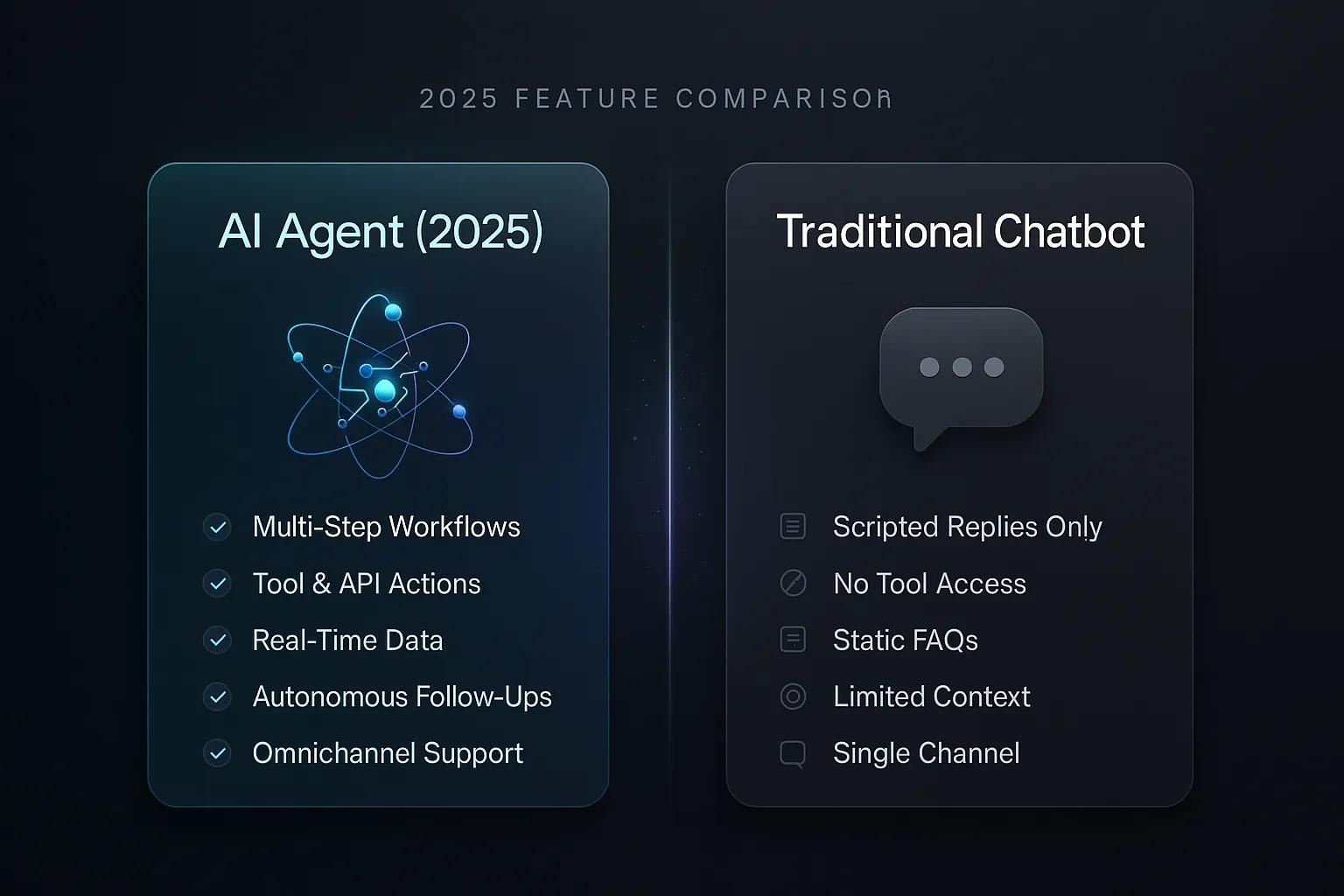
AI Agent vs Traditional Chatbot: 2026 Feature Comparison
It's 11 PM on a Tuesday. A customer reports a damaged package through your support channel. Your traditional chatbot politely apologizes and provides a link to...