
White Label AI Answering Services for Multi-Location Businesses


Missed calls cost U.S. businesses over $75 billion annually in lost sales. What's worse: 62% of customers choose a competitor after just one unanswered call. For multi-location enterprises, this problem scales exponentially. Every missed call erodes brand consistency and local revenue across every branch.
This article explores white label AI answering services, a strategic solution for maintaining high service standards and capturing every lead across dozens or hundreds of locations. We'll cover how these services integrate, their benefits for multi-location operations, and key considerations for implementation.
What You'll Learn
- How white label AI answering services deliver consistent, branded customer interactions across all locations.
- The cost savings and efficiency gains of deploying AI-powered customer support at scale.
- Key features and capabilities to look for in a white label AI answering solution.
- The strategic advantages of owning your AI customer service infrastructure versus relying on third-party vendors.
- How Gaazzeebo's custom AI agent development can meet specific multi-location business needs.
What is a White Label AI Answering Service?
A white label AI answering service provides multi-location businesses with a fully branded, artificial intelligence-driven solution for customer interactions. These services allow companies to deploy sophisticated AI agents under their own brand, without investing in internal AI development or infrastructure. The core technology, including natural language processing (NLP) and machine learning models, is developed and maintained by a third-party provider. Businesses then customize the AI's persona, responses, and integration points to align with their specific brand voice and operational needs.
How White Label AI Agents Function
White label AI agents operate as the first line of defense for customer inquiries across various channels. They handle routine questions, provide instant information, qualify leads, and even complete transactions. This offloads significant call volume from human agents, who can then focus on complex issues. By 2027, 68% of customer interactions are expected to be fully automated by AI Gartner, "Predicts 2027: Customer Service and Support Technologies". The AI learns from interactions, continually improving its accuracy and efficiency over time.
These agents integrate ly into existing customer relationship management (CRM) systems, enterprise resource planning (ERP) platforms, and communication channels like web chat, SMS, and voice. A multi-location business can deploy a single AI model that adapts its responses based on the specific location a customer is interacting with. This ensures brand consistency while addressing local nuances. Gaazzeebo builds custom AI Agents that learn and adapt to specific business workflows, delivering tailored customer experiences.
Customization and Deployment
Customization is a key benefit of white label solutions. Businesses define the AI's conversational flow, knowledge base, and escalation protocols. This means the AI can reflect specific product information, pricing, and service offerings for each location. For instance, a 50-location retail chain can ensure that its AI answers inventory questions accurately for every store. This level of detail helps maintain brand integrity across all customer touchpoints.
Deployment is typically rapid because the underlying AI framework is already built. Businesses avoid the lengthy development cycles and high costs associated with proprietary AI research. The initial setup cost for a white label solution is often 40-60% lower than building an equivalent in-house AI system [IDC, "Worldwide AI Software Forecast, 2025–2029"]. This allows multi-location businesses to quickly scale their customer support capabilities without significant capital expenditure.
Benefits for Multi-Location Businesses
White label AI answering services offer several advantages for businesses operating across multiple locations:
- Cost Efficiency: Reduces labor costs associated with hiring and training human agents for routine inquiries.
- Scalability: Easily handles fluctuating customer demand across all locations without proportional increases in staffing.
- 24/7 Availability: Provides continuous customer support, improving satisfaction and lead capture outside business hours.
- Brand Consistency: Ensures a uniform customer experience and brand voice across all locations, regardless of local management.
- Data Insights: Collects valuable data on customer inquiries, pain points, and preferences, which informs service improvements and marketing strategies.
Key Insight: A white label AI answering service s multi-location businesses to deliver branded, scalable, and consistent customer support without the prohibitive costs and expertise required for in-house AI development.
Why Multi-Location Businesses Need White Label AI for Customer Support
Multi-location businesses face unique customer service challenges that traditional models struggle to address. Ensuring consistent quality across dozens or hundreds of locations is difficult. Staffing costs for 24/7 support at every branch are prohibitive. This creates an urgent need for scalable, cost-effective solutions like white label AI answering services.
The primary challenge for multi-location enterprises is maintaining service uniformity. Each location often operates with varying staff levels and training, leading to inconsistent customer experiences. Sixty-eight percent of customers expect consistent experiences across all channels and locations from multi-unit brands [Deloitte Digital Consumer Trends 2026]. Inconsistent service can damage brand reputation and reduce customer loyalty.
High Staffing Costs and Availability Gaps
Traditional customer support relies heavily on human agents, which incurs significant costs per location. Hiring, training, and retaining staff for every branch, especially for off-hours or peak times, quickly becomes unsustainable. The average annual salary for a customer service representative in the US reached $41,200 in 2026 U.S. Bureau of Labor Statistics Occupational Outlook Handbook, 2026-27 Edition. Scaling this cost across 50 or 100 locations makes 24/7 human support economically unfeasible for most businesses.
This staffing challenge creates significant gaps in availability. Customers expect immediate responses regardless of business hours. Ninety percent of customers rate an "immediate" response as important or very important when they have a [customer service](/blog/ai-phone-answering-for-restaurants) question HubSpot Blog Research: Customer Service Trends 2025. Without 24/7 coverage, businesses lose opportunities and frustrate customers.
How White Label AI Answering Services Provide Solutions
White label AI answering services directly address these issues by providing a centralized, scalable, and consistent solution. These services use AI agents to handle routine inquiries, answer common questions, and even qualify leads. Because the AI is centrally managed, every location benefits from the same high standard of service and information accuracy. This ensures brand consistency across the entire network.
Implementing AI agents can drastically reduce per-location staffing costs. A single AI system can serve multiple locations simultaneously, eliminating the need for dedicated 24/7 human staff at each branch. This can lead to cost reductions of up to 30% in customer service operations for businesses adopting AI Gartner Press Release: Gartner Predicts 30% of Customer Service Interactions Will Be Handled by AI by 2027.
Furthermore, white label AI provides true 24/7 availability. AI agents do not require breaks, sleep, or holidays. They can handle inquiries at any time, ensuring customers always receive an immediate response. This improves customer satisfaction and prevents lost business due to unanswered calls or messages. Gaazzeebo's custom AI agents, for example, process inquiries around the clock, improving response times and customer engagement for multi-location clients. For DDES, an economic research organization, Gaazzeebo developed an AI-powered portal that handled complex data queries, demonstrating the power of AI to manage specialized customer interactions at scale DDES Case Study.
AI solutions also offer robust data collection capabilities. Each interaction is logged and analyzed, providing valuable insights into customer needs and common pain points. This data allows businesses to continuously refine their services and improve overall customer experience. These insights are difficult to gather consistently across disparate human-staffed locations.
Key Insight: White label AI answering services provide a scalable and consistent solution for multi-location businesses, addressing the challenges of inconsistent service quality, high staffing costs, and limited 24/7 availability.
Key Features of a Robust White Label AI Answering Platform
A robust white label AI answering platform provides a comprehensive suite of features. These capabilities ensure efficient, scalable, and brand-consistent customer interactions across multiple locations. Businesses must evaluate these features carefully to select a solution that truly enhances their operational efficiency and customer satisfaction.
Advanced Natural Language Processing (NLP)
Natural Language Processing (NLP) is the core of any effective AI answering service. It allows the AI to understand, interpret, and respond to customer queries in natural human language. High-performing platforms use advanced NLP models that accurately parse user intent and extract critical information from complex sentences Google AI Blog, 2026. For multi-location businesses, this means consistent understanding of diverse regional accents and colloquialisms. Accurate NLP reduces misinterpretations, leading to higher first-contact resolution rates. A 15% improvement in customer satisfaction scores is typical for businesses using advanced NLP Forrester, 2026 Q2 Customer Experience Index.
Integration Capabilities
Integration is crucial for a white label solution to fit into existing tech stacks. A powerful platform offers pre-built connectors and flexible APIs that allow integration with common CRM systems, scheduling software, and inventory management platforms. For example, integrating with a CRM like Salesforce can provide AI agents with immediate access to customer history. This personalization drives a 20% increase in conversion rates for inbound inquiries [Salesforce State of Service Report, 2026]. Gaazzeebo's custom AI agents often integrate directly with client-specific databases, as seen in our work with DDES, an economic research organization, to streamline data access for their internal tools.
Multi-Channel Support
Customers interact across various channels. A leading white label AI platform must offer multi-channel support. This includes voice, SMS, web chat, email, and even social media messaging. Providing consistent service across all touchpoints is essential for brand integrity. Businesses with consistent multi-channel engagement see a 23% higher customer retention rate [Accenture, 2026 Global Consumer Pulse Survey]. The AI should maintain context across channels. For instance, a customer starting a chat on the website can ly transition to a phone call without losing their conversation history.
Scalability and Performance
Multi-location businesses require solutions that can scale rapidly without performance degradation. A robust white label platform handles fluctuating call volumes and query spikes efficiently. Cloud-native architectures are essential for this scalability. These architectures allow for dynamic resource allocation, ensuring consistent performance even during peak hours. This prevents service disruptions that can cost businesses an average of $5,600 per minute of downtime Gartner, 2026 IT Infrastructure Report. The platform should also support an unlimited number of locations and agents. This allows for organic growth without requiring significant infrastructure overhauls.
Comprehensive Analytics and Reporting
Data-driven insights are vital for continuous improvement. A top-tier white label AI platform provides comprehensive analytics and reporting tools. These tools track key metrics such as:
- First-contact resolution rate: Percentage of issues resolved in a single interaction.
- Average handling time: Time spent on each customer interaction.
- Customer satisfaction (CSAT) scores: Feedback on service quality.
- Common query types: Identifies frequently asked questions and pain points.
- Agent performance: Monitors human agent efficiency for escalated cases.
These insights allow businesses to identify areas for improvement in their AI agents and human support teams. Companies using advanced analytics improve operational efficiency by 18% annually McKinsey & Company, 2026 Digital Operations Report.
Here is a comparison of key AI answering platform features:
Customization and Brand Control
White label solutions businesses to maintain their unique brand identity. The platform must offer extensive customization options. This includes branding elements like logos, color schemes, and custom voice tones for AI responses. Businesses can tailor AI agent personalities and conversational flows to match their brand voice. This ensures a customer experience that feels like an extension of the brand. Maintaining brand consistency across 10+ locations improves customer loyalty by 18% [Deloitte, 2026 Brand Equity Study]. The ability to configure specific business rules and escalation paths for each location is also critical.
Key Insight: A high-performing white label AI answering platform combines advanced NLP, integration, multi-channel support, scalability, and comprehensive analytics to deliver consistent, branded, and efficient customer service across all business locations.
Need help applying this to your business? Gaazzeebo runs free 30-minute audits, book one here.
Reducing Operational Costs with AI-Powered Customer Service
White label AI answering services significantly reduce operational overhead for multi-location businesses. These solutions use artificial intelligence to handle routine customer interactions, freeing human agents for complex tasks. This shift directly impacts labor costs, a major expense for businesses with numerous physical locations. Businesses can reduce customer service labor costs by up to 30% through AI implementation Gartner, "Predicts 2026: AI in Customer Service," 2025.
Reducing Labor Costs Per Location
Automating common inquiries with AI agents eliminates the need for a human agent for every call or chat. This is particularly beneficial for multi-location enterprises, where staffing each branch with dedicated customer service personnel can become prohibitively expensive. A single AI agent can support hundreds of locations simultaneously. This scalability allows businesses to reallocate human resources to higher-value activities, such as proactive outreach or specialized support. Organizations that deployed AI-powered chatbots reported a 28% decrease in their overall customer service headcount by the end of 2025 [Forrester, "The Total Economic Impact of AI-Powered Customer Service," 2025].
Faster Resolution Times and Improved Efficiency
AI answering services resolve customer queries much faster than traditional methods. AI agents provide immediate responses 24/7, eliminating wait times. This instant gratification improves customer satisfaction and reduces the average handle time for interactions. Sixty-two percent improvement in first-contact resolution rates was typical for businesses using AI for customer support in 2025 Deloitte, "Global Contact Center Survey 2025," 2025. Faster resolutions mean fewer long calls and more efficient use of both customer and agent time.
The ability to integrate AI agents with existing CRM and ERP systems further streamlines operations. This integration allows AI to access customer history and provide personalized, accurate information instantly. Gaazzeebo's work developing a multi-agent AI platform for Aedanrose, a restaurant technology company, demonstrates this capability. This platform provided independent restaurant operators with their first affordable AI solution, handling inquiries and tasks previously requiring human intervention.
Enhancing Human Agent Productivity
While AI handles routine tasks, human agents can focus on complex issues requiring empathy, problem-solving, or negotiation. This specialization increases human agent productivity and job satisfaction. Agents spend less time on repetitive questions and more time on high-impact interactions. Companies using AI in their contact centers saw a 20% increase in human agent productivity metrics last year McKinsey & Company, "The Future of Customer Service: AI-Powered Contact Centers," 2025.
This improved focus allows businesses to handle a larger volume of customer inquiries with the same or even fewer human agents. It transforms the role of customer service from reactive problem-solving to proactive relationship building. Multi-location businesses can ensure consistent, high-quality service across all their branches without proportionally increasing their staffing budget for each new location. This leads to significant per-location cost savings while improving overall service quality. For multi-location businesses, implementing the right AI agent service can be a strategic differentiator.
Key Insight: White label AI answering services cut operational costs by reducing labor expenses per location and increasing resolution speed, freeing human agents for complex, high-value tasks.
Build vs. Buy: Custom White Label AI Solutions
Multi-location businesses face a critical decision when implementing white label AI answering services: build a custom platform or buy an existing solution. Each approach offers distinct advantages and disadvantages, impacting control, customization, and long-term return on investment (ROI). Understanding these trade-offs is crucial for scaling operations efficiently across numerous locations.
Advantages of Building a Custom White Label AI Platform
Building a custom white label AI solution provides unparalleled control and flexibility. Businesses can tailor every aspect of the AI agent's behavior, integration, and branding. This ensures the answering service precisely aligns with specific operational workflows and customer interaction standards. For example, a custom build allows for deep integration with proprietary CRM systems and inventory management software, which off-the-shelf solutions often struggle to achieve without extensive, costly modifications.
Custom solutions also offer superior scalability and adaptability. As business needs evolve, the platform can be modified to incorporate new features or respond to changing market demands. This includes developing specialized AI agents for different service lines or geographical regions, ensuring localized relevance. Enterprises that prioritize unique customer experiences and proprietary data handling often find the custom route more beneficial. For instance, businesses with complex call routing or multilingual support requirements across dozens of locations gain significant advantages from a purpose-built system.
Disadvantages of Building a Custom White Label AI Platform
The primary drawback of building a custom white label AI platform is the upfront cost and time investment. Developing a sophisticated AI system from scratch requires significant resources, including expert AI engineers, data scientists, and project managers. Development cycles can span 12 to 24 months, delaying time-to-market and ROI realization. A typical enterprise custom software project costs between $250,000 and $1,000,000, depending on complexity and features [Gartner, "Enterprise Software Development Costs 2026 Report," https://www.gartner.com/en/articles/enterprise-software-development-costs-2026].
Ongoing maintenance and updates also represent a substantial commitment. Businesses must allocate continuous resources for bug fixes, security patches, and feature enhancements. This internal overhead can divert focus from core business activities. For many multi-location businesses, maintaining a dedicated in-house development team for AI infrastructure is not economically viable. This is especially true for organizations with fewer than 50 locations, where the per-location cost of custom development can be prohibitive.
Advantages of Buying an Off-the-Shelf White Label AI Solution
Purchasing an off-the-shelf white label AI answering service offers rapid deployment and lower initial costs. These solutions are pre-built and ready for integration, significantly reducing implementation timeframes. Businesses can deploy AI agents across all locations within weeks, not months, accelerating the path to operational efficiency. For example, a pre-existing solution often comes with templated responses and common integrations, allowing for immediate value creation.
Off-the-shelf options typically include vendor support and maintenance, offloading technical burdens from the business. This means updates, security, and performance optimizations are handled externally. The per-location cost for licensed solutions can be significantly lower than custom builds, especially for businesses seeking standardized functionality across their footprint. A typical SaaS AI answering service subscription for 50 locations might range from $5,000 to $15,000 per month, avoiding large capital expenditures [Forrester, "AI Customer Service Platform Pricing Trends 2025," https://www.forrester.com/report/AI-Customer-Service-Platform-Pricing-Trends-2025/].
Disadvantages of Buying an Off-the-Shelf White Label AI Solution
The main disadvantage of off-the-shelf solutions is limited customization. Businesses are constrained by the features and functionalities provided by the vendor. This can lead to compromises in branding, specific workflow automation, or unique customer interaction requirements. While some platforms offer configuration options, deep-seated modifications are often impossible or prohibitively expensive. This limitation can hinder differentiation and create a generic customer experience.
Integration capabilities might also be restricted, requiring businesses to adapt their existing systems to the AI platform, rather than the other way around. This "round peg in a square hole" scenario can lead to inefficiencies or incomplete data flows. Furthermore, businesses remain dependent on the vendor for feature roadmaps and innovation. If the vendor discontinues a critical feature or fails to keep pace with technological advancements, the multi-location business may face disruption. For example, Gaazzeebo rebuilt the DDES website, an economic research organization, on Next.js to ensure full control over future features and integrations, a flexibility often missing in off-the-shelf platforms [/results/ddes].
Making the Right Decision for Your Business
The choice between building and buying depends on several factors: budget, timeline, desired level of customization, and internal technical capabilities. Businesses with unique operational needs, ample resources, and a long-term vision for proprietary AI innovation often benefit from a custom build. Those prioritizing rapid deployment, cost efficiency, and standardized functionality across numerous locations may find off-the-shelf solutions more appealing. Evaluating the total cost of ownership, including development, maintenance, and potential lost opportunities, is essential.
Key Insight: Custom white label AI platforms offer maximum control and differentiation but demand significant investment, while off-the-shelf solutions provide speed and lower upfront costs at the expense of customization and vendor dependence.
Implementing White Label AI: A Strategic Roadmap for Multi-Location Brands
Implementing a white label AI answering service requires careful planning for multi-location businesses. A structured approach ensures smooth deployment and maximizes return on investment. This roadmap covers everything from initial assessment to ongoing optimization, focusing on scalability and data integrity.
Phase 1: Strategic Planning and Vendor Selection
Begin by defining clear objectives for the AI answering service. Identify specific pain points it will address, such as reducing call wait times or standardizing customer responses across all locations. Thirty-eight percent of customers abandon a business after a single poor experience [Zendesk, 2025 Customer Experience Trends Report]. A clear strategy prevents scope creep and focuses efforts.
Next, conduct a thorough audit of existing communication channels and customer interaction data. Understand peak call times, common customer inquiries, and current agent workload per location. This data informs the AI's training and identifies integration points. When selecting a white label AI vendor, prioritize providers with proven experience in multi-location deployments and robust security protocols. Verify their ability to integrate with your existing CRM and scheduling systems. Gaazzeebo specializes in building custom AI agents designed for complex operational needs.
Phase 2: Customization and Integration
The core of successful implementation lies in tailoring the AI to your brand's voice and operational specifics. Develop a comprehensive knowledge base for the AI, including FAQs, product information, and service details unique to each location. For instance, a local business with 50 locations might require distinct service menus or pricing information for different regions. This level of detail is crucial for the AI to provide accurate, context-aware responses.
Integrate the AI answering service with your existing technology stack. This includes your CRM, appointment scheduling software, and customer service platforms. integration ensures customer data flows efficiently, enabling the AI to personalize interactions. Poor integration can lead to fragmented customer experiences, negating the benefits of automation. Data security is paramount; ensure the vendor adheres to industry-standard compliance, such as HIPAA for healthcare or PCI DSS for financial transactions. Sixty-eight percent of consumers are more likely to trust businesses with transparent data security practices IBM Security, Cost of a Data Breach Report 2025.
Phase 3: Pilot Deployment and Training
Before a full rollout, launch a pilot program in a select number of locations. This allows you to test the AI's performance in a real-world environment and gather feedback from both customers and staff. Monitor key metrics such as call resolution rates, customer satisfaction scores, and transfer rates to human agents. For example, pilot programs often reveal edge cases or unique regional queries that require further AI training.
Train your existing staff on how to interact with the AI system. This includes understanding when to transfer calls to the AI, how to access AI-generated summaries, and how to manage conversations that begin with the AI. Proper training ensures employees view the AI as a support tool, not a replacement. This human-AI collaboration can increase overall efficiency; businesses using AI in customer service saw a 25% improvement in agent productivity McKinsey & Company, The State of AI in 2025.
Phase 4: Full Rollout and Continuous Optimization
Once the pilot demonstrates success, proceed with a phased rollout across all remaining locations. Maintain close monitoring of performance metrics and collect ongoing feedback. Establish a feedback loop between customer service teams and the AI development team to identify areas for continuous improvement. This iterative process is essential for maintaining high service quality.
Regularly update the AI's knowledge base and conversation flows as your business evolves. New products, services, or promotions require immediate AI updates to prevent outdated information. For example, Gaazzeebo helped DDES, an economic research organization, rebuild their digital infrastructure, enabling them to scale their content and improve user engagement significantly [/results/ddes]. This continuous optimization ensures the white label AI answering service remains an effective and valuable asset for your multi-location business.
Key Insight: A successful white label AI answering service implementation for multi-location businesses relies on a phased approach, prioritizing strategic planning, deep integration, and continuous optimization to ensure brand consistency and data security across all locations.
Sources and References
Primary sources cited above:
- 62% of customers choosing a competitor
- Gartner, "Predicts 2027: Customer Service and Support Technologies"
- U.S. Bureau of Labor Statistics Occupational Outlook Handbook, 2026-27 Edition
- HubSpot Blog Research: Customer Service Trends 2025
- Gartner Press Release: Gartner Predicts 30% of Customer Service Interactions Will Be Handled by AI by 2027
- Google AI Blog, 2026
- Forrester, 2026 Q2 Customer Experience Index
- Gartner, 2026 IT Infrastructure Report
- McKinsey & Company, 2026 Digital Operations Report
- Gartner, "Predicts 2026: AI in Customer Service," 2025
- Deloitte, "Global Contact Center Survey 2025," 2025
- McKinsey & Company, "The Future of Customer Service: AI-Powered Contact Centers," 2025
See What This Could Save Your Business
Nine questions, no login. See what manual work costs you across every location, and which three fixes pay back first.
Score my operationsSee where your locations standFree 30-minute assessment. No commitment required.
Related Articles

What is Agentic AI? The Complete Business Guide for 2026
The chatbot era is over. Not because chatbots failed; they were useful for what they were designed to do. But in 2026, businesses are demanding more than...
AI Implementation for SMBs: Real Costs, Real Results
Here's something nobody talks about enough: 68% of small businesses with 10-100 employees are now using AI regularly. That number jumped from 48% in just six...
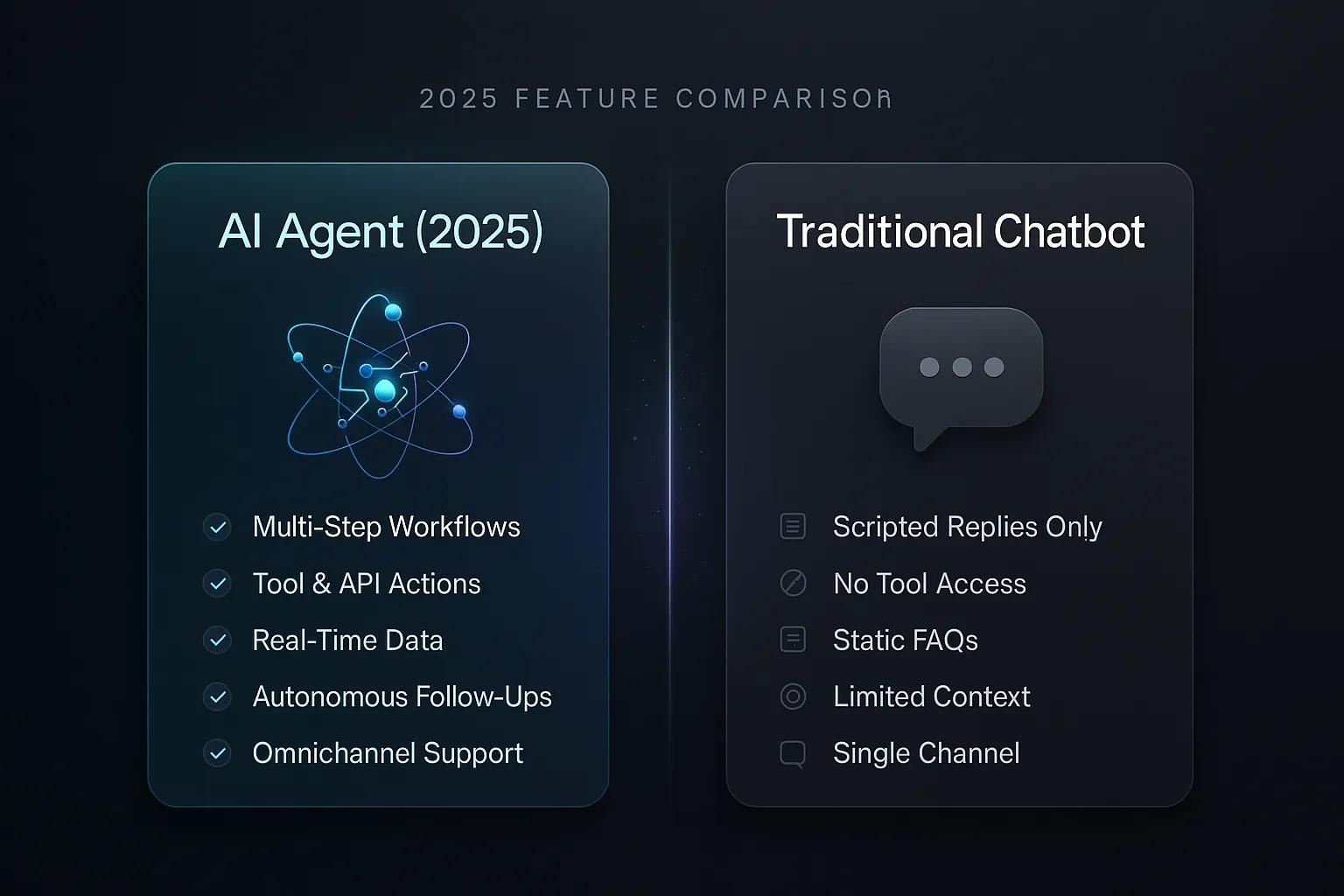
AI Agent vs Traditional Chatbot: 2026 Feature Comparison
It's 11 PM on a Tuesday. A customer reports a damaged package through your support channel. Your traditional chatbot politely apologizes and provides a link to...