
AI Agent vs Traditional Chatbot: 2026 Feature Comparison
The Difference Between Providing Information and Completing Work

It's 11 PM on a Tuesday. A customer reports a damaged package through your support channel. Your traditional chatbot politely apologizes and provides a link to your returns form. The customer sighs, fills out the form, and waits for someone to review it tomorrow.
Now imagine this: An AI agent receives the same report, verifies the order in your system, processes the refund automatically, arranges a replacement shipment, updates the customer's account, and sends a confirmation, all within 90 seconds. No forms. No waiting. No human intervention required.
In 2026, the distinction between chatbots and AI agents isn't just technical, it's the difference between providing information and completing work. As businesses race to automate operations, understanding which solution delivers actual ROI has become critical.
After implementing both chatbots and AI agents across a range of industries, we've seen firsthand what works, what wastes money, and what delivers measurable results. This guide breaks down everything you need to know to make the right decision for your business.
What You'll Learn
- The fundamental differences between traditional chatbots and AI agents
- Feature-by-feature comparison with real business impact
- Actual implementation costs and ROI data from 2025-2026
- When to use each solution (and when a hybrid approach wins)
- How to avoid the mistakes 41% of companies regret
Let's start with the basics.
What Actually IS a Traditional Chatbot?
Think of traditional chatbots as the "choose your own adventure" books of customer service. They follow predetermined paths, and if you deviate from the script, they're lost.
A traditional chatbot is a computer program that uses pre-defined rules, decision trees, and scripted responses to interact with users, powered by natural language processing that requires substantial training on hundreds of utterances. These systems have been around since Joseph Weizenbaum created ELIZA in 1964, and while they've gotten smarter over the decades, their fundamental architecture remains the same.
Here's how they work: When you type "Do you have this shoe in size 8?" the chatbot recognizes keywords like "shoe" and "size 8," matches them against its decision tree, and returns a pre-programmed response. It might check inventory or point you to the returns policy.
But when you follow up with "Change my delivery address," the bot hits a wall, that's outside its script. It either provides a generic link or escalates to a human agent.
What Traditional Chatbots Excel At
Don't get us wrong, chatbots still have their place in 2026. They're excellent for:
✅ High-volume FAQ answering: Store hours, shipping policies, basic product information
✅ Simple lead capture: Collecting names, emails, and basic qualification data
✅ Information retrieval: Looking up order status, checking inventory, finding store locations
✅ Brand voice consistency: For organizations requiring prescriptive control over conversation flows and strict adherence to brand messaging guidelines
✅ Budget-conscious implementations: When you need automation but have limited resources
The Limitations Are Real
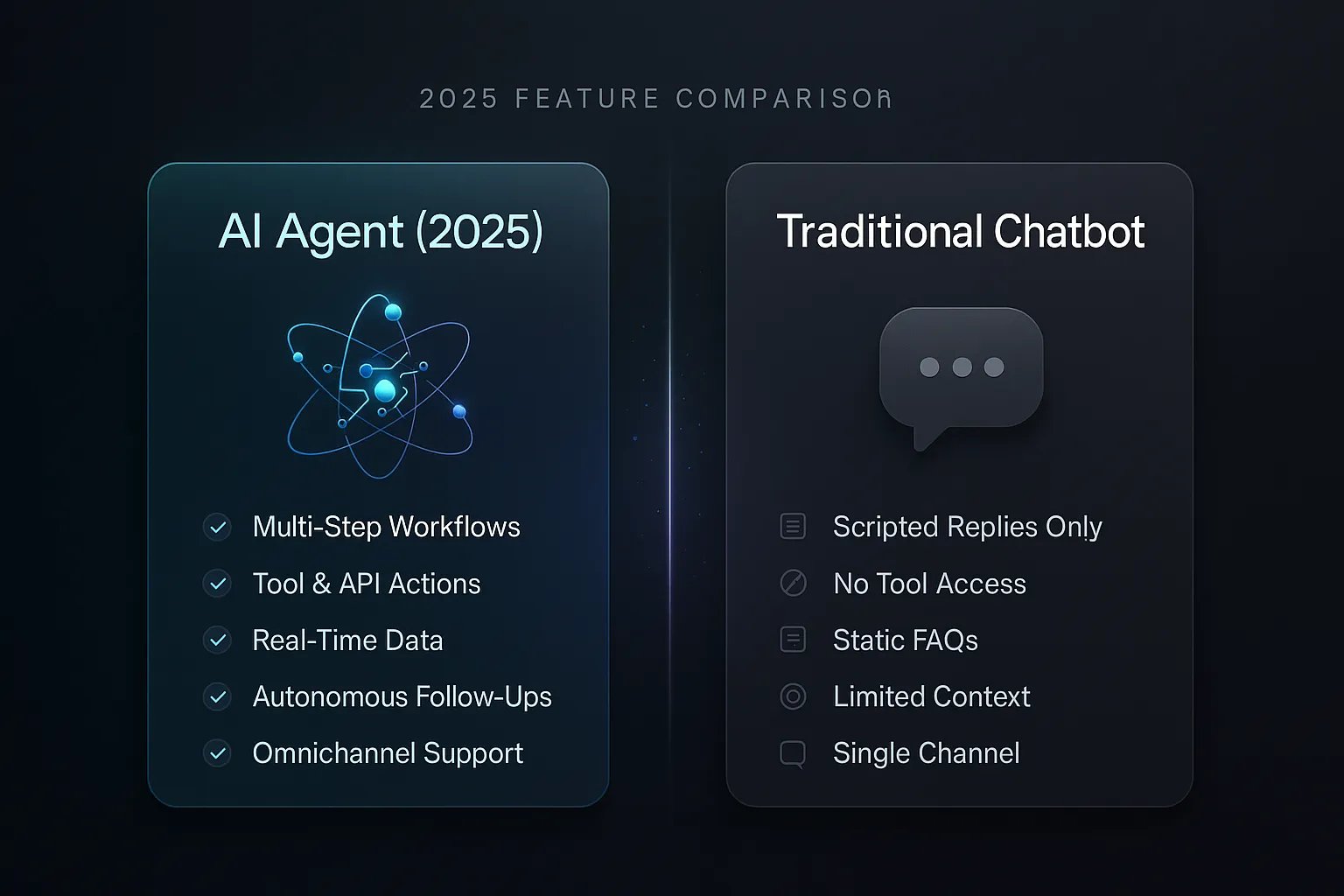
Chatbots provide answers and information, react to individual messages, have limited memory, and stay within the chat interface. They can't take action. They can't learn from mistakes. They can't adapt to unexpected situations.
For instance, a scripted chatbot on an e-commerce site might only recognize exact phrases like "blue compression shirt" and return a fixed link. If you ask for "workout gear in blue for running," it might fail completely, unless someone manually programmed that specific variation into its decision tree.
This is where AI agents change the game entirely.
What Makes AI Agents Different
Want the full picture? For a comprehensive deep dive into the latest capabilities, business use cases, and implementation strategies, see our complete guide to agentic AI in 2026.
If chatbots are choose-your-own-adventure books, AI agents are skilled assistants with access to your entire back office. They don't just respond, they understand, plan, and execute.
AI agents can plan, reason, remember, and execute multi-step workflows autonomously. You tell an agent its goal, and it figures out how to accomplish that goal with minimal intervention. The difference is profound.
The Core Capabilities That Matter
1. True Autonomy
AI agents act independently to achieve objectives without any manual user intervention, while chatbots don't act on their own and need manual intervention to operate. This isn't just about responding faster, it's about completing entire workflows without human involvement.
For example, when a customer reports that damaged package at 11 PM, an AI agent doesn't just acknowledge the problem. It:
- Authenticates the customer and retrieves order details
- Analyzes the issue against return policies
- Processes the refund through your payment gateway
- Creates a replacement order in your fulfillment system
- Updates inventory tracking
- Sends confirmation to the customer
- Logs the interaction for quality assurance
All of this happens automatically, in sequence, while the customer waits.
2. Planning and Reasoning
AI agents understand user goals and take action, plan workflows using tools, remember context across sessions, and integrate with external systems to complete tasks. They break down complex requests into executable steps, then adapt their approach based on what they discover.
Consider a customer asking: "I need to reschedule my appointment because I'll be out of town, and I also want to add the premium service we discussed last time."
A chatbot would likely get confused by the two-part request. An AI agent understands both components, accesses the scheduling system, retrieves the previous conversation about premium services, checks availability, calculates new pricing, and presents options, all in a single conversational turn.
3. Context Awareness and Memory
Agents maintain state over longer horizons through sessions that preserve conversation and tool context across runs, making long-running tasks practical. They don't just remember what you said two messages ago, they understand the full context of your relationship with the company.
This means an AI agent helping with a product return can reference your purchase history, previous support interactions, warranty status, and preferences without asking you to repeat information you've already provided three times to different systems.
4. Tool Integration
Here's where things get technically interesting. AI agents have digital "eyes, ears, and hands", they observe by pulling live data from other systems, remember by keeping context from past interactions, and take action by executing tasks.
Agents connect to tools and APIs to take actions including search, file operations, code execution, and data updates. This is fundamentally different from chatbots, which can only display information or create tickets for humans to handle.
In early 2025, OpenAI's platform update formalized this capability with agent primitives and an agent loop for iterative tool use, making it easier for businesses to deploy agents that actually do work instead of just talking about it.
Feature-by-Feature Comparison
Let's break down exactly how these systems differ across the features that matter for your business.
Intelligence and Understanding
Traditional Chatbots: Offer limited responses and can only execute simple support tasks. They rely on keyword matching and pattern recognition. If a customer phrases something differently than expected, accuracy drops significantly.
AI Agents: Learn from data, adapt responses based on past interactions, and autonomously work to achieve predetermined goals. They understand intent, not just keywords. A customer can ask the same question ten different ways, and the agent comprehends what they're actually trying to accomplish.
Business Impact: AI agents handle 5-10x more complex tasks than traditional chatbots. This means fewer escalations to human agents and higher first-contact resolution rates.
Autonomy and Action-Taking
Traditional Chatbots: Reactive only. They wait for user input and can only respond within their programmed parameters. A chatbot might say "I've found order 12345. I'll create a support ticket. Someone will email you within 24 hours." The result is a ticket created, but the user still waits because the chatbot follows scripts and can't actually process returns.
AI Agents: Understand the goal and figure out how to achieve it. They don't need step-by-step instructions, they determine the necessary actions and execute them in sequence.
Business Impact: Automation of complete workflows, not just individual steps. This translates to 30-50% reductions in human workload for routine operations.
Context and Memory
Traditional Chatbots: Limited to short-term context within a single conversation. Developers can program chatbots to reference past conversations from a database, but they don't use memory to pursue new goals, they only respond to user input or perform simple tasks.
AI Agents: Remember context across sessions and maintain long-term understanding of customer relationships. They build on previous interactions and carry context forward.
Business Impact: Eliminates the frustrating "Can you repeat your account number?" experience. Customers feel recognized and valued rather than processed.
Integration Capabilities
Traditional Chatbots: Typically limited to information retrieval from one or two connected systems. They can display data but rarely modify it.
AI Agents: Connect to tools and APIs to take actions including search, file operations, code execution, data updates, and workflow triggers. They operate across your entire tech stack.
Business Impact: True end-to-end automation. An agent can touch every system in a workflow, CRM, payment processor, fulfillment, email, SMS, without requiring custom integration for each connection.
Implementation Timeline
Traditional Chatbots: Require extensive training on hundreds of utterances to understand natural language requests. Each new use case needs manual configuration and testing.
AI Agents: Quicker to deploy with natural language understanding built in. Agents don't require rule-based dialogs and configuration to call actions and guide conversations.
Business Impact: 40-60% faster launch times and significantly easier updates when business processes change.
Cost Structure
This is where the rubber meets the road.
Traditional Chatbots: Typical implementation costs range from $2,000 to $5,000. Lower upfront investment and more predictable monthly costs.
AI Agents: Typical costs range from $8,000 to $15,000 for platform-based solutions. Custom development ranges from $20,000 to $60,000 depending on complexity, use case, and integration needs.
Business Impact: AI agents cost 3-4x more monthly but handle 5-10x more complex tasks, with ROI depending on the value of actions taken. For the right use cases, this math works decisively in favor of agents.
The Real Talk About Costs and ROI
Let's talk money, because at the end of the day, that's what your CFO cares about.
Initial Investment Breakdown
For traditional chatbots, you're looking at relatively modest upfront costs. Most implementations run $2,000-5,000, covering basic setup, training data preparation, and integration with your website or messaging platform.
AI agents require more substantial investment. Development costs typically range from $20,000 to $60,000 for custom solutions, though platform-based subscriptions can range from $0 for basic tiers to $50,000+ per month depending on scale and functionality.
Why the difference? AI agents require more sophisticated architecture, deeper system integrations, and more comprehensive testing. You're not just building a Q&A interface, you're creating a system that can safely execute transactions across your entire infrastructure.
Ongoing Operating Costs
This is where many businesses get surprised. The monthly bill for AI agents isn't just the platform fee.
For a mid-sized implementation with 1,000 daily users having multi-turn conversations, you can easily consume 5-10 million tokens per month. According to OpenAI's pricing, GPT-4 costs approximately $0.03 per 1,000 input tokens and $0.06 per 1,000 output tokens. That means a typical customer service conversation consuming 500-2,000 tokens translates to $0.015-$0.12 per interaction.
Add in infrastructure costs:
- Database and storage: $500-2,500 monthly
- Monitoring and observability tools: $200-1,000 per month
- Prompt tuning and testing: $1,000-2,500 (10-20 hours monthly)
- Security requirements: $500-2,000 monthly (for sensitive data)
The ROI That Makes It Worth It
Here's where the numbers get exciting.
74% of executives report achieving ROI within the first year of AI agent deployment. That's not speculative, that's measured returns from actual implementations.
62% of organizations expect more than 100% ROI from agentic AI, with the average expected return at 171%. U.S. companies specifically expect an average ROI of almost 2x at 192%.
Why such high returns? Because companies implementing AI agents report revenue increases ranging between 3% and 15%, along with a 10% to 20% boost in sales ROI, while some have achieved up to 37% in marketing cost reductions.
Real-World ROI Examples
Consider a customer support AI agent that deflects just 30% of tickets, that could represent $20,000-50,000 per month in cost savings, depending on ticket volume and support headcount.
Or look at sales operations: An AI agent that cuts 10 hours per week per account executive across a team of 15 AEs saves 150 hours weekly. At $100-150 per hour in revenue-generating time value, that's approximately $15,000 per week back in the funnel, delivering roughly 10x ROI within 3-6 months.
From our work with restaurant clients, we've seen AI agents handling reservations and FAQs typically break even at 4-7 months, with full ROI realized by month 10. The key factor is transaction value, higher-value interactions justify larger investments in agent sophistication.
The Growth Story
The market is voting with dollars. The AI agent market is expected to grow at approximately 45% annually, reaching $7.60 billion in 2025, while the chatbot market is projected to grow at about 23% annually during the same period.
The AI agents market was valued at $3.7 billion in 2023 and is projected to reach $103.6 billion by 2032, growing at a CAGR of 44.9%. That's not hype, that's capital flowing toward solutions that deliver measurable business outcomes.
When to Use Each Solution
The question isn't "Which is better?", it's "Which is right for your specific situation?"
Deploy a Traditional Chatbot When:
✅ Budget constraints are primary: If you're working with under $10,000 for the entire project, chatbots deliver solid value without requiring significant investment.
✅ FAQ answering is 80%+ of inquiries: When most customer interactions involve looking up information rather than executing transactions, chatbots handle this efficiently and cost-effectively.
✅ Brand voice control is critical: For organizations requiring very specific brand voice and prescriptive control over conversation flows in key scenarios, traditional bots provide the capability to control those conversations.
✅ Simple lead capture is the goal: Collecting names, emails, phone numbers, and basic qualification data doesn't require sophisticated AI.
✅ Information retrieval only: Store hours, directions, basic product specs, order tracking, if you're not modifying data or completing transactions, chatbots do the job well.
✅ Predictable queries: When queries are predictable and don't require context-critical decisions or high-value outcomes.
Real-world examples: Store locators, password reset flows, basic product information lookup, FAQ answering for SaaS documentation, appointment availability checking (but not booking).
Deploy an AI Agent When:
✅ Multi-step workflows need automation: If more than three of these apply, choose an AI agent: modifies data, requires multi-step processes, handles unpredictable queries, needs context-critical decisions, or produces high-value outcomes.
✅ Integration across multiple systems is required: When completing a task requires touching 3+ different systems, CRM, payment processor, scheduling, email, inventory, AI agents orchestrate these connections seamlessly.
✅ Goal-directed behavior matters: Process automation where the system needs to identify leads, qualify them based on criteria, draft personalized outreach, follow up automatically, schedule meetings, and log interactions.
✅ Investigation + resolution required: When customers present problems that need diagnosis, analysis, and action, not just information, AI agents can handle the complete workflow.
✅ Context is critical: When the right answer depends on customer history, previous interactions, account status, and business rules that change based on circumstances.
✅ Process automation at scale: 71% of organizations deploying intelligent agents use them specifically for process automation, making it the primary use case driving adoption.
Real-world examples: Complete order processing including payment, refunds, and shipping updates; appointment scheduling with calendar integration and confirmation; technical troubleshooting that requires system diagnostics; personalized product recommendations based on purchase history; vendor/contractor management workflows.
The Hybrid Approach Often Wins
Most organizations get the best results with hybrid approaches that blend chatbot structured efficiency with AI agent adaptive intelligence.
This means using chatbots for high-volume, low-complexity interactions while deploying AI agents for situations requiring judgment, multi-step processes, or high-value outcomes. The chatbot handles 70-80% of inquiries at minimal cost, while the agent manages the 20-30% that actually move business metrics.
For instance, a property management company might use a chatbot for lease renewal reminders and maintenance request logging, while deploying an AI agent for vendor coordination, emergency escalation, and tenant dispute resolution.
The key is matching capability to need, and not over-engineering solutions for problems that don't require it.
Implementation: What Actually Matters for Success
Choosing between chatbots and AI agents is one decision. Implementing them successfully is another challenge entirely.
Critical Success Factors
Security and guardrails come first: You need layered defenses, validate inputs and outputs, mask sensitive data where appropriate, and trace all tool calls. This isn't optional.
Agents can change data and trigger workflows, so you need guardrails, datasets, and trace grading. Without proper constraints, an AI agent can make mistakes at scale, fast.
Evaluation and monitoring: Modern agents need to be evaluated on success rate, response time, and behavior consistency. You should conduct pilot tests to find your agent's "half-life", the point where performance drops to 50% effectiveness.
Evaluation with trace grading helps you prove and improve behavior over time. You're not just monitoring for errors, you're continuously optimizing for better outcomes.
Change management: The technology is the easy part. People are harder. 41% of companies identify rushing implementation without planning as their biggest GenAI mistake they hope not to repeat with AI agents.
36% of companies made the mistake of not having well-defined ROI expectations before deployment. Set clear metrics before launch: What does success look like? What specific workflows will improve? How will you measure impact?
Common Implementation Mistakes
We've seen these patterns repeatedly:
❌ Insufficient scoping: Deploying an AI agent without mapping actual workflows leads to solutions that don't match real business processes.
❌ Under-investing in training: Even AI agents need good training data and continuous refinement.
❌ Ignoring context limitations: Every AI model has token limits. Design your agent architecture to work within these constraints.
❌ Over-promising to stakeholders: 40% of leaders are worried about spending too much, while 35% are worried about spending too little. Set realistic expectations from day one.
Our Proven Implementation Framework
Week 1-2: Goal Mapping
- Identify specific workflows for automation
- Define success metrics and ROI targets
- Map integration requirements
- Set implementation timeline and budget
Week 2-3: Process Audit
- Document current state workflows
- Identify bottlenecks and inefficiencies
- Determine data requirements
- Assess security and compliance needs
Week 4-8: Phased Deployment
- Start with limited pilot (single workflow or user group)
- Test thoroughly in controlled environment
- Gather feedback and refine
- Gradually expand scope based on results
Ongoing: Optimization Cycle
- Monitor performance metrics continuously
- Collect user feedback systematically
- Iterate on prompts and logic monthly
- Scale to additional workflows as confidence builds
The key is starting small, proving value, then scaling deliberately.
Industry Trends and Future Outlook
Understanding where this technology is heading helps inform decisions you're making today.
The Adoption Curve Is Accelerating
As of early 2025, 78% of organizations are using AI in at least one business function, up from 72% in early 2024. This isn't experimental anymore, it's mainstream.
51% of companies have already deployed AI agents, and another 35% plan to deploy within the next two years. That means by 2027, fully 86% of companies expect to be operational with AI agents.
Budget Allocations Signal Serious Commitment
Three-fourths of companies (75%) surveyed are spending $1 million or more on AI. This isn't experimentation money, it's production investment.
43% of enterprises are allocating over half of their AI budgets to agentic AI specifically, indicating confidence that agents, not just models or chatbots, represent the future of automation.
Learning From the GenAI Wave
Companies are applying lessons from their generative AI implementations to agent deployments. 94% believe they will adopt agentic AI more quickly than GenAI, thanks to infrastructure and organizational learning already in place.
What This Means for Your Business
The market is clearly moving toward AI agents for complex workflows while maintaining chatbots for simpler use cases. The companies winning aren't necessarily the ones with the most sophisticated technology, they're the ones matching the right solution to specific business problems.
39% of executives report their organizations have already deployed more than 10 agents across their enterprise. This signals a shift from pilot projects to systematic deployment strategies.
Traditional chatbots aren't disappearing. They remain cost-effective for specific scenarios. But the growth, investment, and attention are flowing toward AI agents capable of autonomous work.
The Bottom Line: Making Your Decision
Let's bring this home with clarity.
A chatbot talks; an agent acts. That single distinction captures everything.
If your business needs faster answers to common questions, chatbots deliver that efficiently and affordably. If your business needs completed workflows, transactions processed, appointments scheduled, problems resolved, AI agents are worth the investment.
The Decision Framework
Choose chatbots when:
- Budget is tight
- Queries are predictable
- Information retrieval is the goal
- Brand voice control is paramount
Choose AI agents when:
- Workflows span multiple systems
- Outcomes are high-value
- Context matters deeply
- You need autonomous execution of complex tasks
Choose hybrid when:
- You have diverse use cases with varying complexity
- You can segment high-volume simple interactions from lower-volume complex ones
What Success Actually Looks Like
We've implemented both solutions across industries from restaurants to real estate to professional services. The pattern is consistent: successful deployments start with clear goals, realistic timelines, and appropriate matching of technology to need.
The restaurants that implement AI agents for reservation management and basic FAQs see break-even in 4-7 months. Property management companies automating vendor coordination reduce operational costs by 30-40%. Professional services firms using agents for client intake and scheduling reclaim 10-15 hours weekly per team member.
But the implementations that fail? They typically tried to automate everything simultaneously, under-invested in training and refinement, or chose technology based on trends rather than actual business requirements.
Take the Next Step
The AI automation landscape will continue evolving rapidly. The AI agent market growing at 45% annually while chatbots grow at 23% tells you where the industry is headed.
But your decision shouldn't be based on trends. It should be based on your specific workflows, budget constraints, and business goals.
Not sure which solution fits your operation? We've implemented both chatbots and AI agents across a range of industries. From a single-channel chat agent at $6,000 to orchestrated multi-agent systems, we build what actually moves your metrics, not what looks impressive in demos.
Schedule a free 20-minute strategy call →
We'll map your current workflows, identify automation opportunities, and show you exactly what's possible for your industry and budget. No sales pitch, just straight talk about what works.
Contact Gaazzeebo:
- Website: gaazzeebo.net
- Email: carter@gaazzeebo.net
- Phone: (813) 444-3798
Sources & References
- PagerDuty Agentic AI Survey, 2025
- OpenAI Pricing Documentation
- Lindy, "AI Agents vs. Chatbots in 2025"
- Skywork AI, "AI Agents vs Chatbots: OpenAI AgentKit Comparison Guide"
- LiveChatAI, "AI Agent vs Chatbot: Evaluation, Differences, Use Cases"
- Salesforce, "AI Agent vs. Chatbot, What's the Difference?"
- P0STMAN, "AI Agent vs Traditional Chatbot: Complete Comparison Guide (2025)"
- Nectar Innovations, "AI Agents vs Chatbots: Real Differences Explained in 2025"
- Plivo, "AI Agent Statistics for 2025: Adoption, ROI, Performance & More"
- Master of Code, "150+ AI Agent Statistics [July 2025]"
- Azilen Technologies, "AI Agent Development Cost: Full Breakdown for 2025"
- AIMultiple, "AI Agent Performance: Success Rates & ROI"
- Multimodal, "10 AI Agent Statistics for Late 2025"
- Google Cloud Blog, "The ROI of AI: Agents are delivering for business now"
- NoCodeFinder, "AI Agent Pricing 2025: Complete Cost Guide & Calculator"
About Gaazzeebo: Tampa-based technology company specializing in custom websites, mobile applications, and AI automation solutions. Serving clients since 2024.
See What This Could Save Your Business
Nine questions, no login. See what manual work costs you across every location, and which three fixes pay back first.
Score my operationsSee where your locations standFree 30-minute assessment. No commitment required.
Related Articles

What is Agentic AI? The Complete Business Guide for 2026
The chatbot era is over. Not because chatbots failed; they were useful for what they were designed to do. But in 2026, businesses are demanding more than...
AI Implementation for SMBs: Real Costs, Real Results
Here's something nobody talks about enough: 68% of small businesses with 10-100 employees are now using AI regularly. That number jumped from 48% in just six...
AI Chatbots for Small Business: Complete Implementation Guide
It's 2:47 AM. A potential customer lands on your website, ready to book your service. But there's nobody there to answer. By morning, they've moved on to your...