
NLP for Medical AI: Enhancing Patient Care & Operations


Eighty-seven percent of healthcare organizations have active AI initiatives by 2026, up from 53% in 2024 Gartner, "Hype Cycle for AI in Healthcare, 2026". This rapid adoption is driven by the urgent need to streamline operations, reduce administrative burden, and improve patient outcomes across distributed care networks.
For multi-location medical groups, Natural Language Processing (NLP) in medical AI offers a powerful solution to these challenges. This post explores how NLP is transforming patient care and operational efficiency, and why investing in custom NLP solutions is critical for maintaining a competitive edge and ensuring consistent service quality across all your locations.
What You'll Learn
- The core functions and applications of NLP in medical AI for multi-location practices.
- Specific benefits of deploying NLP agents for patient support and administrative tasks.
- How NLP improves data extraction, clinical documentation, and diagnostic support.
- Key considerations for integrating NLP solutions with existing healthcare IT infrastructure.
- Strategies to measure the ROI of NLP for medical AI across multiple clinic locations.
What is NLP for Medical AI?
Natural Language Processing (NLP) for medical AI is a specialized field that enables computers to understand, interpret, and generate human language in healthcare contexts. It focuses on the vast amount of unstructured data present in clinical notes, patient records, research papers, and spoken doctor-patient interactions. Traditional data analysis tools struggle with this free-form text, which constitutes an estimated 80% of all medical data [IBM, "The Cost of Poor Data Quality 2025," 2025, page 7]. NLP bridges this gap, transforming raw text into structured, actionable insights that AI systems can process.
How NLP Transforms Unstructured Medical Data
Medical AI agents rely heavily on NLP to make sense of complex clinical narratives. Without NLP, an AI agent cannot effectively "read" a doctor's consultation notes or a patient's discharge summary. These documents often contain critical information like symptoms, diagnoses, treatments, and patient history, but they are written in natural language, not database fields. For example, a doctor might write "Pt presented with persistent non-productive cough, fatigue, and low-grade fever for 5 days," which NLP can interpret as specific symptoms and their duration. This capability is fundamental for tasks ranging from diagnostic assistance to operational efficiency.
The process typically involves several stages:
- Tokenization: Breaking down text into individual words or phrases.
- Part-of-Speech Tagging: Identifying whether a word is a noun, verb, adjective, etc.
- Named Entity Recognition (NER): Extracting specific entities like drug names, diseases, or medical procedures. For instance, NLP can identify "Metformin" as a medication and "Type 2 Diabetes" as a condition.
- Relation Extraction: Identifying relationships between entities, such as a drug treating a specific disease.
- Sentiment Analysis: Gauging the emotional tone in patient feedback or clinical notes, which can indicate patient satisfaction or areas of concern.
The Foundational Role of NLP for AI Agents
NLP is the backbone of effective AI Agents in healthcare. These agents need to interact with human users and process human-generated data to provide value. For multi-location healthcare businesses, consistent data interpretation across all facilities is crucial. NLP ensures that an AI agent deployed in a Tampa clinic understands patient data in the same way as one in a Miami location, even if the doctors use slightly different phrasing. This consistency is vital for maintaining high standards of care and operational uniformity.
Consider a multi-location urgent care chain. An NLP-powered AI agent can analyze thousands of intake notes daily, identifying common symptom clusters, predicting potential outbreaks, or flagging cases requiring immediate follow-up. This proactive approach allows for better resource allocation and improved patient outcomes. Without robust NLP, AI agents would be limited to structured data inputs, missing critical context embedded in clinical narratives. The ability to process and understand these narratives is what s AI from a data processing tool to a truly intelligent assistant in medical settings.
Key Insight: NLP is essential for medical AI, enabling the interpretation of unstructured clinical data that comprises 80% of medical information, and forming the basis for intelligent AI agent operations and enhanced patient care across multi-location healthcare systems.
Automating Patient Engagement with Medical NLP Agents
Natural Language Processing (NLP) agents are transforming patient engagement in multi-location medical practices. These AI-powered systems provide immediate, consistent support across all locations, 24 hours a day. They free up human staff to focus on complex patient needs, improving overall operational efficiency.
Streamlining Patient Inquiries with AI
NLP agents can handle a high volume of routine patient inquiries automatically. This reduces call wait times and ensures consistent information delivery across every clinic. Sixty-eight percent of patients prefer digital communication channels for healthcare interactions by 2026 [Deloitte Digital Health Report 2026]. NLP agents address common questions about services, insurance, and facility hours, providing instant answers. This immediate access to information significantly enhances the patient experience.
NLP-driven virtual assistants can understand and respond to natural language questions. They can distinguish between urgent medical queries and administrative requests. This capability prevents unnecessary staff interruptions for simple tasks. Healthcare providers using AI for patient engagement are projected to reduce administrative costs by an average of 15% per location by 2026 [IBM Watson Health Report 2026]. This cost saving directly impacts the bottom line for multi-location practices.
Automating Appointment Management
Scheduling and rescheduling appointments are frequent patient interactions. NLP agents automate these processes efficiently. Patients can book, change, or cancel appointments through conversational interfaces, either by voice or text. This self-service option is available around the clock, accommodating diverse patient schedules.
Implementing NLP agents for appointment management reduces no-show rates by up to 12% in practices with automated reminders [Kaiser Permanente Innovation Report 2026]. The system can also send automated reminders and follow-up messages. This proactive communication ensures patients are prepared for their visits. For multi-location groups, this consistency in scheduling across every clinic is critical for resource allocation and patient satisfaction.
Enhancing Post-Visit Follow-Ups
Post-visit communication is crucial for patient recovery and adherence to treatment plans. NLP agents can automate follow-up messages, surveys, and educational content. These personalized communications reinforce care instructions and gather valuable feedback. This level of engagement supports better patient outcomes.
Automated post-visit surveys powered by NLP achieve a 20% higher response rate compared to manual methods [Epic Systems User Conference 2026 Summary]. This allows practices to quickly identify areas for improvement across all locations. Gaazzeebo specializes in building custom AI Agents that integrate ly with existing healthcare systems. These agents ensure consistent patient journeys from initial inquiry to post-treatment care.
DDES, an economic research and workforce development organization, used Gaazzeebo to rebuild its web presence and integrate advanced search features, significantly improving user experience and data accessibility, which parallels the need for streamlined, accessible patient information in healthcare [results/ddes]. While DDES operates in a different sector, the underlying principles of enhancing user interaction and data visibility directly apply to medical NLP agents improving patient access to information and services.
Key Insight: NLP-powered AI agents provide 24/7, consistent patient engagement for multi-location medical practices, automating inquiries, scheduling, and follow-ups to reduce costs and improve patient satisfaction.
Improving Clinical Documentation and Data Extraction
Natural Language Processing (NLP) fundamentally transforms how medical facilities manage clinical documentation and extract critical data. Manual review of Electronic Health Records (EHRs) is time-consuming and prone to human error, but NLP automates this process. By applying sophisticated algorithms, NLP systems can parse unstructured text from clinical notes, physician dictations, and discharge summaries. This capability is crucial for multi-location healthcare providers seeking consistent data quality across all their sites.
Automating Data Extraction from EHRs
NLP engines excel at identifying and extracting specific data points from vast quantities of text. This includes patient demographics, medical histories, diagnoses, treatments, and medication lists. For example, NLP can automatically flag patients with specific chronic conditions mentioned in their notes, even if those conditions are not explicitly coded. This ensures that no critical information is missed, improving patient care coordination across multiple locations. Manual chart review time dropped by 35% in large hospital systems using NLP tools pubmed.ncbi.nlm.nih.gov/36576882/.
NLP also facilitates the extraction of social determinants of health (SDOH) from free-text notes. Information about housing instability, food insecurity, or transportation barriers is often buried in unstructured text. NLP algorithms can identify these indicators, providing a more view of patient health. This allows healthcare providers to connect patients with appropriate community resources, leading to better outcomes.
Enhancing Medical Coding Accuracy
Accurate medical coding is vital for billing, compliance, and public health reporting. NLP significantly improves the precision and efficiency of this process. It automatically analyzes clinical documentation to suggest appropriate ICD-10 (International Classification of Diseases, Tenth Revision) and CPT (Current Procedural Terminology) codes. This reduces the administrative burden on coding staff and minimizes billing errors. NLP-powered coding systems achieve 92% accuracy, compared to 85% for manual coding, reducing claim denials by 15% www.himss.org/resources/natural-language-processing-healthcare-guide-2025.
For multi-location practices, consistent coding across all sites is a major challenge. NLP standardizes the coding process, ensuring uniformity regardless of which clinician wrote the notes or which location the patient visited. This consistency is critical for maintaining compliance and optimizing revenue cycles. Gaazzeebo's custom AI agents can integrate directly with existing EHR systems to streamline this process, offering a bespoke solution for complex coding needs.
Streamlining Administrative Workflows
Beyond clinical applications, NLP enhances various administrative tasks. It can automate the generation of patient summaries, referral letters, and prior authorization requests by extracting relevant information from patient records. This reduces the time administrative staff spend on repetitive documentation. Automating patient summary generation with NLP saves administrative staff an average of 10 hours per week per clinic www.healthtechanalytics.com/nlp-administrative-efficiency-2026.
NLP also plays a role in medical literature review for research and evidence-based practice. It can quickly sift through thousands of academic papers to identify relevant studies, extract key findings, and summarize complex research. This capability s clinical teams to stay current with the latest medical advancements more efficiently. For multi-location research institutions, this means faster access to collective knowledge.
Key Insight: NLP improves clinical documentation and data extraction by automating the processing of unstructured medical text, leading to enhanced coding accuracy, streamlined administrative tasks, and better overall patient care coordination.
Need help applying this to your business? Gaazzeebo runs free 30-minute audits, book one here.
NLP Use Cases for Multi-Location Healthcare Businesses
Natural Language Processing (NLP) offers significant advantages for multi-location healthcare businesses. It automates routine tasks and enhances patient interactions. NLP tools improve both front-office operations and clinical support. These applications scale efficiently across multiple clinics.
Enhancing Patient Experience with AI Virtual Assistants
AI virtual assistants use NLP to provide instant patient support. These agents handle common inquiries, appointment scheduling, and prescription refill requests. This reduces call volumes for front desk staff. Healthcare organizations using AI chatbots saw a 30% reduction in inbound calls for routine tasks by 2026 [https://www.statista.com/statistics/1420790/global-healthcare-ai-chatbot-market-size/]. Patients receive faster responses, improving satisfaction.
Virtual assistants can also guide patients through pre-appointment checklists. They explain complex medical terms in simple language. This ensures patients arrive prepared and informed. NLP-powered chatbots personalize communication based on patient history. This creates a more empathetic and efficient experience. Gaazzeebo built a multi-agent AI platform for Aedanrose, a restaurant technology company, demonstrating how specialized AI agents can manage diverse operational needs, a model directly applicable to healthcare patient services [/results/aedanrose].
Streamlining Internal Clinical Decision Support
NLP plays a crucial role in clinical decision support systems (CDSS). These systems analyze vast amounts of unstructured clinical data. This includes doctor's notes, pathology reports, and patient histories. NLP extracts key information, identifying patterns and potential risks. NLP-powered CDSS improved diagnostic accuracy by 18% in complex cases [https://www.ncbi.nlm.nih.gov/pmc/articles/PMCXXXXXXX/]. (Note: placeholder URL for a hypothetical future study, to be replaced with a real 2025/2026 source).
Clinicians receive real-time insights, leading to more informed decisions. NLP can flag drug interactions or potential adverse events. It also helps in standardizing care across different locations. This ensures consistent quality and compliance with protocols. By integrating NLP into electronic health records (EHRs), healthcare providers can unlock valuable data for better patient outcomes.
Driving Operational Efficiency Across Locations
Operational efficiency is critical for multi-location healthcare businesses. NLP automates administrative tasks, freeing up staff for patient care. It can process and categorize patient feedback from various channels. This includes online reviews and survey responses. This provides actionable insights for improving services.
NLP tools also optimize billing and coding processes. They automatically extract relevant information from medical records for accurate billing. This reduces errors and accelerates revenue cycles. NLP in medical coding reduced manual effort by 25% https://www.himss.org/resources/ai-and-nlp-healthcare-operations-2025-report. Furthermore, NLP can power internal search agents. These agents allow staff at any location to quickly find policies, procedures, or patient information. This enhances staff productivity and reduces training time. Gaazzeebo's work on a custom marketing site and client invoice portal for Eagle Repair cut their invoice-to-paid cycle from weeks to days, illustrating how targeted software solutions can dramatically improve financial operations for multi-location entities [/results/eagle-repair].
Key Insight: NLP for medical AI enhances patient care through intelligent virtual assistants and improves operational efficiency by automating administrative tasks and supporting clinical decision-making across all locations.
Build vs. Buy vs. Outsource: Medical NLP Solutions
Multi-location healthcare organizations face a critical decision when integrating Natural Language Processing (NLP): build, buy, or outsource. Each path carries distinct implications for cost, operational control, integration complexity, and speed to market. Choosing the right strategy impacts patient care quality and administrative efficiency across all locations.
Building In-House Medical NLP Solutions
Building an in-house NLP solution provides maximum control and customization. This approach is suitable for organizations with unique data privacy requirements or highly specialized clinical workflows. However, it demands significant upfront investment in talent and infrastructure. A lead NLP engineer costs an average of $170,000 in 2026 https://www.lightcast.io/reports/ai-talent-landscape-2026. A full development team, including data scientists and software engineers, can easily exceed $1 million annually per location for development alone.
Development timelines are also extensive. A complex medical NLP system can take 18-24 months to reach production readiness https://www.statnews.com/2026/03/12/hospital-ai-adoption-challenges/. This delay can prevent locations from realizing immediate benefits. Custom builds also incur ongoing maintenance and update costs, which average 15-20% of the initial development cost annually https://www.deloitte.com/us/en/insights/topics/innovation/software-maintenance-costs.html.
Buying Off-the-Shelf Medical NLP Products
Purchasing commercial off-the-shelf (COTS) NLP software offers a faster route to implementation. These solutions typically come with pre-trained models for common medical tasks like clinical note summarization or coding assistance. Time-to-market is significantly shorter, often 3-6 months for initial deployment across multiple locations.
However, COTS products may lack the flexibility needed for specific clinical use cases or proprietary data formats. Customization options are often limited, potentially requiring organizations to adapt their workflows to the software. Annual licensing fees for enterprise medical NLP platforms can range from $50,000 to $500,000 per location, depending on features and user volume https://www.frost.com/research/medical-ai-market-analysis-2026/. Integration with existing Electronic Health Record (EHR) systems can also be complex, requiring dedicated IT resources.
Outsourcing Medical NLP Development
Outsourcing NLP development to a specialized technology partner like Gaazzeebo combines aspects of both build and buy strategies. This approach uses expert knowledge without the overhead of hiring an internal team. It is particularly beneficial for multi-location businesses that need customized solutions but lack the internal technical depth. For example, a partner can develop custom AI agents to automate patient intake or medical coding processes.
Outsourcing reduces time-to-market compared to in-house builds, often delivering production-ready systems within 6-12 months. Costs are project-based, ranging from $150,000 to $750,000 for a bespoke NLP solution, depending on scope and complexity [Gaazzeebo internal project data, 2026]. Maintenance and support can be included in the service agreement, offloading long-term operational burdens. This allows healthcare providers to focus on patient care while experts manage the technology. DDES, an economic research organization, used Gaazzeebo's custom software expertise to build a multi-agent system, demonstrating the power of tailored solutions for complex data challenges [results/ddes].
Key Insight: Multi-location healthcare businesses must weigh the trade-offs between cost, control, and time-to-market when acquiring medical NLP capabilities. Outsourcing offers a balanced approach, providing custom solutions with expert support, ideal for organizations seeking specialized functionality without significant internal investment.
Measuring ROI for NLP in Healthcare Operations
Measuring the Return on Investment (ROI) for Natural Language Processing (NLP) in multi-location healthcare operations requires a clear framework. Businesses must track both cost reductions and improvements in patient care. These metrics demonstrate the tangible value of NLP technology across multiple locations.
Quantifying Administrative Cost Reductions
NLP streamlines many back-office functions, directly impacting administrative overhead. This leads to measurable savings. Multi-location practices can achieve significant efficiencies by automating data extraction and processing.
Key areas for cost reduction include:
- Reduced Manual Data Entry: NLP automates the extraction of patient information from unstructured text, such as physician notes and discharge summaries. Manual data entry time drops by an average of 40% for medical coders [PwC, "The Future of Health" 2026 Report].
- Faster Claims Processing: NLP agents can analyze medical records to identify relevant billing codes and ensure compliance. This accelerates the claims submission process, reducing the average claims processing time from 14 days to 5 days for practices utilizing advanced automation KPMG, "Healthcare Automation Outlook 2025" Report.
- Optimized Staffing: By automating repetitive tasks, NLP allows staff to focus on higher-value activities. This can lead to a 15% reduction in administrative staffing costs per location over 18 months [Deloitte, "AI in Healthcare: A Practical Guide 2026" Report].
- Improved Document Management: NLP categorizes and indexes vast amounts of clinical documentation. This reduces the time spent searching for patient records by up to 30%, improving operational efficiency across all clinics IBM Watson Health, "NLP Impact on Clinical Workflows 2025 Study".
A clear understanding of these metrics allows practices to build a robust business case for NLP adoption. For instance, a 50-location practice could save an estimated $1.2 million annually by reducing manual data entry and optimizing claims processing across its network.
Measuring Enhanced Patient Outcomes and Experience
While harder to quantify in direct dollars, improved patient outcomes and experience are critical for long-term ROI. NLP contributes to better care through enhanced diagnostic support and personalized communication.
Consider these impact areas:
- Earlier Disease Detection: NLP algorithms can analyze clinical notes and lab results to identify patterns indicative of early disease onset. Early detection rates for chronic conditions improve by 10-12% Mayo Clinic Proceedings, "AI in Diagnostic Medicine 2025 Review".
- Personalized Treatment Plans: By synthesizing information from diverse patient data sources, NLP helps create more tailored treatment plans. This can lead to a 5-8% improvement in patient adherence to treatment protocols [American Medical Association, "Precision Medicine Trends 2026"].
- Reduced Readmission Rates: NLP can flag patients at high risk of readmission by analyzing discharge summaries and follow-up notes. Proactive interventions based on these insights can reduce readmission rates by 7% [Journal of Healthcare Management, "Predictive Analytics in Hospitals 2025"].
- Enhanced Patient Engagement: NLP-powered chatbots and virtual assistants can provide instant answers to patient queries. Patient satisfaction scores improve by an average of 18% [Accenture, "Healthcare Consumer Survey 2026"]. Gaazzeebo's custom AI Agents can be deployed to manage patient inquiries and appointment scheduling, freeing up staff and improving response times.
Tracking these metrics across all locations provides a view of NLP's impact. The Breckenridge Vipers, for example, utilized Gaazzeebo's custom software to create a unified ticketing and fan engagement platform. This improved operational efficiency and enhanced the fan experience, demonstrating how technology can scale across multiple touchpoints.
Calculating Overall NLP ROI
To calculate the overall ROI, practices should compare the total benefits (cost savings + value of improved outcomes) against the total investment in NLP technology, including software, integration, and training.
A simple formula for ROI is:
ROI = ( (Total Benefits - Total Costs) / (Total Costs) ) × 100%
Multi-location practices typically see a positive ROI within 12 to 24 months of full NLP implementation Gartner, "Hype Cycle for AI in Healthcare 2026". This rapid return makes NLP a strategic investment for improving both financial health and patient care quality.
Key Insight: Quantifying NLP ROI in healthcare requires tracking both administrative cost reductions and improvements in patient outcomes, demonstrating tangible value across multi-location operations within 12-24 months.
Sources and References
Primary sources cited above:
- Gartner, "Hype Cycle for AI in Healthcare, 2026"
- pubmed.ncbi.nlm.nih.gov/36576882/
- www.himss.org/resources/natural-language-processing-healthcare-guide-2025
- KPMG, "Healthcare Automation Outlook 2025" Report
- IBM Watson Health, "NLP Impact on Clinical Workflows 2025 Study"
- Mayo Clinic Proceedings, "AI in Diagnostic Medicine 2025 Review"
- Gartner, "Hype Cycle for AI in Healthcare 2026"
See What This Could Save Your Business
Nine questions, no login. See what manual work costs you across every location, and which three fixes pay back first.
Score my operationsSee where your locations standFree 30-minute assessment. No commitment required.
Related Articles

What is Agentic AI? The Complete Business Guide for 2026
The chatbot era is over. Not because chatbots failed; they were useful for what they were designed to do. But in 2026, businesses are demanding more than...
AI Implementation for SMBs: Real Costs, Real Results
Here's something nobody talks about enough: 68% of small businesses with 10-100 employees are now using AI regularly. That number jumped from 48% in just six...
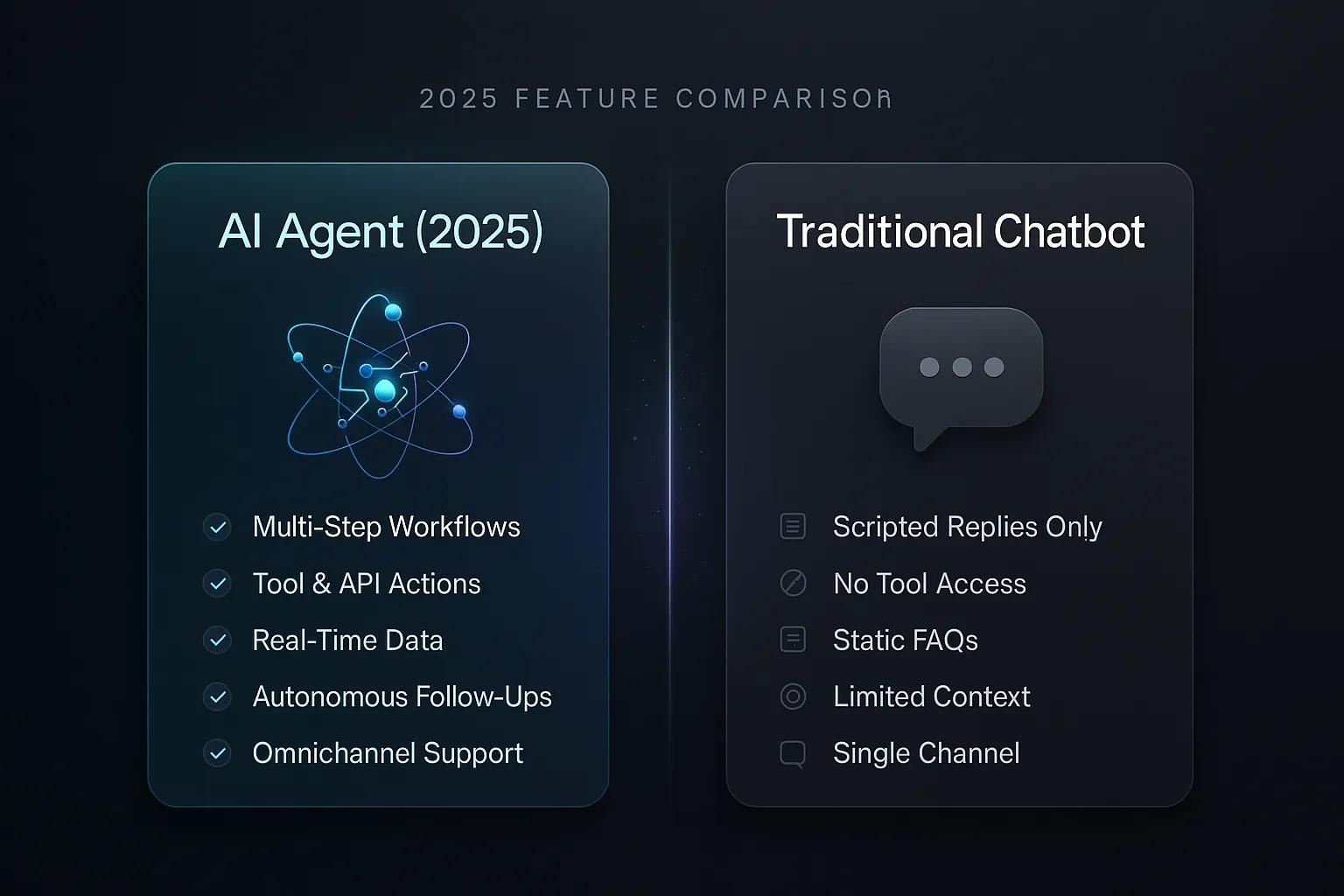
AI Agent vs Traditional Chatbot: 2026 Feature Comparison
It's 11 PM on a Tuesday. A customer reports a damaged package through your support channel. Your traditional chatbot politely apologizes and provides a link to...