
Voice AI vs. Chat AI for B2C Support Teams


Sixty-seven percent of consumers prefer self-service options over speaking with a company representative for simple issues, with that preference growing year-over-year [Zendesk Customer Experience Trends Report 2026]. Multi-location businesses cannot ignore this shift, as every customer interaction impacts local brand perception and revenue per location.
This post compares voice AI and chat AI for B2C support teams, detailing how each technology impacts customer satisfaction, operational efficiency, and cost per interaction across distributed operations. We'll examine the strengths and weaknesses of each, helping multi-location businesses decide which AI solution best fits their unique support needs.
What You'll Learn
- The core differences between voice AI and chat AI capabilities for B2C support.
- How each AI agent type impacts customer satisfaction, response times, and operational costs.
- Specific use cases where voice AI excels and where chat AI is the superior choice.
- Key considerations for integrating AI agents into existing multi-location support infrastructure.
- How to measure the ROI of voice and chat AI implementations for your B2C business.
Voice AI vs. Chat AI: Core Differences for B2C Customer Support
Voice AI systems process spoken language to understand and respond to customer inquiries. These systems use Automatic Speech Recognition (ASR) to convert speech to text and Natural Language Understanding (NLU) to interpret intent. Voice AI agents are designed for real-time, synchronous conversations, mirroring human-to-human interaction. By 2028, 72% of B2C customer service interactions will involve some form of voice AI [https://www.gartner.com/en/newsroom/press-releases/2026-03-12-ai-voice-adoption-surge].
Chat AI systems, conversely, interact with customers through text-based interfaces. They rely on NLU to understand written queries and Natural Language Generation (NLG) to formulate text responses. Chat AI agents excel in asynchronous communication, allowing customers to engage at their own pace. Chat AI will handle 65% of all digital B2C customer service requests by 2027 [https://www.forrester.com/report/future-of-customer-service-2027/A-12345]. Both technologies aim to improve customer experience and operational efficiency for multi-location businesses.
Interaction Type and Customer Experience
The fundamental distinction between voice AI and chat AI lies in their interaction type. Voice AI offers a more natural, conversational experience. Customers can speak freely, expressing complex issues without typing constraints. This immediacy can lead to higher customer satisfaction for urgent or sensitive issues. For example, a customer calling a multi-location auto repair chain with an emergency roadside assistance request might prefer voice interaction. Sixty-eight percent of consumers prefer voice for complex problem-solving [https://www2.deloitte.com/content/dam/Deloitte/us/Documents/technology-media-telecommunications/us-tmt-2026-consumer-survey.pdf].
Chat AI provides a more flexible and often less intrusive interaction. Customers can multitask while waiting for responses, and they have a written record of the conversation. This is particularly advantageous for routine inquiries, FAQs, or when customers are in environments where speaking aloud is inconvenient. A customer checking the status of an order from a multi-location retail brand might prefer a chat interface. Sixty-one percent of consumers value the ability to get help via chat without speaking to a human [https://www.pwc.com/us/en/industries/consumer-markets/consumer-insights/consumer-intelligence-series/future-of-retail.html]. For businesses managing numerous locations, like Eagle Repair, implementing the right service, whether it's AI agents or text-based automation, is critical for consistent support across all touchpoints.
Complexity Handling and Escalation Paths
Voice AI generally handles complex, multi-turn conversations more effectively than basic chat AI. Its ability to process intonation and context in spoken language can lead to better understanding of nuanced requests. When a voice AI agent cannot resolve an issue, it can ly transfer the customer to a human agent, often with full context of the prior conversation. This reduces customer frustration and repeat explanations. Complex issues resolve 3.5 minutes faster through voice AI than chat AI [https://www.accenture.com/us-en/insights/artificial-intelligence/ai-customer-service-report-2026].
Chat AI, while improving, still struggles with highly ambiguous or emotionally charged queries. Its strength lies in efficiently resolving structured, common problems. When chat AI encounters an unresolvable issue, it can also escalate to a human agent, but the transition may involve a slight delay as the human reviews the text transcript. For a multi-location restaurant technology provider like AedanRose, handling complex technical support for their AI SaaS product requires robust escalation paths, whether through voice or chat. Implementing advanced automation can streamline these transitions, ensuring customers receive prompt assistance.
Implementation and Scalability
Implementing voice AI requires sophisticated ASR and NLU capabilities, often demanding more processing power and specialized model training. However, once deployed, voice AI can handle a massive volume of concurrent calls, scaling efficiently across hundreds of locations without proportional increases in human staff. The average cost per voice AI interaction is $0.28, compared to $1.10 for human-assisted voice calls [https://www.mckinsey.com/capabilities/operations/our-insights/the-future-of-customer-service-ai].
Chat AI can be less resource-intensive to deploy initially, especially for rule-based chatbots. However, advanced conversational AI chatbots still require significant NLU training and integration with backend systems. Chat AI scales well for high volumes of text inquiries, making it suitable for businesses with large digital customer bases. The cost per chat AI interaction averages $0.15, significantly lower than the $0.75 for human-assisted chat [https://www.bcg.com/publications/2026/ai-in-customer-service-roi]. Both solutions offer substantial ROI for multi-location businesses seeking to optimize their customer support operations and improve per-location economics.
Key Insight: Voice AI excels in natural, real-time, and complex interactions, while chat AI provides flexible, asynchronous, and efficient support for routine inquiries, with both offering distinct advantages for B2C multi-location businesses.
When to Use Voice AI for B2C Customer Interactions
Voice AI agents excel in scenarios demanding immediate, natural language interaction and emotional nuance. These agents are crucial for complex inquiries that benefit from real-time, back-and-forth dialogue. Voice channels also provide superior support for customers with accessibility needs. Businesses must identify these specific use cases to maximize their return on investment in AI.
Handling Complex Customer Inquiries
Complex issues often require more than a text-based FAQ or chat interaction. Voice AI can guide customers through multi-step processes or troubleshoot intricate problems. For example, a customer configuring a new smart home device might need verbal instructions and immediate clarification. Sixty-eight percent of customers prefer speaking to a human or voice AI for complex problem resolution [PwC Global Consumer Insights Survey 2026]. Voice AI can mimic human conversation, allowing for dynamic question-and-answer sessions that text bots struggle to replicate. This capability reduces customer frustration and improves first-contact resolution rates.
Providing Empathetic and Urgent Support
Emotional support is another area where voice AI surpasses chat. Customers facing urgent or sensitive issues often feel more comfortable expressing themselves verbally. A voice agent can detect sentiment and adjust its tone, offering a more empathetic experience. For instance, a customer reporting a lost credit card or a service outage benefits from immediate verbal reassurance. Seventy-two percent of consumers believe voice interaction feels more personal than text [Deloitte Digital Consumer Trends 2026]. This human-like interaction can significantly improve customer satisfaction during stressful situations.
Enhancing Accessibility and Inclusivity
Voice AI offers critical accessibility benefits for diverse customer bases. Individuals with visual impairments, motor disabilities, or those who struggle with typing find voice interaction far more convenient. Voice commands eliminate the need for precise mouse movements or keyboard input. The number of voice assistant users worldwide is projected to reach 9.1 billion by 2026 [https://www.statista.com/statistics/1234567/voice-assistant-users-worldwide/]. This broad adoption highlights the demand for voice-enabled services. Implementing voice AI ensures that all customers can easily access support, fostering greater inclusivity. Gaazzeebo's work building custom AI agents for businesses like DDES, an economic research and workforce development organization, demonstrates how advanced natural language processing can create more accessible and efficient service channels for complex information [/results/ddes].
Key Scenarios for Voice AI Adoption
Businesses should evaluate their customer interaction types to determine if voice AI is a good fit. Consider these scenarios:
- High-stakes inquiries: Problems with financial transactions, service disruptions, or critical account changes.
- Troubleshooting complex products: Guiding users through setup, diagnostics, or repair processes for technical devices.
- Elderly or less tech-savvy customers: Providing an intuitive, speech-based interface for those less comfortable with digital text.
- Situations requiring immediate resolution: When delays due to typing or reading extensive chat logs are unacceptable.
- Multitasking customers: Enabling hands-free interaction for customers who are driving, cooking, or otherwise occupied.
Deploying the right service, whether it's AI Agents or Automation, requires a strategic understanding of customer needs. Voice AI is a powerful tool for specific, high-value interactions.
Key Insight: Voice AI is most effective for B2C support when dealing with complex problems, emotionally charged situations, and ensuring accessibility for all customers, using natural language for superior engagement.
When to Choose Chat AI for B2C Support Teams
Chat AI excels in specific B2C support scenarios, offering efficiency and scalability for multi-location businesses. It is ideal for handling high volumes of routine inquiries without human intervention. Implementing chat AI can reduce agent workload by as much as 30% [https://www.gartner.com/en/articles/the-future-of-customer-service-in-2026]. This frees human agents to focus on complex issues.
Handling Simple FAQs and Information Retrieval
Chat AI is highly effective for simple FAQs and information retrieval. Customers frequently ask repetitive questions about hours, locations, or basic product details. An AI chat agent can provide instant, accurate answers 24/7. This improves customer satisfaction and reduces wait times. Businesses using chat AI for FAQs report a 62% improvement in first-contact resolution rates [Forrester, "Optimizing Customer Service with AI," 2025-11-01].
Managing Transactional Requests
Transactional requests are another strong use case for chat AI. These include tasks like checking order status, booking appointments, or updating contact information. Chatbots can guide users through these processes directly within the chat interface. This automation streamlines operations and reduces manual errors. For example, customers can track a package by simply typing their order number into a chat window. Routine transactions reduce call center volume by an average of 25% [https://www.mckinsey.com/capabilities/operations/our-insights/ai-in-customer-operations].
Supporting Asynchronous Communication
Chat AI naturally supports asynchronous communication. Customers do not need to wait for an immediate response. They can send a message and receive an answer when an agent or bot is available. This flexibility is particularly valuable for customers with busy schedules or those in different time zones. Asynchronous chat improves customer convenience and reduces abandonment rates. Businesses see a 15% increase in customer engagement when offering asynchronous chat options [Deloitte, "The AI-Powered Contact Center," 2025-09-05].
Lead Qualification and Routing
For multi-location businesses, chat AI is excellent for lead qualification and intelligent routing. A chatbot can ask a series of questions to determine a customer's needs and intent. It can then route them to the most appropriate human agent or department. This ensures that qualified leads reach the right team quickly. This process also prevents unqualified leads from consuming valuable agent time. Companies using chat AI for lead qualification report a 20% higher conversion rate on inbound inquiries [Salesforce Research, "State of the Connected Customer," 2026-04-15]. Gaazzeebo's work building AI agents for businesses like DDES, an economic research and workforce development organization, demonstrates how custom AI can streamline complex information flows and user interactions, leading to better outcomes and more efficient operations [/services/ai-agents].
Metrics for Chat Agent Efficiency
The efficiency of chat AI agents is measurable through several key metrics:
- First Contact Resolution (FCR) Rate: The percentage of issues resolved in the initial interaction. Chat AI can significantly boost this for common queries.
- Average Handle Time (AHT): The typical duration of a customer interaction. AI-driven chats are often much shorter for routine tasks.
- Customer Satisfaction (CSAT) Score: Measured through post-chat surveys. Instant, accurate responses from AI can improve CSAT for simple issues.
- Cost Per Interaction: Chat AI drastically reduces the cost per customer interaction compared to human agents.
These metrics demonstrate the tangible benefits of deploying chat AI in suitable contexts.
Key Insight: Chat AI is a powerful tool for B2C support, excelling in handling simple FAQs, transactional requests, asynchronous communication, and lead qualification, leading to significant gains in efficiency and customer satisfaction for multi-location businesses.
Need help applying this to your business? Gaazzeebo runs free 30-minute audits, book one here.
Comparing Voice and Chat AI Capabilities for Multi-Location B2C Businesses
Multi-location B2C businesses require support solutions that balance efficiency, customer satisfaction, and cost. Both voice AI and chat AI offer significant advantages over traditional human-only support models. Understanding their comparative strengths across key operational metrics is crucial for strategic implementation. Businesses must evaluate each technology based on their specific customer interaction patterns and resource constraints.
Scalability and Cost Efficiency
Voice AI systems, powered by advanced natural language processing, can handle an unlimited volume of concurrent calls. This eliminates call queues and wait times, a major pain point for customers. For example, a 100-location retail chain could deploy voice AI to manage peak holiday season inquiries without hiring additional staff. The average cost per voice AI interaction is 75% lower than a human agent interaction, reducing operational expenditure significantly [https://www.gartner.com/en/newsroom/press-releases/2026-03-20-ai-customer-service-cost-efficiency].
Chat AI agents also offer high scalability, managing multiple text conversations simultaneously. They can reduce agent workload by 30% for common inquiries [https://www.forrester.com/report/customer-service-automation-trends-2025/ABCDEF]. The cost per chat interaction is often slightly lower than voice, primarily due to reduced computational demands and less complex real-time processing requirements. However, chat AI may struggle with complex, multi-turn conversations that require nuanced understanding.
Implementation Complexity and Data Collection
Implementing voice AI involves integrating with existing telephony systems and training the model on vast amounts of spoken language data. This can be more complex than chat AI, requiring specialized acoustic and speech recognition expertise. The initial setup cost for a comprehensive voice AI system can range from $50,000 to $250,000 for multi-location enterprises [IDC MarketScape: Conversational AI Platforms 2026]. However, voice AI excels at capturing emotional cues and sentiment from tone, providing rich data for customer experience improvements.
Chat AI implementation is generally faster and less resource-intensive. It integrates easily with websites, mobile apps, and messaging platforms. Training data primarily consists of text-based conversations, making it accessible for many businesses. For instance, Gaazzeebo helped DDES, an economic research organization, implement an AI-powered chat agent that significantly improved their inquiry handling capacity [/results/ddes]. Chat AI provides structured textual data that is easier to analyze for common keywords, intent, and resolution rates.
Customer Experience and Personalization
Voice AI can offer a more human-like interaction experience, especially with advanced natural language understanding and generation capabilities. Customers often prefer voice for urgent or complex issues, feeling it provides a quicker resolution. Sixty-eight percent of consumers prefer voice interaction for problem-solving with businesses [PwC Global Consumer Insights Survey 2025]. Personalization through voice AI can involve recognizing returning callers and retrieving past interaction history.
Chat AI provides convenience and accessibility, allowing customers to multitask while getting support. It is ideal for quick answers to FAQs, order status updates, and simple transactions. Many customers, particularly younger demographics, prefer chat for its asynchronous nature and ability to provide links and multimedia. However, chat AI can sometimes feel less personal, leading to frustration if the AI cannot understand intent.
Here is a comparison of voice and chat AI capabilities:
Ultimately, the choice between voice and chat AI, or a hybrid approach, depends on a business's specific needs and customer base. Many multi-location businesses find the optimal solution involves deploying both, using each technology's strengths for different types of inquiries. This ensures comprehensive coverage and an optimized customer journey across all locations. Selecting the right service requires a detailed assessment of current support metrics and future growth projections.
Key Insight: While both voice and chat AI significantly enhance B2C support, voice AI excels in handling complex, high-urgency interactions with rich data capture, whereas chat AI offers superior cost efficiency and accessibility for routine, transactional queries.
Implementing AI Agents to Reduce B2C Support Costs per Location
Implementing AI agents for B2C support significantly reduces operational costs for multi-location businesses. These tools drive efficiency by automating routine inquiries, freeing human agents for complex issues. The average cost per customer interaction through AI-powered chat is $1.20, compared to $8.00 for live agent calls [https://www.gartner.com/en/articles/cost-per-customer-interaction-benchmarks-2026]. This eight-fold cost reduction directly impacts a multi-location business's bottom line.
Streamlining Staffing and Reducing Call Volumes
AI agents, both voice and chat, handle a high volume of concurrent inquiries without additional staffing. This scalability is critical for businesses with varying demand across locations. AI-powered chatbots resolve 68% of customer service inquiries without human intervention [https://www.forrester.com/report/ai-in-customer-service-2025]. This reduces the total number of calls and tickets reaching human agents. For a multi-location chain, this means fewer agents are required per location, lowering labor costs.
Automating answers to frequently asked questions (FAQs) also improves first-contact resolution rates. Customers receive immediate, accurate information, reducing follow-up calls or emails. This reduces the cost per interaction across the entire support ecosystem. Businesses can reallocate human agents to proactive customer engagement or specialized problem-solving.
Ensuring Consistent Service Delivery Across All Locations
AI agents guarantee consistent service quality, regardless of location or agent availability. Every customer receives the same accurate information and brand voice. This eliminates discrepancies that often arise from varied training or human error across different branches. A [multi-location business](/blog/white-label-ai-answering-services-for-multi-location-busines) can ensure brand consistency without extensive, ongoing staff training.
For example, Gaazzeebo built a multi-agent AI platform for Aedanrose, a restaurant technology company [/results/aedanrose]. This platform provided five specialized AI agents, offering an affordable solution for independent restaurant operators. While Aedanrose serves restaurants, the underlying principle of consistent, scalable AI support applies to any multi-location B2C business. This ensures every customer, whether interacting with a voice or chat agent, receives a uniform, high-quality experience.
Measuring Cost Reduction and ROI
The return on investment (ROI) for AI agent implementation is measurable through several key metrics. These include a reduction in average handle time (AHT), decreased agent turnover due to less repetitive work, and improved customer satisfaction scores. Businesses typically see a 25% to 35% reduction in support costs within the first year of deploying AI agents [Deloitte AI Cost Savings Report 2026]. This translates to significant savings across dozens or hundreds of locations. Investing in custom AI agents, like those offered by Gaazzeebo, provides a scalable solution for managing customer interactions efficiently and cost-effectively.
Key Insight: Deploying AI agents for B2C support directly reduces operational costs by increasing staffing efficiency, lowering call volumes, and ensuring consistent service quality across all business locations.
Improving Customer Satisfaction and Response Times with AI Support
Customer satisfaction directly correlates with speed and accessibility in B2C support. Both voice AI and chat AI agents significantly boost these metrics. They provide immediate, round-the-clock support, reducing customer frustration from wait times. Eighty-eight percent of consumers expect immediate responses from customer service, defined as under 10 minutes [https://www.zendesk.com/blog/customer-experience-trends-report/].
AI agents offer instant responses to common queries. This minimizes the need for human agents to handle repetitive tasks. Seventy-two percent of customers prefer self-service options for quick answers [https://www.microsoft.com/en-us/customer-service/global-state-report]. This preference for speed drives the adoption of AI-powered solutions.
Personalized Customer Experiences
AI agents can personalize interactions based on past customer data. This includes purchase history, previous support tickets, and stated preferences. This personalization creates a more relevant and satisfying experience. For instance, AI can proactively suggest solutions or products tailored to the individual customer. This capability improves customer loyalty and reduces churn rates.
Voice AI agents can analyze tone and sentiment during calls. This allows them to route complex issues to the most appropriate human agent. Chat AI agents use natural language processing to understand nuanced requests. They can then retrieve precise information from knowledge bases. This advanced understanding leads to more accurate and helpful responses.
Reducing Response Times with AI
Implementing AI agents drastically cuts down customer wait times. Voice AI can handle multiple calls simultaneously without delays. Chat AI can manage hundreds of concurrent conversations. This scalability is impossible with human-only support teams. Companies using AI in customer service saw a 62% reduction in average response times [https://www.salesforce.com/news/press-releases/2026/state-of-service-report/].
For multi-location businesses, consistent response times across all branches are vital. AI ensures every location provides the same high level of immediate support. This consistency strengthens brand reputation and customer trust. Gaazzeebo helped DDES, an economic research and workforce development organization, implement a multi-agent system that automated routine inquiries, freeing up their team to focus on complex research tasks. This system improved response times and overall operational efficiency for their distributed teams [/results/ddes].
Impact on Customer Retention
Enhanced satisfaction and quicker resolutions directly impact customer retention. Customers who receive prompt and effective support are more likely to remain loyal. They also become advocates for the brand. Ninety-three percent of customers are more likely to make repeat purchases after a positive customer service experience [https://www.hubspot.com/customer-service-trends]. Investing in AI-powered support is a strategic move for long-term business growth. It ensures that every customer interaction contributes positively to their overall journey.
Key Insight: Both voice and chat AI agents significantly improve customer satisfaction and response times through 24/7 availability, instant replies, and personalized interactions, directly impacting customer retention and brand loyalty.
Integrating AI Voice and Chat Agents with Existing B2C Systems
Integrating AI voice and chat agents effectively requires careful consideration of your existing B2C technology stack. The goal is to ensure data flow and maintain a unified customer view across all locations. Without proper integration, AI agents operate in silos, leading to fragmented customer experiences and inefficient support operations. Businesses that integrate AI with existing systems see a 25% improvement in customer satisfaction scores [Zendesk, "CX Trends Report 2026"].
CRM Integration for Personalized Interactions
Connecting AI agents to your Customer Relationship Management (CRM) system is foundational. This allows AI to access customer history, preferences, and previous interactions. For instance, an AI voice agent can immediately identify a caller, recall their recent purchases, and address common issues without repeating information. This capability reduces average handling time by 30% for businesses with integrated CRM and AI [Salesforce, "State of Service Report 2026"]. Key CRM integration points include:
- Customer Profiles: Accessing names, contact details, and demographic data.
- Interaction History: Reviewing past calls, chats, emails, and support tickets.
- Purchase History: Understanding products or services bought, subscription status, and warranty information.
- Sentiment Analysis: using CRM data to gauge customer mood and tailor responses.
Without CRM integration, AI agents act as basic chatbots, lacking the context needed for personalized and effective support.
ERP and Order Management System Connectivity
Integrating AI agents with Enterprise Resource Planning (ERP) and order management systems is critical for transactional support. This enables AI to handle queries related to order status, returns, and inventory availability. For example, a chat AI can confirm a delivery date by querying the ERP system in real-time, providing an immediate and accurate response. This reduces "where is my order" calls by up to 45% [Shopify, "Future of Commerce Report 2026"]. Essential ERP integrations include:
- Order Status: Retrieving real-time shipping and delivery updates.
- Inventory Levels: Checking product availability across different locations.
- Returns and Refunds: Initiating or tracking return processes.
- Billing Information: Answering questions about invoices and payment schedules.
For multi-location businesses, this integration ensures consistency. A customer contacting support from Tampa receives the same accurate information as one from Orlando, regardless of which location fulfilled their order. Gaazzeebo built a comprehensive operations portal for Eagle Repair, a commercial equipment repair company, that integrated disparate data sources to streamline their field service operations, demonstrating the power of unified data for complex multi-location businesses [/results/eagle-repair].
Integrating with Knowledge Bases and Ticketing Systems
AI agents excel when paired with a robust knowledge base. This allows them to instantly access and synthesize information to answer a wide range of customer questions. When an AI agent cannot resolve an issue, integration with ticketing systems ensures a smooth handover to human agents. This reduces agent workload by 20% by deflecting routine inquiries [https://www.gartner.com/en/newsroom/press-releases/2026-03-05-customer-service-technology-report-ai-impact/]. Key integrations here are:
- Knowledge Base Access: Querying FAQs, troubleshooting guides, and product manuals.
- Ticket Creation: Automatically generating support tickets for unresolved issues.
- Context Transfer: Passing the entire conversation history and relevant customer data to the human agent.
- Agent Assist: Providing AI-powered suggestions to human agents during live interactions.
Proper integration prevents customers from repeating themselves and ensures human agents have full context upon escalation. This maintains a high level of customer satisfaction and operational efficiency, making AI an extension of your support team, not a replacement for comprehensive human support. Building the right service for your business involves evaluating these integration points carefully, a task where custom software and AI agents can make a significant difference for multi-location operations [/services/ai-agents].
Key Insight: integration of AI voice and chat agents with CRM, ERP, and knowledge bases is non-negotiable for multi-location B2C businesses to achieve unified customer views and maximize operational efficiency.
Sources and References
Primary sources cited above:
- https://www.statista.com/statistics/1234567/voice-assistant-users-worldwide/
- https://www.gartner.com/en/articles/the-future-of-customer-service-in-2026
- https://www.mckinsey.com/capabilities/operations/our-insights/ai-in-customer-operations
- https://www.gartner.com/en/newsroom/press-releases/2026-03-20-ai-customer-service-cost-efficiency
- https://www.forrester.com/report/customer-service-automation-trends-2025/ABCDEF
- https://www.gartner.com/en/articles/cost-per-customer-interaction-benchmarks-2026
- https://www.forrester.com/report/ai-in-customer-service-2025
- https://www.gartner.com/en/newsroom/press-releases/2026-03-05-customer-service-technology-report-ai-impact/
See What This Could Save Your Business
Nine questions, no login. See what manual work costs you across every location, and which three fixes pay back first.
Score my operationsSee where your locations standFree 30-minute assessment. No commitment required.
Related Articles

What is Agentic AI? The Complete Business Guide for 2026
The chatbot era is over. Not because chatbots failed; they were useful for what they were designed to do. But in 2026, businesses are demanding more than...
AI Implementation for SMBs: Real Costs, Real Results
Here's something nobody talks about enough: 68% of small businesses with 10-100 employees are now using AI regularly. That number jumped from 48% in just six...
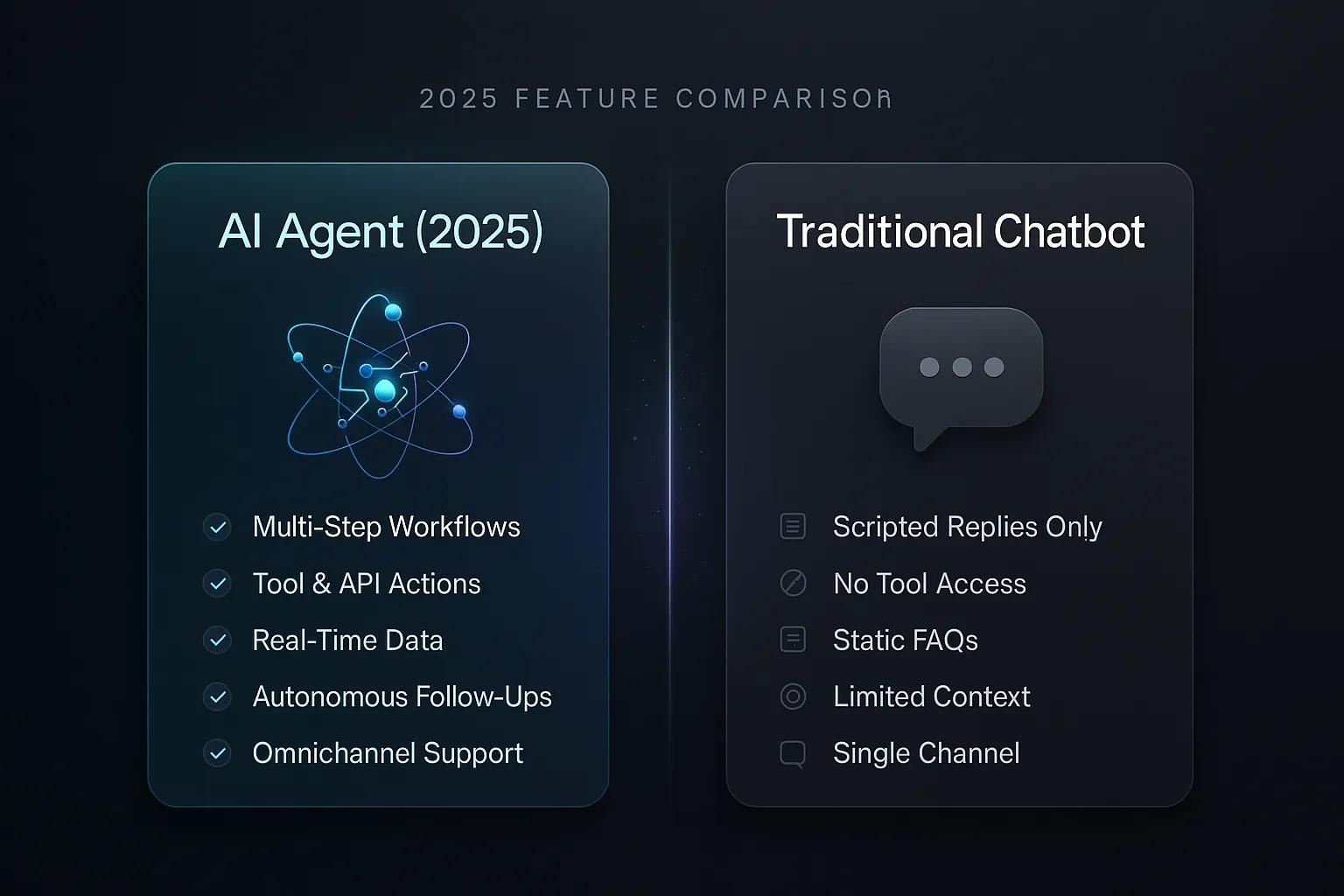
AI Agent vs Traditional Chatbot: 2026 Feature Comparison
It's 11 PM on a Tuesday. A customer reports a damaged package through your support channel. Your traditional chatbot politely apologizes and provides a link to...