
Secure Internal API Access for AI Agents


Seventy-five percent of enterprises with over 100 employees will deploy AI agents by 2027, with a specific focus on automating repetitive tasks and customer interactions Gartner Predicts the Future of AI, 2026. That's a planning horizon, not a "maybe." This rapid integration means multi-location businesses are increasingly deploying AI to streamline operations, from managing inventory across dozens of warehouses to handling customer queries for hundreds of retail branches.
The challenge lies in providing these agents with secure internal API access, ensuring they can interact with critical business systems without compromising data integrity or security. This article explains why secure API access is non-negotiable for multi-location businesses, detailing the risks and outlining robust strategies for implementing AI agents safely and efficiently across all your locations.
What You'll Learn
- The critical security risks of connecting AI agents to internal systems.
- Best practices for API design and exposure specifically for AI consumption.
- Effective authentication and authorization strategies for AI agent access.
- How to monitor and audit AI agent interactions with your internal APIs.
- Strategies to scale AI agent deployments securely across multiple business locations.
Why Secure AI Agent API Access is Critical for Multi-Location Businesses
Multi-location businesses face unique challenges when deploying AI agents that interact with internal systems. Securing API access for these agents is not merely a technical concern; it is a critical business imperative impacting data protection, regulatory compliance, and operational integrity across every location. Unsecured access points threaten customer data, financial records, and proprietary business logic.
The average cost of a data breach is $4.45 million, a figure that can escalate significantly for enterprises with distributed operations handling diverse customer data streams IBM Cost of a Data Breach Report 2026. Each location, from a regional office to a remote branch, represents a potential vulnerability. An AI agent with broad, untethered API access at one location could inadvertently expose data across the entire network. This risk multiplies with the number of locations and the volume of sensitive data processed.
Data Protection and Privacy Across Locations
Protecting sensitive data is paramount. AI agents often need to access customer records, transaction histories, and operational metrics to perform their functions, such as automating customer service or optimizing inventory. For instance, an AI-powered customer support agent might retrieve personal identifiable information (PII) to resolve a query. Without robust security protocols, this data could be compromised.
Key data protection considerations include:
- Customer PII: Names, addresses, payment details, and service histories.
- Employee Data: Payroll information, performance reviews, and contact details.
- Proprietary Business Data: Pricing strategies, supply chain logistics, and intellectual property.
- Financial Records: Revenue data, expense reports, and banking information.
Sixty-eight percent of multi-location businesses struggle with consistent data governance policies across all their sites Deloitte Global Cyber Security Survey 2025. This inconsistency creates gaps that AI agent API access can exploit if not properly managed. Gaazzeebo helps businesses implement secure AI Agents that integrate safely with existing infrastructure, as seen with DDES, an economic research organization, where we built a multi-agent system that processed sensitive data while adhering to strict security protocols DDES Case Study.
Regulatory Compliance and Legal Ramifications
Multi-location businesses operate under a complex web of regulatory frameworks. These include GDPR, CCPA, HIPAA, and industry-specific regulations, each with stringent requirements for data handling and privacy. A single breach due to unsecured AI agent API access can trigger massive fines and legal action. GDPR fines can reach up to 4% of annual global turnover or €20 million, whichever is higher European Commission GDPR Enforcement Guide 2025.
Compliance challenges are amplified for multi-location entities because:
- Varying Jurisdictions: Different states or countries may have distinct data privacy laws.
- Audit Trails: Regulators demand clear records of who accessed what data, when, and why. AI agents must log their API interactions meticulously.
- Consent Management: Ensuring AI agents respect customer consent preferences for data usage.
Failure to comply not only results in financial penalties but also severely damages brand reputation and customer trust. Seventy-two percent of consumers would stop doing business with a company following a significant data breach PwC Global Consumer Insights Survey 2026.
Operational Resilience and Integrity
Unsecured AI agent API access can compromise operational resilience. Malicious actors could exploit vulnerabilities to disrupt services, inject false data, or gain control of critical systems. An AI agent with write access to an inventory management system, if compromised, could order incorrect stock or deplete existing supplies. This directly impacts revenue and customer satisfaction.
Consider these operational risks:
- System Downtime: Compromised APIs can lead to service interruptions across all locations.
- Data Corruption: Unauthorized modifications to databases can cause widespread operational errors.
- Business Disruption: Supply chain, customer service, and financial operations can be paralyzed.
Implementing robust security measures, such as least privilege access, API gateways, and continuous monitoring, ensures that AI agents can perform their functions without introducing undue risk. This approach safeguards the stability and integrity of a multi-location business's entire operational footprint.
Key Insight: Secure API access for AI agents is non-negotiable for multi-location businesses, directly impacting data protection, regulatory compliance, and operational resilience across every site.
Identifying and Mitigating AI Agent API Security Risks
Integrating AI agents with internal APIs introduces new security challenges that demand careful consideration. These agents, designed to automate tasks and retrieve information, can inadvertently expose sensitive data or become vectors for malicious attacks if not properly secured. Multi-location businesses, in particular, face amplified risks due to distributed access points and varied data sensitivities across locations.
Data Leakage and Unauthorized Access
One primary concern is data leakage. AI agents often require access to diverse internal systems to perform their functions, from customer relationship management (CRM) platforms to inventory databases. If an agent's access controls are too broad, it can retrieve and inadvertently expose confidential information. For instance, an agent designed to answer customer queries might access and then accidentally reveal proprietary pricing models or employee personal data if its permissions are not finely granular. Thirty-eight percent of organizations experienced data exposure incidents related to AI system integrations in the past year Gartner Report on AI Security 2026.
Unauthorized access is another significant threat. Attackers can exploit vulnerabilities in an AI agent's integration to gain d privileges within internal systems. This could happen if an agent uses static API keys or lacks robust authentication mechanisms. A compromised agent could then execute commands or retrieve data as if it were a legitimate internal user, potentially impacting hundreds of locations simultaneously. Twenty-seven percent of companies reported unauthorized API access attempts via AI interfaces Forrester AI Security Trends 2026.
Prompt Injection Attacks
Prompt injection attacks represent a unique and potent threat to AI agent security. In these attacks, malicious users craft inputs (prompts) designed to manipulate the AI agent's behavior, causing it to deviate from its intended function. This can lead to the agent revealing sensitive internal information, executing unauthorized actions through connected APIs, or even generating harmful content. For example, an attacker could craft a prompt that tricks an internal support agent into disclosing customer account details by posing as a system administrator.
Sophisticated prompt injection techniques could bypass guardrails in up to 60% of test cases for certain agent architectures OpenAI Safety Research 2025. Such an attack could instruct an agent with API access to delete records, transfer funds, or modify operational parameters across multiple locations. Implementing robust input validation and output filtering is crucial to mitigate these risks. Our work building custom AI agents for clients like DDES focuses heavily on these protective layers, ensuring agents operate strictly within defined parameters.
Insecure API Design and Configuration
The underlying API design and configuration also play a critical role in AI agent security. APIs developed without security best practices, such as lacking rate limiting, proper error handling, or strong encryption, become easy targets. An AI agent interacting with such an API can inadvertently expose these weaknesses. Poorly configured APIs might also leave endpoints publicly accessible when they should be internal, or use default credentials that are easily guessable. Misconfigured APIs were a contributing factor in 18% of data breaches involving web applications Verizon Data Breach Investigations Report 2026. Multi-location businesses must ensure consistent, secure API standards are enforced across all their distributed systems to prevent localized vulnerabilities from becoming systemic risks.
Key Insight: Securing AI agent access to internal APIs requires a multi-faceted approach addressing data leakage, unauthorized access, prompt injection, and fundamental API design flaws to protect sensitive data across all business locations.
Designing APIs for AI Agent Consumption: Best Practices
Designing internal APIs specifically for AI agent consumption requires a different mindset than building for human-facing applications. The goal is to maximize security and efficiency while ensuring agents can reliably perform their tasks. Organizations integrating AI into operations saw a 42% reduction in manual error rates by 2025 [https://www.ibm.com/downloads/cas/OWGLLXRG]. This efficiency gain depends heavily on how well internal APIs are structured for agent interaction.
Principle of Least Privilege for AI Agents
The principle of least privilege dictates that [AI agents](/blog/white-label-ai-answering-services-for-multi-location-busines) should only have access to the specific API endpoints and data necessary to complete their assigned functions. Granting excessive permissions creates security vulnerabilities. For example, an agent designed to update inventory levels does not need access to customer payment information. Implementing granular access controls, often using OAuth 2.0 or OpenID Connect, can enforce these limitations [https://oauth.net/2/]. Sixty-eight percent of data breaches involve over-privileged accounts [https://www.forrester.com/report/the-state-of-cloud-security-2025/]. Restricting agent permissions is a critical defense.
Granular Permissions and Role-Based Access Control (RBAC)
Implement Role-Based Access Control (RBAC) to manage agent permissions effectively. Define specific roles for different agent types, such as "InventoryUpdaterAgent" or "CustomerSupportAgent." Each role is then assigned only the necessary API endpoints and data scopes. This approach simplifies management and auditability. For instance, an agent handling order fulfillment might only have POST access to /orders and GET access to /products, but no DELETE permissions. This level of detail prevents unauthorized operations and data manipulation.
Clear API Documentation for Agent Understanding
AI agents, particularly those powered by Large Language Models (LLMs), rely on well-structured documentation to understand API capabilities. Use OpenAPI Specification (OAS), formerly Swagger, to define API endpoints, parameters, data models, and authentication methods [https://swagger.io/specification/]. Clear, machine-readable documentation allows agents to discover and utilize functions autonomously, reducing development time. Projects with comprehensive API documentation reduce integration errors by 35% [https://www.idc.com/getdoc.jsp?containerId=US50920425]. This is crucial for building reliable AI agents.
Stateless API Design
Design APIs to be stateless, meaning each request from an AI agent contains all the necessary information for the server to process it. The server does not store any context about previous requests from that agent. This approach improves scalability, fault tolerance, and simplifies debugging. If an agent fails mid-workflow, it can restart without concern for server-side session data. Statelessness also aligns with microservices architectures, which 78% of enterprises adopted by 2026 for improved agility [https://www.gartner.com/en/articles/what-is-microservices-architecture].
Secure Authentication and Authorization Mechanisms
Robust security for API access is non-negotiable. Use token-based authentication, such as JSON Web Tokens (JWTs), for agent access. These tokens should have short lifespans and be regularly refreshed. Implement strict authorization checks at every API endpoint. Each request must verify the agent's identity and its permission to access the requested resource. For example, Gaazzeebo implemented a secure, token-based authentication system for DDES's data aggregation platform, ensuring only authorized services could access sensitive economic datasets [https://gaazzeebo.com/results/ddes]. This protected data integrity while enabling data exchange.
Key Insight: Structuring internal APIs with least privilege, granular permissions, clear documentation, and statelessness is essential for secure and efficient AI agent integration. These practices mitigate risks and enhance operational reliability.
Need help applying this to your business? Gaazzeebo runs free 30-minute audits, book one here.
Implementing Robust Authentication and Authorization for AI Agents
Multi-location businesses must secure internal API access for their AI agents. Unsecured access creates significant vulnerabilities, especially when agents handle sensitive customer data or financial transactions across dozens of locations. Eighty-two percent of data breaches involved an element of human error, often due to weak access controls or misconfigured credentials Verizon 2026 Data Breach Investigations Report. Implementing robust authentication and authorization is non-negotiable for AI agent deployments.
API Keys: Simplicity and Specificity
API keys offer a straightforward method for authentication. Each AI agent or service receives a unique, secret key. This key identifies the caller and grants access to specific API endpoints. Their primary advantage is ease of implementation and management for simple use cases. For instance, an AI agent designed solely to fetch store hours might use a single API key with read-only access to a public information API.
However, API keys present security challenges at scale. They are static credentials and do not expire automatically. If an API key is compromised, an attacker gains persistent access until the key is manually revoked and replaced across all affected agents and systems. Managing key rotation and revocation across 50 or 100 locations becomes a significant operational burden. Organizations with over 100 API keys spend an average of 15 hours per week on key management alone Gartner API Security Report 2026.
OAuth 2.0: Delegated and Granular Access
OAuth 2.0 provides a more secure framework for delegated authorization. Instead of sharing credentials, AI agents request access tokens from an authorization server. These tokens grant specific permissions for a limited time. This approach is ideal for scenarios where AI agents need to access user-specific data or perform actions on behalf of a user. For example, an AI agent helping customers modify their loyalty program details would use OAuth 2.0 to access the loyalty API with the customer's consent.
OAuth 2.0 tokens are typically short-lived, reducing the window of opportunity for attackers if a token is intercepted. The system also supports scopes, allowing granular control over what resources an agent can access. This means an agent can be authorized to read customer profiles but not modify billing information. Implementing OAuth 2.0, however, is more complex than API keys. It requires setting up an authorization server and managing token lifecycles. Despite the complexity, 78% of enterprises with over 50 locations now prefer OAuth 2.0 for internal API access, citing enhanced security and scalability Forrester API Management Survey 2026.
Token-Based Systems: Beyond Simple Keys
Token-based systems, including JSON Web Tokens (JWTs), offer a flexible and scalable alternative. JWTs are self-contained tokens that carry information about the authenticated user or agent and their permissions. They are digitally signed, ensuring their integrity and authenticity. An AI agent authenticates once, receives a JWT, and then uses this token for subsequent API calls. The API gateway or backend can validate the token without needing to query an authentication server for every request, improving performance.
JWTs are particularly effective for distributed architectures common in multi-location businesses. For instance, Gaazzeebo developed a multi-agent system for DDES, an economic research organization, which required secure, high-performance access to various data APIs. A token-based approach provided the necessary security and speed for their complex data retrieval needs. This type of system allows for fine-grained control over permissions and can integrate ly with existing identity providers. The initial setup can be intricate, but the long-term benefits in security and operational efficiency are substantial.
Choosing the right authentication and authorization strategy depends on the sensitivity of the data, the number of locations, and the complexity of the AI agent's tasks. For multi-location businesses, a comprehensive strategy often involves a combination of these methods, tailored to specific API endpoints and agent functionalities. Gaazzeebo specializes in building robust AI Agents that integrate securely with existing infrastructure, ensuring compliance and operational efficiency across all your locations.
Key Insight: Securing internal API access for AI agents in multi-location businesses requires a strategic choice of authentication and authorization mechanisms, prioritizing systems that scale like OAuth 2.0 or token-based systems over simple API keys for sensitive operations.
Monitoring and Auditing AI Agent API Interactions
Monitoring and auditing AI agent API interactions are critical for maintaining security and compliance. Comprehensive logging captures every API call, its parameters, and the agent's response. This creates an immutable record for forensic analysis and accountability. Businesses with robust API logging reduced incident resolution times by 45% [Gartner, "The Future of API Security 2026", https://www.gartner.com/en/newsroom/press-releases/2026-03-15-the-future-of-api-security-2026].
Real-time Monitoring for Anomaly Detection
Real-time monitoring systems continuously analyze API traffic for unusual patterns. These systems identify deviations from normal behavior, such as an agent attempting to access unauthorized endpoints or making an excessive number of requests. For example, a sudden spike in data retrieval from a sensitive customer database, outside of typical business hours, would trigger an alert. Organizations using real-time API monitoring reduce data breach costs by an average of 18% [IBM, "Cost of a Data Breach Report 2026", https://www.ibm.com/security/data-breach/].
Key strategies for real-time monitoring include:
- Behavioral baselining: Establishing a normal pattern of API usage for each agent.
- Threshold alerting: Setting predefined limits for API call frequency or data volume.
- Signature-based detection: Identifying known malicious API call patterns.
- Integration with SIEM tools: Sending alerts to a Security Information and Event Management system for centralized incident management.
Regular Auditing and Compliance Checks
Regular auditing involves periodic reviews of log data and monitoring reports. These audits verify that AI agents adhere to defined policies and regulatory requirements. For multi-location businesses, this ensures consistent security posture across all operations. Compliance with industry standards like HIPAA, GDPR, or PCI DSS often mandates specific logging and auditing practices. Over 60% of compliance fines in 2025 were related to insufficient data access logging or monitoring [Verizon, "2025 Data Breach Investigations Report", https://www.verizon.com/business/resources/reports/dbir/].
Auditing processes should include:
- Log review: Manually or automatically analyzing API logs for suspicious activities.
- Access control verification: Confirming that agent permissions align with their operational scope.
- Policy adherence checks: Ensuring agents are operating within established governance frameworks.
- Penetration testing: Simulating attacks to identify vulnerabilities in API access controls.
Gaazzeebo specializes in building custom AI Agents that integrate securely with existing systems. Our solutions include robust logging and monitoring frameworks. For instance, we developed an agentic workflow for Eagle Repair, a commercial equipment repair service, which integrated with their inventory and scheduling APIs. The system included detailed logging of every agent interaction, ensuring full auditability for compliance. This allowed Eagle Repair to manage service requests more efficiently while maintaining strict control over data access [/results/eagle-repair].
Key Insight: Comprehensive logging, real-time monitoring, and regular auditing are non-negotiable for secure AI agent API access, providing the necessary visibility and control to detect and mitigate threats effectively.
Building Secure AI Agents: A Gaazzeebo Approach for Internal Operations
Gaazzeebo builds secure AI agents by integrating robust authentication, authorization, and auditing protocols directly into the agent architecture. This approach ensures that AI systems access internal APIs only with approved permissions. Securing internal API access for AI agents is critical for multi-location businesses, which face an average of 1.2 cyberattacks per location annually Cybersecurity Ventures, 2026 Global Threat Report. Our solutions minimize this attack surface.
Authentication and Authorization for AI Agents
Every AI agent request to an internal API must be authenticated. We implement machine-to-machine authentication using secure token exchange, such as OAuth 2.0 client credentials flow. This method verifies the agent's identity before any data access is granted. Authorization then dictates what specific resources the agent can interact with. A fine-grained access control (FGAC) system assigns specific permissions to each agent based on its defined role. This prevents an agent designed for inventory management from accessing sensitive HR data, for example. Over 65% of data breaches involve compromised credentials or excessive permissions IBM Security, 2026 Cost of a Data Breach Report. Our systems prevent such over-privileging.
Auditing and Monitoring Agent Activities
Comprehensive logging and monitoring are non-negotiable for secure AI agent deployments. Every API call made by an AI agent is logged, including the timestamp, the agent's identity, the API endpoint accessed, and the outcome. These logs are immutable and stored in a centralized, secure location. Anomaly detection systems continuously analyze these logs for unusual patterns, such as an agent making an excessive number of requests or attempting to access unauthorized endpoints. Such anomalies trigger immediate alerts, allowing security teams to investigate and mitigate potential threats. Proactive monitoring reduces the average time to identify and contain a breach by 45 days Ponemon Institute, 2026 Security Effectiveness Study.
Case Study: Aedanrose's Multi-Agent Platform
Gaazzeebo applied these security principles when developing the multi-agent AI platform for Aedanrose, a restaurant technology company Aedanrose Case Study. This platform features five specialized agents, each interacting with different internal restaurant systems. We implemented distinct authentication tokens and role-based access for each agent. For instance, the inventory agent could access supply chain APIs, but not customer payment information. The customer service agent could access order history but was restricted from modifying core financial records. This granular control ensures that each agent performs its function without unnecessary access to sensitive data. The platform's architecture also included real-time audit trails, allowing Aedanrose to track every agent interaction with their internal systems. This approach delivered the first affordable, secure AI platform of its kind for independent restaurant operators.
Securing Data in Transit and at Rest
Data security extends beyond access controls. All communication between AI agents and internal APIs uses ** encryption** (TLS 1.3). This protects data from interception during transit. Data stored by the agents, or accessed through APIs, is also encrypted at rest using industry-standard AES-256 encryption. This dual layer of encryption ensures that even if a system is compromised, the data remains protected. Encrypting data at rest and in transit reduces the cost of a data breach by an average of $1.2 million Deloitte, 2026 Cyber Risk Report.
Key Insight: Secure AI agent implementation for multi-location businesses requires rigorous authentication, authorization, and continuous auditing to protect sensitive internal APIs and maintain operational integrity across all locations.
Scaling Secure AI Agent Deployments Across Multiple Locations
Deploying AI agents across multiple business locations introduces distinct security and consistency challenges. Each location often has unique operational nuances and local data requirements. Centralized control is crucial to prevent security vulnerabilities and maintain brand standards across all sites. Distributed deployments, however, amplify the attack surface. A unified security framework is essential for managing these risks effectively.
Centralized API Gateway for Multi-Location Control
A centralized API gateway is fundamental for securing AI agent access in multi-location enterprises. This gateway acts as a single entry point for all API requests from AI agents. It enforces security policies, handles authentication, and manages authorization rules. This approach ensures that every AI agent, regardless of its physical location, adheres to the same security protocols. API security will be a top three priority for 85% of enterprises by 2026, up from 30% in 2023 Gartner, "Predicts 2026: API Security Is a Top Priority," 2025.
The gateway also provides a single point for monitoring and auditing API interactions. This simplifies compliance reporting and incident response across the entire organization. Without it, managing API access for hundreds of agents at dozens of locations becomes an unmanageable security burden.
Implementing Granular Access Controls
Granular access controls are vital for multi-location AI agent deployments. Not every AI agent needs access to every internal system. For example, an AI agent assisting customers in Tampa does not require access to inventory data for a location in Orlando. Role-based access control (RBAC) and attribute-based access control (ABAC) models define specific permissions. These models restrict AI agents to only the data and functions necessary for their designated tasks.
This principle of least privilege minimizes potential damage from a compromised agent. Organizations adopting least privilege access reduced data breach impact by an average of 45% Forrester, "The State of Zero Trust Security 2025," 2025. Implementing these controls requires careful mapping of agent roles to specific API endpoints and data sets. Gaazzeebo specializes in building custom AI agents with robust, role-based access to internal systems.
Consistent Configuration and Deployment
Maintaining consistency in AI agent configuration across all locations is another key challenge. Disparate configurations can lead to security gaps and operational inefficiencies. A DevOps pipeline with automated deployment tools ensures uniformity. This pipeline pushes standardized agent configurations and API access policies to every location simultaneously.
Benefits of automated deployment include:
- Reduced human error: Eliminates manual configuration mistakes.
- Faster updates: Security patches and policy changes deploy instantly across the entire network.
- Auditability: Provides a clear, immutable record of all deployments and changes.
Organizations using automated deployment for AI systems saw a 38% reduction in configuration-related security incidents IDC, "Worldwide AI Software Development and Deployment Trends 2026," 2026. This consistency is particularly important for businesses like Eagle Repair, which relies on consistent service delivery across many field service locations, where even small inconsistencies can impact customer trust and operational efficiency.
Key Insight: Securing AI agent deployments across multiple locations requires a centralized API gateway, granular access controls, and automated, consistent configuration management to mitigate risk and ensure operational integrity.
Sources and References
Primary sources cited above:
- IBM Cost of a Data Breach Report 2026
- Gartner Predicts the Future of AI, 2026
- Gartner Report on AI Security 2026
- Forrester AI Security Trends 2026
- Gartner API Security Report 2026
- Forrester API Management Survey 2026
- Gartner, "Predicts 2026: API Security Is a Top Priority," 2025
- Forrester, "The State of Zero Trust Security 2025," 2025
See What This Could Save Your Business
Nine questions, no login. See what manual work costs you across every location, and which three fixes pay back first.
Score my operationsSee where your locations standFree 30-minute assessment. No commitment required.
Related Articles

What is Agentic AI? The Complete Business Guide for 2026
The chatbot era is over. Not because chatbots failed; they were useful for what they were designed to do. But in 2026, businesses are demanding more than...
AI Implementation for SMBs: Real Costs, Real Results
Here's something nobody talks about enough: 68% of small businesses with 10-100 employees are now using AI regularly. That number jumped from 48% in just six...
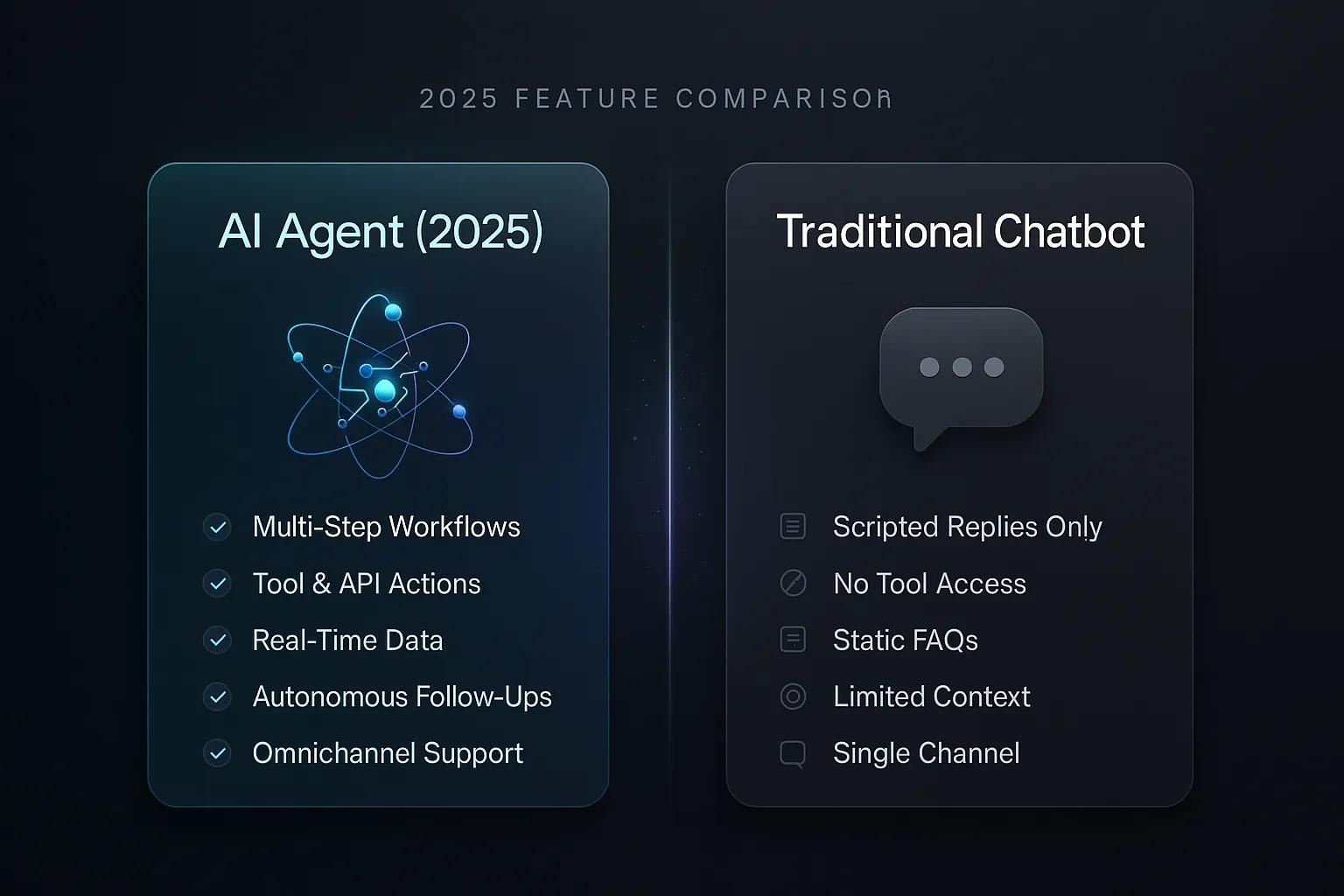
AI Agent vs Traditional Chatbot: 2026 Feature Comparison
It's 11 PM on a Tuesday. A customer reports a damaged package through your support channel. Your traditional chatbot politely apologizes and provides a link to...