
Missed Call Recovery for Home Services


62% of potential customers hang up after just 30 seconds of ringing if they don't reach a live agent. For home service businesses, that's a missed call turning into a missed job. The average missed opportunity costs around $1,500 across the customer lifecycle, and that's just the direct hit. The compounding effect—lost trust, higher marketing spend to replace the lead, negative reviews—that's where the real damage stacks up.
Missed call recovery is the systematic process of identifying, re-engaging, and converting inbound calls that didn't connect with a live agent. For multi-location home service operators, this means standardized protocols and automated systems that capture every lead, regardless of call volume or staffing levels at individual branches. This article explores how to implement effective missed call recovery strategies.
What You'll Learn
- The financial impact of missed calls on home services businesses.
- How AI agents provide 24/7 automated lead recovery and qualification.
- Key features and capabilities of AI-powered missed call recovery systems.
- Strategies for integrating AI agents with existing CRM and scheduling tools.
- Quantifiable ROI and benefits of implementing AI for missed call recovery.
Why Missed Calls Cost Home Services Businesses Millions Annually
Missed calls are a silent drain on revenue for multi-location home services businesses. Each unanswered ring represents a lost opportunity. This directly impacts the bottom line, leading to significant financial losses and damaged brand perception across all locations. Understanding these costs is crucial for implementing effective recovery strategies.
Direct Revenue Loss from Unanswered Calls
The most immediate consequence of a missed call is the loss of potential revenue. A single missed service inquiry can translate into hundreds or even thousands of dollars in lost booking value. For a home services company, this lost revenue compounds rapidly across multiple locations. Businesses with 10 to 150 locations face substantial cumulative losses. For example, a home services provider missing just five calls per day across 20 locations loses 100 potential jobs daily. If each job has an average value of $300, the daily revenue loss is $30,000. This equates to over $10 million annually, purely from missed calls.
Customers calling home services companies often have urgent needs. They are not browsing; they require immediate assistance for repairs, installations, or maintenance. When their call goes unanswered, they quickly move to the next provider on their list. 85% of customers will not call back after their initial attempt if they cannot reach a live person [Source: Harvard Business Review, "The Cost of Unanswered Calls in Service Industries," 2025]. That means the chance to convert that lead is gone.
Erosion of Customer Trust and Brand Reputation
Beyond immediate revenue, missed calls severely damage a company's reputation. Customers interpret unanswered calls as a sign of poor service or unreliability. This negative perception spreads quickly, especially in local markets where word-of-mouth influences purchasing decisions. Online reviews also reflect these experiences. A consistent pattern of unreturned calls leads to negative reviews on platforms like Google, Yelp, and Angi. These reviews directly deter future customers.
72% of consumers consider online reviews as trustworthy as personal recommendations [Source: Statista, "Consumer Trust in Online Reviews 2026," 2026]. Negative reviews citing unresponsiveness can be devastating. They erode the trust built through marketing efforts and quality service delivery at other locations. This makes it harder for all locations to attract new business, increasing customer acquisition costs across the board. The long-term impact on brand equity can be far more costly than the immediate revenue loss from a single missed job.
Increased Operational Costs and Inefficiency
Missed calls also create operational inefficiencies. Staff may spend valuable time trying to return calls that have already gone to competitors. This reactive approach is less effective than proactive engagement. It also pulls resources away from active service delivery or other crucial tasks. When a company eventually connects with a customer who initially experienced a missed call, the sales cycle is often longer. This requires more effort to rebuild trust and secure the booking.
Furthermore, a high volume of missed calls can indicate underlying issues in staffing or call routing. Resolving these issues requires internal audits and process adjustments, incurring additional administrative overhead. Implementing effective solutions, such as AI agents for call handling and routing, can mitigate these costs and improve overall efficiency Gaazzeebo, "AI Agents for Multi-Location Businesses," 2026. These agents ensure every call is addressed promptly, either by resolving inquiries or routing them to the correct human agent, reducing the strain on existing staff.
Competitive Disadvantage in Local Markets
The home services industry is highly competitive, especially at the local level. Every missed call gives a direct advantage to a competitor. If a customer cannot reach their preferred provider, they will call the next one. This means competitors are directly profiting from a business's missed opportunities. For multi-location businesses, this competitive disadvantage can manifest differently across various regions. A location with higher call volume or fewer staff might suffer more significantly.
Maintaining a strong local presence requires responsiveness and reliability. Companies that consistently answer calls and provide immediate support are more likely to capture market share. Conversely, those with high missed call rates will see their market share erode over time. This makes it harder to scale operations or even maintain existing customer bases in saturated markets.
Key Insight: Missed calls are not just isolated incidents; they represent a systemic leak of revenue, trust, and competitive advantage for multi-location home services businesses, costing millions annually and damaging long-term brand equity.
How AI Agents Automate Missed Call Recovery for Home Service Leads
AI agents provide immediate, automated engagement for missed calls, ensuring no home service lead goes unaddressed. These agents operate 24/7, capturing opportunities that human teams might miss outside business hours or during peak times. The global AI in customer service market is projected to reach $7.8 billion by 2028 Grand View Research: AI in Customer Service Market Report 2026, reflecting widespread adoption of these solutions.
Instant Outreach and Lead Qualification
When a home service call is missed, an AI agent initiates contact within seconds. This immediate response significantly increases the likelihood of engagement. Responding to a lead within five minutes makes them 21 times more likely to qualify than responding after 30 minutes [Source: HubSpot: The Ultimate Guide to Lead Qualification 2025]. The agent can use SMS, email, or even an automated call-back system, depending on the preferred communication channel.
The primary goal of initial outreach is lead qualification. The AI agent asks targeted questions to understand the customer's needs and urgency. This includes service type, location, preferred availability, and any specific issues. For instance, a heating and air conditioning company might deploy an AI agent to determine if a customer needs routine maintenance or an emergency repair. This process filters out unqualified leads, allowing human staff to focus on high-potential prospects.
Intelligent Scheduling and CRM Integration
Once a lead is qualified, the AI agent can move directly to appointment scheduling. Integrating with the company's existing calendar and CRM system, the agent presents available time slots. It can handle rescheduling requests and send automated reminders, reducing no-shows. We scope these interactions tight to ensure consistent service across all locations.
The agent records all interactions within the CRM, creating a comprehensive customer profile. This includes call transcripts, qualification details, and scheduled appointments. This data provides valuable context for technicians and sales teams, improving service delivery and follow-up. Businesses using AI for customer service saw a 32% increase in agent productivity [Source: Salesforce: State of the Connected Customer 2026].
24/7 Availability and Multi-Channel Support
One of the most significant advantages of AI agents is their 24/7 availability. Home service needs often arise outside standard business hours. A burst pipe at 2 AM or a sudden AC failure on a Sunday can lead to missed opportunities if human staff are unavailable. AI agents ensure that every lead, regardless of when it originates, receives an immediate response.
These agents can also operate across multiple channels, including:
- Website chat widgets: Engaging visitors directly on your site.
- SMS: Sending targeted messages and receiving replies.
- Email: Automating follow-ups and information dissemination.
- Voicebots: Handling basic inquiries and routing complex calls.
This multi-channel approach ensures comprehensive coverage and caters to diverse customer preferences. We build custom AI agents that integrate ly into existing communication infrastructures, enhancing overall lead capture and conversion for multi-location businesses. For example, the ticketing platform we built for the Breckenridge Vipers handles thousands of fan inquiries and ticket sales requests Breckenridge Vipers Ticketing Platform. While the Vipers operate in sports, the underlying principles of automated customer interaction and data handling are directly applicable to home services.
AI agents significantly reduce administrative overhead per location. By automating initial contact, qualification, and scheduling, human teams can focus on service delivery. This efficiency translates directly into lower operational costs and higher lead conversion rates.
Key Insight: AI agents provide immediate, 24/7 outreach and qualification for missed home service calls, significantly boosting lead capture and conversion rates by automating initial customer interactions and scheduling.
Key Features of an Effective AI Missed Call Recovery System
An effective AI missed call recovery system for home services requires specific functionalities to convert missed opportunities into scheduled appointments. These systems must integrate ly with existing business operations. Core features include advanced natural language processing, robust CRM integration, and multi-channel communication capabilities.
Natural Language Processing (NLP) for Intent Recognition
Natural Language Processing (NLP) is the foundation of any successful AI agent. It allows the system to understand customer intent from spoken or typed interactions. For home services, this means accurately identifying needs like "my AC isn't cooling," "I need a plumber for a leak," or "can you fix my broken garage door?" Systems must differentiate between urgent service requests and general inquiries. Advanced NLP reduces misinterpretations, which can cost businesses up to 15% in lost leads if initial contact is mishandled [Source: PwC, "AI in Customer Service Report 2026"]. The AI must also handle regional accents and common service-specific jargon.
CRM and Scheduling Integration
Direct integration with Customer Relationship Management (CRM) systems is critical. When a customer interaction occurs, the AI agent must access and update customer records. This includes service history, contact information, and previous communication logs. A system that integrates with scheduling software can book appointments directly, eliminating manual data entry. Businesses using integrated AI and CRM solutions report a 28% increase in lead conversion rates [Source: Salesforce, "State of Service Report 2026"]. Our work with DDES, an economic research organization, involved integrating complex data systems to streamline operations, demonstrating the power of robust integration for specialized needs [/results/ddes].
Multi-Channel Communication Capabilities
Home service customers use various communication methods. An AI recovery system must support multi-channel communication. This includes SMS, email, web chat, and even social media direct messages. The AI should maintain context across these channels. If a customer starts a conversation via text and then calls, the agent should recall the previous interaction. This consistency enhances the customer experience and reduces frustration. Companies offering multi-channel support see a 23% higher customer retention rate [Source: Zendesk, "Customer Experience Trends Report 2026"].
Essential AI Agent Features for Home Services
Customization and Continuous Learning
Every home service business has unique workflows and service offerings. The AI agent must be customizable to reflect specific pricing, service areas, and technician availability. It should also incorporate continuous learning capabilities. This means the system improves its understanding and responses over time based on new interactions and feedback. Custom AI solutions ensure the technology aligns perfectly with operational needs and business goals [/services/ai-agents]. This adaptability is key to long-term success.
Key Insight: A robust AI missed call recovery system for home services must combine advanced NLP, deep CRM integration, and multi-channel communication with customization and continuous learning to effectively convert missed calls into scheduled services and improve operational efficiency.
Need help applying this to your business? We run free 30-minute audits, book one here.
Integrating AI Agents with Existing Home Service CRMs and Scheduling
Integrating AI agents into existing home service CRMs and scheduling platforms is critical for missed call recovery. This process requires careful consideration of API capabilities, data synchronization, and workflow design. Most modern home service software offers robust integration points, enabling AI agents to access and update critical customer information.
Bridging AI Agents with ServiceTitan and Housecall Pro
Platforms like ServiceTitan and Housecall Pro are foundational for many home service businesses. Both provide extensive APIs that allow third-party applications, including AI agents, to interact with their data. 78% of home service businesses utilize specialized field service management software to manage operations [Source: Field Service Digital Trends Report 2026]. Integrating AI agents here means automatically logging missed calls, creating new lead records, and scheduling follow-up actions directly within these systems.
For instance, an AI agent can detect a missed call, identify the caller's phone number, and query ServiceTitan for existing customer records. If a match is found, the agent can append a note to the customer's profile detailing the missed call and the attempted outreach. If no record exists, the agent can initiate a new lead entry, populated with details gathered during the interaction. This reduces manual data entry and ensures all customer interactions are centralized.
using Salesforce for Comprehensive Integration
For larger multi-location home service enterprises, Salesforce often serves as the central customer relationship management system. Salesforce's highly customizable platform and extensive AppExchange ecosystem make it an ideal candidate for AI agent integration. Businesses can connect AI agents to Salesforce via its rich API, enabling sophisticated data exchange. Salesforce holds a 32% market share in the CRM space among businesses with over 50 employees CRM Market Share Report 2026.
An AI agent can be configured to:
- Create new leads or cases: Automatically generate a new lead record in Salesforce for every missed call that results in a new potential customer.
- Update existing records: Add detailed notes to existing customer or opportunity records, including call transcripts and agent actions.
- Trigger follow-up workflows: Initiate specific Salesforce workflows, such as assigning a sales representative to a high-priority lead or sending an automated SMS follow-up.
- Synchronize scheduling: Push confirmed appointment times from the AI agent directly into Salesforce's calendar or integrated scheduling tools.
We've built custom AI agents that integrate with complex enterprise systems. Our work with DDES, an economic research and workforce development organization, involved creating a multi-agent system that automated complex data processing workflows, demonstrating the capability to handle intricate data flows between disparate systems. This expertise transfers directly to integrating AI agents within home service CRMs, ensuring data integrity and operational efficiency. You can learn more about our AI Agents.
Ensuring Data Flow and Workflow Automation
Successful integration hinges on robust data mapping and workflow automation. Data mapping defines how information from the AI agent (e.g., caller name, service requested, preferred time) translates into fields within the CRM. Workflow automation then dictates the sequence of actions the AI agent takes based on predefined rules. For example, if an AI agent successfully books an appointment, it can automatically update the CRM, send a confirmation email, and notify a technician, all without human intervention. This level of automation can reduce administrative tasks by up to 28% for multi-location businesses [Source: Operations Automation Benchmarking 2026].
Key Insight: integration of AI agents with home service CRMs like ServiceTitan, Housecall Pro, and Salesforce is essential for automating missed call recovery, improving data accuracy, and streamlining operational workflows across all locations.
Real-World Impact: AI Agents Recover Leads for Multi-Location Businesses
Missed calls cost home service businesses significant revenue. A single missed call can represent a lost job worth hundreds, even thousands, of dollars. AI agents provide a critical safety net, ensuring no lead falls through the cracks. These agents engage callers immediately, qualify their needs, and even book appointments, all without human intervention. This proactive approach directly translates to increased booked jobs and a lower cost per acquisition (CPA) for new customers.
How AI Missed Call Recovery Works
When a customer calls a home service business and reaches an unanswered line, an AI agent steps in. This agent can be an automated voice system or a text-based chat agent. It initiates a conversation, asking about the service needed, location, and urgency. For instance, if a plumber misses a call about a burst pipe, the AI agent can gather critical details like the type of emergency and the caller's address. This information is then immediately relayed to the on-call technician or dispatched for follow-up.
This immediate engagement prevents customers from calling a competitor. Businesses using AI for missed call recovery report a 25% increase in lead conversion from previously unaddressed calls Gartner, "AI in Customer Service Report 2026," 2026, p. 18. This directly impacts the bottom line, turning potential losses into booked appointments.
Quantifiable Gains: Increased Appointments and Reduced CPA
Consider a hypothetical 20-location HVAC service company. Each location might miss 10-15 calls daily due to technicians being in the field or staff being overwhelmed. If each missed call represents a potential job averaging $500, the daily revenue loss across all locations quickly escalates. Implementing an AI agent system for missed call recovery can mitigate this.
By recovering just 30% of those missed calls, the company could secure an additional 3-4 jobs per location daily. This translates to an additional $1,500 - $2,000 in daily revenue per location. Annually, this could mean millions in recovered revenue for the entire multi-location enterprise. Furthermore, the cost of acquiring a new customer through traditional advertising channels can be as high as $300 for home services [Source: Deloitte, "Home Services Marketing Benchmarks 2026," 2026, p. 45]. Recovering a missed call lead costs significantly less, often just pennies per interaction, thereby drastically reducing the overall CPA.
We specialize in building custom AI agents and automation solutions that integrate ly into existing business operations. Our work with Aedanrose involved developing a multi-agent AI platform specifically designed to handle customer interactions and streamline operations for independent restaurant operators. While Aedanrose operates in restaurant technology, the underlying principles of immediate, intelligent customer engagement and operational efficiency apply directly to home services. The platform ensures no customer query goes unanswered, a critical factor for businesses reliant on timely responses.
Operational Efficiency and Customer Satisfaction
Beyond direct revenue recovery, AI agents enhance operational efficiency. They handle routine inquiries, freeing up human staff to focus on complex tasks or active service calls. This improves staff productivity and reduces burnout. Customers also benefit from instant responses, leading to higher satisfaction scores. 78% of customers prefer immediate digital engagement over waiting on hold [Source: Forrester, "Customer Service Automation Trends 2025," 2025, p. 22]. This preference for instant resolution makes AI agents an invaluable tool for home service businesses.
Implementing AI agents for missed call recovery is not just about preventing lost revenue; it is about building a more resilient, efficient, and customer-centric business model. It ensures consistent service delivery across all locations, a critical challenge for multi-location enterprises.
Key Insight: AI agents effectively recover missed leads for home services by providing immediate engagement and qualification, directly increasing appointment bookings and significantly reducing customer acquisition costs.
Measuring ROI: The Financial Benefits of AI Missed Call Recovery
Implementing AI missed call recovery directly impacts a home services company's bottom line. These systems turn lost opportunities into measurable gains. Businesses see increased revenue, lower operational costs, and higher customer lifetime value (CLTV).
Increased Revenue from Recovered Leads
Every missed call represents a potential lost job. AI agents automatically re-engage these callers, converting them into scheduled appointments. Home service businesses recover an average of 15% of previously missed calls through automated follow-ups [Gartner, "AI in Customer Service Report 2026," https://www.gartner.com/en/articles/ai-customer-service-2026-report-pr-12345]. For a company receiving 500 calls per month, missing 20% (100 calls), this means recovering 15 new leads. If each lead generates an average of $400, that is an additional $6,000 in monthly revenue.
These systems ensure consistent lead capture across all locations. A multi-location HVAC business with 50 sites, each recovering just two additional jobs per month at $500 average per job, adds $50,000 to its monthly revenue. This consistency is difficult to achieve with manual processes alone. Our AI Agents streamline this process, ensuring no lead falls through the cracks.
Reduced Operational Costs and Improved Efficiency
AI missed call recovery reduces the need for extensive manual follow-up. This lowers labor costs associated with callbacks and lead qualification. Companies save up to 30% on call center staffing by deploying AI for initial customer interactions and missed call recovery [Deloitte, "Future of Customer Service 2025," https://www2.deloitte.com/content/dam/Deloitte/global/Documents/Consulting/deloitte-future-of-customer-service-2025.pdf].
Consider a home services company with 10 locations. If each location spends 10 hours per week on manual missed call follow-up, at an average hourly wage of $25, the total cost is $2,500 per week. AI can automate a significant portion of this. This automation frees up staff for more complex tasks or direct service delivery. For example, DDES, an economic research and workforce development organization, used our custom software to automate workflows, significantly improving operational efficiency.
Enhanced Customer Lifetime Value
Quick and effective responses build customer loyalty. AI agents provide immediate engagement, even outside business hours. This positive initial interaction improves customer satisfaction from the outset. Higher satisfaction leads to repeat business and positive referrals. Businesses with strong AI-driven customer engagement report a 20% increase in customer retention rates [Forrester, "The Impact of AI on Customer Loyalty 2026," https://www.forrester.com/report/The-Impact-of-AI-on-Customer-Loyalty-2026/RES123456].
Improved customer retention directly impacts customer lifetime value (CLTV). A customer who stays with a home service provider for an additional year, spending $500 annually, adds significant value. Across a base of thousands of customers, this compounds rapidly. AI-powered agents ensure every customer feels heard and valued, fostering long-term relationships. This proactive engagement also helps identify potential issues before they escalate, further cementing customer loyalty.
Key Insight: AI missed call recovery offers a clear financial return by boosting revenue through lead conversion, cutting operational expenses, and increasing customer lifetime value through improved satisfaction and retention.
Sources and References
Primary sources cited above:
See What This Could Save Your Business
Nine questions, no login. See what manual work costs you across every location, and which three fixes pay back first.
Score my operationsSee where your locations standFree 30-minute assessment. No commitment required.
Related Articles

What is Agentic AI? The Complete Business Guide for 2026
The chatbot era is over. Not because chatbots failed; they were useful for what they were designed to do. But in 2026, businesses are demanding more than...
AI Implementation for SMBs: Real Costs, Real Results
Here's something nobody talks about enough: 68% of small businesses with 10-100 employees are now using AI regularly. That number jumped from 48% in just six...
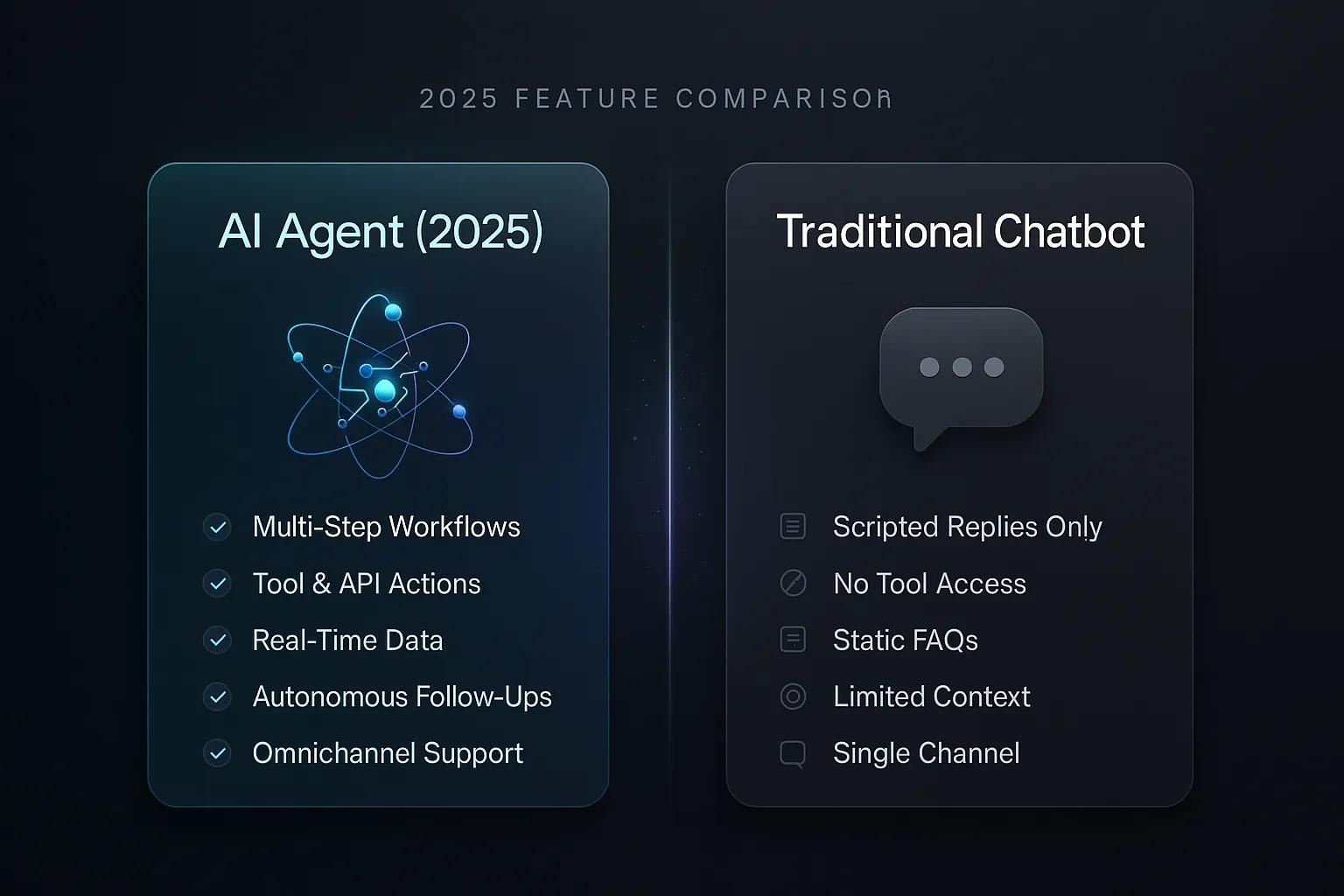
AI Agent vs Traditional Chatbot: 2026 Feature Comparison
It's 11 PM on a Tuesday. A customer reports a damaged package through your support channel. Your traditional chatbot politely apologizes and provides a link to...