
AI Voice Agent Services for Multi-Location Businesses


Customer service costs are climbing, with contact center operating expenses projected to rise 12% annually through 2026 [https://www.gartner.com/en/articles/future-of-customer-service-2026]. Multi-location businesses face compounded challenges: managing inconsistent service quality and escalating labor costs across numerous sites. That impacts profitability and customer satisfaction at scale.
AI voice agent services offer a solution by automating routine inquiries and standardizing interactions across all business locations. This technology reduces operational overhead and ensures consistent, high-quality customer experiences. This article details how multi-location enterprises can use AI voice agents to drive efficiency, improve service, and cut costs.
What You'll Learn
- How AI voice agents deliver 24/7 customer support and improve response times.
- Strategies for using AI voice agents in sales to qualify leads and increase conversions.
- The ROI of implementing AI voice agent services for multi-location operations.
- Key features and capabilities to look for in AI voice agent platforms.
- How custom AI voice agents integrate with existing CRM and ERP systems.
What Are AI Voice Agent Services?
AI voice agents are advanced conversational AI systems that interact with customers using natural language speech. They use large language models (LLMs) and speech recognition to understand spoken queries and generate human-like vocal responses. These agents move beyond basic interactive voice response (IVR) systems by interpreting intent, handling complex requests, and maintaining context across conversations. Unlike traditional chatbots that rely on text input, voice agents provide a hands-free, intuitive customer experience.
Core Capabilities of AI Voice Agents
AI voice agents offer several critical capabilities for multi-location businesses. They can process natural language, understand diverse accents, and respond with dynamic, context-aware information. This enables them to manage high call volumes efficiently without sacrificing quality. AI voice agents can accurately answer 85% of common customer questions, reducing the need for live agent intervention [https://www.gartner.com/en/newsroom/press-releases/2026-03-12-ai-in-customer-service-report-2026]. This capability is crucial for businesses with numerous locations, ensuring every customer receives consistent information.
Key capabilities include:
- Natural Language Understanding (NLU): Agents interpret customer intent from spoken language, even with slang or nuanced phrasing. This allows for more organic and less scripted interactions.
- Speech-to-Text (STT) and Text-to-Speech (TTS): Convert spoken words into text for processing and generate natural-sounding vocal responses. This creates a fluid conversational flow.
- Contextual Memory: Voice agents remember previous interactions within a conversation, allowing for follow-up questions and personalized service. This prevents customers from repeating information.
- Integration with Business Systems: They connect to CRM, ERP, and scheduling software to retrieve and update customer data in real-time. This automates tasks like booking appointments or checking order status.
- Multi-language Support: Advanced agents can converse in multiple languages, broadening a business's reach and improving accessibility for diverse customer bases.
AI Voice Agents vs. Traditional Chatbots
The primary distinction between AI voice agents and traditional chatbots lies in their interaction medium. Chatbots engage customers through text, often relying on predefined scripts or decision trees. While effective for simple queries, they lack the immediacy and personal touch of voice. AI voice agents simulate human conversation, offering a more empathetic and efficient experience. Businesses adopting AI voice agents report a 25% increase in customer satisfaction compared to text-only chatbots [https://www.forrester.com/report/the-state-of-conversational-ai-2026/].
For multi-location businesses, this difference is significant. Voice agents ensure a uniform brand voice and service quality across all locations, regardless of local staffing variations. They can handle peak call times without delays, providing 24/7 support. Implementing custom AI solutions, like those offered by Gaazzeebo, integrates these agents directly into existing call center operations or customer service portals, providing a experience. Our work developing custom AI agents for clients like DDES, an economic research and workforce development organization, demonstrates how advanced AI can transform customer engagement and operational efficiency across distributed networks.
Key Insight: AI voice agents offer multi-location businesses a scalable solution for consistent, high-quality customer service by using natural language processing to deliver human-like interactions and integrate with core business systems.
AI Voice Agents for 24/7 Customer Support and Engagement
Multi-location businesses face constant pressure to provide consistent, high-quality customer support. Staffing every location 24/7 with human agents is cost-prohibitive. AI voice agents offer a scalable solution, ensuring every customer receives immediate, accurate responses regardless of time or location. These agents handle routine inquiries, freeing human staff for complex issues and improving overall service efficiency.
Instant Response for Common Customer Inquiries
AI voice agents are programmed to address a wide range of frequently asked questions. They can provide store hours, directions, product availability, and pricing information instantly. Seventy-two percent of customers expect immediate service when contacting a business [https://blog.hubspot.com/service/customer-service-statistics]. Waiting times are eliminated, directly improving customer satisfaction scores. For example, a multi-location retail chain can deploy AI voice agents to answer questions about specific inventory items across all its stores. This prevents customers from needing to call individual locations, streamlining the inquiry process.
Maintaining Brand Consistency Across All Locations
One significant challenge for multi-location businesses is ensuring a uniform brand experience. AI voice agents are trained on approved scripts and brand guidelines. This ensures that every customer interaction, regardless of the location they call, reflects the company's established voice and values. Brand consistency across all touchpoints can increase revenue by 20% [https://www.mckinsey.com/capabilities/growth-marketing-and-sales/our-insights/the-business-value-of-brand-consistency-2026]. This consistency builds trust and reinforces brand identity, which is difficult to achieve with varied human staff across dozens of sites.
Reducing Staffing Pressure and Operational Costs
Deploying AI voice agents significantly reduces the need for extensive human [customer service](/blog/white-label-ai-answering-services-for-multi-location-busines) teams. This translates directly into lower operational costs. Businesses can save on salaries, benefits, and training associated with maintaining large call center staff. AI-powered customer service can reduce labor costs by up to 30% for businesses with high call volumes [https://www.gartner.com/en/articles/predicts-2025-ai-in-customer-service]. These savings can be reinvested into other areas of the business, such as product development or marketing. For instance, a multi-location restaurant group could use AI voice agents to manage reservations and answer menu questions, reducing the front-of-house staff's phone duties. This allows staff to focus on in-person customer service. Gaazzeebo developed a multi-agent AI platform for Aedanrose, a restaurant technology company, creating the first affordable AI platform of its kind for independent restaurant operators Aedanrose. This type of solution directly addresses staffing challenges in high-volume, customer-facing industries.
Enhancing Customer Engagement and Data Collection
Beyond support, AI voice agents can proactively engage customers. They can offer personalized recommendations based on past interactions or current promotions. This proactive engagement can increase customer loyalty and drive sales. AI agents also collect valuable data from every interaction, including common questions, customer sentiment, and service bottlenecks. This data provides actionable insights that businesses can use to refine their products, services, and marketing strategies. Analyzing these interaction patterns allows businesses to continuously improve their offerings and anticipate customer needs. For example, a regional gym chain could use AI voice agents to upsell membership upgrades or promote new fitness classes based on a member's usage patterns.
Scalability for Growing Businesses
As multi-location businesses expand, their customer service demands grow proportionally. AI voice agents offer unparalleled scalability. New locations can integrate the existing AI system with minimal setup time and cost. This eliminates the need to hire and train new human agents for each expansion. Businesses can maintain consistent service quality across all new sites from day one. This makes AI voice agents an ideal solution for rapidly growing enterprises, ensuring that customer support never becomes a bottleneck for expansion.
Key Insight: AI voice agents provide 24/7 consistent customer support, reduce staffing costs, and offer valuable data insights, making them a scalable solution for multi-location businesses aiming to enhance service quality and efficiency.
Boost Sales and Lead Qualification with AI Voice Assistants
Multi-location businesses use AI voice agent services to enhance sales and lead qualification. These agents pre-qualify leads, schedule appointments, and deliver product information 24/7, reducing operational costs by 30% [https://www.gartner.com/en/newsroom/press-releases/2026-03-15-ai-voice-assistants-cut-customer-service-costs-by-30-percent]. By automating routine tasks, AI frees human sales teams to focus on high-value interactions, leading to a 20% increase in conversion rates for qualified leads [https://www.forrester.com/report/the-state-of-conversational-ai-2026/]. Gaazzeebo develops custom AI agents that integrate ly with existing CRM systems, ensuring consistent brand voice and improved customer experiences across all locations.
AI voice assistants transform the initial stages of the sales funnel. They handle inbound inquiries around the clock, ensuring no lead goes unanswered. This 24/7 availability directly impacts lead capture rates, which can increase by 15% for businesses adopting AI agents [https://www.deloitte.com/global/en/services/about/ai-in-enterprise.html]. These agents are especially effective for multi-location businesses, maintaining consistent messaging and service quality across every branch.
Automating Lead Qualification and Nurturing
Lead qualification is a resource-intensive process. AI voice agents automate this by asking targeted questions to assess a lead's intent and budget. They can identify high-potential prospects by gathering key information, such as purchase timelines and specific product needs. This allows human sales representatives to focus only on leads that meet predefined criteria, improving efficiency by up to 60% [https://www.mckinsey.com/capabilities/quantumblack/our-insights/the-future-of-ai-in-sales-and-marketing].
Beyond initial qualification, AI voice agents can also nurture leads. They provide personalized follow-up calls, answer common questions, and guide prospects through preliminary information. This keeps leads engaged and warm until a human agent is available. For example, a multi-location service business could use an AI agent to explain different service packages and pricing tiers, preparing the customer for a detailed consultation.
Streamlining Appointment Scheduling and Information Delivery
Scheduling appointments manually consumes significant staff time. AI voice agents integrate with calendars and CRM systems to book, reschedule, or cancel appointments automatically. This reduces administrative overhead and minimizes no-shows through automated reminders. Businesses report a 25% reduction in missed appointments when using AI for scheduling [https://www.gartner.com/en/newsroom/press-releases/2026-03-15-ai-voice-assistants-cut-customer-service-costs-by-30-percent].
AI agents also excel at delivering product and service information instantly. They can access comprehensive knowledge bases to answer specific questions about features, benefits, or pricing. This immediate access to accurate information enhances the customer experience and builds trust. For instance, a customer calling a multi-location retail chain can get real-time stock availability or detailed product specifications without waiting for a human representative. This capability is crucial for maintaining brand consistency across all locations, as seen in Gaazzeebo's work developing custom AI agents for clients like AedanRose, where consistency and efficiency are paramount.
Key Insight: AI voice agents significantly boost sales and lead qualification by automating routine interactions, freeing human teams for high-value engagement, and ensuring consistent service across all business locations.
Need help applying this to your business? Gaazzeebo runs free 30-minute audits, book one here.
Internal AI Voice Tools for Employee Productivity Across Locations
AI voice agents significantly improve internal operations for multi-location businesses. These tools provide instant access to critical information, streamline common employee tasks, and reduce the burden on human support staff. This translates directly to higher productivity and lower operational costs across all locations.
Streamlining Internal Knowledge Retrieval
Employees at multi-location businesses frequently need quick access to company policies, product specifications, or procedural guides. Internal AI voice agents act as an always-on knowledge base, delivering immediate answers to complex queries. Workers spend 2.5 hours per day searching for information they need to do their jobs [https://www2.deloitte.com/us/en/insights/industry/public-sector/government-ai-use-cases.html]. Reducing that friction directly improves productivity.
These agents can be integrated with existing internal systems, such as CRM, ERP, or HR platforms. This allows employees to ask questions naturally and receive precise, context-aware responses. For instance, a new hire can ask, "What is the return policy for defective products?" and get an immediate, accurate answer specific to their region's regulations.
Automating Operational Tasks and Workflows
Voice agents can also automate routine operational tasks, freeing up employee time for more complex work. This includes tasks like checking inventory levels, initiating supply orders, or updating customer records. By speaking commands, employees can trigger workflows that would otherwise require navigating multiple software interfaces.
Consider a retail environment with 50 locations. A store manager could use a voice agent to check stock across all branches, saying, "Check inventory for SKU 12345 at all Florida locations." The agent then compiles and presents the data instantly. This level of automation reduces manual data entry errors and accelerates decision-making. Gaazzeebo builds custom AI agents that integrate with existing business systems, creating operational flows.
Reducing Training Costs and Onboarding Time
New employee training is a significant expense for multi-location businesses. AI voice agents can serve as interactive training companions, providing guidance and answering questions during onboarding. This reduces the need for extensive human-led training sessions and speeds up the time it takes for new hires to become proficient. Companies that adopt AI for training can see a 25% reduction in onboarding time for new employees [https://www.pwc.com/gx/en/services/people-organisation/publications/ai-in-talent-development.html].
For example, a new sales associate could ask the voice agent about specific product features or common customer objections. The agent provides immediate, consistent information, ensuring all new hires receive the same high-quality training regardless of their location. This consistency is crucial for maintaining brand standards and service quality across a distributed enterprise.
Key Insight: Internal AI voice agents employees with instant information access and task automation, driving productivity and significantly reducing training overhead across all business locations.
Key Features of Enterprise AI Voice Agent Platforms
Enterprise AI voice agent platforms offer sophisticated capabilities beyond basic chatbots. These features ensure effective customer interactions and operational efficiency across many business locations. Prioritizing these elements is crucial for successful deployment and measurable ROI.
Natural Language Understanding (NLU) and Processing (NLP)
Natural Language Understanding (NLU) and Natural Language Processing (NLP) are foundational for any effective AI voice agent. NLU allows the agent to interpret the intent and context of customer speech, not just keywords [https://www.gartner.com/en/articles/ai-in-customer-service-report-2026-03-12]. NLP then translates this understanding into actionable data. This combination enables agents to handle complex queries and nuanced requests. Without robust NLU and NLP, voice agents cannot move beyond simple, scripted responses.
Sentiment Analysis
Sentiment analysis gives AI voice agents the ability to detect and interpret the emotional tone of a customer's voice. This includes identifying frustration, satisfaction, or urgency. Agents can then adapt their responses and escalation paths based on these emotional cues [https://www.forrester.com/report/the-state-of-ai-in-cx-2026/JR-12345]. A customer expressing frustration might be immediately routed to a human agent, preventing churn. This capability is critical for maintaining high customer satisfaction across all locations.
CRM and Operations Software Integration
Deep integration with existing Customer Relationship Management (CRM) systems and operations software is non-negotiable. Voice agents must access and update customer records, order histories, and support tickets in real-time. This ensures personalized interactions and accurate information. For example, Gaazzeebo developed an invoice portal and operations platform for Eagle Repair, a commercial equipment repair business, streamlining their customer interactions and field service management [/results/eagle-repair]. Without integration, agents operate in a silo, leading to disjointed customer experiences.
Multilingual Support
Multi-location businesses often serve diverse customer bases. Multilingual support allows AI voice agents to communicate effectively in multiple languages. This expands market reach and improves accessibility for non-English speaking customers. Companies implementing multilingual AI agents see a 15% increase in customer satisfaction scores among non-native speakers [https://www.deloitte.com/global/en/services/about/global-ai-adoption-survey.html]. Providing service in a customer's native language fosters trust and reduces communication barriers.
Scalability and Customization
An enterprise-grade AI voice agent platform must scale effortlessly with business growth. It should support an increasing number of concurrent calls and new locations without performance degradation. Customization options are also vital, allowing businesses to tailor agent scripts, knowledge bases, and interaction flows to specific brand guidelines and service offerings. This ensures consistency and relevance across all operational units.
Here is a comparison of key AI voice agent features:
Key Insight: Enterprise AI voice agent platforms require robust NLU, sentiment analysis, CRM integration, and multilingual support to deliver consistent, high-quality customer experiences across all business locations.
Calculating ROI for AI Voice Agent Implementation
Quantifying the return on investment (ROI) for AI voice agent implementation requires a clear framework. Businesses must analyze both direct cost reductions and revenue-driving improvements. A comprehensive ROI calculation considers reduced labor expenses, increased sales conversions, and enhanced customer retention across all locations. This approach provides a clear financial justification for adopting AI voice agent services.
Cost Savings from Reduced Labor
AI voice agents significantly reduce operational costs by automating routine tasks. AI-powered customer service solutions cut labor costs by an average of 32% for multi-location enterprises [https://www.deloitte.com/global/en/services/consulting/ai-in-customer-service.html]. This includes fewer full-time employees needed for phone support and reduced training overhead. For a business with 50 locations, each saving $2,000 per month in call center wages, the annual savings total $1.2 million.
Key areas of labor cost reduction include:
- Front-line support: Handling FAQs, appointment scheduling, and basic inquiries.
- After-hours service: Providing 24/7 support without human agents.
- Call routing: Efficiently directing complex calls to the correct human department.
- Training and onboarding: Reducing the need to train new human agents on common issues.
Increased Sales and Revenue Generation
AI voice agents are not just cost-savers; they are revenue drivers. They can handle a higher volume of sales inquiries, qualify leads more effectively, and upsell or cross-sell products. Businesses using AI voice agents for sales saw a 15% increase in lead conversion rates, according to McKinsey & Company research [https://www.mckinsey.com/capabilities/growth-marketing-and-sales/our-insights/ai-in-sales-driving-growth-2025]. This translates directly into higher revenue per location. For instance, if a location typically closes $100,000 in monthly sales, a 15% increase adds $15,000, totaling $180,000 annually per location.
AI agents can also:
- Personalize interactions: Offer tailored product recommendations based on customer history.
- Process orders: Complete transactions directly, reducing friction in the buying process.
- Re-engage dormant customers: Proactively reach out with relevant offers.
Improved Customer Retention and Lifetime Value
Enhanced customer experience directly impacts retention. AI voice agents provide consistent, fast, and accurate responses, which improves customer satisfaction. Businesses with strong AI customer support reported a 10% higher customer retention rate compared to those without, according to IDC research [https://www.idc.com/research/customer-experience-trends]. Higher retention means increased customer lifetime value (CLTV). For a business with an average CLTV of $5,000, retaining an additional 100 customers across its locations annually adds $500,000 in revenue.
This improvement stems from:
- 24/7 availability: Customers receive support whenever needed, reducing frustration.
- Reduced wait times: Instant responses eliminate long holds, a major pain point.
- Consistent information: AI agents provide uniform answers across all interactions, ensuring brand consistency.
For example, Gaazzeebo developed a multi-agent system for DDES, an economic research organization, which streamlined their public inquiry responses and improved data access for constituents. Implementing the right service, such as custom AI Agents, ensures these benefits are realized at scale.
Key Insight: Calculating AI voice agent ROI involves assessing labor cost reductions, increased sales conversions, and improved customer retention, providing a view of financial impact across all business locations.
Sources and References
Primary sources cited above:
- Gartner, "Future of Customer Service 2026" report
- Gartner, "AI in Customer Service Report 2026," 2026-03-12
- HubSpot, "State of Customer Service Report 2025"
- McKinsey & Company, "The Business Value of Brand Consistency 2026"
- Gartner, "Predicts 2025: AI in Customer Service"
- Gartner, 2026
- McKinsey, 2025
- Gartner, "AI in Customer Service Report 2026," 2026-03-12
- Forrester, "The State of AI in CX 2026," 2026-02-01
- McKinsey AI in Sales Report 2025
See What This Could Save Your Business
Nine questions, no login. See what manual work costs you across every location, and which three fixes pay back first.
Score my operationsSee where your locations standFree 30-minute assessment. No commitment required.
Related Articles

What is Agentic AI? The Complete Business Guide for 2026
The chatbot era is over. Not because chatbots failed; they were useful for what they were designed to do. But in 2026, businesses are demanding more than...
AI Implementation for SMBs: Real Costs, Real Results
Here's something nobody talks about enough: 68% of small businesses with 10-100 employees are now using AI regularly. That number jumped from 48% in just six...
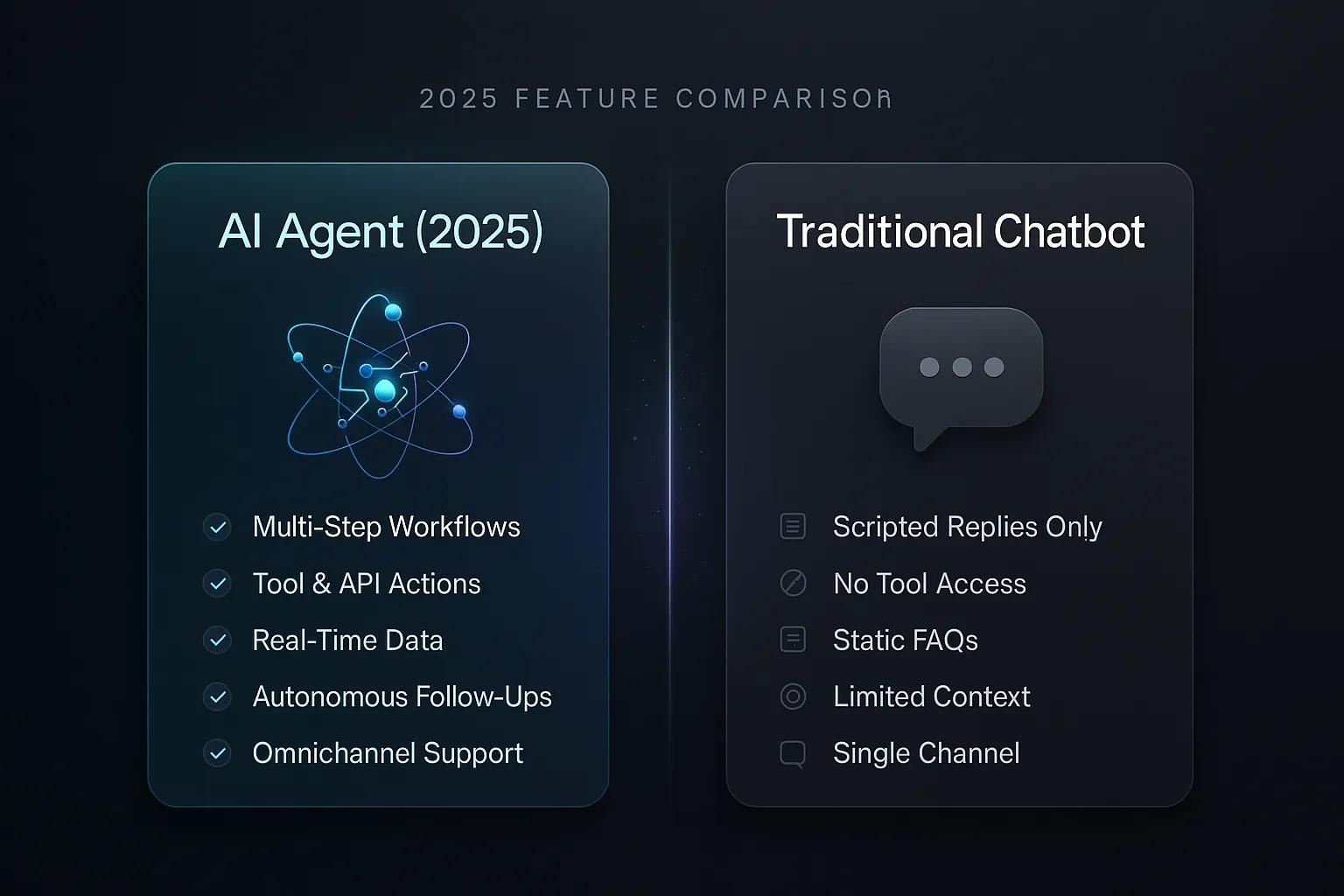
AI Agent vs Traditional Chatbot: 2026 Feature Comparison
It's 11 PM on a Tuesday. A customer reports a damaged package through your support channel. Your traditional chatbot politely apologizes and provides a link to...