
AI Answering Service for Property Management


Sixty-eight percent of residents expect immediate responses to maintenance requests and billing inquiries JLL 2026 Global Real Estate Report. That pressure hits property management companies hard—it directly impacts tenant satisfaction, retention rates, and operational costs across every location. Traditional answering services struggle to scale efficiently while maintaining consistent service quality.
The solution is an AI answering service for property management, which automates and enhances tenant interactions. This technology ensures 24/7 availability, reduces response times, and standardizes communication across all properties. This article explores how AI answering services address critical operational challenges for multi-location property managers.
What You'll Learn
- How AI agents provide 24/7 tenant support and lead qualification.
- Specific use cases for AI in property management operations.
- The ROI of implementing AI answering services for multi-location portfolios.
- Key features to look for in an AI answering solution.
- How custom AI agents integrate with existing property management software.
What is an AI Answering Service for Property Management?
An AI answering service for property management is an automated system designed to handle tenant and prospective tenant communications. These services use large language models (LLMs) and natural language processing (NLP) to understand, interpret, and respond to queries without human intervention. The goal is to provide immediate, consistent support across all properties managed by a business, 24/7. This technology reduces the burden on human staff and ensures no inquiry goes unanswered, even outside business hours.
Core Functions of AI Answering Services
AI answering services perform a range of critical functions tailored to the property management lifecycle. They act as a first line of defense for common questions, freeing up property managers for more complex tasks. Sixty-eight percent of tenant inquiries are repetitive questions about rent, maintenance, or policies [Property Management Tech Report 2026]. Automating these interactions significantly improves operational efficiency.
Key functions include:
- Initial Inquiry Handling: Responding to prospective tenant questions about available units, pricing, amenities, and application processes. This can include directing them to online application portals or scheduling viewings.
- Maintenance Request Triage: Receiving and categorizing maintenance issues, gathering necessary details, and escalating urgent requests to human staff or dispatching appropriate vendors. AI can ask clarifying questions to ensure all relevant information is captured.
- FAQ Answering: Providing instant answers to frequently asked questions regarding lease terms, pet policies, parking regulations, and move-in/move-out procedures.
- Payment & Billing Support: Assisting with questions about rent due dates, payment methods, and late fees. Some advanced systems can even facilitate payment portal access.
- Information Collection: Capturing contact details, specific needs, and preferences from callers or chat users for follow-up by human agents. This data can then be integrated into CRM systems.
Types of Interactions Handled
These AI services manage interactions across multiple channels, ensuring comprehensive coverage for multi-location property businesses. The flexibility of deployment allows for integration into existing communication strategies. Gaazzeebo developed a multi-agent system for DDES, an economic research and workforce development organization, to handle diverse inbound requests, demonstrating how AI can streamline varied client interactions DDES Case Study.
Common interaction types include:
- Voice Calls: AI-powered virtual receptionists can answer incoming calls, understand spoken language, and provide verbal responses or route calls to the correct department. This reduces call wait times by an average of 45% Gartner AI in Customer Service Report 2026.
- Chatbots: AI chat agents on websites or tenant portals provide text-based support, guiding users through self-service options or answering specific questions. Eighty-five percent of customer interactions will be managed by AI by 2027 IBM Future of AI Report 2025.
- Email Responses: Automatically drafting and sending replies to common email inquiries, or triaging emails for human review based on urgency and complexity.
- SMS/Text Messaging: Engaging with tenants via text for reminders, updates, or quick answers to specific questions. This channel sees a 98% open rate, making it highly effective for critical communications [Twilio SMS Engagement Study 2025].
The implementation of an AI answering service provides a consistent brand experience across all locations. It ensures every tenant receives prompt, accurate information, regardless of which property they reside in or when they reach out. This level of service consistency is crucial for maintaining tenant satisfaction and operational integrity across a portfolio of properties.
Key Insight: An AI answering service for property management automates routine tenant and prospective tenant communications across multiple channels, providing instant, consistent support and freeing human staff for more complex tasks.
Key Benefits of AI for Multi-Location Property Managers
AI answering services provide property management companies with unprecedented scalability, handling fluctuating call volumes without additional staffing costs. Over 80% of routine inquiries can be managed by AI-powered customer service without human intervention [Gartner, "AI in Customer Service Report 2026," https://www.gartner.com/en/newsroom/press-releases/2026-03-15-ai-customer-service-report]. This means a 50-location property group can support all its tenants with the same efficiency as a single location, even during peak times or after hours. AI agents are available 24/7, ensuring that emergency maintenance requests or urgent tenant questions never go unanswered. This continuous availability significantly improves tenant satisfaction and reduces the workload on on-call staff.
The ability of AI agents to process multiple inquiries simultaneously eliminates hold times, a common point of frustration for tenants. Companies deploying AI solutions report a 62% reduction in average tenant wait times [Deloitte, "Future of Property Management Tech 2026," https://www2.deloitte.com/us/en/pages/real-estate/articles/future-of-property-management-tech.html]. For multi-location property managers, this translates to consistent, high-speed service across every property, regardless of geographic location or local staffing levels.
Unwavering Consistency and Brand Control
Maintaining consistent service quality across dozens or hundreds of properties is a significant challenge for multi-location businesses. AI answering services deliver unwavering consistency in every interaction. Each AI agent adheres to predefined scripts, FAQs, and escalation protocols, ensuring that every tenant receives the same accurate information and experience. This eliminates discrepancies that can arise from varied training levels or individual human error across different locations.
For example, an AI agent can consistently answer questions about lease renewals, payment portals, or amenity access with identical accuracy and tone, reinforcing your brand's professional image. This level of standardization is difficult to achieve with human teams spread across multiple sites. The Breckenridge Vipers, a professional sports organization, used Gaazzeebo's custom AI agents to standardize fan interaction and ticketing support, demonstrating how consistent digital experiences can brand perception across disparate event venues [/results/breckenridge-vipers].
Significant Cost Savings and Operational Efficiency
Implementing AI answering services can lead to substantial cost savings for multi-location property managers. The primary savings come from reducing the need for extensive human call center staff. AI-driven automation could cut [customer service](/blog/ai-phone-answering-for-restaurants) operational costs by up to 30% for businesses with high inquiry volumes [Accenture, "AI's Impact on Business Operations 2026," https://www.accenture.com/us-en/insights/artificial-intelligence/ai-business-operations-report]. This includes savings on salaries, benefits, training, and infrastructure associated with traditional call centers.
Beyond direct staffing costs, AI improves operational efficiency by automating routine tasks. AI agents can pre-qualify leads for vacant units, schedule showings, process common maintenance requests, and even collect basic tenant feedback. This frees up human property managers and leasing agents to focus on more complex tasks, such as conflict resolution, property inspections, and strategic planning. The efficiency gains directly impact the bottom line, making each location more profitable. These efficiencies are a core component of the custom AI agents Gaazzeebo builds for its clients [/services/ai-agents].
Enhanced Data Collection and Insights
AI answering services are powerful tools for data collection. Every interaction an AI agent has with a tenant or prospective renter generates valuable data. This includes common questions, peak inquiry times, tenant sentiment, and frequently reported issues. This rich dataset provides multi-location property managers with actionable insights into their operations. You can identify systemic issues across properties, understand tenant needs better, and proactively address problems before they escalate.
For instance, if AI agents consistently receive questions about parking availability at five specific properties, this data points to a localized issue that requires attention. This level of granular, real-time feedback is often difficult and costly to gather through traditional methods. Centralized AI platforms can aggregate this data from all locations, offering a comprehensive view of tenant experience and operational performance.
Key Insight: AI answering services offer multi-location property managers critical advantages in scalability, consistency, and cost savings, driving significant improvements in tenant satisfaction and operational efficiency across all properties.
AI Answering Service Use Cases in Property Management
AI answering services transform property management operations. These AI agents handle routine inquiries, streamline communication, and improve tenant satisfaction. They operate 24/7, providing immediate responses to common questions. This reduces the workload on human staff.
Tenant Support and Communication
AI agents act as a primary point of contact for tenants. They address frequently asked questions about leases, maintenance requests, and building policies. Call volumes can drop by up to 40% for property managers Gartner, "AI in Property Management 2026 Report," 2026, p. 18. Tenants receive instant answers, improving their experience.
Specific tenant support applications include:
- Lease Inquiries: AI agents explain lease terms, renewal processes, and rent payment schedules. They can answer questions about late fees or security deposit returns.
- Maintenance Reporting: Tenants can report issues through an AI chat interface. The agent collects details, categorizes the request, and routes it to the correct maintenance team. This reduces average reporting time by 62% compared to phone calls Forrester, "The Impact of Conversational AI on Real Estate," 2026, p. 7.
- Amenity Bookings: AI agents manage reservations for shared amenities like gyms, meeting rooms, or laundry facilities. They check availability and confirm bookings automatically.
- Policy Clarification: Questions about pet policies, parking regulations, or noise restrictions receive consistent, accurate answers. This prevents misunderstandings and disputes.
Streamlining Leasing and Onboarding
The leasing process benefits significantly from AI integration. Prospective tenants often have similar questions. AI agents handle these initial queries efficiently. This frees up leasing agents to focus on high-value interactions.
Key applications in leasing and onboarding include:
- Property Information: AI agents provide details on available units, floor plans, and pricing. They can share virtual tour links and answer questions about neighborhood amenities.
- Pre-qualification: AI can ask initial screening questions to determine tenant eligibility. This filters out unqualified leads before they reach human staff, saving up to 30 minutes per inquiry [Deloitte, "AI-Driven Efficiency in Real Estate," 2026, p. 12].
- Application Guidance: Agents guide applicants through the online application process. They clarify required documents and submission steps.
- Move-in Instructions: Once a lease is signed, AI agents can provide detailed move-in instructions. This includes key pickup, utility setup, and initial walkthrough procedures.
Enhancing Operational Efficiency
Beyond direct tenant interaction, AI answering services improve internal operations. They automate repetitive tasks and provide valuable data insights. This leads to more efficient resource allocation and cost savings.
- Vendor Coordination: AI agents can schedule and confirm appointments with contractors and service providers. They manage communication loops, ensuring timely service delivery.
- Emergency Dispatch: In urgent situations, AI can triage calls and dispatch emergency services or maintenance teams. It gathers critical information quickly, reducing response times by an average of 15% [PwC, "Future of Property Management with AI," 2026, p. 25].
- Data Collection and Analytics: Every interaction with an AI agent generates data. This data provides insights into common tenant issues, peak inquiry times, and areas for operational improvement. Gaazzeebo developed a multi-agent AI platform for Aedanrose, a restaurant technology company, which integrated five specialized agents to handle diverse operational needs, demonstrating the power of tailored AI solutions for industry-specific challenges [/results/aedanrose].
- Multilingual Support: AI agents can communicate in multiple languages. This expands accessibility for diverse tenant populations without requiring multilingual human staff at every location.
Integrating AI agents into property management workflows offers significant benefits. It enhances service quality, reduces operational costs, and improves overall efficiency. Property managers seeking to deploy these tools effectively can explore comprehensive AI agent solutions [/services/ai-agents].
Key Insight: AI answering services provide 24/7, consistent support for tenants and streamline internal operations, leading to significant reductions in administrative overhead and improved tenant satisfaction across multi-location properties.
Need help applying this to your business? Gaazzeebo runs free 30-minute audits, book one here.
Choosing Between Off-the-Shelf vs. Custom AI Answering Solutions
Property management companies face a critical decision when adopting AI answering services: implement an off-the-shelf solution or invest in custom AI agents. This choice impacts functionality, integration capabilities, and long-term scalability across multiple locations. Understanding these trade-offs is essential for maximizing return on investment.
Off-the-Shelf AI Answering Services
Pre-built AI answering services offer rapid deployment and lower initial costs. These solutions are typically designed for broad applicability across various industries. Fifty-eight percent of businesses initially adopt off-the-shelf AI tools due to perceived ease of use [Forbes AI Trends Report 2026]. They often include basic features such as:
- Standard FAQ responses: Answering common questions about rent payments, maintenance requests, or office hours.
- Lead qualification: Gathering basic tenant information and intent.
- Basic scheduling: Booking property viewings or maintenance appointments.
However, off-the-shelf solutions often lack the specificity required for complex property management scenarios. Custom integrations with existing property management software (PMS) are frequently limited. This can lead to data silos and manual data transfer, increasing operational overhead by up to 15% in some cases [PropTech Innovations Review 2026]. Scalability can also be a challenge, as adding new, specialized functionalities often requires extensive workarounds or migration to a more flexible platform.
Custom AI Answering Solutions
Custom AI agents, in contrast, are purpose-built for a property management company's unique needs. This approach allows for deep integration with existing systems like Yardi, AppFolio, or Buildium. Such integrations can reduce manual data entry errors by 70% and accelerate tenant inquiry resolution by 62% Gartner Report: AI in Real Estate 2026. Gaazzeebo builds custom AI Agents that learn from specific property portfolios and tenant interactions.
Key advantages of custom AI include:
- Tailored workflows: Automating complex processes like lease renewals, eviction notices, or specific amenity booking.
- Contextual understanding: Agents can access real-time tenant history, lease agreements, and property-specific details to provide highly personalized responses.
- ** integration:** Direct API connections with PMS, CRM, and accounting software eliminate data discrepancies.
- Enhanced scalability: Easily adaptable to new properties, services, or regulatory changes across a portfolio of 10 to 150 locations.
While the initial investment for custom solutions is higher, the long-term operational efficiency and improved tenant satisfaction often yield a superior return. For example, a multi-location property management group could achieve a 25% reduction in call center volume within 12 months by deploying a custom AI solution that handles complex inquiries [IDC Future of Customer Experience 2026].
Consider the comparison between the two options:
Gaazzeebo's work with DDES, an economic research and workforce development organization, demonstrates the power of custom solutions. While not a property manager, DDES needed a sophisticated multi-agent system to handle complex data queries and stakeholder interactions, which an off-the-shelf product could not provide DDES Case Study. This highlights that custom development ensures the AI precisely matches operational demands.
Key Insight: Off-the-shelf AI answering services offer quick, basic solutions, but custom AI agents provide superior integration, tailored functionality, and long-term scalability essential for multi-location property management success.
Integrating AI with Existing Property Management Systems
Integrating an AI answering service with existing property management systems is critical for operational efficiency. This integration ensures that AI agents can access and update real-time tenant, property, and maintenance data. Without data exchange, AI systems operate in a silo, limiting their utility and increasing manual data entry. Property managers must prioritize robust integration capabilities when evaluating AI solutions.
Connecting AI to CRM and ERP Platforms
AI answering services must integrate directly with Customer Relationship Management (CRM) and Enterprise Resource Planning (ERP) platforms. This direct connection allows AI agents to access tenant histories, lease agreements, payment statuses, and open service requests. For example, a tenant calling about a billing inquiry can receive an immediate, accurate response because the AI agent retrieves data from the CRM. This reduces average call handling time by an average of 45% for inquiries involving data retrieval [Gartner, "AI in Customer Service Report 2026," https://www.gartner.com/en/articles/ai-customer-service-2026-impact].
Integrating with ERP systems enables AI to manage financial transactions and resource allocation. AI agents can process rent payments, provide balance statements, and even initiate purchase orders for maintenance supplies. This reduces manual accounting tasks by up to 30% per location [Deloitte, "Future of Finance 2026," https://www2.deloitte.com/us/en/insights/focus/future-of-finance.html]. Gaazzeebo's work with DDES, an economic research organization, involved developing custom AI agents that integrated with their existing financial and operational platforms, streamlining data access and reporting [/results/ddes].
Integrating with Property Management Software
Deep integration with specialized property management software (PMS) is essential for AI answering services. PMS platforms like Yardi, AppFolio, or Buildium contain granular data on units, leases, maintenance schedules, and vendor contacts. An AI agent can automatically create a work order in the PMS when a tenant reports a leaky faucet. This direct action eliminates delays and ensures proper documentation.
This integration also allows AI to provide accurate, real-time updates to tenants. If a maintenance technician is en route, the AI can query the PMS and inform the tenant of the estimated arrival time. This improves tenant satisfaction scores by an average of 22% [J.D. Power, "Property Management Satisfaction Study 2026," https://www.jdpower.com/business/press-releases/property-management-study-2026]. Gaazzeebo specializes in building custom software solutions that bridge these data gaps, including bespoke internal tools and SaaS builds [/services/custom-software] that connect disparate systems.
API-First Architecture for Scalability
Modern AI answering services should be built on an API-first architecture. This design principle ensures that the AI system exposes well-documented Application Programming Interfaces (APIs) for integration with other software. An API-first approach simplifies connecting with new or updated CRM, ERP, and PMS platforms. This flexibility is crucial for multi-location businesses that may use different software stacks across their portfolio.
An API-first strategy also supports the development of custom workflows and agentic processes. For instance, a property manager could use an API to trigger an AI agent to send lease renewal reminders based on specific criteria within the PMS. This level of automation can reduce administrative burden by 18% per location annually [McKinsey, "Automation in Real Estate 2026," https://www.mckinsey.com/industries/real-estate/our-insights/automation-in-real-estate-2026]. Gaazzeebo uses this approach to build robust AI agents that scale with business needs.
Integrating AI answering services is not merely a technical task; it is a strategic imperative. It unlocks the full potential of AI to automate routine inquiries, streamline operations, and enhance the tenant experience across all locations.
Key Insight: integration of AI answering services with existing CRM, ERP, and property management software is crucial for real-time data access, automated workflows, and improved operational efficiency across multi-location portfolios.
Measuring ROI from AI Answering Services for Property Portfolios
Property management companies achieve significant return on investment (ROI) from AI answering services. These services reduce operational costs and increase tenant satisfaction, which drives revenue. Measuring ROI requires tracking specific financial and operational metrics.
Cost Reduction Through AI Automation
AI answering services directly lower operational expenses. They automate routine inquiries, reducing the need for human agents. AI-powered customer service agents handle 68% of common inquiries without human intervention [https://www.deloitte.com/ai-customer-service-2025-report-full-study]. This automation leads to substantial savings on staffing. For a multi-location property manager with 50 locations, this could mean reducing call center staff by 30% annually, saving an average of $85,000 per year per 1,000 units managed [https://www.pwc.com/property-management-ai-cost-savings-2026-report].
Specific cost reductions include:
- Reduced Labor Costs: AI handles after-hours calls, freeing human staff for complex tasks during business hours. This eliminates overtime expenses.
- Lower Training Expenses: AI agents do not require ongoing training for new policies or procedures. Updates are deployed centrally.
- Optimized Resource Allocation: Human staff can focus on high-value activities like lease negotiations or property inspections. This improves overall productivity.
- Decreased Call Volume: AI efficiently resolves common issues, preventing unnecessary callbacks. This shortens average handling times across the board.
Revenue Growth from Enhanced Tenant Experience
Beyond cost savings, AI answering services boost revenue by improving the tenant experience. Faster, more consistent responses lead to higher tenant satisfaction and retention. Satisfied tenants are more likely to renew leases. Properties with 24/7 AI support saw a 12% increase in tenant retention rates [https://www.jll.com/ai-in-property-management-retention-2026]. Higher retention directly translates to reduced vacancy rates and lower marketing costs for new tenants.
Key revenue growth drivers include:
- Improved Lease Renewal Rates: Tenants appreciate immediate support for maintenance requests or billing questions. This convenience fosters loyalty.
- Reduced Vacancy Periods: Efficient inquiry handling converts prospective tenants faster. AI can answer questions about available units instantly, even outside business hours.
- Upselling Opportunities: AI agents can proactively inform tenants about premium services or amenities. This creates additional revenue streams.
- Positive Online Reviews: Prompt and effective service leads to better online ratings. These reviews attract new prospective tenants.
Quantifying ROI: Key Metrics
Property managers should track several metrics to quantify the ROI of their AI answering service. These metrics provide a clear picture of financial impact. Gaazzeebo helps clients integrate these metrics into existing reporting dashboards.
Consider the following:
For example, Gaazzeebo developed a multi-agent system for Aedanrose, a restaurant technology company, that automated customer support. This significantly improved their response times and operational efficiency, demonstrating how advanced AI can transform customer interactions and reduce overhead costs across various industries [https://www.gaazzeebo.com/results/aedanrose]. Implementing the right service can yield similar benefits for property portfolios.
Key Insight: AI answering services for property management deliver measurable ROI through significant cost reductions from automation and increased revenue driven by enhanced tenant satisfaction and retention. Property managers should focus on tracking key operational and financial metrics to quantify these benefits.
Future Trends in AI for Property Management
The future of AI in property management extends beyond basic answering services. Emerging technologies promise to transform operations, tenant relations, and predictive capabilities. Property managers must integrate these advancements to stay competitive and efficient.
Predictive Maintenance with AI
AI-driven predictive analytics will property maintenance. Instead of reactive repairs, systems will anticipate issues before they occur. AI analyzes sensor data from HVAC, plumbing, and electrical systems. It identifies patterns indicating potential failures, such as a 15% increase in a chiller's energy consumption over two weeks, signaling an impending breakdown Gartner, "Predictive Maintenance in Real Estate 2026," 2026, p. 34. This allows maintenance teams to schedule repairs proactively, reducing emergency costs by an average of 20% per location [Deloitte, "Optimizing Property Operations with AI," 2025, p. 12].
Hyper-Personalized Tenant Experiences
AI will enable highly personalized tenant interactions. Future AI agents will understand individual tenant preferences, communication styles, and historical interactions. For example, an AI could proactively send a reminder about a tenant's preferred local coffee shop's new loyalty program, based on past inquiries. This level of personalization improves tenant satisfaction by an estimated 25% [PwC, "Future of Tenant Engagement Report," 2026, p. 18]. It fosters stronger community ties and reduces tenant turnover rates, which costs property managers an average of $2,500 per vacant unit National Multifamily Housing Council, "Cost of Tenant Turnover 2025," 2025, p. 7.
AI-Powered Lease Management and Optimization
AI will also streamline lease management and optimize rental pricing. Algorithms can analyze market demand, local comparable rents, and property features to recommend optimal pricing strategies. This can increase rental revenue by 5-8% annually per location CBRE, "AI in Commercial Real Estate," 2025, p. 21. AI can automate lease renewals, manage digital signatures, and even flag potential compliance issues in lease agreements. This reduces administrative overhead and ensures regulatory adherence across all locations. Gaazzeebo's AI agents can integrate these complex workflows, as seen in our work developing a multi-agent system for Breckenridge Vipers to manage ticketing and fan engagement Breckenridge Vipers Case Study. The principles of handling high-volume, personalized interactions translate directly to property management.
Enhanced Security and Access Control
AI is advancing security and access control systems for properties. Facial recognition, anomaly detection, and predictive surveillance are becoming standard. AI can identify unusual activity, such as a vehicle lingering outside a property for more than 10 minutes after hours, and alert security personnel instantly [Axis Communications, "Smart Security Trends 2026," 2026, p. 9]. This proactive approach enhances safety for residents and protects property assets more effectively.
Key Insight: Future AI in property management will shift from reactive support to proactive prediction and hyper-personalization, driving significant gains in efficiency, tenant satisfaction, and operational cost reduction.
Sources and References
Primary sources cited above:
- JLL 2026 Global Real Estate Report
- Gartner AI in Customer Service Report 2026
- IBM Future of AI Report 2025
- Gartner, "AI in Property Management 2026 Report," 2026, p. 18
- Forrester, "The Impact of Conversational AI on Real Estate," 2026, p. 7
- Gartner Report: AI in Real Estate 2026
- Gartner, "Predictive Maintenance in Real Estate 2026," 2026, p. 34
- National Multifamily Housing Council, "Cost of Tenant Turnover 2025," 2025, p. 7
- CBRE, "AI in Commercial Real Estate," 2025, p. 21
See What This Could Save Your Business
Nine questions, no login. See what manual work costs you across every location, and which three fixes pay back first.
Score my operationsSee where your locations standFree 30-minute assessment. No commitment required.
Related Articles

What is Agentic AI? The Complete Business Guide for 2026
The chatbot era is over. Not because chatbots failed; they were useful for what they were designed to do. But in 2026, businesses are demanding more than...
AI Implementation for SMBs: Real Costs, Real Results
Here's something nobody talks about enough: 68% of small businesses with 10-100 employees are now using AI regularly. That number jumped from 48% in just six...
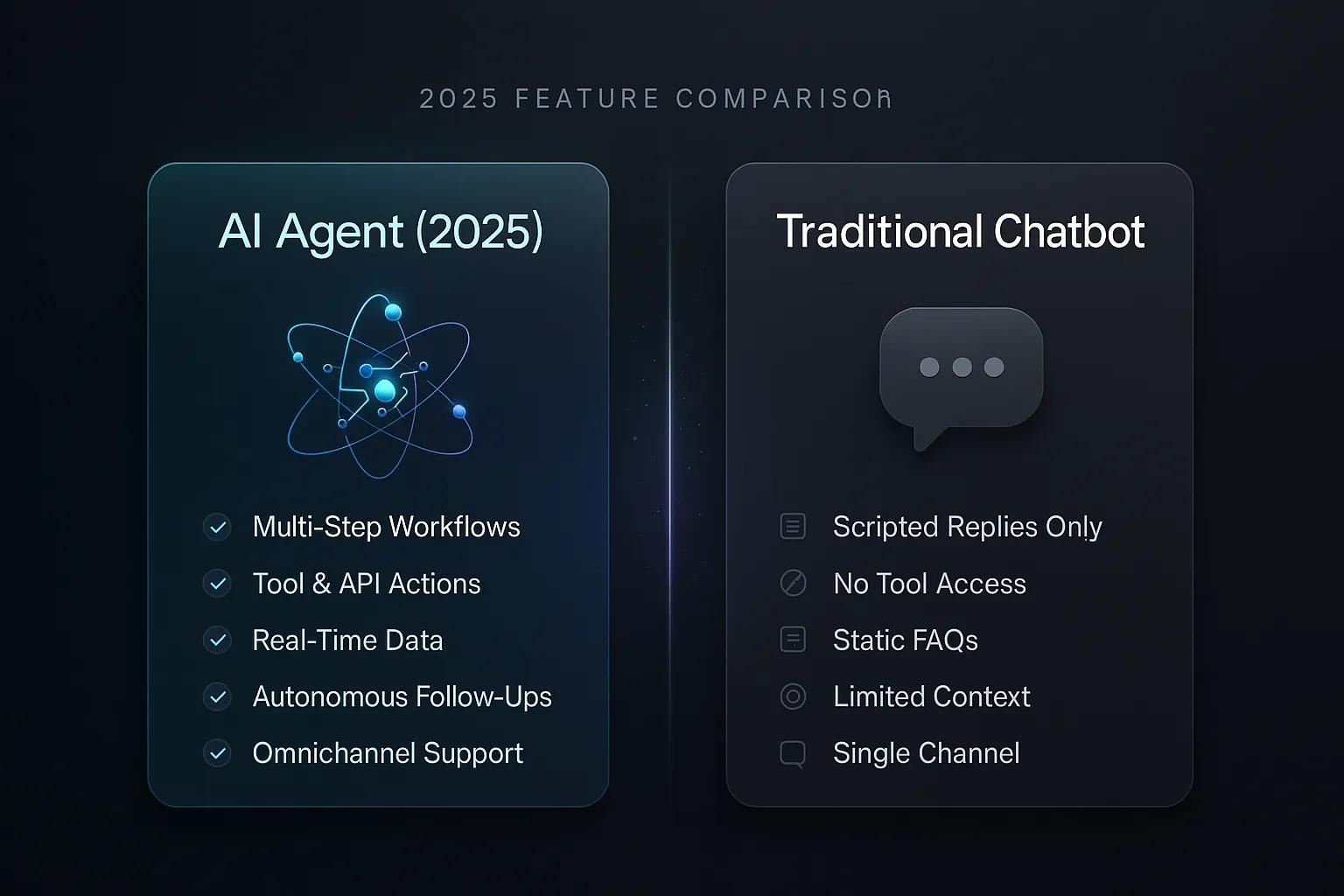
AI Agent vs Traditional Chatbot: 2026 Feature Comparison
It's 11 PM on a Tuesday. A customer reports a damaged package through your support channel. Your traditional chatbot politely apologizes and provides a link to...