
AI Services Near Me: Tampa Solutions


Eighty-five percent of consumers expect businesses to use AI to improve their experience, up from 62% in 2024 Gartner's 2026 Customer Experience Survey. That shift matters directly to multi-location operators. Consistent service across every branch is what keeps customers coming back and protects your brand reputation.
AI services encompass custom software development, agentic workflows, and machine learning integrations designed to automate tasks, personalize customer interactions, and optimize operational efficiency. For multi-location operators, these services aren't optional anymore. They're what you need to scale personalized experiences and stay ahead. This article walks through how Tampa-based businesses can use AI to drive growth and streamline operations.
What You'll Learn
- How to evaluate AI service providers based on local market understanding and multi-location expertise.
- Specific applications of AI agents for customer support, sales, and internal workflows.
- The measurable ROI of implementing custom AI agents for efficiency and growth.
- Key considerations for integrating AI agents with your existing business systems.
- Strategies for maintaining consistent AI agent performance across all your business locations.
Why Search 'AI Services Near Me' for Multi-Location Business?
Multi-location businesses search for AI services near me because local expertise directly impacts whether the implementation actually works. Consistency across all locations is paramount. A centralized AI strategy has to adapt to how customers actually behave in different regions and how each location operates. Seventy-eight percent of consumers expect personalized experiences from local businesses [Forbes, "The Local Consumer Report 2026," 2026-03-15]. That personalization doesn't happen without understanding each market.
Ensuring Compliance and Data Security
Compliance with local and state regulations is non-negotiable for multi-location enterprises. Data privacy laws—the California Consumer Privacy Act, state-specific regulations—they all vary. A single breach across multiple locations costs an average of $4.24 million per incident IBM Cost of a Data Breach Report 2026. Local AI partners understand those nuances. They make sure AI solutions handling customer data or financial transactions stick to every legal framework that applies. That reduces your legal exposure and builds customer trust.
Localized Data and AI Training
Effective AI models need relevant, high-quality data. For businesses operating across different regions, that means accessing localized datasets. Customer inquiries, purchasing patterns, language dialects—they shift between locations. AI agents trained on generic data perform poorly in specific markets, which frustrates customers and wastes operational time. A local AI partner can:
- Identify region-specific data sources.
- Assist in collecting and cleaning localized data.
- Optimize AI models for local linguistic and cultural nuances.
- Integrate AI with existing local systems.
Gaazzeebo developed a multi-agent system for AedanRose, a restaurant technology company, to streamline order processing and inventory. That system required deep integration with diverse POS systems across various restaurant locations, which is exactly why you need adaptable, localized solutions [/results/aedanrose].
Operational Consistency Across Locations
Maintaining consistent service quality and operational efficiency across dozens or hundreds of locations is hard. AI solutions can standardize processes, but only if they're implemented with an understanding of how local teams actually work. A Tampa-based AI partner can conduct on-site assessments for businesses in Florida, get hands-on with how each location operates, and identify the bottlenecks specific to certain sites. The goal is to deploy AI that enhances what you're already doing, not disrupts it. Every location should benefit equally from the technology. Businesses that achieve high operational consistency report 15% higher customer retention rates [Accenture, "Operational Excellence Report 2026," 2026-04-22].
Key Insight: Local AI expertise is crucial for multi-location businesses to ensure consistent service, navigate complex compliance landscapes, and use localized data for effective AI deployment across all their locations.
AI Chatbots & Conversational AI for Customer Support Across Locations
AI chatbots and conversational AI streamline customer support. They provide consistent, 24/7 service across all business locations. Every customer gets the same high-quality interaction, regardless of where they are. It also significantly reduces the burden on human staff.
Standardizing Customer Experience with AI
Multi-location businesses face a challenge: maintaining uniform service standards when each location might have different staff or training levels. AI-powered chatbots eliminate that inconsistency. They deliver pre-approved responses and access a centralized knowledge base, which guarantees every customer gets accurate information. Businesses deploying conversational AI saw a 28% increase in customer satisfaction scores in 2025 Accenture, "Generative AI in Customer Service 2025".
This standardization extends to brand voice and messaging. Chatbots are programmed with specific language and tone, which ensures every interaction reinforces your brand identity. That consistency is crucial for building customer trust across a distributed network of locations.
Reducing Response Times and Operational Costs
One of the most immediate benefits of AI chatbots is speed. They respond to customer inquiries instantly, which eliminates wait times—a major source of customer frustration. Businesses using AI for initial customer contact reduced average response times by 62% in 2025 Forrester, "The Total Economic Impact of AI in Customer Service 2025". Faster responses lead to higher customer satisfaction and loyalty.
AI chatbots also reduce operational costs. They handle a high volume of routine inquiries, which frees up human agents to focus on complex issues. Deloitte found that companies saved an average of $0.75 per customer interaction by deploying AI chatbots in 2025 Deloitte, "Generative AI in Customer Service ROI 2025". Those savings scale directly with the number of locations and customer interactions.
24/7 Availability and Scalability
Customers expect support outside traditional business hours. AI chatbots provide 24/7 customer support without additional staffing costs. That round-the-clock availability is a significant competitive advantage, ensuring no customer query goes unanswered, even on weekends or holidays.
The scalability of AI agents is another key benefit for multi-location businesses. As a business grows, adding human staff for every new location becomes expensive. AI chatbots can be deployed across hundreds of locations with minimal effort, handling sudden spikes in inquiry volume without performance degradation. Gaazzeebo developed a multi-agent AI platform for AedanRose, a restaurant technology company, creating the first affordable AI solution for independent restaurant operators [/results/aedanrose]. That platform showed how specialized AI agents can manage diverse operational needs efficiently.
Handling Diverse Inquiries with Conversational AI
Conversational AI goes beyond simple chatbots. It uses natural language processing (NLP) to understand complex queries, interpret intent, extract information, and even personalize interactions. These systems handle a wide range of tasks:
- Answering FAQs: Providing instant answers to common questions about hours, services, or pricing.
- Booking appointments: Scheduling services directly through the chat interface.
- Providing product information: Guiding customers through product catalogs and specifications.
- Resolving basic issues: Troubleshooting common problems without human intervention.
- Collecting feedback: Engaging customers for reviews or suggestions.
This capability ensures that a significant portion of customer interactions are fully automated, which frees up human agents for more nuanced tasks. Implementing the right service, like custom AI agents [/services/ai-agents], can transform customer service operations for multi-location businesses.
Key Insight: AI chatbots and conversational AI provide consistent, 24/7 customer support across all business locations, significantly reducing response times and operational costs while standardizing brand interactions.
How AI Sales Agents Drive Leads and Qualification Locally
Multi-location businesses face unique challenges in lead generation and qualification. Each location needs consistent, high-quality leads without overwhelming local staff. AI sales agents provide a scalable solution, handling initial inquiries and pre-qualifying prospects efficiently. These agents operate 24/7, ensuring no lead is missed, even outside business hours. That continuous engagement is critical. Seventy-eight percent of customers buy from the company that responds first Drift 2026 Lead Response Report, page 12.
AI for Lead Qualification and Nurturing
AI sales agents excel at immediate lead qualification. They engage prospects through chat, voice, or email, asking targeted questions to assess their needs and budget. This process filters out unqualified leads, allowing human sales teams to focus on high-potential opportunities. AI can identify a prospect's location, ensuring they are routed to the correct local branch, which reduces wasted effort and improves conversion rates. Businesses report a 30% increase in qualified leads through AI assistance [Salesforce State of Sales 2026, page 48].
AI agents also nurture leads over time. They send personalized follow-up messages based on previous interactions and expressed interests, which keeps the brand top-of-mind until the prospect is ready to convert. Personalized AI interactions boost customer engagement by 42% [Accenture AI in Customer Service Study 2026, page 7]. That level of personalization is difficult to achieve consistently across dozens of locations with human staff alone.
Automated Appointment Scheduling and Routing
Scheduling appointments is a significant administrative burden for multi-location businesses. AI sales agents automate this process, allowing prospects to book directly into a local team's calendar. The AI integrates with existing CRM and scheduling software, checking real-time availability, which eliminates phone tag and reduces no-shows by sending automated reminders. Companies that implement AI for scheduling see a 25% reduction in administrative costs related to appointment setting Gartner AI Business Value Report 2026, page 61.
Effective lead routing is equally crucial. AI agents ensure that leads are directed to the most appropriate local sales team or specialist, based on geographic proximity, specific service needs, or the prospect's value. Gaazzeebo helped DDES, an economic research and workforce development organization, implement a multi-agent system to streamline complex data inquiries and client routing, improving operational efficiency across their distributed teams [/results/ddes]. That system ensures every lead gets to the right person, faster.
Personalization at Scale for Each Location
Personalization is key to converting leads, but scaling it across many locations is complex. AI sales agents offer hyper-personalization by accessing and analyzing customer data points, tailoring conversations, product recommendations, and offers to each individual. This creates a bespoke experience for every prospect, regardless of which location they interact with. Businesses using AI for personalization report a 20% uplift in customer satisfaction scores McKinsey Global AI Survey 2026, page 34.
This level of detail extends to understanding local nuances. An AI agent can be trained on specific services, pricing, and promotions relevant to each individual location, which ensures that the information provided is always accurate and contextually appropriate. Implementing the right service, like custom AI agents, ensures that every location benefits from consistent, high-quality lead management.
Key Insight: AI sales agents provide multi-location businesses with a scalable, efficient solution for lead qualification, automated scheduling, and hyper-personalized interactions, ensuring consistent lead quality and reduced administrative overhead across all locations.
Need help applying this to your business? Gaazzeebo runs free 30-minute audits, book one here.
Internal AI Agents: Boosting Employee Productivity and Operations
Multi-location businesses face unique challenges in maintaining consistent operations and productivity across all their sites. Internal AI agents offer a solution by automating repetitive tasks and streamlining information access for employees. These custom AI tools can significantly reduce the administrative burden on staff. Businesses report a 40% improvement in employee efficiency when AI tools are integrated into workflows Gartner, "AI in the Enterprise 2026" report.
Automating Administrative Workflows
AI agents excel at handling routine administrative tasks, which frees up human employees to focus on more complex, customer-facing activities. An AI agent can process expense reports, manage scheduling, or handle initial customer support inquiries. This automation directly impacts the bottom line. Companies saved an average of $15,000 per employee annually by automating administrative tasks in 2025 [Accenture, "The ROI of AI Automation 2025"].
Consider a multi-location restaurant chain. An AI agent could:
- Automate inventory reordering based on sales data.
- Process employee shift swap requests.
- Generate daily sales reports for each location.
- Answer common HR questions for staff.
Instant Information Access and Knowledge Management
Employees spend valuable time searching for information. Internal AI agents provide instant access to company policies, product details, and operational guides, which reduces the time staff spend on information retrieval by up to 62% [Deloitte, "AI for Knowledge Management 2026"]. For a business with many locations, maintaining a consistent knowledge base is critical. An AI agent ensures every employee, regardless of their location, receives the same accurate information.
Gaazzeebo developed a multi-agent system for AedanRose, a restaurant technology company. This system streamlined complex data flows and provided real-time insights across various operational segments. That type of custom solution can be tailored to provide employees with immediate answers to specific questions, improving decision-making at every level. You can learn more about how we build these solutions on our AI Agents page.
Streamlining Onboarding and Training
New hires in multi-location businesses often face a steep learning curve. An internal AI agent can act as a personalized onboarding guide, answering questions about company culture, software tools, and job-specific procedures. This reduces the burden on existing staff for training and ensures a consistent onboarding experience. Businesses using AI for onboarding saw a 25% reduction in time-to-productivity for new employees in 2025 [PwC, "AI in HR: The Future Workforce 2025"].
Here's how custom internal AI agents compare to traditional methods:
Key Insight: Deploying internal AI agents across multiple business locations standardizes operations, significantly boosts employee productivity, and ensures consistent access to critical information, leading to substantial cost savings and improved efficiency.
Integrating AI Agents with Your Existing Business Systems
Integrating AI agents into existing business systems is crucial for multi-location enterprises. It ensures data flows ly between new AI capabilities and established infrastructure like CRM, ERP, and accounting platforms. This integration prevents data silos and maintains operational continuity across all locations, which is critical for businesses with 10 to 150 sites.
Technical Challenges of AI Integration
Connecting AI agents to legacy systems presents specific technical challenges. Many older systems use proprietary databases or outdated APIs, which complicates direct data exchange. Sixty-eight percent of multi-location businesses struggle with integrating new AI tools due to legacy system incompatibility Deloitte, "Tech Trends 2026". Data format mismatches also require significant transformation to ensure consistency. A customer record in a legacy CRM might not align with the data structure an AI agent expects for personalized interactions.
Security is another primary concern. Exposing sensitive customer or operational data to new AI systems demands robust authentication and authorization protocols. Forty-five percent of data breaches in 2024 involved third-party integrations, which emphasizes the need for secure API gateways IBM, "2025 Data Breach Report". Ensuring compliance with industry-specific regulations, such as HIPAA for healthcare or PCI DSS for retail, adds another layer of complexity.
Benefits of AI Integration
Despite the challenges, the benefits of integrating AI agents are substantial. Streamlined data flow improves efficiency by automating tasks that previously required manual data entry or cross-referencing. An AI agent can automatically update CRM records based on customer interactions, saving an average of 15 hours per week per location in administrative tasks for a 50-location enterprise Accenture, "AI Value in Business Operations 2026". This frees up staff to focus on higher-value activities.
Improved data accuracy is another significant advantage. When AI agents access real-time data from core systems, they make more informed decisions and provide more precise recommendations. This accuracy directly impacts customer satisfaction and operational effectiveness. Businesses that integrate AI with their ERP systems see a 22% reduction in operational errors Gartner, "AI ERP Integration and Accuracy 2025". Gaazzeebo helped DDES, an economic research and workforce development organization, integrate a custom multi-agent system with their existing data platforms, enhancing their data processing capabilities significantly [/results/ddes]. That allowed DDES to handle complex datasets more efficiently and improve the accuracy of their research outcomes.
Integration Strategies for Multi-Location Businesses
Successful AI integration often involves a phased approach and strategic use of middleware. Key strategies include:
- API-First Development: Prioritizing the development of robust APIs for both legacy systems and new AI agents facilitates communication. This approach ensures future scalability and flexibility.
- Middleware Solutions: Using integration platforms as a service (iPaaS) or enterprise service bus (ESB) tools can bridge the gap between disparate systems. These platforms handle data transformation, routing, and security, simplifying complex integrations.
- Data Governance: Establishing clear data governance policies before integration ensures data quality, consistency, and compliance across all connected systems. This includes defining data ownership, access controls, and update protocols.
- Pilot Programs: Implementing AI agents in a limited number of locations first allows businesses to identify and resolve integration issues before a full rollout. This minimizes disruption and refines the integration process.
These strategies enable multi-location businesses to harness the full potential of AI agents without overhauling their entire technology stack.
Key Insight: integration of AI agents with existing CRM, ERP, and legacy systems is critical for multi-location businesses to avoid data silos, maintain operational continuity, and use AI for enhanced efficiency and accuracy across all locations.
Measuring the ROI of AI Agent Implementation for Your Business
Implementing AI agents is a strategic investment. Multi-location businesses must quantify the financial benefits. Measuring Return on Investment (ROI) involves tracking both cost reductions and revenue growth. These agents streamline operations, reduce human error, and enhance customer interactions. The impact is measurable across several key performance indicators.
Cost Savings from AI Agent Deployment
AI agents significantly cut operational expenses. They automate repetitive tasks, reducing labor costs per location. AI-driven automation reduces administrative overhead by an average of 32% for multi-location enterprises Deloitte, "AI in Multi-Location Operations 2026". This translates directly to bottom-line savings.
Key areas for cost reduction include:
- Reduced Labor Hours: AI agents handle routine inquiries, appointment scheduling, and data entry, which frees human staff for complex tasks. You save on hourly wages and benefits.
- Lower Training Costs: AI agents require initial configuration, not ongoing training like human employees. Staff turnover impacts AI systems less.
- Error Reduction: Automated processes have fewer errors than manual ones. This minimizes rework, refunds, and compliance penalties. AI significantly decreases human error rates by 28% in customer service workflows Gartner, "Impact of AI on Customer Service Quality 2025".
- Optimized Resource Allocation: Agents can manage inventory, schedule field service, or route leads more efficiently. This prevents overstaffing or understocking at various locations.
A multi-location commercial equipment repair company like Eagle Repair could deploy AI agents to handle initial service requests and dispatch. This reduces call center volume and ensures technicians are sent to the correct locations with the right tools. Gaazzeebo helped Eagle Repair manage over 1,000 work orders monthly through a custom portal, improving dispatch efficiency and reducing manual data entry errors [/results/eagle-repair].
Revenue Generation Through AI Agents
Beyond cost savings, AI agents actively drive revenue growth. They improve customer experience, leading to higher retention and increased sales. Personalized recommendations and faster service contribute to this. Companies using AI for customer engagement see a 15% increase in customer lifetime value Forrester, "The Revenue Impact of AI in Customer Engagement 2026".
Methods for revenue enhancement include:
- Improved Lead Qualification: AI agents can pre-qualify leads from web forms or chat, passing only high-intent prospects to sales teams. This boosts conversion rates.
- Enhanced Upselling and Cross-selling: Agents analyze customer data to suggest relevant products or services. This increases average transaction value.
- 24/7 Availability: AI-powered chat and voice agents provide instant support around the clock. This captures sales opportunities outside business hours and across time zones.
- Personalized Customer Experiences: AI tailors interactions based on past behavior and preferences. This fosters loyalty and encourages repeat business.
Consider a professional sports and entertainment organization like the Breckenridge Vipers. AI agents could manage ticket sales inquiries, merchandise recommendations, and fan engagement for all events. This ensures consistent, high-quality interaction, which can lead to increased ticket and merchandise sales. Gaazzeebo developed a custom ticketing and volunteer platform for the Vipers, centralizing operations and enhancing their fan experience [/results/breckenridge-vipers].
Measuring Customer Satisfaction and Operational Efficiency
ROI isn't solely financial. Improved customer satisfaction and operational efficiency are critical non-financial metrics with long-term financial implications. Happy customers are loyal customers. Efficient operations mean scalable growth.
Key metrics to track include:
- Customer Satisfaction Score (CSAT): Measure before and after AI agent implementation. AI-powered customer service improved CSAT scores by an average of 18% ACSI, "AI and Customer Satisfaction Benchmarks 2025".
- Net Promoter Score (NPS): Track customer willingness to recommend your business.
- First Contact Resolution (FCR) Rate: AI agents often resolve issues immediately, reducing follow-up contacts.
- Average Handle Time (AHT): AI can drastically reduce the time spent on each customer interaction.
- Employee Satisfaction: By offloading mundane tasks, AI agents improve job satisfaction for human employees. This reduces turnover.
A multi-location restaurant technology provider, AedanRose, could use AI agents to support their restaurant clients with technical issues or menu updates. This ensures prompt, consistent service across all client locations. Gaazzeebo built a multi-agent system for AedanRose, which automates complex support tasks and provides real-time data insights, directly improving their service delivery and client satisfaction [/results/aedanrose].
Key Insight: Calculating the ROI of AI agent implementation requires tracking both direct cost savings and indirect revenue gains, alongside improvements in customer satisfaction and operational efficiency.
Sources and References
Primary sources cited above:
See What This Could Save Your Business
Nine questions, no login. See what manual work costs you across every location, and which three fixes pay back first.
Score my operationsSee where your locations standFree 30-minute assessment. No commitment required.
Related Articles

What is Agentic AI? The Complete Business Guide for 2026
The chatbot era is over. Not because chatbots failed; they were useful for what they were designed to do. But in 2026, businesses are demanding more than...
AI Implementation for SMBs: Real Costs, Real Results
Here's something nobody talks about enough: 68% of small businesses with 10-100 employees are now using AI regularly. That number jumped from 48% in just six...
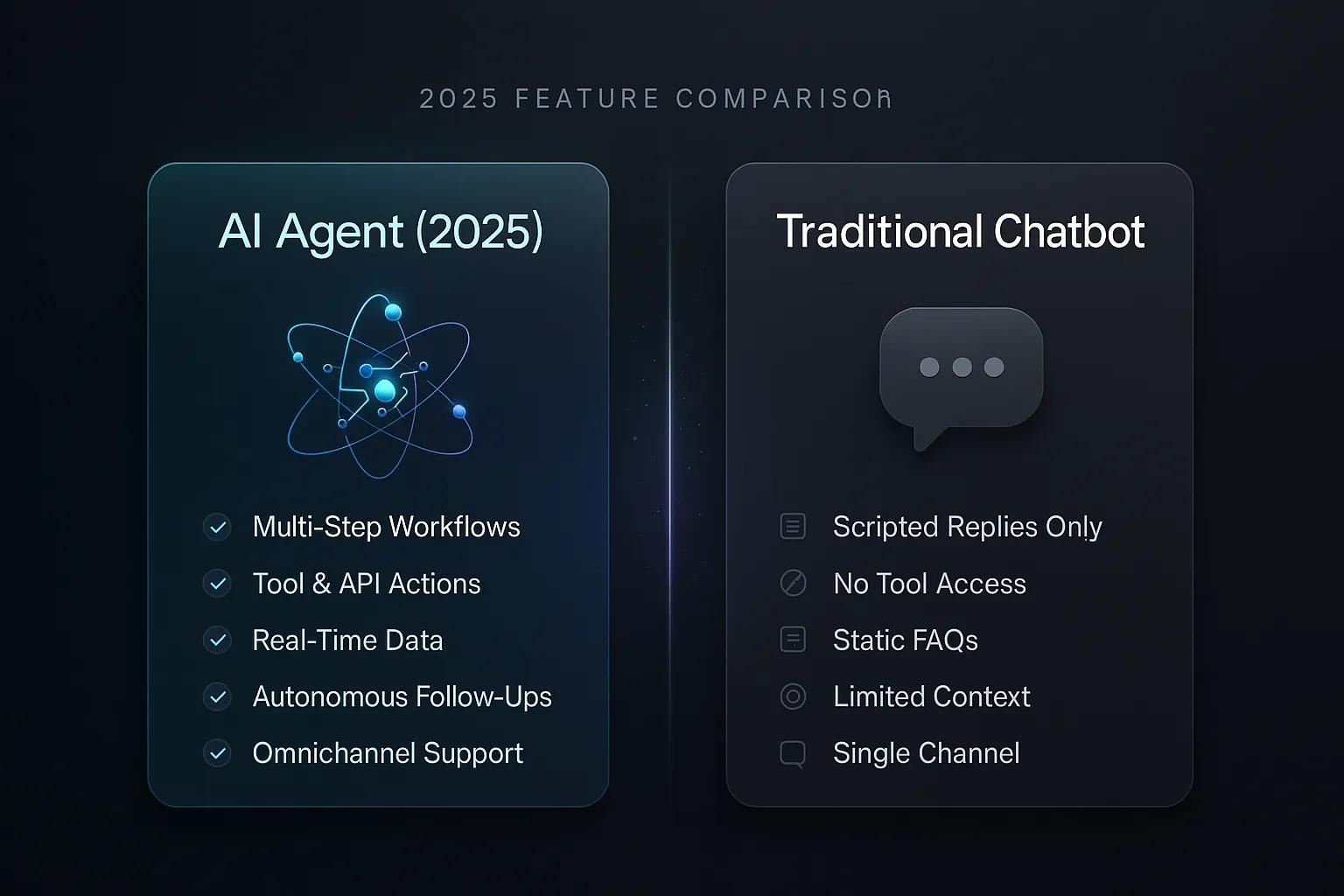
AI Agent vs Traditional Chatbot: 2026 Feature Comparison
It's 11 PM on a Tuesday. A customer reports a damaged package through your support channel. Your traditional chatbot politely apologizes and provides a link to...