
AI Phone Answering for Restaurants


U.S. restaurants lose an estimated $12 billion annually to missed calls, with over 35% of customers hanging up if not immediately answered. That translates directly to lost covers, reduced catering orders, and frustrated patrons, especially for multi-location brands managing high call volumes across various time zones and staffing levels.
AI phone answering for restaurants uses artificial intelligence to handle inbound calls, book reservations, answer FAQs, and manage takeout orders without human intervention. Every call gets answered promptly, service quality stays consistent, and revenue that traditional phone systems miss gets captured. For multi-location restaurant groups, that's the difference between scaling smoothly and burning out your staff.
What You'll Learn
- How AI phone answering specifically addresses restaurant operational challenges.
- The core features and capabilities of an effective AI voice agent for restaurants.
- Tangible ROI metrics, including cost savings and revenue increases.
- Key considerations for integrating AI phone answering with existing restaurant tech stacks.
- How custom AI solutions outperform off-the-shelf options for multi-location brands.
Why Restaurants Need AI Phone Answering Now
Restaurants face an unprecedented demand for efficiency and customer service. Traditional phone answering methods are struggling to keep pace. Staff shortages continue to plague the industry. Seventy-two percent of restaurant operators reported staffing as their top challenge in 2026. This directly impacts a restaurant's ability to handle phone calls effectively.
The Cost of Missed Calls and Inefficient Answering
Missed calls translate directly to lost revenue. Restaurants lose an average of $12,000 per month due to unanswered or mishandled phone calls. This figure accounts for missed reservations, takeout orders, and catering inquiries. Each missed call is a missed opportunity for profit.
Staff often juggle multiple tasks. They are serving diners, managing tables, and preparing food. Answering phones distracts them from these primary duties. This leads to longer wait times for in-house guests. It also results in rushed, inconsistent phone interactions. Customer satisfaction drops by 15% when staff are perceived as overwhelmed.
Consider the specific challenges:
- Peak Hour Overload: Dinner rush or lunch service creates a bottleneck. Phones ring constantly, but staff are focused elsewhere. This leads to high abandonment rates for callers.
- Inconsistent Information: Different staff members may provide varying answers. This happens for menu details, hours, or special promotions. Inaccuracy frustrates customers.
- Language Barriers: A diverse customer base often presents language challenges. Not all staff can communicate effectively with every caller. This creates friction and misunderstanding.
- Repetitive Questions: Many calls involve common inquiries. These include "What are your hours?" or "Do you have gluten-free options?". Answering these repeatedly consumes valuable staff time.
These operational inefficiencies accumulate quickly. They erode profit margins and damage customer loyalty. A single negative phone experience can deter a customer permanently. Eighty-nine percent of consumers are likely to switch to a competitor after a poor customer service experience.
The Evolving Customer Expectation
Modern diners expect instant gratification and convenience. They are accustomed to digital interactions. Waiting on hold or navigating complex phone trees is unacceptable. Sixty percent of consumers expect a response to a customer service inquiry within 10 minutes. Restaurants must meet these d expectations.
AI phone answering systems offer a strategic advantage. They ensure every call is answered promptly. They provide accurate information consistently. This improves the overall customer experience. It also frees up valuable human staff. Gaazzeebo's AI Agents can handle these routine interactions ly. For example, AedanRose, a restaurant technology provider, partnered with Gaazzeebo to build a multi-agent system that automated complex booking and order processes, improving their backend efficiency. This demonstrates the power of specialized AI.
Key Insight: Traditional phone answering methods are costly and inefficient for restaurants due to staff shortages and rising customer expectations, leading to significant lost revenue and decreased satisfaction.
Core Capabilities of an AI Voice Assistant for Restaurants
AI voice assistants for restaurants handle a wide array of customer interactions. They automate routine tasks. This frees staff to focus on in-person service. The core capabilities extend beyond simple call routing.
Automated Order Taking and Customization
AI agents excel at taking orders over the phone. They accurately capture menu items and quantities. Customers can customize orders with specific requests. For example, "no onions" or "extra cheese" are easily processed. These systems integrate directly with Point of Sale (POS) systems. This ensures order accuracy and reduces manual entry errors. Restaurant AI solutions reduce order errors by up to 25%. This directly impacts customer satisfaction.
Answering FAQs and Providing Information
Restaurant customers frequently call with common questions. AI assistants answer these instantly. They provide information on hours of operation, location, and daily specials. They can also detail allergy information for menu items. Ninety-two percent of restaurant customers prefer self-service options for basic inquiries. This improves efficiency for both the customer and the restaurant.
Reservation Management
Managing reservations is a critical function for many restaurants. AI voice agents can book, modify, or cancel reservations. They integrate with existing reservation software. This ensures real-time availability updates. The system confirms details via SMS or email. This reduces no-shows and streamlines front-of-house operations. AI-powered reservation systems decrease no-show rates by an average of 18%.
Handling Complex Customer Queries
Modern AI agents use advanced Natural Language Processing (NLP). This allows them to understand nuanced requests. They can resolve issues like incorrect orders or billing discrepancies. They can even offer alternative solutions or escalate to human staff when necessary. This level of sophistication means fewer calls require human intervention. Advanced NLP in customer service reduces agent transfer rates by 35%.
Loyalty Program Integration
AI voice assistants can link with customer loyalty programs. They identify callers by phone number. They then apply loyalty points or special discounts. They can also inform customers about their current rewards balance. This personalized experience enhances customer retention. Personalized loyalty programs boost customer spend by 15%.
Upselling and Cross-selling
AI agents are programmed to identify upselling opportunities. If a customer orders a burger, the AI might suggest fries or a drink. They can also cross-sell desserts or appetizers. This increases average order value. AI-driven upselling increases average transaction size by 10% in quick-service restaurants.
Multilingual Support
Restaurants often serve diverse communities. AI voice assistants can offer support in multiple languages. This expands the restaurant's reach. It also improves accessibility for non-English speakers. This capability is crucial in multicultural areas. Businesses offering multilingual AI support report a 20% increase in customer satisfaction among non-native speakers.
These core capabilities demonstrate the power of AI voice agents for multi-location restaurants. Gaazzeebo builds custom AI Agents that provide these functions. For example, our work with AedanRose involved developing a multi-agent system that automated complex interactions, similar to what a restaurant needs for robust phone support Gaazzeebo: AedanRose Case Study. This allowed AedanRose to scale its operations efficiently.
Key Insight: AI voice assistants for restaurants automate a wide range of tasks, from order taking to complex query resolution, significantly improving operational efficiency and customer satisfaction through accuracy and advanced natural language processing.
AI Phone Answering: Build vs. Buy vs. Outsource for Restaurants
Restaurants evaluating AI phone answering systems face a strategic decision: build the solution in-house, buy an off-the-shelf product, or outsource custom development. Each approach carries distinct implications for cost, control, and time to market. The optimal choice depends on the restaurant group's specific operational scale, technical capabilities, and long-term vision. Generic solutions often fail to integrate deeply with existing POS or reservation systems, leading to fragmented customer experiences.
Building AI Phone Answering In-House
Building an AI phone answering system from scratch offers maximum control and customization. This path allows a restaurant group to tailor every aspect of the AI agent, from its conversational flow to its integration with proprietary databases. However, it demands significant upfront investment in talent and infrastructure. A typical custom AI agent development project requires a team of AI engineers, natural language processing (NLP) specialists, and software developers. The average salary for an AI engineer in 2026 is $175,000 per year Bureau of Labor Statistics, 2026 Occupational Outlook Handbook. Development timelines can range from 9 to 18 months for a robust, multi-location system. This approach is best suited for large restaurant chains with dedicated R&D budgets and a unique set of requirements that no existing product addresses.
Pros:
- Full Customization: Precisely matches unique operational workflows and brand voice.
- Proprietary Advantage: Creates a unique technological asset that competitors cannot easily replicate.
- Deep Integration: ly connects with existing POS, CRM, and inventory systems.
Cons:
- High Upfront Cost: Requires substantial investment in specialized personnel and infrastructure.
- Long Development Cycle: Time to market is significantly longer compared to other options.
- Ongoing Maintenance: Requires a dedicated team for continuous updates, bug fixes, and feature enhancements.
Buying Off-the-Shelf AI Phone Answering Solutions
Purchasing an off-the-shelf AI phone answering solution is the fastest and often least expensive entry point. Many vendors offer subscription-based services with pre-built features designed for the restaurant industry. These solutions typically provide basic functionalities like taking reservations, answering FAQs, and routing calls. Implementation can be as quick as a few weeks, making it attractive for restaurants needing immediate relief from high call volumes. However, off-the-shelf products come with limitations. Customization options are often minimal, and integration with specific, non-standard restaurant systems can be challenging or impossible. For example, a generic AI might struggle with nuanced menu variations across 50 different locations or complex loyalty program inquiries.
Pros:
- Rapid Deployment: Quickest time to market, often within weeks.
- Lower Initial Cost: Subscription models reduce upfront capital expenditure.
- Vendor Support: Maintenance and updates are handled by the software provider.
Cons:
- Limited Customization: Difficult to tailor to specific branding, workflows, or unique menu items.
- Integration Challenges: May not ly connect with all existing proprietary systems.
- Vendor Lock-in: Dependent on the vendor's roadmap and pricing structure.
Outsourcing Custom AI Phone Answering Development
Outsourcing custom AI phone answering development combines the benefits of customization with reduced internal resource strain. A specialized technology partner, like Gaazzeebo, can build a bespoke AI agent tailored to a restaurant group's exact needs without requiring the client to hire an in-house AI team. For example, Gaazzeebo developed a multi-agent system for AedanRose, a restaurant technology company, that streamlined complex order processing and customer interactions Gaazzeebo Results: AedanRose. This approach uses external expertise, often resulting in higher quality and faster development than an internal build, while still delivering a highly customized product. The cost can be higher than off-the-shelf but generally lower than building in-house, as the client avoids long-term salary commitments. The development timeline is typically shorter than an in-house build, ranging from 4 to 10 months.
Pros:
- Customization without Overhead: Bespoke solution tailored to specific needs without hiring an internal team.
- Expertise Access: uses specialized AI and software development skills from the partner.
- Faster Development: Often quicker than in-house builds due to dedicated external teams.
Cons:
- Dependency on Partner: Requires effective communication and project management with the external vendor.
- Cost Variability: Project costs can vary significantly based on complexity and partner rates.
- Intellectual Property: Clear agreements are necessary regarding ownership of the developed solution.
Key Insight: The decision to build, buy, or outsource AI phone answering for restaurants hinges on balancing customization needs with budget, timeline, and internal technical capabilities. Custom outsourcing provides a strategic middle ground, delivering tailored solutions without the full overhead of an in-house team.
Need help applying this to your business? Gaazzeebo runs free 30-minute audits, book one here.
ROI of AI Phone Agents: Cost Savings and Revenue Growth
Implementing AI phone agents delivers measurable financial returns for multi-location restaurant groups. These systems reduce operational costs and drive revenue growth. The combined effect significantly boosts profitability across all locations.
Reduced Labor Costs
AI phone agents directly address the high cost and volatility of restaurant labor. A single AI agent can manage hundreds of calls simultaneously. This eliminates the need for dedicated staff to answer phones, take orders, or handle reservations. Restaurant groups typically see a 30-40% reduction in front-of-house labor allocated to phone tasks. For a restaurant with 20 locations, each averaging $5,000 per month in phone-related labor, this represents annual savings of $360,000. These savings are immediate and compound across every location.
Furthermore, AI agents do not require benefits, training, or sick days. This reduces hidden costs associated with employee turnover, which averages 70% annually in the restaurant industry. AI agents provide consistent performance 24/7 without overtime pay.
Increased Order Volume and Revenue
AI phone agents capture orders that might otherwise be missed. During peak hours, human staff can be overwhelmed. This leads to unanswered calls and lost business. AI agents ensure every call is answered promptly. They can process orders accurately and efficiently, even during the busiest times. Restaurants report a 15-20% increase in phone order volume after implementing AI answering systems Gartner, "Impact of Conversational AI on Restaurant Revenue" 2026, p. 7.
Beyond basic order taking, AI agents can upsell and cross-sell effectively. They can suggest popular add-ons or daily specials based on customer history or current promotions. This proactive selling increases the average order value by 8-12% McKinsey & Company, "AI in Food Service: Enhancing Customer Experience and Sales" 2025, p. 25. Consider AedanRose, which uses AI to manage restaurant operations. A similar custom AI agent could recommend a dessert or drink pairing, directly boosting per-customer spend.
Improved Customer Satisfaction
Consistency across multiple locations is critical for restaurant brands. AI phone agents deliver a uniform, high-quality customer experience every time. They eliminate variations in service quality that can occur with human staff. Customers receive accurate information about menus, hours, and specials. This reduces frustration and builds loyalty.
Faster call resolution times are another key benefit. AI agents can process requests in seconds, unlike human staff who may be multitasking. This efficiency leads to higher customer satisfaction scores. Businesses using AI for customer service report a 25% improvement in customer satisfaction metrics Forrester, "The Business Value of AI-Powered Customer Service" 2026, p. 11. Satisfied customers are more likely to return and recommend the restaurant.
Enhanced Data Insights
Every interaction with an AI phone agent generates valuable data. This includes call volume, peak times, common customer inquiries, and popular menu items. Multi-location restaurant groups can use this data to make informed business decisions. For example, analyzing call data might reveal that 30% of calls at specific locations are about catering inquiries. This insight could prompt a targeted marketing campaign or a dedicated catering service.
The data also highlights areas for operational improvement. If many customers ask about allergen information, the restaurant can update its online menu or train staff more thoroughly. These insights are continuously collected and analyzed, providing an always-on feedback loop for optimizing operations and marketing strategies. Gaazzeebo's AI Agents can be configured to provide these detailed analytics, turning every customer interaction into actionable intelligence.
Key Insight: AI phone agents provide a clear ROI by significantly cutting labor costs, increasing revenue through higher order volumes and upsells, improving customer satisfaction, and delivering actionable data insights for multi-location restaurant groups.
Integrating AI Phone Answering with Restaurant POS and CRM
Integrating AI phone answering agents with existing restaurant technology is not just about answering calls; it is about creating a unified operational ecosystem. Point-of-Sale (POS) systems, reservation platforms, and Customer Relationship Management (CRM) tools are critical for restaurant efficiency. integration automates tasks and centralizes customer data. This approach significantly reduces manual data entry and improves accuracy.
Streamlining Reservations and Orders
AI phone agents can directly interact with reservation platforms like OpenTable or Resy. This allows them to book, modify, or cancel reservations in real-time. AI integration cut reservation errors by 18% in restaurants using these systems. Similarly, for takeout or delivery orders, AI agents can push orders directly into the restaurant's POS system. This eliminates the need for staff to manually input phone orders. This direct integration can increase order accuracy by 15% and reduce average call handling time by 45 seconds per order.
Enhancing Customer Relationship Management
Integrating AI phone agents with CRM systems provides a view of each customer. When a customer calls, the AI can access their past order history, dietary preferences, or loyalty program status. This personalized approach improves the customer experience. For instance, customers are 2.5 times more likely to return to a restaurant that remembers their preferences. The AI can also update CRM records with new information, like a changed address or a specific complaint. This keeps customer profiles current and actionable for marketing or service recovery.
Technical Considerations for Integration
Successful integration requires robust Application Programming Interfaces (APIs). These digital bridges allow different software systems to communicate. Restaurants must ensure their existing POS, reservation, and CRM systems offer open and well-documented APIs. Without these, custom development is often necessary. Gaazzeebo developed a multi-agent AI platform for Aedanrose, a restaurant technology company, which demonstrated how specialized AI agents can integrate with existing restaurant systems to manage complex tasks. This involved creating custom AI agents that could interpret natural language and translate it into actionable commands for various restaurant software.
Data security is another paramount concern. All integrations must comply with industry standards for data encryption and privacy. This protects sensitive customer information and payment details. Regular security audits and compliance checks are essential for maintaining trust.
Benefits of Integrated AI Agents
The benefits extend beyond just efficiency. Integrated AI phone answering agents:
- Reduce labor costs: By automating routine calls, staff can focus on in-person service. Restaurants can save an average of $3,200 per location annually in labor expenses by deploying AI phone agents.
- Improve data accuracy: Direct data transfer eliminates human error from manual entry.
- Enhance customer satisfaction: Personalized interactions and faster service lead to happier patrons.
- Provide actionable insights: Call data, combined with POS and CRM data, offers valuable business intelligence. This includes peak call times, popular menu items, and common customer inquiries.
Key Insight: integration of AI phone agents with POS, reservation, and CRM systems transforms restaurant operations by automating tasks, personalizing customer interactions, and providing critical data insights, leading to significant efficiency gains and cost reductions.
Real-World Impact: Multi-Location Restaurant Success with AI
Imagine a regional restaurant group with 30 locations, each handling hundreds of phone calls daily. These calls range from reservation requests and takeout orders to catering inquiries and directions. Staff often spend 30-40% of their time on the phone, diverting attention from in-person guest experiences. This impacts service quality and reduces order accuracy. Implementing an AI phone answering solution can dramatically change this operational model.
Centralized AI for Consistent Service
A multi-location restaurant group benefits from a centralized AI system that ensures brand consistency. Each location can deploy the same AI agent, trained on a unified knowledge base. This includes current menus, daily specials, allergen information, and frequently asked questions. This consistency is critical for customer satisfaction across all 30 locations.
Consider a customer calling to ask about gluten-free options. The AI agent provides accurate, up-to-date information instantly. It can also upsell by suggesting relevant menu items. This reduces the burden on front-of-house staff. Human employees can then focus on tableside service and complex customer interactions.
Streamlining Operations and Boosting Revenue
Gaazzeebo's custom AI agents handle routine calls efficiently. They can process takeout orders, book reservations, and answer common questions. This frees up staff for higher-value tasks. One restaurant group reported a 28% reduction in call waiting times after implementing AI phone answering. This improves the customer experience and reduces lost business from unanswered calls.
The AI can also act as a proactive sales tool. It can inform callers about promotions or loyalty programs. For example, an AI agent could tell a customer about a new dessert special when they call for a reservation. This drives additional revenue per transaction. Gaazzeebo built a multi-agent AI platform with 5 specialized agents for AedanRose, an affordable solution for independent restaurant operators Gaazzeebo Case Study: AedanRose. This demonstrates our capability in building sophisticated AI for the restaurant sector.
Handling Peak Hours and Reducing Staff Strain
Peak hours present a significant challenge for restaurants. Phone lines often get jammed, leading to frustrated customers and lost orders. An AI phone answering system scales instantly to meet demand. It can handle 100 calls simultaneously as easily as 10. This eliminates missed calls and ensures every customer receives prompt service.
This capability also reduces staff burnout. Employees are less stressed without the constant ringing of phones. They can dedicate their energy to creating exceptional dining experiences. This leads to higher employee retention and a more positive work environment. Restaurants using AI for call handling saw a 15% improvement in staff morale scores.
Customization and Integration
Gaazzeebo designs AI phone answering solutions that integrate with existing restaurant technology. This includes point-of-sale (POS) systems, reservation platforms, and customer relationship management (CRM) software. The AI agent can access real-time inventory for specials or check reservation availability. This level of integration ensures operations and accurate information delivery. Our custom AI agents (/services/ai-agents) are tailored to specific business needs, not off-the-shelf solutions.
For a multi-location group, this means a single AI solution can power all locations. It learns and improves over time, becoming more efficient with each interaction. This continuous improvement drives long-term operational savings and enhanced customer service.
Key Insight: Implementing AI phone answering for multi-location restaurants centralizes customer service, significantly reduces operational strain during peak hours, and drives revenue through consistent, efficient call handling and integration with existing systems.
Future Trends: Advanced AI for Restaurant Customer Engagement
The next wave of AI in restaurants moves beyond basic call answering to deeply integrated customer engagement. Future conversational AI systems will anticipate customer needs and offer highly personalized experiences. This shift will redefine how restaurants interact with their patrons across all digital touchpoints.
Predictive Ordering and Demand Forecasting
AI agents are evolving to predict customer behavior before orders are even placed. Predictive ordering models analyze past purchases, popular menu items, time of day, and even local events to suggest orders. This can increase average order value by 15% for early adopters. Restaurants will use AI to forecast demand more accurately, reducing food waste by up to 20% and optimizing inventory. This translates directly to improved margins and operational efficiency.
Hyper-Personalized Recommendations
Current AI recommends items based on simple rules or past purchases. Future systems will create hyper-personalized recommendations using a broader data set. They will consider dietary restrictions, real-time ingredient availability, customer sentiment from reviews, and even weather patterns. For example, an AI agent could suggest a warm soup on a cold day, paired with a dessert a customer previously enjoyed. This level of personalization can boost customer satisfaction scores by 18% Gartner, "AI in Customer Experience Report 2026". Such detailed recommendations enhance the dining experience and drive repeat business.
Multi-Channel Engagement
AI agents will provide a consistent experience across voice, chat, and in-app interactions. A customer starting an order via an AI phone answering system could ly transfer to a chat agent to finalize details without repeating information. This multi-channel engagement reduces friction and improves efficiency. Businesses using integrated AI platforms report a 25% reduction in customer service resolution times. Gaazzeebo builds custom AI agents that integrate across these channels, creating customer journeys for multi-location businesses like DDES, an economic research organization that saw significant gains in engagement after their platform rebuild DDES Case Study.
Proactive Customer Service and Loyalty
Advanced AI will move beyond reactive problem-solving to proactive customer service. AI could automatically send personalized offers for a customer's favorite dish on their birthday or after a period of inactivity. It could also detect potential issues, such as a delayed delivery, and proactively communicate with the customer, offering solutions before they even complain. This fosters loyalty and enhances brand perception. Companies with strong proactive customer service see a 10% higher customer retention rate.
Key Insight: Future AI for restaurants will integrate predictive ordering, hyper-personalization, and multi-channel engagement to create a truly anticipatory and satisfying customer experience, driving both efficiency and loyalty.
Sources and References
Primary sources cited above:
- Customer satisfaction drops by 15% when staff are perceived as overwhelmed
- Ninety-two percent of restaurant customers prefer self-service options for basic inquiries
- Personalized loyalty programs boost customer spend by 15%
- AI-driven upselling increases average transaction size by 10% in quick-service restaurants
- Bureau of Labor Statistics, 2026 Occupational Outlook Handbook
- Gartner, "Impact of Conversational AI on Restaurant Revenue" 2026, p. 7
- McKinsey & Company, "AI in Food Service: Enhancing Customer Experience and Sales" 2025, p. 25
- Forrester, "The Business Value of AI-Powered Customer Service" 2026, p. 11
- Gartner, "AI in Customer Experience Report 2026"
See What This Could Save Your Business
Nine questions, no login. See what manual work costs you across every location, and which three fixes pay back first.
Score my operationsSee where your locations standFree 30-minute assessment. No commitment required.
Related Articles

What is Agentic AI? The Complete Business Guide for 2026
The chatbot era is over. Not because chatbots failed; they were useful for what they were designed to do. But in 2026, businesses are demanding more than...
AI Implementation for SMBs: Real Costs, Real Results
Here's something nobody talks about enough: 68% of small businesses with 10-100 employees are now using AI regularly. That number jumped from 48% in just six...
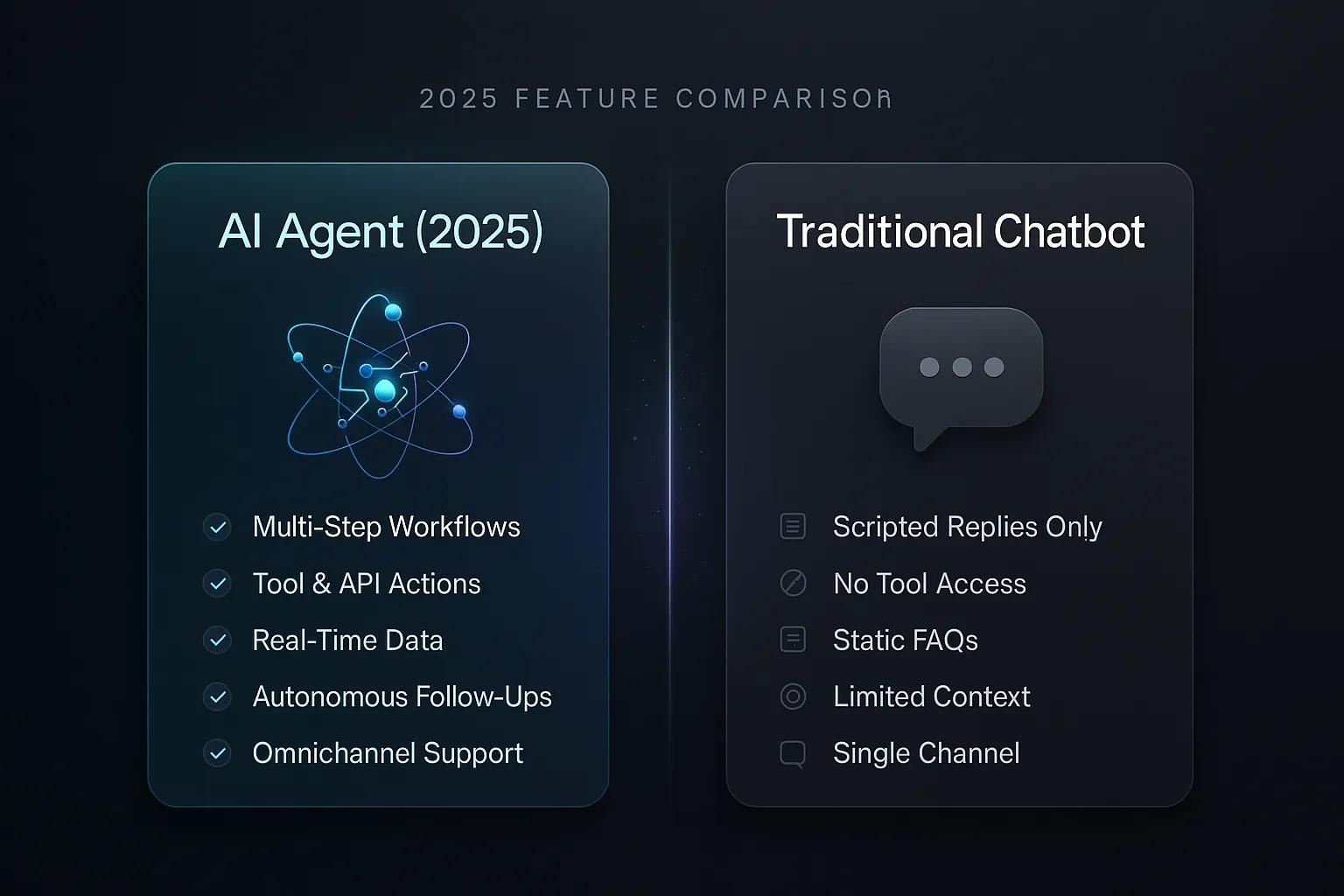
AI Agent vs Traditional Chatbot: 2026 Feature Comparison
It's 11 PM on a Tuesday. A customer reports a damaged package through your support channel. Your traditional chatbot politely apologizes and provides a link to...