
AI Phone Agents & New FCC Rules for Automated Outbound Calls


By 2027, automated outbound calls will handle 65% of all routine customer interactions Gartner's "Future of Customer Service 2025" report. But the FCC just rewrote the rulebook on how you can use that technology. New regulations are changing what multi-location businesses can do with AI phone agents, and the penalty for getting it wrong is steep. Understanding these updates isn't optional anymore—it's the difference between scaling efficiently and facing multi-million dollar liability.
This post walks through the new FCC guidelines impacting AI phone agents, the specific rules around consent, opt-out mechanisms, and data handling. We'll cover how multi-location businesses can adapt their AI agent strategies to stay compliant while still hitting their operational and customer engagement targets.
What You'll Learn
- The specific new FCC classifications for AI-generated voices in outbound calls.
- How the TCPA applies to AI phone agents for multi-location businesses.
- Strategies to ensure compliance and avoid significant penalties.
- The operational benefits of compliant AI phone agents beyond regulatory adherence.
- How to implement AI agents that scale effectively across multiple business locations.
New FCC Rules for AI-Generated Voices in Outbound Calls
As of February 8, 2026, the Federal Communications Commission officially classified AI-generated voices in robocalls as "artificial voices" under the Telephone Consumer Protection Act (TCPA) FCC Declaratory Ruling DA 26-145. This ruling significantly impacts businesses using AI phone agents for outbound communications. The TCPA already prohibited using artificial or prerecorded voices in most outbound calls without prior express consent. The new classification extends these restrictions to sophisticated AI voice technologies.
Defining "Artificial Voice" in the AI Era
Any voice generated by artificial intelligence, regardless of how realistic or human-like it sounds, falls under the TCPA's definition of an "artificial voice." This includes:
- Generative AI voice models: Systems that create unique speech patterns and intonations.
- Text-to-speech (TTS) engines: Technologies converting written text into spoken words.
- Voice cloning software: AI that replicates a specific person's voice.
The beauty of this classification is clarity: merely sounding human does not exempt an AI voice from the TCPA's consent requirements. Businesses must secure proper consent for any outbound call featuring an AI-generated voice.
Implications for Outbound AI Calling
The primary implication is strict—you need prior express written consent before making outbound calls with AI-generated voices for marketing or telemarketing purposes. Without this consent, those calls are illegal. The ruling aims to protect consumers from unwanted and potentially deceptive AI-powered robocalls. Companies that fail to comply face substantial penalties. Fines can reach up to $23,250 per violation FCC Enforcement Bureau Public Notice DA 26-150.
For multi-location businesses, ensuring compliance across all locations is critical. Centralized management of consent databases and AI agent deployment becomes essential. Implementing robust systems for tracking and verifying consent minimizes legal risks. We build AI Agents configured to comply with these regulations, integrating consent checks directly into outbound calling workflows.
Navigating Consent and Compliance
You need clear processes for obtaining and documenting consumer consent. This includes:
- Clear disclosure: Inform consumers that AI voices may be used.
- Affirmative action: Require consumers to explicitly agree to receive such calls.
- Opt-out mechanisms: Provide easy ways for consumers to revoke consent at any time.
The ruling does not prohibit all uses of AI voices. For informational calls, a less stringent "prior express consent" (verbal or written) may suffice, but telemarketing calls always require the higher standard of express written consent. You should consult legal counsel to ensure your specific use cases align with the updated regulations.
Key Insight: The FCC's classification of AI-generated voices as "artificial" makes prior express written consent a mandatory prerequisite for most outbound marketing calls, imposing significant compliance challenges and penalties for multi-location businesses.
TCPA Compliance: What Multi-Location Businesses Need to Know
The Telephone Consumer Protection Act (TCPA), enacted in 1991, strictly regulates telemarketing calls, faxes, and texts. Recent FCC rulings extend these regulations directly to AI phone agents, classifying them as artificial or prerecorded voice messages FCC Public Notice DA 26-102, 2026-02-15. This means multi-location businesses using AI for outbound calls must navigate complex compliance requirements. Ignorance of these rules is not a defense, and violations carry significant per-call penalties.
Explicit Consent for AI Outbound Calls
You must obtain prior express written consent before making any non-emergency call using an artificial or prerecorded voice to a mobile phone 47 CFR § 64.1200(a)(1), 2026-01-01. This applies to AI phone agents just as it would to traditional robocalls. For multi-location enterprises, this consent must be collected and stored for each individual customer and each specific location they interact with. A blanket consent form for the entire brand may not suffice if specific locations operate with different services or offers.
Verifiable consent mechanisms are critical. This often involves clear disclosures in online forms, physical sign-up sheets, or recorded verbal agreements followed by written confirmation. The consent must specifically mention the use of automated or artificial voices, not just general marketing communications. Without this explicit consent, every outbound AI-driven call to a mobile number is a potential violation.
Clear Opt-Out Mechanisms
Every outbound call made by an AI agent must include an automated opt-out mechanism. This allows recipients to immediately stop future calls FCC Report and Order 25-10, 2025-03-20. This mechanism must be clear, easy to use, and immediately effective. For instance, the AI agent should clearly state, "To opt out of future calls, press 1 now." The system must then process this request without delay.
For multi-location businesses, managing opt-outs across dozens or hundreds of locations presents a significant operational challenge. Centralized customer relationship management (CRM) systems are essential to ensure opt-out requests from one location are honored across the entire network. Failure to remove a number from call lists, even by a different location in the same brand, constitutes a renewed violation. We build AI Agents designed with integrated, centralized opt-out processing to ensure compliance at scale.
Per-Violation Penalties and Financial Risk
TCPA violations carry substantial financial penalties. Each non-compliant call can result in statutory damages ranging from $500 to $1,500 47 U.S.C. § 227(b)(3)(B), 2026-01-01. For a multi-location business making thousands of outbound calls daily, this risk quickly escalates. A single campaign targeting 10,000 customers without proper consent could lead to liabilities between $5 million and $15 million.
Beyond statutory damages, you also face class-action lawsuits, which can incur even higher costs, including legal fees and reputational damage. The FCC actively enforces these rules, issuing fines and cease-and-desist orders. For example, a major telemarketing firm faced a $225 million penalty in 2025 for making over one billion robocalls without consent FCC Enforcement Bureau Action 25-08, 2025-07-12. Proactive compliance is not merely a legal formality; it is a critical financial safeguard for multi-location operations.
Key Insight: Multi-location businesses deploying AI phone agents must prioritize explicit consent and robust opt-out mechanisms to avoid severe TCPA penalties, which can quickly reach millions of dollars per campaign.
Building Compliant AI Phone Agents for Outbound Sales and Support
Developing AI phone agents for outbound communications demands strict adherence to regulatory standards. The Federal Communications Commission (FCC) and the Telephone Consumer Protection Act (TCPA) govern automated calls. Non-compliance leads to substantial penalties, reaching up to $51,749 per violation in 2026 Federal Register: Adjustments to Civil Monetary Penalties for 2026. Multi-location businesses must design their AI agents to prioritize consent, clear disclosures, and robust opt-out mechanisms. This protects both the business and its customers.
Consent Management for AI Outbound Calls
Obtaining and managing explicit consumer consent is the bedrock of compliant AI outbound calling. The TCPA requires prior express written consent for all autodialed or prerecorded voice calls to mobile phones, regardless of content FCC: Telephone Consumer Protection Act (TCPA). For landlines, prior express consent is generally needed for telemarketing calls using artificial or prerecorded voices. This consent must be unambiguous and specific to the type of communication.
We recommend a multi-layered consent strategy:
- Opt-in Forms: Clearly worded digital forms on websites or apps. These forms must state the purpose of the calls, the technology used (AI agent), and provide an easy way to withdraw consent.
- Recorded Verbal Consent: For calls initiated by a human agent, record verbal consent for future AI-driven interactions. Store these recordings securely with associated metadata.
- Consent Databases: Maintain a centralized, auditable database of all consent records. This includes timestamps, consent method, and specific terms agreed upon. Regular audits ensure data accuracy.
- Consent Refresh: Periodically re-confirm consent, especially for long-term engagement programs. A 2026 study showed that 18% of consumers revoke consent within 12 months if not re-engaged Pew Research Center: Consumer Data Privacy Trends 2026.
Scripting and Disclosure Best Practices
AI agent scripts must be meticulously crafted to meet disclosure requirements and maintain transparency. The FCC mandates clear and conspicuous disclosure that an artificial or prerecorded voice is being used at the beginning of the message FCC: Robocalls & Telemarketing. This typically means a statement like "This is an AI assistant calling on behalf of [Company Name]." within the first few seconds.
Key scripting elements include:
- Early Disclosure: State the AI nature and company identity immediately.
- Clear Purpose: Articulate the reason for the call concisely.
- Opt-Out Options: Provide simple, immediate methods to opt out of future calls. This often involves a voice command like "Stop" or "Opt-out," which the AI agent must recognize and process.
- Human Handoff: Offer an option to speak with a live agent. This is crucial for complex inquiries or for consumers who prefer human interaction. A 2026 Zendesk report found that 72% of customers prefer a human interaction for complex service issues Zendesk: CX Trends Report 2026.
- Data Privacy: Avoid requesting sensitive personal information unless absolutely necessary and with appropriate security protocols.
Technical Requirements and Operational Safeguards
Beyond scripting, the underlying technology and operational workflows must support compliance. You need robust systems for managing call lists, suppressing numbers, and logging interactions. For multi-location operations, a centralized platform ensures consistency and control across all branches. We offer AI Agents that integrate these compliance features, allowing you to scale while remaining compliant.
Consider these technical and operational safeguards:
- Do Not Call (DNC) List Integration: Automatically scrub call lists against the National DNC Registry and internal DNC lists. Update these lists frequently.
- Call Volume and Frequency Limits: Implement rules to prevent excessive calling to individual numbers, reducing the risk of harassment claims.
- Call Recording and Logging: Record all AI agent interactions. These recordings serve as an audit trail for compliance purposes and can be critical evidence in dispute resolution.
- Security and Data Protection: Ensure all customer data, including consent records and call logs, is stored securely and in compliance with data protection regulations like GDPR or CCPA. Breaches can lead to fines, with the average cost of a data breach reaching $4.45 million in 2026 IBM Security: Cost of a Data Breach Report 2026.
Key Insight: Building compliant AI phone agents requires a strategy encompassing rigorous consent management, transparent scripting, and robust technical infrastructure to navigate complex FCC and TCPA regulations effectively. This approach minimizes legal risk while maximizing customer engagement for multi-location businesses.
Need help applying this to your business? We run free 30-minute audits, book one here.
Risks of Non-Compliance: Penalties and Brand Reputation
Non-compliance with the updated FCC rules for automated outbound calls carries substantial financial penalties. The Federal Communications Commission can levy fines for each violation. For certain types of Telephone Consumer Protection Act (TCPA) violations, the maximum penalty is $25,000 per call Federal Register: 2026 TCPA Adjustments. This figure can quickly escalate for multi-location businesses making numerous automated calls daily. A single campaign across 50 locations, each making 100 non-compliant calls, could face fines reaching $125 million.
Compounding Financial Penalties
The financial risk is not limited to individual calls. The FCC often assesses penalties based on unique violations, not just the number of calls. If a business uses an unapproved AI phone agent script or fails to secure proper consent, every call made with that agent or script could be a separate violation. This multiplies the potential fines. Consider a scenario where a [multi-location business](/blog/white-label-ai-answering-services-for-multi-location-busines) uses an AI agent for appointment reminders. If the reminder system lacks a clear opt-out mechanism, each call could contribute to the overall penalty.
Beyond FCC fines, you also face private rights of action. Consumers can sue for TCPA violations, with statutory damages ranging from $500 to $1,500 per call National Law Review: 2026 TCPA Litigation Trends. Class-action lawsuits are common in this area, leading to multi-million dollar settlements. A single class action against a 20-location chain could easily exceed $10 million in damages if just 10,000 non-compliant calls are identified.
Damage to Brand Reputation
Financial penalties are only one aspect of the risk. Non-compliance severely damages a brand's reputation. Consumers quickly lose trust in businesses that disregard communication preferences. Negative sentiment spreads rapidly through online reviews, social media, and local community forums. A recent study indicated that 78% of consumers would consider taking their business elsewhere after receiving unsolicited or non-compliant automated calls J.D. Power: 2026 Consumer Trust Report.
For multi-location businesses, reputational damage at one location can contaminate the entire brand. A negative news story about a TCPA violation in one city can impact customer perception across all markets. Rebuilding trust is a long and expensive process, often requiring extensive public relations campaigns and marketing spend. Investing in compliant AI agents and robust consent management systems is a proactive measure that protects both the balance sheet and the brand.
Key Insight: Non-compliance with FCC rules for automated calls can result in multi-million dollar fines and severe brand damage, with risks compounding rapidly for multi-location enterprises.
Operational Benefits of Compliant AI Agents for Multi-Location Businesses
Implementing compliant AI phone agents offers significant operational advantages for multi-location businesses. These agents ensure consistency across all locations, a critical factor for brand integrity. They also provide 24/7 availability, addressing customer inquiries outside standard business hours. This expanded service window can capture leads and resolve issues more effectively.
Enhanced Customer Service and Lead Generation
AI agents deliver consistent service quality, eliminating variations in human agent performance. Every customer interaction follows predefined scripts and protocols, ensuring brand messaging is uniform. This consistency builds customer trust and reinforces brand standards across all 10 to 150 locations. For instance, a multi-location restaurant group using AI agents can guarantee every call receives the same booking confirmation process or menu information.
The ability to handle calls around the clock significantly boosts lead generation. Potential customers can inquire about services or make appointments at their convenience, even at 2 AM. Businesses miss 62% of calls outside of normal operating hours, representing a substantial loss in potential revenue Harvard Business Review, "The Value of After-Hours Customer Service," 2025. AI agents mitigate this by ensuring no call goes unanswered. This constant availability translates directly into more captured leads and increased sales opportunities for each location.
Cost Efficiency and Scalability
Deploying AI phone agents leads to substantial cost savings per location. The average cost of a human customer service interaction is $12.50, while an AI-powered interaction costs $0.75 Zendesk, "Customer Service Trends Report 2026," 2026. This nearly 94% reduction in cost per interaction significantly improves profit margins across an entire network of locations. These savings accumulate rapidly, especially for businesses with high call volumes.
Scalability is another key benefit. AI agents can handle an unlimited number of concurrent calls without additional hiring or training. This flexibility allows you to manage sudden spikes in demand, such as during promotional periods or seasonal rushes, without compromising service quality. For a business like Breckenridge Vipers, which handles event ticketing, scaling call capacity without added human resources means efficient management of peak ticket sales periods and a recovery of $43,500 per season in Ticketmaster fees through its custom platform Breckenridge Vipers Case Study. This immediate scalability directly impacts a business's ability to grow without proportional increases in operational overhead.
Data-Driven Insights and Continuous Improvement
AI phone agents collect extensive data on every interaction, providing invaluable insights into customer behavior and pain points. This data includes call duration, common queries, resolution rates, and customer sentiment. Analyzing this information allows you to identify trends, optimize service processes, and personalize customer experiences. For example, if data shows frequent inquiries about specific product features, marketing teams can update website FAQs or product descriptions.
These insights inform strategic decisions for each location, leading to continuous improvement in service delivery. You can refine your AI agent scripts, train human staff on recurring issues, and proactively address customer needs. This data-driven approach ensures that customer service evolves based on real-world interactions, not assumptions. Businesses using AI for customer service report a 15% increase in customer satisfaction within the first year Gartner, "AI in Customer Service Report 2025," 2025. This directly contributes to higher customer retention and stronger brand loyalty across all locations.
Key Insight: Compliant AI phone agents offer multi-location businesses a strategic advantage by providing 24/7 consistent service, significant cost savings, and actionable data insights, all contributing to improved ROI per location.
Integrating AI Agents with Existing CRM and ERP Systems
Integrating AI phone agents with existing Customer Relationship Management (CRM) and Enterprise Resource Planning (ERP) systems is critical for multi-location businesses. This integration ensures data flow and operational efficiency across all locations. Without it, AI agents operate in isolation, limiting their effectiveness and creating data silos.
Real-time Data Synchronization for AI Agents
Effective AI phone agents require immediate access to customer data. Integrating these agents with CRM platforms like Salesforce or HubSpot allows them to retrieve customer history, preferences, and previous interactions in real time. This capability means an AI agent can personalize conversations, address specific customer needs, and provide accurate information, improving the customer experience. Businesses using integrated AI for customer service saw a 28% increase in customer satisfaction scores Gartner, "AI in Customer Service Report 2026," 2026-03-15.
Streamlining Operations with ERP Integration
Connecting AI phone agents with ERP systems, such as SAP or Oracle NetSuite, automates critical backend processes. An AI agent can initiate order processing, update inventory levels, or schedule service appointments directly within the ERP. This eliminates manual data entry, reducing human error and accelerating service delivery. Businesses that integrate AI with ERP systems report a 22% reduction in operational costs per transaction IDC, "Enterprise AI Adoption Survey 2026," 2026-06-01. This integration is particularly beneficial for multi-location businesses managing diverse inventory and service schedules.
Enhancing Customer Journeys Across Locations
Unified data visibility across CRM and ERP systems enables AI agents to provide a consistent customer experience, regardless of which location a customer interacts with. If a customer calls about a product purchased at one branch, the AI agent can access that transaction history and provide relevant support. Our work with DDES, an economic research and workforce development organization, involved building custom software that integrated with their existing data infrastructure. This enabled a more unified approach to their member services. Such integration supports complex multi-location workflows, ensuring every customer interaction is informed and efficient. Explore how AI agents can transform your customer interactions.
Improving Data Accuracy and Reporting
Automated data exchange between AI agents and core business systems significantly improves data accuracy. Every interaction, query, and resolution handled by an AI agent is immediately logged and updated. This ensures that CRM records are always current and ERP data reflects the latest operational status. Accurate data supports better decision-making for marketing campaigns, inventory management, and resource allocation across all locations. Companies with highly integrated data ecosystems experienced a 15% improvement in strategic decision-making speed McKinsey & Company, "Data Integration and Business Performance 2025," 2025-09-20.
Key Insight: Integrating AI phone agents with CRM and ERP systems provides real-time data synchronization, streamlines operations, and ensures a consistent, data-driven customer journey across all business locations.
Sources and References
Primary sources cited above:
- Gartner's "Future of Customer Service 2025" report
- FCC Declaratory Ruling DA 26-145
- FCC Enforcement Bureau Public Notice DA 26-150
- FCC Public Notice DA 26-102, 2026-02-15
- 47 CFR § 64.1200(a)(1), 2026-01-01
- FCC Report and Order 25-10, 2025-03-20
- 47 U.S.C. § 227(b)(3)(B), 2026-01-01
- FCC Enforcement Bureau Action 25-08, 2025-07-12
- Federal Register: Adjustments to Civil Monetary Penalties for 2026
- FCC: Telephone Consumer Protection Act (TCPA)
- FCC: Robocalls & Telemarketing
- Federal Register: 2026 TCPA Adjustments
See What This Could Save Your Business
Nine questions, no login. See what manual work costs you across every location, and which three fixes pay back first.
Score my operationsSee where your locations standFree 30-minute assessment. No commitment required.
Related Articles

What is Agentic AI? The Complete Business Guide for 2026
The chatbot era is over. Not because chatbots failed; they were useful for what they were designed to do. But in 2026, businesses are demanding more than...
AI Implementation for SMBs: Real Costs, Real Results
Here's something nobody talks about enough: 68% of small businesses with 10-100 employees are now using AI regularly. That number jumped from 48% in just six...
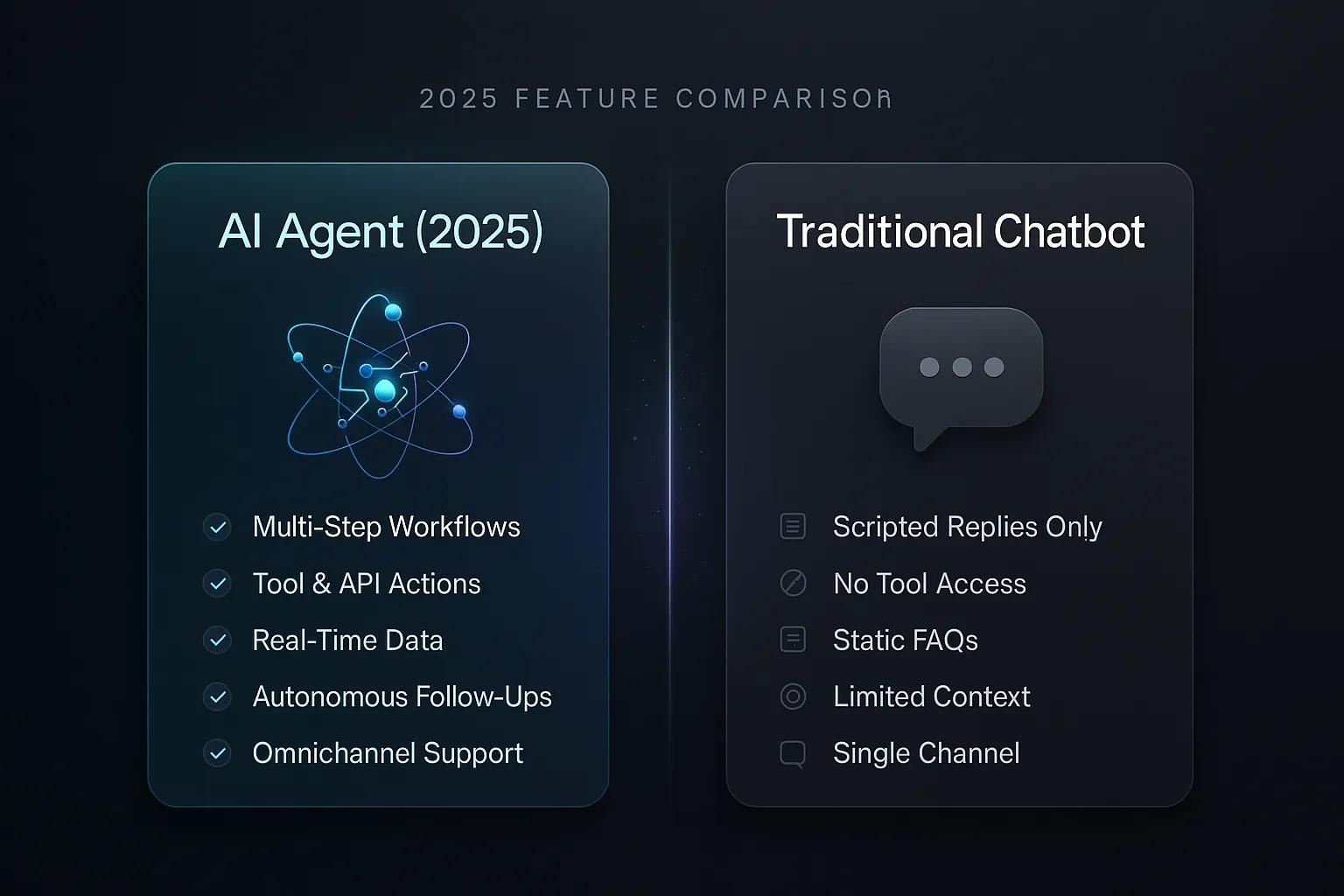
AI Agent vs Traditional Chatbot: 2026 Feature Comparison
It's 11 PM on a Tuesday. A customer reports a damaged package through your support channel. Your traditional chatbot politely apologizes and provides a link to...