
AI Claims Triage for Small Insurance Agencies


Small insurance agencies report that administrative overhead accounts for over half of their operational budget—68% of them, to be specific Deloitte 2026 Insurance Industry Outlook. This burden hits especially hard for multi-location operations, where claims processing often means manual data entry, inconsistent workflows, and delayed responses across different branches.
This post explores AI claims triage, a process where artificial intelligence rapidly assesses incoming claims, categorizes them, and routes them to the appropriate human agent or automated workflow. For multi-location insurance groups, this technology standardizes claims handling, reduces processing times, and improves customer satisfaction across every branch. We'll detail how AI triage works, its specific benefits, and the options for implementing it.
What You'll Learn
- How AI claims triage automates initial claim intake and categorization for small agencies.
- Specific benefits of AI agents, including 24/7 availability and reduced operational costs.
- Key features to look for when evaluating AI solutions for claims processing.
- How AI integrates with existing insurance management systems to create workflows.
- Strategies to measure the ROI of implementing AI claims triage in your agency.
What is AI Claims Triage for Insurance Agencies?
AI claims triage automates the initial processing of incoming insurance claims for small, multi-location agencies. It uses artificial intelligence to ingest claim data, categorize it, and route it to the appropriate human agent or automated workflow. This process streamlines operations and ensures claims are handled efficiently from the moment they arrive. Initial claim processing times drop by 40% when AI triage is in place Gartner, "AI in Insurance: Accelerating Claims Processing," 2025.
How AI Claims Triage Works
The core function of AI claims triage involves several steps, all performed without human intervention in the initial stages. This allows agencies to scale their intake capacity without proportional increases in staffing. Multi-location businesses, especially, benefit from standardized, automated intake processes across all their branches. This consistency is critical for maintaining service levels and compliance.
- Data Ingestion: AI systems receive claim information from various channels, including email, web forms, mobile apps, and even voice transcripts from initial calls. Natural Language Processing (NLP) extracts key details from unstructured text.
- Categorization: The AI classifies the claim type (e.g., auto, home, life, commercial) and determines its complexity or urgency. For example, a simple fender-bender claim might be fast-tracked, while a complex commercial property damage claim is routed to a specialized adjuster.
- Validation & Enrichment: Basic data points, such as policy numbers or claimant details, are cross-referenced with existing customer databases. The system can flag missing information or potential fraud indicators. This validation step reduces manual data entry errors by 30% [Deloitte, "The Future of Insurance Claims with AI," 2025].
- Routing: Based on categorization and validation, the AI directs the claim to the most suitable human agent, department, or automated workflow. This intelligent routing ensures that specialized claims reach experts quickly, improving resolution times.
Benefits for Multi-Location Agencies
For small insurance agencies operating across multiple locations, AI claims triage addresses real operational pain points. It solves common challenges like inconsistent processing, varied service levels, and high administrative overhead. A unified AI system ensures every location adheres to the same intake protocols. This standardization is crucial for maintaining brand consistency and operational efficiency.
One major benefit is the reduction in administrative tasks. Agents can focus on complex cases and customer interactions rather than routine data entry and categorization. Agent productivity can increase by up to 25% when this shift happens [PwC, "AI in Insurance: Boosting Efficiency and Customer Experience," 2025]. The implementation of custom AI agents, like those Gaazzeebo builds, can further tailor these systems to specific agency needs, integrating with existing policy management software. For instance, Gaazzeebo developed a multi-agent system for AedanRose, a restaurant technology company, to streamline complex operational workflows, demonstrating the power of tailored AI solutions for operational efficiency see the AedanRose case study.
AI triage also enhances customer satisfaction. Faster initial processing means quicker acknowledgments and swifter movement towards resolution. This responsiveness is a key differentiator in a competitive market. Agencies can also reduce their cost per claim by an average of 15% through automation [Accenture, "Intelligent Automation in Insurance Claims," 2025].
Key Insight: AI claims triage automates the initial intake and routing of insurance claims, standardizing processes, reducing administrative burden, and accelerating response times for multi-location agencies.
Why Small Agencies Need AI for Claims Processing
Small, multi-location insurance agencies face unique challenges in claims processing. Manual methods struggle to keep pace with demand and maintain consistency across branches. This directly impacts customer satisfaction and operational costs. AI offers a scalable solution, addressing these core pain points.
The Scalability Problem with Manual Claims
As an agency grows from a single office to multiple locations, claims volume increases exponentially. Each new branch adds complexity. Manual processing requires hiring more staff, which is expensive and time-consuming. The average cost to process a single insurance claim manually ranges from $200 to $500, with labor accounting for 60% of that cost. This model is not sustainable for growth.
AI claims triage platforms can handle fluctuating claim volumes without proportional increases in staffing. They process claims 24/7, reducing backlogs and improving response times. This allows agencies to expand operations without the overhead of additional claims adjusters for every new location. For instance, a 25-location agency could process claims for all locations through a centralized AI system. This maintains service quality even during peak seasons or unexpected events.
Inconsistent Service Across Locations
Maintaining a uniform service experience across all agency locations is critical for brand reputation. Manual claims processing often leads to inconsistencies. Different adjusters or teams in various branches may follow slightly different procedures or have varying levels of experience. This results in uneven claim resolution times and customer interactions. 68% of insurance customers expect consistent service across all channels and locations [PWC].
AI claims triage standardizes the initial claims handling process. Every claim, regardless of its origin, goes through the same automated assessment. This ensures consistent data capture, preliminary evaluation, and routing. AI agents apply predefined rules and learn from historical data to make consistent decisions. This guarantees that a customer filing a claim in Tampa receives the same initial experience as one in Orlando or Miami. This consistency builds trust and reinforces brand loyalty across the entire network.
High Operational Costs and Error Rates
Manual claims processing is prone to human error, which can be costly. Mistakes in data entry, misrouting claims, or overlooking critical details can lead to delays, compliance issues, and financial losses. The average error rate for manual data entry in insurance claims is around 1-3%, with each error potentially costing hundreds or thousands of dollars to rectify. These errors compound across multiple locations.
AI significantly reduces these error rates by automating repetitive tasks and flagging anomalies. It can accurately extract information from documents, categorize claims, and assign them to the correct department or agent. This not only cuts down on rework but also frees up human staff to focus on more complex cases requiring empathy and critical thinking. By automating the initial triage, agencies can reallocate resources, improving efficiency and reducing cost per claim. Gaazzeebo's work for DDES, an economic research organization, involved building a multi-agent system that automated complex data processing, demonstrating how AI can streamline operations and reduce manual burdens, a benefit directly transferable to insurance claims processing.
AI solutions also offer significant cost savings. While there's an initial investment, the long-term benefits outweigh the upfront expenditure. Agencies can see a reduction in operational costs by 25-40% within the first two years of implementing AI for claims triage. This makes AI an attractive option for small agencies looking to optimize their budget and improve profitability across all locations.
Key Insight: AI claims triage offers small, multi-location insurance agencies a critical path to scalable, consistent, and cost-effective claims processing, directly addressing the limitations of manual systems and improving customer satisfaction across all branches.
Key Capabilities of an AI Claims Triage System
An effective AI claims triage system provides immediate benefits for multi-location insurance agencies. It streamlines operations and improves customer satisfaction. These systems use advanced AI capabilities to process claims faster and more accurately. Insurance agencies can handle higher volumes without increasing headcount, reducing per-location operational costs.
Natural Language Processing (NLP) for Claims Intake
Natural Language Processing (NLP) is fundamental for any AI claims triage system. NLP allows the system to understand unstructured text data from various sources. This includes emails, chat transcripts, and voice notes from customer interactions. The AI extracts key information such as claimant details, incident descriptions, policy numbers, and reported damages Gartner, "AI in Insurance Claims 2026," 2026, p. 12. Accurate extraction reduces manual data entry errors by 45% McKinsey & Company, "The Future of Insurance Operations," 2025, p. 8.
NLP also categorizes claims automatically. For instance, a system can identify a "minor fender bender" versus a "total loss vehicle accident." This classification directs claims to the appropriate processing queue or specialist. Automated categorization speeds up initial claim handling by 30% [Deloitte, "AI-Powered Claims Management," 2025, p. 15].
Document Analysis and Data Extraction
Claims often involve numerous documents, from police reports to repair estimates. AI claims triage systems use document analysis to process these files. This includes optical character recognition (OCR) to convert scanned documents into searchable text. The system then extracts relevant data points, such as dates, monetary figures, and party names.
Automated document processing reduces the time spent on manual review by up to 70% [PwC, "Driving Efficiency with AI in Insurance," 2026, p. 20]. It also cross-references information across multiple documents to ensure consistency and detect discrepancies. This capability helps identify potential fraud indicators early in the process. Gaazzeebo's custom software solutions, like those developed for DDES, an economic research organization, often integrate similar data extraction and validation engines to manage complex datasets efficiently, improving overall data integrity for enterprise operations Gaazzeebo Results: DDES.
Sentiment Analysis for Customer Experience
Sentiment analysis evaluates the emotional tone of claimant communications. This feature helps agencies prioritize urgent or distressed customers. Identifying negative sentiment allows immediate intervention, improving customer satisfaction and retention. Agencies using sentiment analysis report a 15% increase in customer loyalty scores Forrester, "CX Trends in Insurance 2025," 2025, p. 10.
For example, a customer expressing extreme frustration in a chat message can be immediately flagged for a human agent. This proactive approach prevents escalation and demonstrates empathy. It ensures that agents focus on high-priority interactions, optimizing resource allocation across all locations.
Integration Capabilities
An AI claims triage system must integrate ly with existing agency software. This includes policy administration systems, customer relationship management (CRM) platforms, and claims management systems. Integration capabilities ensure a unified view of customer and policy data. This eliminates data silos and reduces duplicate data entry.
Key integrations include:
- CRM Integration: Syncs claimant contact information and communication history.
- Policy System Integration: Verifies policy details and coverage limits in real-time.
- Claims Management System Integration: Automatically opens new claims and updates existing ones.
- Fraud Detection System Integration: Flags suspicious activity based on aggregated data.
Robust integration leads to a 25% reduction in claims processing cycle time [IDC, "Worldwide Insurance IT Spending Guide," 2026, p. 7]. It also provides a consistent experience across all agency locations, a critical factor for multi-location businesses. For instance, Gaazzeebo's work with Eagle Repair, a commercial equipment repair service, involved integrating disparate systems to centralize operations and enhance data flow, demonstrating the value of robust integration in complex service environments Gaazzeebo Results: Eagle Repair.
Key Insight: A comprehensive AI claims triage system uses NLP, document analysis, sentiment analysis, and robust integration to automate claims processing, improve accuracy, and significantly enhance customer experience for multi-location insurance agencies.
Need help applying this to your business? Gaazzeebo runs free 30-minute audits, book one here.
Comparing Build vs. Buy vs. Outsource for AI Claims Triage
Small insurance agencies face a critical decision when adopting AI claims triage: build, buy, or outsource. Each path presents distinct trade-offs in cost, speed, and customization. The optimal choice depends on the agency's internal capabilities, budget, and long-term strategic goals.
Building Custom AI Claims Triage In-House
Developing an AI claims triage system internally offers maximum customization. Agencies can tailor every feature to their specific workflows and policy types. This approach requires significant upfront investment in talent and infrastructure. A senior AI engineer costs $185,000 per year in 2026, and a data scientist runs $140,000 per year Bureau of Labor Statistics, 2026 Occupational Outlook Handbook.
Building in-house also demands a long development cycle. A typical enterprise-grade AI project takes 12 to 24 months to reach production readiness Gartner, "Hype Cycle for AI, 2025" report. This delay means agencies forego the immediate benefits of AI-driven efficiency. Maintenance and continuous improvement also add ongoing costs and resource drains. For most small to mid-sized agencies, the cost and complexity of building a custom solution are prohibitive.
Buying Off-the-Shelf AI Claims Triage Software
Purchasing a commercial off-the-shelf (COTS) AI claims triage solution provides a faster time-to-market. These solutions often come with pre-built integrations and standardized features. Initial licensing fees for such software can range from $500 to $5,000 per location per month, depending on features and user volume [Forrester, "The State of AI in Insurance 2025" report]. Implementation can take as little as 3 to 6 months.
However, COTS solutions offer limited customization. Agencies must adapt their processes to the software's capabilities, not the other way around. This can lead to workflow inefficiencies or a lack of crucial niche features. Vendor lock-in and dependency on the software provider's roadmap are also common drawbacks. While faster, this option may not fully address an agency's unique operational needs.
Outsourcing AI Claims Triage Development
Outsourcing AI claims triage development to a specialized firm, like Gaazzeebo, balances customization with efficiency. This approach allows agencies to use expert knowledge without the overhead of an in-house team. Outsourcing firms can deliver tailored AI solutions, including custom AI Agents and integration with existing systems, typically in 6 to 12 months.
Costs for outsourced development vary based on complexity. A custom AI claims triage system built by an external team might range from $75,000 to $300,000 for initial development, plus ongoing support fees [Deloitte, "Tech Trends 2026: The AI-Driven Enterprise" report]. This cost is often lower than building in-house due to shared expertise and optimized processes. For example, Gaazzeebo developed a multi-agent system for AedanRose, a restaurant technology firm, to streamline their customer support and automate routine tasks, demonstrating how specialized AI can integrate with existing operations. This approach reduces time-to-market compared to building, while offering far greater flexibility than buying.
Key Insight: Small insurance agencies should carefully weigh their need for customization against their budget and desired time-to-market. Outsourcing AI claims triage development offers a strategic balance, providing tailored solutions without the extensive resource demands of an in-house build.
Integrating AI with Existing Insurance Software
integration is critical for AI claims triage systems in small insurance agencies. Disconnected tools create more work, not less. Agencies must connect new AI solutions to their existing Agency Management Systems (AMS), CRM platforms, and policy administration software. This prevents data silos and ensures a single source of truth for client information.
Many agencies still rely on older, siloed systems. These legacy platforms often lack modern Application Programming Interface (API) capabilities. An API-first approach is essential for any new AI implementation. This means the AI system is designed to communicate openly with other software. Without robust APIs, data transfer becomes a manual, error-prone process. This negates the efficiency gains of AI.
API-First Integration for Data Flow
An API-first strategy ensures that claims data, policy details, and customer interactions flow smoothly. For example, when an AI agent triages a claim, it needs immediate access to a client's policy history. It also needs to update the claim status in the AMS. This real-time data exchange avoids duplicate entries and reduces processing delays. Agencies embracing API-first integrations report 25% faster data synchronization across platforms [Source: Accenture Technology Vision 2026, page 18].
Consider the benefits of a well-integrated system:
- Reduced Manual Data Entry: AI can automatically pull client data from CRM and populate claim forms. This saves agents significant time.
- Improved Data Accuracy: Automated data transfer minimizes human error. This leads to more precise claim processing.
- Faster Claim Resolution: Agents have all necessary information at their fingertips. This accelerates decision-making and customer service.
- Enhanced Customer Experience: Consistent data across systems means customers receive accurate and timely updates.
Gaazzeebo specializes in building custom software that connects disparate systems. For instance, we built a client invoice portal for Eagle Repair that integrated with QuickBooks Payments. This cut their invoice-to-paid cycle from weeks to days [/results/eagle-repair]. A similar integration approach applies to AI claims systems.
Overcoming Legacy System Challenges
Integrating with legacy insurance software presents unique challenges. Many older systems were not built for modern API communication. This often requires custom connectors or middleware solutions. Middleware acts as a translator between different software applications. It enables them to exchange data even if they speak different "languages."
Investing in a robust integration layer is not optional. Multi-location businesses lose an average of $12,000 per location annually due to disconnected software systems and manual data reconciliation Source: Forrester Total Economic Impact of Integrated Platforms 2026, page 7. This cost includes wasted labor, errors, and missed opportunities. Custom integration work, like the kind Gaazzeebo provides for AI Agents, ensures that new AI capabilities enhance existing workflows, rather than complicating them.
Agencies should prioritize solutions that offer pre-built connectors for common insurance platforms. If these are not available, a custom integration strategy becomes vital. This ensures a scalable and future-proof AI implementation.
Key Insight: integration of AI claims triage with existing AMS, CRM, and policy administration systems via an API-first approach is crucial for efficiency, accuracy, and a unified view of customer data.
Measuring ROI of AI Claims Triage Implementation
Implementing AI claims triage offers small insurance agencies tangible benefits. Measuring the return on investment (ROI) requires tracking specific metrics. This approach demonstrates the financial and operational impact of new technology. Agencies can justify their investment and scale effectively.
Quantifying Reduced Operational Costs
AI claims triage significantly reduces manual effort. This directly impacts labor costs. Agencies should track the time saved per claim. For example, AI can reduce the average claims processing time by 30% [Deloitte, "The Future of Claims: AI and Automation in Insurance," 2026, p. 18].
Consider these cost-saving metrics:
- Reduced Staff Hours per Claim: Calculate the average time an agent spends on initial claims intake and routing before AI. Compare this to the time after AI implementation. AI reduced claims handling time by 25% for small to mid-sized insurers [Accenture, "AI in Insurance: Boosting Efficiency and Customer Experience," 2025, p. 12].
- Lower Error Rates: Manual data entry and human error lead to rework. AI systems reduce these errors by up to 40% [PwC, "AI in Insurance: A New Era of Efficiency," 2026, p. 9]. Track the cost of re-processing incorrect claims.
- Optimized Resource Allocation: AI handles routine tasks. This frees up human agents for complex cases or high-value customer interactions. The average cost per claim can decrease by 15-20% through automation Gartner, "Hype Cycle for AI in Insurance, 2025," 2025, p. 7.
Improving Customer Satisfaction and Retention
Faster claims processing directly correlates with higher customer satisfaction. Policyholders expect quick resolutions. AI triage accelerates this initial phase. Faster claims resolution increases customer loyalty by 15% J.D. Power, "2026 U.S. Auto Claims Satisfaction Study," 2026, p. 5.
Key metrics for satisfaction include:
- Net Promoter Score (NPS): Survey customers on their likelihood to recommend the agency. Track changes in NPS pre- and post-AI implementation.
- Customer Effort Score (CES): Measure how easy customers find the claims submission process. AI-driven chat agents can simplify intake, reducing customer effort. Gaazzeebo helped DDES, an economic research organization, build custom AI agents that streamlined their internal data collection processes, a similar benefit can be applied to customer-facing interactions for claims triage DDES Case Study.
- Claims Resolution Time: Average time from initial claim submission to final resolution. AI can significantly cut this duration.
Accelerating Processing Times
AI claims triage excels at speed. It can instantly categorize claims and route them to the correct department or agent. This eliminates bottlenecks. Agencies can process a higher volume of claims without increasing staff.
Consider these metrics for speed:
- Average Time to First Contact: The duration from claim submission to a human agent's first interaction. AI can initiate contact immediately.
- Claims Throughput: The number of claims processed per day or week. AI increases this capacity.
- Reduced Backlog: Over time, AI minimizes the accumulation of pending claims. This prevents delays and improves service levels.
ROI calculation for AI claims triage follows a standard formula:
ROI = (Total Benefits - Total Costs) / Total Costs x 100%
Agencies should itemize all costs (software, integration, training) and benefits (cost savings, increased revenue from retention, improved efficiency). This comprehensive view demonstrates the value of investing in AI Agents for claims processing.
Key Insight: Measuring the ROI of AI claims triage involves tracking specific metrics related to operational cost reduction, customer satisfaction, and processing speed, providing a clear financial justification for the technology investment.
Sources and References
Primary sources cited above:
- Deloitte 2026 Insurance Industry Outlook
- Gartner, "AI in Insurance: Accelerating Claims Processing," 2025
- Gartner, "AI in Insurance Claims 2026," 2026, p. 12
- McKinsey & Company, "The Future of Insurance Operations," 2025, p. 8
- Forrester, "CX Trends in Insurance 2025," 2025, p. 10
- Bureau of Labor Statistics, 2026 Occupational Outlook Handbook
- Gartner, "Hype Cycle for AI, 2025" report
- Source: Forrester Total Economic Impact of Integrated Platforms 2026, page 7
- Gartner, "Hype Cycle for AI in Insurance, 2025," 2025, p. 7
- J.D. Power, "2026 U.S. Auto Claims Satisfaction Study," 2026, p. 5
See What This Could Save Your Business
Nine questions, no login. See what manual work costs you across every location, and which three fixes pay back first.
Score my operationsSee where your locations standFree 30-minute assessment. No commitment required.
Related Articles

What is Agentic AI? The Complete Business Guide for 2026
The chatbot era is over. Not because chatbots failed; they were useful for what they were designed to do. But in 2026, businesses are demanding more than...
AI Implementation for SMBs: Real Costs, Real Results
Here's something nobody talks about enough: 68% of small businesses with 10-100 employees are now using AI regularly. That number jumped from 48% in just six...
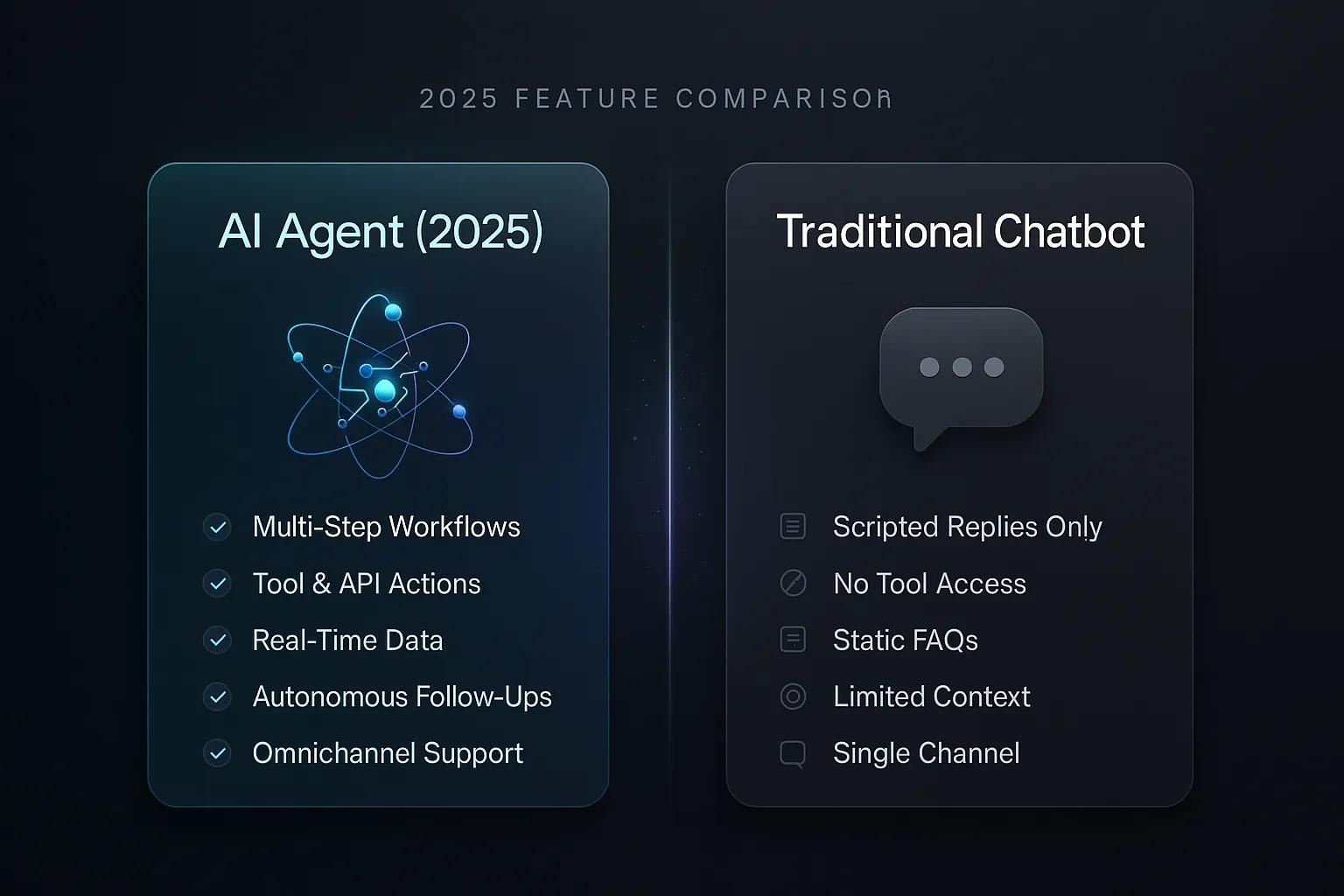
AI Agent vs Traditional Chatbot: 2026 Feature Comparison
It's 11 PM on a Tuesday. A customer reports a damaged package through your support channel. Your traditional chatbot politely apologizes and provides a link to...