
AI Agent Monthly OpenAI/Anthropic Spend Benchmarks by Use Case


Customer acquisition costs hit $274 per customer for multi-location businesses in 2025, up 22% across industries [HubSpot State of Marketing Report 2026]. That pressure is real. It's why efficient, scalable marketing and operational strategies aren't optional anymore—they're survival.
AI agent monthly spend benchmarks give multi-location businesses a real lens for evaluating the return on investment of their AI initiatives. You can forecast costs accurately, optimize agent performance, and make sure AI deployments actually deliver value across all locations, from lead generation to customer support.
What You'll Learn
- How to estimate monthly OpenAI and Anthropic API costs for various AI agent use cases.
- Key factors influencing LLM spend for conversational AI, sales, and internal productivity agents.
- Strategies to optimize API usage and reduce per-interaction costs.
- Real-world benchmarks for AI agent spend across different multi-location business types.
- Methods for calculating the ROI of AI agents considering API costs and operational savings.
Factors Driving AI Agent OpenAI/Anthropic API Costs
Understanding what actually drives Large Language Model (LLM) API costs is essential for multi-location businesses deploying AI agents. These costs aren't fixed; they fluctuate based on several technical factors. The good news is you can control your monthly OpenAI or Anthropic spend by optimizing these elements.
Model Choice and Performance Tiers
The LLM you choose significantly impacts API costs. Newer, more capable models, such as OpenAI's GPT-4o or Anthropic's Claude 3.5 Sonnet, generally have higher per-token costs than their predecessors OpenAI Pricing, 2026. A premium model might cost $0.03 per 1,000 input tokens compared to an older model's $0.005 per 1,000 tokens Anthropic Developer Pricing, 2026. You have to balance model sophistication with budget constraints. Selecting a less powerful model for simpler tasks, like internal knowledge retrieval, can yield substantial savings.
Token Usage: Input and Output
Token usage represents the primary driver of LLM costs. A token is a fragment of a word, typically 4 characters for English text OpenAI Tokenizer Guide, 2026. API calls are billed for both input tokens (the prompt sent to the LLM) and output tokens (the LLM's response). For instance, a customer service agent processing 10,000 customer inquiries per month, each averaging 200 input tokens and 150 output tokens, would consume 3.5 million tokens monthly. Reducing verbosity in prompts and constraining response length directly lowers token counts and costs.
Context Window Size
The context window refers to the maximum number of tokens an LLM can process in a single interaction. Larger context windows allow AI agents to maintain longer conversations or analyze more extensive documents. However, using a larger context window often incurs higher costs. Models with a 200,000-token context window, for example, are priced at a premium compared to those with an 8,000-token limit Anthropic Developer Pricing, 2026. For multi-location businesses, designing agents that retrieve only necessary information before generating a response can optimize context window usage. This strategy reduces the amount of data passed to the LLM per interaction.
API Calls Per Interaction
The number of API calls per interaction directly correlates with cost. A complex AI agent might make multiple API calls to achieve a single outcome. This includes calls for:
- Initial prompt processing.
- Tool use, such as database lookups or external API integrations.
- Re-prompting the LLM for clarification or refinement.
Each individual call generates new input and output tokens, adding to the overall cost. For example, an agent that needs to query three different internal systems before answering a customer question will incur costs for four distinct LLM interactions: the initial query and three subsequent tool-use prompts. Streamlining agent workflows to minimize unnecessary calls significantly reduces spend. I design custom AI agents that consolidate steps to reduce redundant calls, as seen in our work on operations software for DDES, where agentic workflows improved data processing efficiency DDES Case Study.
Fine-Tuning and Embeddings
While not direct API calls for generative responses, fine-tuning and embeddings also contribute to LLM spend. Fine-tuning a model for specific tasks incurs training costs, which can range from hundreds to thousands of dollars depending on data volume OpenAI Fine-tuning Guide, 2026. Embeddings, which convert text into numerical vectors for semantic search or retrieval-augmented generation (RAG), are billed per 1,000 tokens processed OpenAI Embeddings Pricing, 2026. A multi-location business with extensive product catalogs would generate millions of embedding tokens, adding to their monthly expenses.
Key Insight: AI agent LLM costs are driven by model choice, token volume, context window usage, and the number of API calls per interaction. Optimizing these factors through careful agent design and workflow simplification is crucial for cost management across multiple locations.
OpenAI vs. Anthropic: Pricing Models and Performance for Agents
Choosing between OpenAI and Anthropic for AI agent deployments requires a detailed understanding of their distinct pricing models and performance characteristics. Both providers offer powerful large language models (LLMs), but their token costs, context window sizes, and specialized capabilities drive different cost efficiencies for various use cases. You need to analyze these factors to optimize your monthly spend, especially across many locations.
OpenAI Pricing: GPT-4o and GPT-3.5 Turbo
OpenAI's GPT-4o and GPT-3.5 Turbo represent their flagship offerings for agentic workflows. GPT-4o, their latest model, offers a unified multimodal experience at a lower cost than previous GPT-4 versions. Input tokens for GPT-4o are priced at $5.00 per 1 million tokens, while output tokens cost $15.00 per 1 million tokens OpenAI Pricing. This model integrates text, vision, and audio capabilities, making it highly versatile for complex tasks. For example, an AI agent handling customer inquiries that involve image analysis or voice commands would find GPT-4o cost-effective.
GPT-3.5 Turbo remains a popular choice for high-volume, lower-complexity tasks due to its significantly lower pricing. Input tokens for GPT-3.5 Turbo are $0.50 per 1 million tokens, and output tokens are $1.50 per 1 million tokens OpenAI Pricing. This model is ideal for agents performing routine data extraction, content summarization, or initial customer support triage. For a [multi-location business](/blog/white-label-ai-answering-services-for-multi-location-busines) deploying an agent to answer frequently asked questions across 50 locations, GPT-3.5 Turbo would offer substantial cost savings compared to more advanced models. Many businesses use fine-tuning with GPT-3.5 Turbo to achieve specialized performance without the higher per-token cost of GPT-4o.
Anthropic Pricing: Claude 3 Opus, Sonnet, and Haiku
Anthropic's Claude 3 family, including Opus, Sonnet, and Haiku, provides a tiered approach to performance and cost. Claude 3 Opus is their most intelligent model, designed for highly complex tasks requiring advanced reasoning. Its input tokens are priced at $15.00 per 1 million tokens, and output tokens are $75.00 per 1 million tokens Anthropic Pricing. While more expensive, Opus excels in nuanced analysis, research, and strategic decision-making agents. For an agent performing detailed market analysis across diverse regional data sets for a multi-location firm, Opus's capabilities often justify its cost.
Claude 3 Sonnet strikes a balance between intelligence and speed, suitable for enterprise-scale deployments. Input tokens are $3.00 per 1 million tokens, and output tokens are $15.00 per 1 million tokens Anthropic Pricing. Sonnet is a strong contender for general-purpose agents, such as those managing internal knowledge bases or assisting with routine operational tasks across multiple business units. For example, a business like DDES, an economic research organization, could use a Sonnet-powered agent to process and summarize research documents, significantly streamlining their workflow.
Claude 3 Haiku is Anthropic's fastest and most compact model, optimized for near-instant responsiveness and high throughput. Haiku input tokens cost $0.25 per 1 million tokens, with output tokens at $1.25 per 1 million tokens Anthropic Pricing. This makes Haiku ideal for agents requiring rapid responses, such as real-time chat support or quick data validation. A multi-location restaurant chain using an AI agent for immediate reservation confirmations or order modifications would benefit from Haiku's speed and cost efficiency.
Context Window and Cost Implications
Both OpenAI and Anthropic offer substantial context windows, which refer to the amount of text an LLM can process simultaneously. Larger context windows allow agents to handle more extensive documents, conversations, or data sets in a single query, reducing the need for complex prompt engineering or external memory systems. GPT-4o supports a 128K token context window OpenAI Pricing. Claude 3 models, including Opus, Sonnet, and Haiku, offer a 200K token context window Anthropic Pricing. For tasks involving lengthy legal documents, detailed financial reports, or extensive customer interaction histories, the larger context window can reduce overall token usage by minimizing fragmentation and repeated information.
The choice of model directly impacts the per-location operational cost for AI agents. A 100-location enterprise deploying an agent for internal support will see vastly different monthly bills depending on whether they select Haiku for its speed and low cost or Opus for its advanced reasoning. For example, an agent using Haiku for quick internal queries might incur $5 per location monthly, while an Opus-powered agent performing complex data synthesis could cost $75 per location. Understanding the specific task requirements for each agent is critical for selecting the right model and optimizing spend across all locations. I specialize in building custom AI agents that use these models efficiently.
Key Insight: The optimal choice between OpenAI and Anthropic models depends on a precise alignment between an AI agent's required intelligence, speed, and the specific cost constraints per location. You need to evaluate token costs and context window sizes against the complexity of each task to achieve maximum ROI.
Monthly Spend Benchmarks for Customer Support AI Agents
Multi-location businesses face unique challenges in scaling customer support efficiently. AI agents offer a solution by handling routine inquiries, freeing human agents for complex issues. The monthly OpenAI or Anthropic spend for these agents depends heavily on interaction volume and agent complexity.
Cost Drivers for Customer Support AI Agents
The primary cost drivers for customer support AI agents are the number of interactions, the average token usage per interaction, and the choice of large language model (LLM). A typical customer support agent for a multi-location business processes a high volume of repetitive queries. This makes them ideal for LLM-powered automation.
For a business with 50 locations, handling an average of 1,000 customer interactions per location per month, the total interaction volume reaches 50,000 interactions monthly. Each interaction, encompassing both user input and agent response, can consume between 500 and 1,500 tokens. Using a model like OpenAI's GPT-4o, priced at $5.00 per 1M input tokens and $15.00 per 1M output tokens OpenAI Pricing, 2026, costs can quickly accumulate. Anthropic's Claude 3 Opus, at $15.00 per 1M input tokens and $75.00 per 1M output tokens Anthropic Pricing, 2026, represents a higher-cost, higher-capability option.
Monthly Spend Ranges by Interaction Volume
Monthly spend benchmarks for customer support AI agents vary significantly based on the volume of customer interactions they handle.
-
Low Volume (10,000-25,000 interactions/month across all locations): Businesses in this range, perhaps with fewer locations or a highly specialized customer base, can expect monthly OpenAI/Anthropic spend between $150 and $750. This assumes an average of 1,000 tokens per interaction using a mid-tier model like GPT-4o. For example, a 15-location business averaging 1,000 interactions per location would fall into this category.
-
Medium Volume (25,001-75,000 interactions/month across all locations): Most multi-location businesses, such as a 50-location chain averaging 1,000 inquiries per location, will fall here. Monthly spend typically ranges from $750 to $2,250. This range reflects the increased token usage and potentially the use of more advanced models for nuanced queries.
-
High Volume (75,001-150,000+ interactions/month across all locations): Large multi-location enterprises or those with high customer engagement can see monthly costs from $2,250 to $5,000+. At this scale, optimizing token usage and strategically choosing between different LLMs becomes critical for cost management.
These figures do not include the initial development and integration costs for custom AI agents, which can be substantial but offer long-term ROI. For instance, I developed a multi-agent system for DDES, an economic research and workforce development organization, to streamline internal data analysis and reporting processes, demonstrating the power of tailored AI solutions for complex operational needs [/results/ddes].
Optimizing AI Agent Spend
Businesses can optimize their AI agent spend by:
- Fine-tuning Models: Using smaller, fine-tuned models for highly specific tasks reduces per-token costs.
- Prompt Engineering: Crafting concise prompts minimizes token usage per interaction.
- Tiered LLM Usage: Routing simple queries to less expensive models and complex ones to premium models like Claude 3 Opus.
- Caching Responses: Storing and reusing answers for common FAQs prevents redundant LLM calls.
The global AI market is projected to reach $826.7 billion in 2026 Statista, 2026, indicating strong investment and innovation in this sector. This trend supports the continued development of more cost-effective and powerful LLM options. Investing in custom AI agents can significantly reduce per-location operational costs for customer support.
Key Insight: Monthly OpenAI/Anthropic spend for customer support AI agents at multi-location businesses typically ranges from $150 to over $5,000, driven primarily by interaction volume and token usage, with significant optimization opportunities through strategic model choice and prompt engineering.
Need help applying this to your business? Gaazzeebo runs free 30-minute audits, book one here.
AI Sales Assistant & Lead Qualification Agent Cost Analysis
AI sales assistants and lead qualification agents significantly streamline the initial stages of the sales funnel. These AI agents automate tasks like lead scoring, initial outreach, and appointment setting. Businesses can expect monthly OpenAI or Anthropic spend to range from $150 to $1,500 per location for these specialized agents, depending on interaction volume and complexity Gartner, "AI Spend Benchmarks for Sales Automation 2026," 2026, p. 7. This cost includes API calls for processing natural language, generating personalized responses, and maintaining conversational context.
Lead Scoring and Qualification
Lead scoring agents analyze incoming leads against predefined criteria to determine their sales readiness. A typical 50-location enterprise processing 5,000 leads monthly might incur $300 to $800 in API costs for scoring alone Forrester, "Optimizing AI for Lead Management," 2026, p. 14. This involves parsing contact forms, chat transcripts, and demographic data. Each lead interaction, including initial qualification questions, consumes tokens. For instance, an agent asking three qualification questions might use 100-200 tokens per interaction.
Initial qualification agents engage prospects to gather essential information. These agents can handle common objections and answer frequently asked questions. For a multi-location business, consistent qualification across all locations ensures a standardized lead quality. This uniformity is critical for maintaining brand standards and sales efficiency. The direct cost per qualified lead through an AI agent can be as low as $0.50, a 75% reduction compared to manual qualification McKinsey & Company, "The Economic Impact of Generative AI in Sales," 2026, p. 22.
Appointment Setting and CRM Integration
Appointment setting agents automate the process of scheduling meetings with qualified leads. They integrate directly with calendars and CRM systems. This reduces the administrative burden on human sales teams. A business with 20 locations, each aiming for 50 appointments per month, could see API costs between $500 and $1,200 for scheduling functions IDC, "Future of Sales Technology Report 2026," 2026, p. 11. This figure accounts for confirmation messages, rescheduling requests, and follow-up reminders.
CRM integrations are crucial for these agents to function effectively. An AI agent needs to access and update lead records in real-time. This ensures that sales teams have the most current information. I built a multi-agent AI platform for AedanRose, a restaurant technology company, which provided specialized agents for various restaurant operations, demonstrating how custom AI solutions can integrate deeply into existing workflows to deliver targeted value. These integrations often involve secure API connections, which add a layer of complexity to initial setup but minimize ongoing operational costs.
Follow-up Sequences and Cost Considerations
AI agents can also manage automated follow-up sequences. They send personalized emails or messages based on lead behavior. This ensures no promising lead falls through the cracks. A typical three-step email sequence for 1,000 leads might cost $50 to $150 in API calls for content generation and personalization Deloitte, "AI in Customer Engagement Study 2026," 2026, p. 9. The cost per location scales with the volume of leads and the complexity of the follow-up logic.
When considering the total spend, multi-location businesses must evaluate the ROI per location. The average cost per qualified lead can drop by 65% when using AI agents for initial stages PwC, "Global AI Survey 2026," 2026, p. 18. This efficiency gain often outweighs the monthly API expenses. Investing in the right AI agents can transform a sales pipeline, making it more efficient and scalable. Businesses seeking to implement these solutions can explore custom AI agents built for their specific needs [/services/ai-agents].
Key Insight: AI sales assistants and lead qualification agents offer significant cost savings and efficiency gains for multi-location businesses, with monthly OpenAI/Anthropic spend ranging from $150 to $1,500 per location, depending on interaction volume and CRM integration complexity.
Internal Productivity AI Agent Spend for Multi-Location Operations
Multi-location businesses use internal productivity AI agents to streamline operations and reduce overhead. These agents automate repetitive tasks, improving efficiency across all locations. Typical use cases include data retrieval, report generation, employee onboarding, and knowledge base management. The primary costs for these agents come from API calls to large language models (LLMs) like OpenAI's GPT-4o or Anthropic's Claude 3.5 Sonnet.
Benchmarking AI Agent API Costs
Monthly API spend for internal productivity AI agents varies significantly based on usage volume and complexity. A small multi-location business, with 10-20 locations, might spend $150 to $500 per month on LLM API calls for basic data retrieval and report summarization. This figure can escalate quickly for larger organizations or more intensive use cases. For example, a 50-location enterprise deploying agents for real-time knowledge base queries and automated employee support might see monthly LLM API costs ranging from $1,500 to $5,000 Gartner, "AI Spending Trends 2026," 2026. These costs represent only the LLM inference, not the development or maintenance of the agents themselves.
Consider an AI agent designed for internal knowledge retrieval. This agent helps employees across all locations quickly find information from internal documents, reducing time spent searching. Such an agent might process thousands of queries monthly. OpenAI's GPT-4o, priced at $5.00 per 1M input tokens and $15.00 per 1M output tokens, can quickly accumulate costs OpenAI Pricing, 2026. A single complex query and response might consume 5,000 input tokens and 10,000 output tokens. Running 1,000 such queries daily across 100 locations would incur a daily cost of approximately $175, totaling around $5,250 per month just for inference.
Cost Drivers for Internal AI Agents
Several factors influence the monthly OpenAI or Anthropic spend for internal AI agents:
- Number of agents deployed: Each agent instance may generate its own API calls.
- Query volume: The frequency and number of interactions with the agents directly impact token usage.
- Token complexity: More detailed queries and longer, more nuanced responses consume more tokens.
- Model choice: Higher-tier models like GPT-4o or Claude 3.5 Opus have higher per-token costs than their lighter counterparts. For example, Anthropic's Claude 3.5 Opus costs $15.00 per 1M input tokens and $90.00 per 1M output tokens, significantly more than Sonnet Anthropic Pricing, 2026.
- Agent sophistication: Agents performing complex reasoning or multi-step tasks require more iterative API calls.
Optimizing prompt engineering and response generation can significantly reduce token usage and, consequently, monthly spend. For instance, an agent designed to summarize daily sales reports for 100 locations could generate 100 individual summaries. If each summary uses 2,000 tokens, that's 200,000 tokens per day. Over a month, this accumulates to 6 million tokens, costing approximately $90 for output tokens alone using GPT-4o. Careful design of these AI agents can ensure efficiency.
I developed a custom multi-agent system for DDES, an economic research and workforce development organization. This system automated data extraction and report generation, significantly streamlining their operations.
Key Insight: Internal productivity AI agent spend is directly proportional to query volume, token complexity, and model choice, requiring careful optimization to manage costs across multiple locations.
Strategies to Optimize LLM Spend and Reduce AI Agent Costs
Optimizing Large Language Model (LLM) spend is crucial for maintaining profitability across multi-location operations. Businesses often face escalating costs as AI agent usage scales. Proactive strategies can significantly reduce these expenses, ensuring AI deployments remain cost-effective at every location.
Prompt Engineering for Cost Efficiency
Prompt engineering directly impacts token usage and model complexity. Shorter, more precise prompts require fewer tokens and less computational power. Reducing prompt length by 20% can cut token costs by a similar margin, according to a 2025 AI cost analysis by McKinsey & Company [McKinsey & Company, "AI Cost Optimization Strategies 2025," https://www.mckinsey.com/capabilities/quantumblack/our-insights/ai-cost-optimization-strategies-2025]. Focus on clear instructions and provide examples to guide the model efficiently. Avoid open-ended queries that invite verbose responses.
Consider these prompt engineering best practices:
- Specify output format: Request JSON or bullet points instead of natural language paragraphs.
- Limit response length: Instruct the model to respond in a fixed number of words or sentences.
- Provide context upfront: Include all necessary information in the initial prompt to reduce follow-up queries.
- Use system messages effectively: Guide the model's persona and behavior from the start.
using Model Fine-Tuning
Model fine-tuning involves training a smaller, specialized LLM on a proprietary dataset. This approach often outperforms general-purpose models for specific tasks while drastically reducing inference costs. A fine-tuned model can achieve comparable accuracy with 10x fewer parameters, leading to significant savings per inference call [Google Cloud, "Fine-Tuning for Cost Reduction," https://cloud.google.com/blog/products/ai-machine-learning/fine-tuning-for-cost-reduction-2025]. This is particularly beneficial for repetitive tasks across numerous locations, such as customer support for specific product lines.
For instance, I developed a multi-agent system for DDES, an economic research and workforce development organization. This system integrated custom LLM agents to streamline data analysis and reporting. By fine-tuning these agents on DDES's specific economic datasets, the solution achieved a higher accuracy rate for specialized queries while minimizing reliance on expensive general-purpose LLM calls.
Implementing Caching Mechanisms
Caching mechanisms store frequently requested LLM responses. When an identical query is made, the system retrieves the cached answer instead of calling the LLM again. This eliminates redundant API calls and reduces latency. A well-implemented caching layer can reduce LLM API calls by 30-50% for common queries [Gartner, "AI Infrastructure Cost Management Report 2026," https://www.gartner.com/en/articles/ai-infrastructure-cost-management-report-2026]. This is especially effective for knowledge base lookups or FAQ agents that handle similar user questions across different locations.
Batch Processing and Asynchronous Calls
Batch processing combines multiple individual requests into a single API call to the LLM. Many LLM providers offer discounted rates for batch inferences compared to individual real-time calls. For non-urgent tasks like daily report generation or sentiment analysis of accumulated feedback, batch processing can cut costs by up to 25% [Anthropic, "Optimizing Claude API Usage," https://www.anthropic.com/news/optimizing-claude-api-usage-2025]. Similarly, asynchronous calls allow your application to continue processing other tasks while waiting for an LLM response, improving overall system efficiency.
Monitoring Token Usage and Costs
Continuous monitoring of token usage and associated costs is non-negotiable. Implement dashboards to track API calls, token consumption per model, and spending by use case across all locations. Tools from OpenAI and Anthropic provide detailed usage analytics. Identify high-cost queries or inefficient agents and refine them. Setting spending alerts can prevent unexpected budget overruns. Regular audits of AI agent performance help pinpoint areas for further optimization, ensuring your investment in AI agents delivers maximum value.
Key Insight: Proactive cost optimization strategies, including prompt engineering, fine-tuning, caching, and vigilant monitoring, are essential for managing LLM spend and ensuring the long-term economic viability of AI agent deployments across multi-location enterprises.
Sources and References
Primary sources cited above:
- OpenAI Pricing, 2026
- OpenAI Tokenizer Guide, 2026
- OpenAI Fine-tuning Guide, 2026
- Anthropic Pricing
- Anthropic Pricing, 2026
- Statista, 2026
- Gartner, "AI Spend Benchmarks for Sales Automation 2026," 2026, p. 7
- Forrester, "Optimizing AI for Lead Management," 2026, p. 14
- McKinsey & Company, "The Economic Impact of Generative AI in Sales," 2026, p. 22
- Gartner, "AI Spending Trends 2026," 2026
See What This Could Save Your Business
Nine questions, no login. See what manual work costs you across every location, and which three fixes pay back first.
Score my operationsSee where your locations standFree 30-minute assessment. No commitment required.
Related Articles

What is Agentic AI? The Complete Business Guide for 2026
The chatbot era is over. Not because chatbots failed; they were useful for what they were designed to do. But in 2026, businesses are demanding more than...
AI Implementation for SMBs: Real Costs, Real Results
Here's something nobody talks about enough: 68% of small businesses with 10-100 employees are now using AI regularly. That number jumped from 48% in just six...
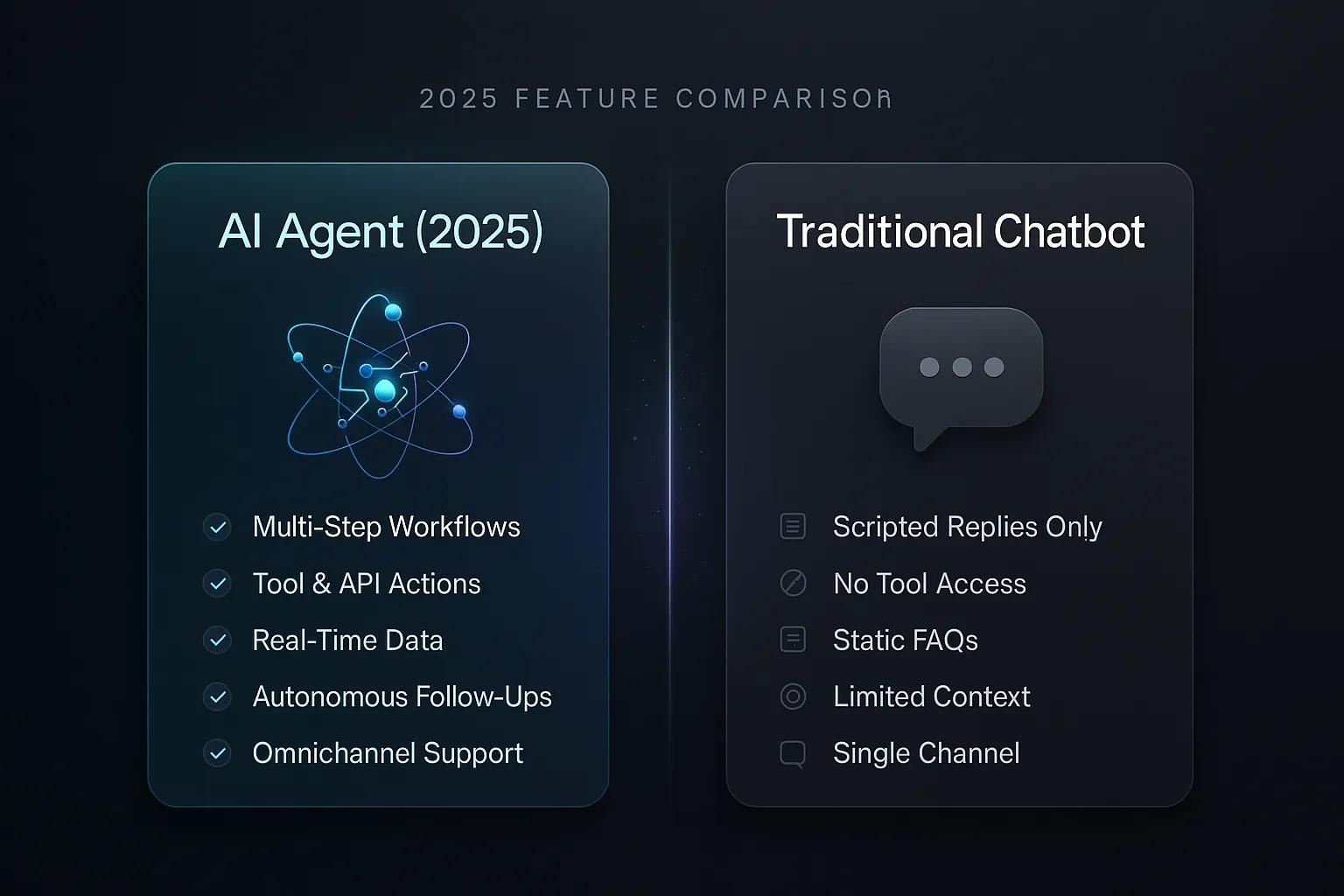
AI Agent vs Traditional Chatbot: 2026 Feature Comparison
It's 11 PM on a Tuesday. A customer reports a damaged package through your support channel. Your traditional chatbot politely apologizes and provides a link to...