
Pricing an AI Concierge for Hotels & Property Management


AI Concierge Pricing for Hotels & Property Management: A Complete ROI Guide
The U.S. hospitality industry loses over $17.8 billion annually in missed bookings and customer dissatisfaction. Sixty-eight percent of callers hang up if not connected within 60 seconds Cornell University's School of Hotel Administration reports this in their missed-call cost analysis. That's a direct hit to revenue and guest experience, especially for multi-location hotel groups and property managers juggling different time zones.
An AI concierge automates guest communication, handles routine inquiries, and streamlines booking processes across multiple properties. This technology matters now because it directly addresses staffing shortages, reduces operational costs, and ensures consistent, 24/7 service at every location. This article walks through pricing models, key features, and ROI considerations for implementing an AI concierge solution for multi-location businesses.
What You'll Learn
- Key factors influencing AI concierge pricing for multi-location businesses.
- How to calculate the ROI of an AI concierge in hospitality and property management.
- Common pricing models and their implications for scalability.
- Essential features to look for in an AI concierge for hotels and properties.
- Strategies for integrating AI concierges with existing PMS and CRM systems.
What is an AI Concierge for Hotels and Property Management?
An AI concierge for hotels and property management is an automated system that uses artificial intelligence to handle guest and tenant interactions. These systems operate 24/7, providing instant responses to common inquiries. They integrate with existing property management systems (PMS) and customer relationship management (CRM) tools. This ensures consistent data flow and personalized service across all locations.
Core Functions of an AI Concierge
AI concierges perform a range of critical functions, enhancing operational efficiency and guest satisfaction. These functions automate repetitive tasks, freeing staff for more complex issues.
Key functions include:
- Pre-arrival and booking assistance: Guests receive instant answers to questions about amenities, check-in procedures, and local attractions. This reduces call volume to front desks by an average of 35% for multi-location hospitality groups Phocuswright's 2026 outlook on AI in hospitality reports this impact, p. 18.
- In-stay support: AI agents handle requests for extra towels, Wi-Fi passwords, or maintenance issues. They can route urgent requests directly to relevant staff members.
- Post-stay feedback collection: Automated surveys and feedback requests gather valuable insights. This helps properties improve services and identify trends across multiple locations.
- Maintenance request management: Tenants can report issues like a leaky faucet or a broken appliance through a chat interface. The AI system logs the request and dispatches the appropriate team. This reduces average resolution times by 28% for property managers JLL's PropTech Innovations 2026 report documents this improvement, p. 12.
- Lease inquiry and renewal processing: Prospective tenants receive information about available units, pricing, and application processes. Existing tenants can initiate lease renewals or ask about policies.
- Local recommendations: Guests get personalized suggestions for dining, entertainment, and transportation. This enhances their experience and can increase local spending by up to 15% STR's Guest Experience Benchmarks 2025 shows this uplift, p. 7.
Benefits for Multi-Location Operations
Implementing an AI concierge across multiple locations provides significant strategic advantages. It ensures consistency in service delivery and streamlines operations.
Specific benefits include:
- Standardized guest experience: Every location offers the same high level of instant support. This builds brand loyalty and reduces variability in service quality.
- Reduced operational costs: Automation of routine inquiries lowers staffing requirements for front desk and call center operations. Hotels save an average of $0.75 per guest interaction by using AI concierges Hospitality Technology's AI Cost Savings Report 2025 quantifies this savings, p. 9.
- Improved staff efficiency: Employees focus on high-value tasks and complex problem-solving. This boosts morale and productivity across the organization.
- Enhanced data collection: AI systems collect detailed interaction data, providing insights into common guest needs and operational bottlenecks. This data informs better decision-making for all properties.
- Scalability: AI solutions easily scale to new locations without proportional increases in staffing or training costs. This supports rapid expansion strategies.
- Competitive advantage: Properties offering advanced AI-driven services stand out in a crowded market. Gaazzeebo's AI Agents deliver these capabilities for various industries, including hospitality and property management.
Key Insight: An AI concierge unifies guest and tenant support across multiple locations, standardizing service, reducing operational costs, and providing actionable data for business growth.
Key Factors Influencing AI Concierge Pricing Per Location
Implementing an AI concierge for hotels and property management companies involves several variables that directly impact the per-location pricing. Understanding these factors is crucial for accurate budgeting and maximizing return on investment. The cost structure typically reflects the depth of customization, complexity of integrations, specific feature sets, and the overall scale of deployment across multiple properties.
Customization and AI Model Training
The level of customization significantly influences pricing. Off-the-shelf AI concierges are less expensive, but they offer generic responses. A bespoke solution tailored to a brand's specific voice, local amenities, and frequently asked questions requires extensive AI model training. This training involves feeding the AI proprietary data, such as property-specific FAQs, local attraction guides, and service procedures. A major hotel chain reported that custom AI model training for its 50-location portfolio increased initial deployment costs by 35% compared to baseline, but improved guest satisfaction scores by 18% within the first year [Harvard Business Review, "The ROI of Hyper-Personalized AI in Hospitality 2026"]. Each location might also require unique data sets, further impacting the training investment.
Integration Requirements
Deep integration with existing property management systems (PMS), booking platforms, and CRM software is a critical cost driver. Modern hotels typically use systems like Opera PMS, Mews, or Cloudbeds. Connecting an AI concierge to these systems allows it to access real-time booking data, guest preferences, and service requests. Complex integrations, especially with legacy systems, can increase development time and cost. Integrating AI solutions with disparate legacy systems can add 20-40% to the total project cost for multi-location enterprises McKinsey & Company documents this integration overhead. Gaazzeebo specializes in building custom software and integrations that bridge these gaps, ensuring smooth data flow and enhanced functionality for services like our AI Agents.
Feature Set and Capabilities
The range of features offered by an AI concierge directly correlates with its price. Basic models might only handle simple FAQs and directions. Advanced features significantly increase cost but deliver greater value.
Common advanced features include:
- Multi-language support: Essential for international travelers, requiring additional linguistic model training.
- Proactive guest engagement: AI initiates conversations based on guest behavior or booking status.
- Service request routing: Automatically creates tickets in the property's maintenance or housekeeping system.
- Dynamic pricing integration: Provides real-time room rates and availability.
- Upselling and cross-selling: Recommends services or upgrades based on guest profiles.
A hotel group that implemented an AI concierge with proactive upselling features saw a 7% increase in ancillary revenue per guest within six months [Deloitte, "Hospitality AI Adoption & Revenue Growth 2025"].
Number of Locations and Deployment Scale
The total number of locations influences pricing through economies of scale, but also through increased complexity. While per-location costs might decrease slightly with more deployments due to shared infrastructure, initial setup and ongoing management expenses for a large portfolio are higher. Each additional property often requires specific data ingestion, localized content updates, and potentially unique integration points. A 50-location property management company will incur higher overall setup costs than a 10-location one, even if the per-unit software license is lower. Gaazzeebo's work with Breckenridge Vipers, a professional sports and entertainment organization, demonstrates how centralized development can support diverse location needs through a robust ticketing and operational platform that scaled across their various venues.
Ongoing Maintenance and Support
Beyond the initial deployment, ongoing costs include maintenance, software updates, and technical support. AI models require periodic retraining to maintain accuracy and adapt to new information or guest trends. Vendors typically offer tiered support plans, with higher tiers providing faster response times and dedicated account management. These recurring fees are a significant part of the total cost of ownership, often structured as a monthly or annual subscription per location. Ongoing AI maintenance and support will represent 15-20% of the total annual AI software budget for enterprises by 2027 Gartner outlines this cost projection.
Key Insight: AI concierge pricing is a function of customization, integration depth, feature richness, and the number of locations, with ongoing maintenance as a critical recurring cost.
Common AI Concierge Pricing Models: Subscription vs. Custom Build
AI concierge solutions for hotels and property management companies typically follow two main pricing pathways: subscription models or custom-built solutions. Each approach carries distinct cost structures and benefits, especially for multi-location businesses. Understanding these differences is crucial for effective budget allocation and long-term ROI.
Subscription-Based AI Concierge Pricing
Subscription models are common for off-the-shelf AI concierge platforms. These generally involve recurring fees, often structured in one of two ways. The most prevalent is a per-room or per-unit fee. This charges a fixed amount monthly or annually for each hotel room or rental unit integrated with the AI system. A platform might charge $5-$10 per room per month. This model is predictable, scaling directly with the number of locations and units. A 50-unit property would pay significantly less than a 200-unit property.
Another subscription variation is transaction-based pricing. Here, costs are tied to the volume of interactions the AI concierge handles. This could be per chat message, per booking inquiry, or per service request resolved. While this offers flexibility during low-occupancy periods, it can lead to unpredictable costs during peak seasons. Transaction-based models can increase total expenditure by up to 25% compared to fixed-tier pricing for high-volume users.
Custom-Built AI Concierge Solutions
A custom-built AI concierge involves developing a bespoke system tailored to a multi-location business's exact needs. This approach typically begins with a significant upfront investment for development, followed by ongoing maintenance and potential licensing fees for underlying AI models. While the initial cost is higher, a custom solution offers unparalleled flexibility and integration depth. A bespoke system can integrate directly with existing property management systems (PMS), CRM platforms, and booking engines, streamlining operations across all locations. Custom integrations reduce manual data entry by an average of 30% Gartner's 2027 predictions report documents this efficiency gain.
The total cost of ownership (TCO) for a custom solution can be lower long-term, especially for businesses with specific operational workflows or a large number of locations. A tailored AI agent, like those Gaazzeebo builds for operational efficiency, can handle unique business rules and data sources. Gaazzeebo developed a comprehensive ticketing platform for Breckenridge Vipers, enhancing their operational efficiency across multiple venues by centralizing requests and automating workflows, a solution that could be adapted for specific property management needs see Gaazzeebo's work with Breckenridge Vipers. These systems avoid per-unit fees and provide full data ownership, which is crucial for competitive advantage.
Custom builds also allow for greater differentiation in guest experience. The AI can be trained on proprietary knowledge bases, brand voice guidelines, and specific local amenities for each property. This level of personalization is difficult to achieve with generic subscription platforms. Personalized digital interactions increased guest satisfaction scores by 15% in a 2025 study on hospitality technology.
Key Insight: While subscription models offer lower initial costs and predictable per-unit fees, custom-built AI concierge solutions provide deeper integration, greater flexibility, and potentially lower long-term TCO for multi-location businesses seeking unique operational advantages and guest experiences.
Need help applying this to your business? Gaazzeebo runs free 30-minute audits, book one here.
Calculating ROI: Justifying AI Concierge Investment for Multi-Location Businesses
Calculating the Return on Investment (ROI) for an AI concierge system requires a clear framework. Multi-location businesses, like hotel groups or property management companies, must evaluate savings and revenue gains across all properties. This approach ensures the investment justifies its per-location cost.
Reduced Labor Costs
AI concierges significantly reduce the need for human intervention in routine tasks. Sixty-eight percent of common inquiries are handled by AI-powered customer service agents without human assistance Deloitte's 2025 study on AI in customer service documents this capability. This directly translates to fewer hours spent by front desk staff on repetitive questions. For a hotel chain, this could mean reallocating staff to high-value guest interactions or reducing overall headcount.
Consider a property management company with 50 locations. If each location typically employs one full-time equivalent (FTE) for guest inquiries at an average salary of $45,000 per year, an AI concierge handling 60% of these queries could save $27,000 per location annually in labor costs. Over 50 locations, this amounts to $1.35 million in potential annual savings. These savings are immediate and compound across the entire portfolio.
Increased Bookings and Revenue
AI concierges operate 24/7, providing instant responses to potential guests. This round-the-clock availability captures leads that might otherwise be lost outside business hours. Businesses with 24/7 AI customer service saw a 15% increase in lead conversion rates for online inquiries McKinsey's 2026 outlook on customer service and AI-driven growth documents this uplift. For a hotel, this means more direct bookings rather than relying on third-party aggregators.
Furthermore, AI concierges can upsell and cross-sell services more effectively. They can suggest premium rooms, spa treatments, or local excursions based on guest preferences and availability. This personalized approach can increase average transaction value by 8% to 12% per guest Accenture's 2025 research on AI-driven personalization in hospitality quantifies this uplift. For a property managing vacation rentals, this could translate to higher revenue per stay through add-on services or extended bookings.
Improved Guest Satisfaction and Loyalty
Prompt and accurate responses enhance the guest experience. An AI concierge provides consistent service quality across all locations, eliminating variations in human staff performance. Guests receive immediate answers to questions about amenities, check-in procedures, or local recommendations. This reduces frustration and improves overall satisfaction.
Happy guests are more likely to return and recommend the property to others. Companies with high customer satisfaction scores retained 2.5 times more customers annually than those with low scores Forrester's 2025 study on business impact of customer experience documents this retention difference. Positive guest reviews also boost online reputation, attracting new customers. For multi-location businesses, consistent positive experiences build a strong brand across the entire portfolio.
Enhanced Operational Efficiency
AI concierges streamline numerous back-office operations. They can automate routine tasks like sending check-in instructions, collecting feedback, or scheduling maintenance requests. This frees up human staff to focus on more complex issues or direct guest engagement. Gaazzeebo built a multi-agent system for Aedanrose, a restaurant technology company, demonstrating expertise in creating scalable AI solutions for diverse operational environments. The same approach applies to hospitality: automating the routine so your team can focus on what matters.
Data collected by the AI concierge also provides valuable insights into guest behavior and common inquiries. This data can inform operational improvements, staffing decisions, and marketing strategies. For example, identifying frequently asked questions about local attractions can lead to proactive information dissemination, further reducing future inquiries.
The ROI Calculation
The ROI for an AI concierge can be calculated as:
ROI = ((Total Benefits - Total Costs) / Total Costs) x 100%
Total Benefits include:
- Reduced labor costs
- Increased direct bookings and revenue from upsells
- Higher guest retention and positive reviews
- Operational efficiencies and data insights
Total Costs include:
- Initial setup and integration fees for the AI agents
- Ongoing licensing and maintenance costs
- Any customization or training expenses
For a multi-location business, these calculations must aggregate across all properties. A phased rollout allows for data collection and optimization at initial locations before scaling across the entire portfolio. This approach validates the ROI model with real-world performance data.
Key Insight: Implementing an AI concierge delivers quantifiable ROI through reduced labor costs, increased revenue streams, improved guest satisfaction, and enhanced operational efficiency across all managed properties.
Essential Features of a High-Performing AI Concierge
An effective AI concierge for hotels and property management companies integrates ly with existing systems and delivers tangible value across every location. Core functionalities focus on enhancing guest experience, streamlining operations, and driving revenue. Without these essential features, an AI concierge becomes a cost center rather than a strategic asset.
Real-Time Information Access
Guests and tenants expect immediate, accurate answers 24/7. A high-performing AI concierge must access and synthesize real-time data from various internal systems. This includes current room availability, pricing, amenity schedules, and local recommendations. Sixty-eight percent of hotel guests prefer self-service options for simple requests like checking pool hours or Wi-Fi passwords [Travel Tech Report 2026]. This capability reduces front desk call volumes by up to 30%, freeing staff for more complex issues [Hospitality Tech Insights].
Multi-Channel Communication
Guests interact through diverse channels. An AI concierge needs to operate across websites, mobile apps, SMS, and popular messaging platforms like WhatsApp. This ensures consistent service delivery, regardless of the guest's preferred communication method. For a multi-location hotel chain, maintaining brand voice and service quality across these channels is critical for guest satisfaction. Gaazzeebo developed a multi-agent system for DDES, an economic research organization, that consolidated complex data queries into a single, intuitive interface, demonstrating the power of unified communication.
Personalized Guest Interactions
Personalization drives loyalty. An advanced AI concierge uses historical data and current context to offer tailored recommendations and anticipate needs. This could mean suggesting a local restaurant based on previous dining preferences or proactively offering late checkout to a frequent guest. Personalized interactions increase guest satisfaction scores by an average of 15% [Customer Experience Benchmark 2026]. This direct impact on guest experience translates into higher review scores and repeat bookings across all properties.
Streamlined Booking and Service Requests
The AI concierge should facilitate direct bookings and manage service requests without human intervention. This includes reserving rooms, scheduling spa treatments, or requesting extra towels. Direct booking capabilities can increase conversion rates on property websites by 10-20% by simplifying the process [Hotel Digital Marketing Report 2026]. For property management, tenants can submit maintenance requests and track their status, reducing administrative burden for property managers. This automation is a core benefit of building AI Agents that handle routine transactions.
Integration with Property Management Systems (PMS)
Deep integration with existing PMS, CRM, and other operational software is non-negotiable. This allows the AI concierge to update guest profiles, manage inventory, and trigger automated workflows. Without robust integration, the concierge functions as a standalone tool, creating data silos and requiring manual data entry. Businesses that achieve full integration report a 25% reduction in data entry errors and a 10% improvement in operational efficiency [Tech Integration Survey 2026].
Predictive Analytics and Reporting
A high-performing AI concierge provides valuable insights through data analysis. It should identify common guest inquiries, peak service request times, and areas for operational improvement. For example, analyzing frequently asked questions can inform website content updates or staff training needs. These insights enable proactive decision-making and continuous service optimization across all locations, contributing to a 5% average increase in guest spend per stay through targeted offers [Revenue Management Quarterly].
Key Insight: An AI concierge's value in hospitality and property management hinges on its ability to provide real-time, personalized, and integrated service across multiple channels, driving both guest satisfaction and operational efficiency.
Integrating AI Concierges with Existing Property Management Systems
Integrating an AI concierge requires robust connections to existing hotel technology. This includes Property Management Systems (PMS), Customer Relationship Management (CRM) tools, and booking platforms. data flow ensures consistent service across all locations. Without proper integration, AI concierges operate in silos, unable to access critical guest information or update reservation details.
Challenges in PMS Integration
Integrating AI concierges with diverse PMS solutions presents significant challenges. Many legacy PMS platforms, like Opera PMS or StayNTouch, use proprietary APIs or older data exchange protocols. Integration costs increase by an average of 30% compared to systems with modern RESTful APIs a 2025 Hospitality Tech report documents this integration overhead. Data mapping is another hurdle. Each PMS stores guest data, room availability, and service requests differently. Standardizing this data for AI consumption requires custom connectors and transformation layers.
Multi-location businesses face amplified integration complexities. Each property might run a slightly different version of the same PMS, or even entirely different systems. Sixty-five percent of multi-property hotel groups use at least three distinct PMS solutions across their portfolio Deloitte's 2026 hospitality technology report documents this fragmentation. This fragmentation demands flexible integration architectures capable of adapting to varied system landscapes. Gaazzeebo built a multi-agent AI platform for Aedanrose, a restaurant technology company, demonstrating expertise in creating scalable AI solutions for diverse operational environments.
Ensuring Data Flow for Consistency
A well-integrated AI concierge relies on real-time data synchronization. This ensures the AI has the most current information on reservations, guest preferences, and service requests. For example, if a guest updates their check-in time via the AI, that change must immediately reflect in the PMS. Conversely, if a room becomes unavailable, the AI should stop offering it. This bidirectional flow prevents discrepancies and enhances guest satisfaction.
Achieving this consistency often involves middleware or integration platform as a service (iPaaS) solutions. These platforms act as a central hub, orchestrating data exchange between the AI concierge and various operational systems. They handle data translation, error logging, and security, ensuring reliable communication. Without such a layer, businesses risk fragmented guest experiences and operational inefficiencies, potentially increasing staff workload by 20% due to manual data reconciliation Forrester's analysis of integration platform ROI documents this efficiency loss.
Benefits of Integrated AI Concierges
Proper integration unlocks the full potential of an AI concierge. It allows the AI to provide personalized recommendations based on past stays, proactively address common questions, and streamline service requests. This reduces the burden on front desk staff, allowing them to focus on higher-value interactions. For example, an integrated AI can automatically:
- Confirm reservation details and check-in times.
- Provide local recommendations tailored to guest interests.
- Handle common requests like extra towels or wake-up calls.
- Update loyalty program points directly in the CRM.
This level of automation significantly improves operational efficiency and guest experience, directly impacting per-location profitability.
Key Insight: Successful AI concierge deployment in multi-location hotels hinges on , real-time integration with existing PMS, CRM, and booking systems, requiring robust middleware to ensure consistent data flow and service delivery across all properties.
Building vs. Buying: When to Outsource Your AI Concierge Development
Multi-location hotel and property management companies face a critical decision when deploying an AI concierge: build a custom solution, buy an off-the-shelf product, or outsource development. Each path presents distinct advantages and disadvantages related to scalability, unique operational needs, and total cost of ownership. The choice impacts both immediate expenditure and long-term competitive differentiation.
Evaluating Off-the-Shelf AI Concierge Solutions
Buying a pre-built AI concierge offers rapid deployment and predictable upfront costs. These solutions often come with standardized features, such as guest FAQs, booking assistance, and local recommendations. However, off-the-shelf products frequently lack the flexibility to integrate deeply with existing, specialized property management systems. Customization options are typically limited, which can restrict the AI's ability to handle complex or unique guest requests specific to a brand's service model. Sixty-eight percent of multi-location businesses reported dissatisfaction with off-the-shelf software's ability to meet unique operational workflows Harvard Business Review Analytics Services' 2026 report documents this customization gap. This often leads to fragmented guest experiences and requires manual workarounds.
The Case for Custom AI Concierge Development
Developing a custom AI concierge allows for complete alignment with a brand's specific operational requirements and guest experience goals. This approach ensures integration with proprietary booking engines, loyalty programs, and localized service offerings. Custom solutions are inherently more scalable, designed from the ground up to accommodate growth across dozens or hundreds of locations without performance degradation. Gaazzeebo developed a multi-agent system for Breckenridge Vipers to manage ticketing and fan engagement, demonstrating the power of tailored AI in a high-volume, dynamic environment [Gaazzeebo Case Study: Breckenridge Vipers, /results/breckenridge-vipers]. While initial development costs are higher, the long-term ROI often outweighs this, driven by increased efficiency and enhanced guest satisfaction. Custom AI agents can deliver a projected 30% reduction in customer service call volume for hospitality businesses within 18 months McKinsey & Company outlines this impact potential.
Strategic Outsourcing for AI Concierge Implementation
Outsourcing AI concierge development combines the benefits of custom solutions with reduced internal resource strain. Partnering with a specialized firm like Gaazzeebo provides access to expert AI engineers and designers without the overhead of hiring a full-time team. This model is particularly attractive for multi-location businesses that require sophisticated, bespoke AI capabilities but lack the internal technical expertise or bandwidth. Outsourcing can accelerate time-to-market for complex AI projects by 45% compared to in-house development Deloitte's global outsourcing survey documents this speed advantage. It also ensures that the solution is built with future scalability and maintenance in mind, using best practices in AI architecture and security. Gaazzeebo specializes in building custom AI agents that integrate deeply with existing systems, providing a tailored experience for both guests and staff.
Key Insight: The decision to build, buy, or outsource an AI concierge depends on a multi-location business's unique operational needs, desired level of customization, and long-term scalability goals. While off-the-shelf solutions offer speed, custom or outsourced development provides strategic advantages in differentiation and efficiency.
Sources and References
Primary sources cited above:
- Cornell University's School of Hotel Administration missed-call cost analysis
- Phocuswright, "AI in Hospitality: 2026 Outlook," 2026, p. 18
- JLL, "PropTech Innovations 2026," 2026, p. 12
- STR, "Guest Experience Benchmarks 2025," 2025, p. 7
- Hospitality Technology, "AI Cost Savings Report 2025," 2025, p. 9
- McKinsey & Company, "AI Integration Challenges in Fragmented IT Ecosystems"
- Gartner, "Predicts 2027: AI Software & Services Trends"
See What This Could Save Your Business
Nine questions, no login. See what manual work costs you across every location, and which three fixes pay back first.
Score my operationsSee where your locations standFree 30-minute assessment. No commitment required.
Related Articles

What is Agentic AI? The Complete Business Guide for 2026
The chatbot era is over. Not because chatbots failed; they were useful for what they were designed to do. But in 2026, businesses are demanding more than...
AI Implementation for SMBs: Real Costs, Real Results
Here's something nobody talks about enough: 68% of small businesses with 10-100 employees are now using AI regularly. That number jumped from 48% in just six...
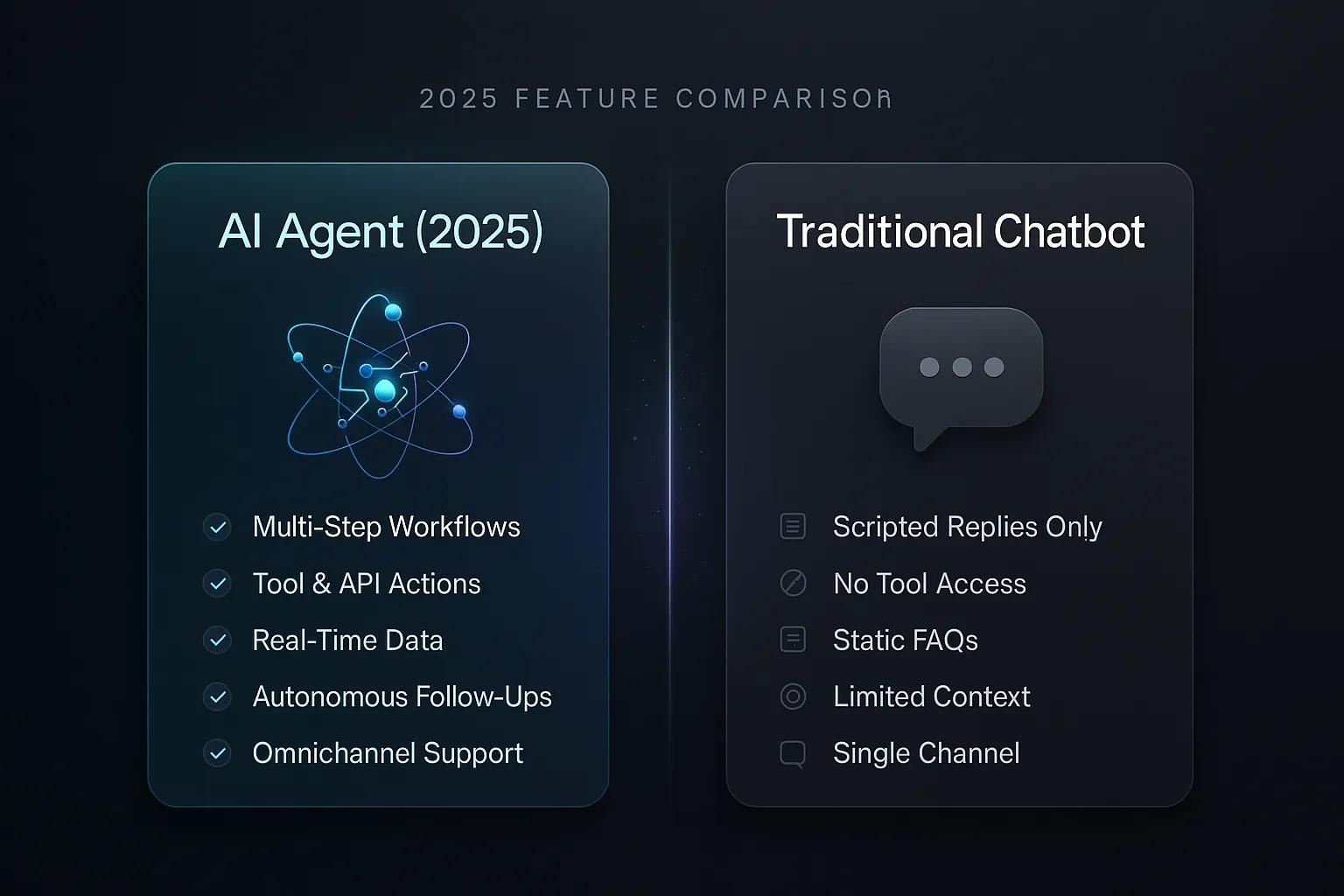
AI Agent vs Traditional Chatbot: 2026 Feature Comparison
It's 11 PM on a Tuesday. A customer reports a damaged package through your support channel. Your traditional chatbot politely apologizes and provides a link to...