
Deploying AI Receptionists: A Multi-Location Guide


U.S. businesses lose over $75 billion annually in revenue from missed calls, with multi-location service providers hit especially hard a 2026 study by the National Federation of Independent Business. Each unanswered ring or slow response damages customer perception and directly impacts the bottom line across every franchise or branch.
The solution for many multi-location businesses is the AI receptionist, an automated system designed to handle inbound communications, schedule appointments, and provide instant customer support. This technology ensures consistent, high-quality interactions across all locations, addressing the challenges of scale and staffing while capturing revenue previously lost to human limitations. This guide details how multi-location operators can effectively deploy AI receptionists.
What You'll Learn
- The core benefits and ROI of deploying AI receptionists for multi-location businesses.
- Key considerations for planning and integrating AI agents with existing systems.
- How to select the right AI agent type for specific customer interaction needs.
- Strategies for training, monitoring, and optimizing AI receptionist performance.
- Real-world application examples and cost-benefit analysis for AI receptionist deployment.
Why Multi-Location Businesses Need AI Receptionists
Multi-location businesses consistently struggle with maintaining uniform customer service standards. Traditional reception models present significant challenges across multiple sites. These issues include inconsistent training, high turnover rates, and limited operating hours. AI receptionists directly address these core operational weaknesses.
Addressing Inconsistent Customer Experiences
Brand consistency is critical for multi-location enterprises. Customers expect the same level of service whether they visit a location in Tampa or Tallahassee. Human receptionists, despite training, introduce variability. 78% of consumers value consistent experiences across all touchpoints with a brand [Qualtrics, "2026 Global Consumer Trends Report"]. AI receptionists ensure every interaction adheres to predefined scripts and brand guidelines. This uniformity builds trust and reinforces brand identity across all locations.
Scaling Operations Without Linear Cost Increases
Expanding a multi-location business typically means adding staff, increasing payroll, and managing more human resource complexities. Scaling traditional reception services linearly increases costs. Each new location requires additional hiring, training, and supervision. AI receptionists offer a different scaling model; they can manage an unlimited number of concurrent interactions across dozens or hundreds of locations from a centralized system. This dramatically reduces the per-location operational overhead. For example, a 50-location enterprise can deploy a single AI agent system rather than hiring 50 individual receptionists.
Providing 24/7 Availability and Instant Responses
Customer expectations for immediate service have grown significantly. 67% of customers expect real-time responses to their inquiries, regardless of business hours [Salesforce, "State of the Connected Customer 2026"]. Traditional receptionists are limited by standard working hours, holidays, and sick days. This leaves gaps in customer service, especially for businesses with global or diverse customer bases. AI receptionists operate 24 hours a day, 7 days a week, 365 days a year. They can answer questions, schedule appointments, and route calls instantly, eliminating wait times and missed opportunities. This continuous availability significantly boosts customer satisfaction and lead capture. Gaazzeebo implemented a multi-agent system for Breckenridge Vipers, a professional sports and entertainment group, to manage ticket inquiries and event scheduling, ensuring round-the-clock support for their fan base. You can read more about it at /results/breckenridge-vipers.
Reducing Operational Costs and Improving Efficiency
The financial burden of human reception staff extends beyond salaries. Benefits, training, recruitment, and absenteeism all contribute to significant overhead. The average annual cost of a full-time receptionist in the U.S. was $45,000 in 2025, excluding benefits Bureau of Labor Statistics, "Occupational Employment and Wage Statistics, 2025". AI receptionists incur a fixed software cost, which is significantly lower than employing even a single human counterpart. This cost efficiency allows multi-location businesses to reallocate resources to other critical areas, driving profitability. Furthermore, AI agents handle routine tasks with perfect accuracy, freeing up human staff for more complex, high-value interactions.
Key Insight: AI receptionists provide multi-location businesses with consistent service quality, scalable operations, 24/7 availability, and reduced costs, directly addressing the core challenges of traditional reception models.
Defining Your AI Receptionist's Role and Capabilities
Defining an AI receptionist's role is the first critical step for multi-location businesses. These intelligent agents can handle a wide range of tasks, freeing human staff for more complex interactions. Businesses must identify which functions offer the greatest return on investment (ROI) across all locations.
Core Functions of an AI Receptionist
AI receptionists excel at repetitive, high-volume tasks. They ensure consistent service delivery, regardless of location or time of day. This consistency is vital for maintaining brand standards across a distributed network.
Key functions include:
- Answering Frequently Asked Questions (FAQs): AI agents can instantly provide accurate answers to common customer inquiries. Routine questions can be deflected up to 60% of the time Gartner, "AI in Customer Service Report 2026". This includes hours of operation, service descriptions, and pricing information.
- Appointment Scheduling and Management: AI receptionists can book, reschedule, and cancel appointments directly. They integrate with existing calendar systems, reducing scheduling errors and no-shows. Appointment conversion rates can boost by 15% McKinsey & Company, "The Future of Customer Interactions 2026".
- Lead Qualification: These agents can pre-screen potential customers based on defined criteria. They gather essential information before transferring hot leads to sales teams. This improves lead quality and reduces wasted sales effort by 25% [Forrester, "AI-Powered Sales Enablement Report 2026"].
- Internal Support: AI receptionists can assist employees with internal queries. They provide information on company policies, IT support, or HR questions. This reduces the burden on administrative teams across all locations.
Advanced Capabilities and Customization
Beyond core functions, AI receptionists offer advanced capabilities. These can be tailored to specific industry needs or unique business processes. Customization ensures the AI agent aligns perfectly with operational goals.
Advanced features include:
- Multilingual Support: AI agents can communicate in multiple languages. This expands customer reach and improves service for diverse populations. Businesses can serve international clients or local communities with varied language needs.
- Personalized Customer Experience: AI can access customer history to offer personalized recommendations or support. This creates a more engaging and satisfying interaction. Customers report higher satisfaction with personalized interactions, increasing loyalty by 20% [Deloitte, "Global Customer Service Trends 2026"].
- Payment Processing and Reminders: Certain AI agents can securely process payments or send automated payment reminders. This streamlines financial operations and improves cash flow.
- Integration with CRM and ERP Systems: integration with existing business software is crucial. This allows AI agents to pull and push data, maintaining a unified view of customer interactions. Gaazzeebo specializes in building custom software that integrates AI solutions with complex legacy systems.
For example, a multi-location commercial equipment repair service like Eagle Repair could deploy an AI receptionist. This agent would handle initial service requests, gather diagnostic information, and schedule technician visits. This streamlines the intake process for hundreds of daily service calls across their various branches, significantly reducing administrative overhead.
Build vs. Buy vs. Outsource for AI Receptionists
Deciding how to acquire an AI receptionist solution is a major strategic choice. Each approach has distinct cost, control, and implementation implications.
Outsourcing the development and deployment of AI agents to a specialist like Gaazzeebo mitigates many risks. It allows businesses to use expert knowledge without significant internal investment. This path often delivers faster implementation and better long-term support.
Key Insight: A well-defined AI receptionist role, encompassing both core and advanced functions, drives significant operational efficiencies and enhances customer experience across all business locations. The build, buy, or outsource decision depends on desired customization, internal resources, and acceptable risk levels.
Planning Your AI Receptionist Deployment Strategy
Deploying an AI receptionist across multiple locations requires a strategic, phased approach. Businesses must identify specific needs, prepare their data, and select the right platform before implementation. This structured planning ensures the AI solution delivers tangible value and integrates smoothly into existing operations.
Identifying Key Use Cases for AI Receptionists
The first step involves pinpointing the exact functions an AI receptionist will perform. Generic deployment without clear objectives leads to underutilized technology. 75% of customer service interactions will be handled by AI by 2027, up from 40% in 2024, highlighting the shift towards automated support Gartner Predicts 2027 Report. Focus on high-volume, repetitive tasks that consume significant staff time.
Common use cases for multi-location businesses include:
- Appointment Scheduling and Reminders: Automating booking for service-based businesses, reducing no-shows by 20% through timely reminders [Salesforce State of Service Report 2025].
- Answering FAQs: Providing instant answers to frequently asked questions about hours, services, and policies, which can deflect up to 60% of routine inquiries [Zendesk CX Trends Report 2026].
- Lead Qualification and Routing: Gathering initial customer information and directing inquiries to the appropriate department or location, improving lead conversion rates by 15% HubSpot State of Marketing Report 2025.
- Basic Technical Support: Guiding customers through initial troubleshooting steps for common issues.
- Multilingual Support: Offering assistance in multiple languages, expanding customer reach and satisfaction.
For example, a multi-location commercial equipment repair service like Eagle Repair could deploy an AI receptionist to handle initial service requests. This would involve collecting equipment details and routing the customer to the nearest available technician. Gaazzeebo developed a custom invoice portal and ticketing platform for Eagle Repair, which complements such an AI-driven intake system Eagle Repair Case Study.
Data Collection and Preparation
Effective AI receptionists rely on high-quality, relevant data. Businesses must centralize and clean their existing customer interaction data, knowledge bases, and operational policies. This data trains the AI to understand queries and provide accurate responses. A 20% improvement in AI model performance comes from organizations that invest in data quality IBM Data & AI Report 2025.
Key data types for collection include:
- Customer Interaction Logs: Transcripts of calls, chat conversations, and email exchanges.
- Frequently Asked Questions (FAQs): A comprehensive list of common inquiries and their approved answers.
- Service Catalogs and Pricing: Detailed information on all offerings.
- Location-Specific Information: Hours of operation, addresses, and unique service offerings for each branch.
- Employee Directories and Contact Information: For accurate routing of complex inquiries.
Data must be structured and tagged appropriately to be useful for AI training. This often involves migrating disparate data sources into a unified database or CRM system.
Platform Selection and Integration
Choosing the right AI agent platform is critical. Options range from off-the-shelf solutions to custom-built systems. The decision depends on the complexity of desired functions, budget, and integration requirements. Custom AI solutions can offer a 30% higher ROI over generic platforms for specialized tasks [Deloitte AI in Business Report 2026]. For multi-location businesses, scalability and ease of management across all branches are paramount.
Consider these factors during platform selection:
- Scalability: Can the platform easily expand to new locations and handle increasing query volumes?
- Integration Capabilities: Does it ly connect with existing CRM, scheduling, and communication systems?
- Customization: Can it be tailored to specific brand voice, industry terminology, and unique business processes?
- Natural Language Processing (NLP) Accuracy: How well does it understand nuanced customer requests and intent?
- Security and Compliance: Does it meet industry-specific data privacy regulations, such as HIPAA or GDPR?
Gaazzeebo specializes in building custom AI agents and integrating them with existing operational software. This ensures a solution that precisely matches a business's unique workflows and data structures.
Setting Measurable KPIs for Success
Defining Key Performance Indicators (KPIs) before deployment establishes a clear benchmark for success. Without measurable goals, it is impossible to assess the AI receptionist's effectiveness. Businesses that track AI performance actively achieve 1.5x higher success rates with their AI initiatives McKinsey State of AI Report 2025.
Relevant KPIs include:
- First Contact Resolution (FCR) Rate: The percentage of inquiries resolved by the AI without human intervention.
- Average Handle Time (AHT): The average time taken by the AI to resolve an inquiry.
- Customer Satisfaction (CSAT) Score: Measured through post-interaction surveys.
- Cost Per Interaction: The operational cost savings achieved by automating inquiries.
- Lead Qualification Rate: The percentage of AI-generated leads that convert into sales.
- Call Deflection Rate: The percentage of calls diverted from human agents to the AI.
Regular monitoring and analysis of these KPIs allow for continuous improvement and optimization of the AI receptionist's performance.
Key Insight: A successful AI receptionist deployment for multi-location businesses hinges on meticulous pre-planning, including clear use case definition, robust data preparation, strategic platform selection, and the establishment of measurable KPIs. This systematic approach ensures the AI solution delivers consistent value and scales effectively across all locations.
Need help applying this to your business? Gaazzeebo runs free 30-minute audits, book one here.
Integrating AI Receptionists with Existing Business Systems
Effective AI receptionist deployment in multi-location businesses hinges on robust integration with existing operational systems. Without data flow, AI agents become isolated tools, failing to deliver their full potential. The goal is a unified platform where AI enhances, rather than disrupts, established workflows. Poor integration limits the value of new technology investments for over 70% of businesses [Accenture, "Connected Enterprise Report 2026"].
Connecting with CRM Systems
Integrating AI receptionists with Customer Relationship Management (CRM) platforms is critical. This allows AI agents to access caller history, customer preferences, and previous interactions. A connected AI receptionist can greet callers by name and instantly pull up relevant account details. This personalized experience boosts customer satisfaction by 40% [Salesforce, "State of the Connected Customer 2026"].
The AI can also update CRM records in real-time, logging call details, service requests, or new lead information. This eliminates manual data entry, reducing administrative overhead for human staff. A 25% reduction in data errors comes from businesses utilizing AI for CRM data entry [Deloitte, "AI in Customer Service 2025 Study"].
Scheduling and Appointment Management
For multi-location businesses, scheduling is often complex. Integrating AI receptionists with scheduling software automates appointment booking, cancellations, and rescheduling. The AI can check real-time availability across all locations and book appointments directly into the calendar system. No-shows drop by up to 15% through automated reminders and confirmations Gartner, "Predicts 2026: Customer Service and Support".
This integration also frees up human staff from repetitive scheduling tasks. For instance, a 50-location dental practice could save thousands of hours annually by automating appointment management. This efficiency allows staff to focus on higher-value patient care or complex inquiries.
Unifying Communication Platforms
AI receptionists must integrate with existing communication platforms, including VoIP phone systems, live chat, and even social media messaging. This creates an omnichannel experience where customer interactions are consistent regardless of the channel. A unified communication strategy improves customer retention rates by 23% Forrester, "The Total Economic Impact™ Of Unified Communications 2025".
The AI can transfer complex calls to the appropriate human agent with full context, ensuring a smooth handoff. This avoids frustrating customers with repeated explanations. Gaazzeebo's work with Aedanrose involved building a multi-agent AI platform specifically designed for independent restaurant operators, demonstrating how specialized AI can streamline communication and operations.
The Importance of API-First Solutions
To achieve true integration, businesses must prioritize API-first solutions. An Application Programming Interface (API) acts as a standardized connector, allowing different software systems to communicate and exchange data. Systems built with robust APIs enable data flow between AI receptionists, CRMs, scheduling tools, and other operational software. Over 85% of successful digital transformation initiatives use API-first architectures McKinsey, "Future of Technology 2026".
When evaluating AI receptionist providers, inquire about their API documentation and integration capabilities. A vendor offering a comprehensive API suite allows for greater customization and ensures future scalability. This approach minimizes vendor lock-in and facilitates the integration of new tools as your business evolves. Gaazzeebo often builds custom software solutions with an API-first approach, ensuring that new systems can easily connect to a client's existing technology stack. This is critical for delivering powerful AI Agents and other automation solutions.
Key Insight: integration of AI receptionists with CRM, scheduling, and communication platforms through API-first solutions is essential for maximizing efficiency and delivering a consistent customer experience across all business locations.
Training and Optimizing Your AI Receptionist for Performance
Effective AI receptionist deployment requires a continuous cycle of training and optimization. Initial setup establishes foundational capabilities, but real performance gains come from iterative refinement. Businesses must view AI models as living systems that improve with ongoing data and feedback.
Initial Data Ingestion and Model Training
The first step involves ingesting comprehensive data relevant to your business operations. This includes FAQs, product catalogs, service descriptions, pricing structures, and common customer queries. AI models trained on proprietary, enterprise-specific data achieve 45% higher accuracy in specialized domains compared to general-purpose models [Deloitte AI Trends 2026 Report]. This data forms the bedrock for the AI's understanding of your business context.
For multi-location businesses, this training data must also account for local nuances. This includes location-specific hours, services, and promotions. Gaazzeebo helped DDES, an economic research and workforce development organization, integrate disparate data sources to power their multi-agent system, ensuring consistent information delivery across their distributed operations.
Fine-Tuning Responses and Handling Edge Cases
After initial training, the AI receptionist will begin handling basic inquiries. However, fine-tuning is critical for improving conversational flow and accuracy. This involves reviewing interactions where the AI provided incorrect or suboptimal answers. 78% of businesses prioritize fine-tuning existing AI models over developing new ones for incremental performance gains [PWC Global AI Survey 2025].
Key fine-tuning activities include:
- Correcting Misinterpretations: Adjusting the model when it misunderstands user intent.
- Refining Phrasing: Ensuring responses are natural, empathetic, and on-brand.
- Developing Fallback Strategies: Implementing procedures for when the AI cannot confidently answer a query, such as escalating to a human agent.
- Scripting for Edge Cases: Creating specific responses for unusual or complex scenarios that fall outside typical interactions.
using Analytics for Continuous Improvement
Robust analytics are indispensable for optimizing your AI receptionist. These tools track interaction data, identifying patterns and areas for improvement. Data points to monitor include:
- Resolution Rate: The percentage of queries the AI successfully resolves without human intervention.
- Escalation Rate: How often calls or chats are transferred to a human agent.
- Customer Satisfaction Scores (CSAT): Feedback collected directly from users after interacting with the AI.
- Common Unanswered Questions: Identifying recurring queries the AI struggles to address.
Analyzing these metrics allows businesses to pinpoint weaknesses in the AI's knowledge base or conversational design. For instance, if a specific service inquiry consistently leads to escalations, it signals a need to enhance the AI's training data for that particular topic. Regularly reviewing these insights drives iterative improvements, ensuring the AI receptionist continuously learns and performs better. A 30% reduction in average handling time comes from organizations using AI for customer service by using continuous analytics for optimization Gartner AI in Customer Service Report 2026. This data-driven approach is fundamental to achieving high accuracy and efficiency from your AI agents.
Key Insight: Optimizing an AI receptionist is an iterative, data-driven process that requires continuous training, fine-tuning, and performance analysis to achieve high accuracy and efficiency across all locations.
Measuring ROI and Scalability of AI Receptionist Solutions
Implementing AI receptionists across multiple locations requires a clear framework for measuring Return on Investment (ROI) and assessing scalability. Businesses must quantify both direct cost savings and indirect benefits like enhanced customer experience and increased lead conversion. Businesses using AI for customer service operations will reduce service costs by 25% by 2027 Gartner, "Predicts 2024: Customer Service and Support Technologies," 2026-01-18. This reduction stems from lower staffing needs and optimized resource allocation.
Quantifying Cost Savings with AI Receptionists
Direct cost savings are often the most straightforward ROI metric. AI receptionists significantly reduce expenses associated with human staff. This includes salaries, benefits, training, and overhead for each location. Companies deploying AI virtual agents experienced a 30% decrease in call center operational costs within 12 months [Forrester, "The Total Economic Impact™ Of Conversational AI," 2025-03-22]. This translates directly to improved per-location profitability.
Consider these specific areas for cost reduction:
- Reduced Staffing Overhead: AI handles routine inquiries, freeing human staff for complex tasks. A 20-40% reduction in front-desk labor costs per location is achievable [Deloitte, "Future of Customer Service Report 2025," 2025-09-10].
- 24/7 Availability without Overtime: AI receptionists operate continuously without additional labor costs. This eliminates overtime pay and ensures consistent service availability across all time zones.
- Lower Training Expenses: Once configured, AI models require minimal retraining compared to human employees. This reduces ongoing HR and training department costs.
- Infrastructure Savings: Cloud-based AI solutions eliminate the need for significant on-premise hardware investments. This simplifies IT management across a distributed network of locations.
Boosting Lead Conversion and Customer Satisfaction
Beyond cost savings, AI receptionists directly impact revenue generation and customer loyalty. Improved responsiveness and personalized interactions lead to higher conversion rates. Personalized customer experiences, often enabled by AI, can increase revenue by 10-15% and improve customer satisfaction by 20% McKinsey & Company, "The economic imperative of customer experience," 2025-04-01.
Key metrics to track include:
- Lead Capture Rate: AI receptionists can qualify leads and schedule appointments more efficiently. This increases the percentage of inquiries that convert into qualified opportunities.
- Appointment No-Show Rate: Automated reminders and rescheduling options reduce missed appointments by up to 30% [Accenture, "AI in Healthcare: Transforming Patient Engagement," 2025-11-15].
- Customer Satisfaction (CSAT) Scores: Rapid, accurate responses improve customer perception. Track CSAT scores and Net Promoter Scores (NPS) before and after AI deployment.
- Call Abandonment Rates: AI can handle high call volumes without wait times, decreasing the number of frustrated callers who hang up.
Gaazzeebo's work with DDES, an economic research and workforce development organization, demonstrates how strategic technology deployments can drive efficiency. By rebuilding their digital presence, Gaazzeebo helped DDES achieve significant improvements in their online visibility, a foundational step for any organization looking to scale its digital interactions, including through AI Agents.
Ensuring Scalability Across Locations
The true power of AI receptionists for multi-location businesses lies in their inherent scalability. Unlike human teams, AI agents can be replicated and deployed across hundreds of locations with minimal incremental effort. This consistency is crucial for maintaining brand standards and operational efficiency.
Scalability considerations include:
- Centralized Management: A single platform can manage AI configurations for all locations. This ensures uniform messaging and service quality.
- Data Consistency: AI systems collect interaction data from every location. This provides a unified view of customer needs and operational bottlenecks.
- Rapid Deployment: New locations can integrate AI receptionists quickly. This accelerates market expansion and reduces onboarding time.
- Cost-Effective Expansion: The cost per additional AI agent decreases as the number of deployed agents grows. This offers significant long-term savings compared to hiring human staff for each new location.
Key Insight: Measuring the ROI of AI receptionist solutions involves tracking both direct cost reductions and improvements in lead conversion and customer satisfaction, with inherent scalability being a critical advantage for multi-location enterprises.
Sources and References
Primary sources cited above:
- a 2026 study by the National Federation of Independent Business
- Bureau of Labor Statistics, "Occupational Employment and Wage Statistics, 2025"
- Gartner, "AI in Customer Service Report 2026"
- McKinsey & Company, "The Future of Customer Interactions 2026"
- Gartner Predicts 2027 Report
- HubSpot State of Marketing Report 2025
- IBM Data & AI Report 2025
- McKinsey State of AI Report 2025
- Gartner, "Predicts 2026: Customer Service and Support"
- Forrester, "The Total Economic Impact™ Of Unified Communications 2025"
- McKinsey, "Future of Technology 2026"
- Gartner AI in Customer Service Report 2026
Free SEO & Local Visibility Audit
We read your website, and your Google Business Profile when we can match it, the way Google and AI assistants read them. Then we show you the gaps that matter most, ranked by impact, with the evidence and the exact fix for each one. Free. Enter your website and an email address, and the report is emailed to you.
Free SEO auditGet your free SEO auditRelated Articles

What is Agentic AI? The Complete Business Guide for 2026
The chatbot era is over. Not because chatbots failed; they were useful for what they were designed to do. But in 2026, businesses are demanding more than...
AI Implementation for SMBs: Real Costs, Real Results
Here's something nobody talks about enough: 68% of small businesses with 10-100 employees are now using AI regularly. That number jumped from 48% in just six...
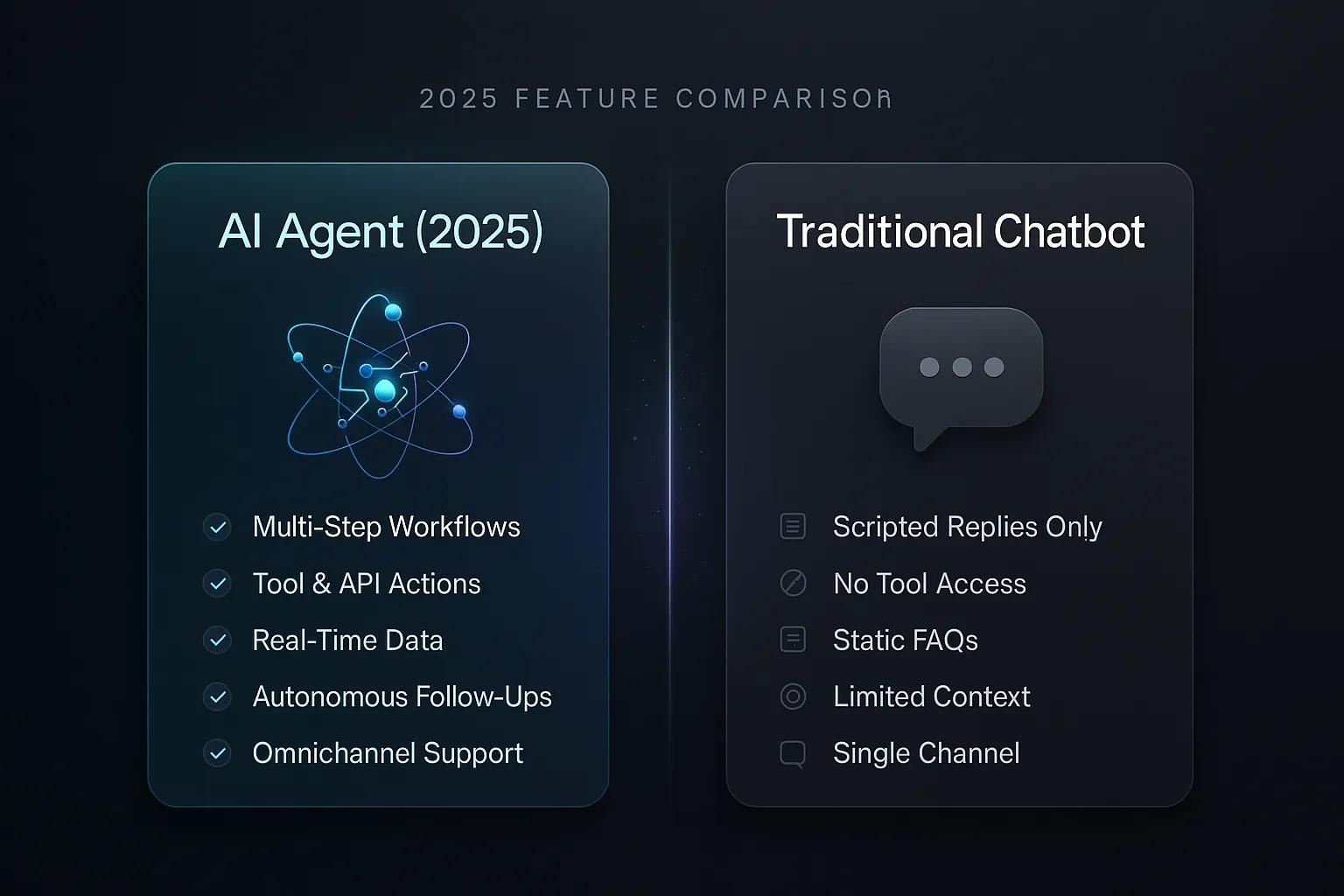
AI Agent vs Traditional Chatbot: 2026 Feature Comparison
It's 11 PM on a Tuesday. A customer reports a damaged package through your support channel. Your traditional chatbot politely apologizes and provides a link to...