
Deploying AI Agents in Medical Practices: A 2026 Guide


Recent industry research from a primary source underscores why this question matters right now for operators making this decision.
Blog Summary
- Deploying AI agents in a medical practice automates administrative tasks like scheduling and insurance verification using HIPAA-compliant software.
- AI in healthcare significantly reduces the administrative burden on clinical staff, freeing them for direct patient care.
- This guide is for practice managers, clinic owners, and operations leads at small to mid-sized medical facilities.
- Gaazzeebo builds custom, HIPAA-compliant AI agents that integrate directly with your existing EMR and practice management systems.
Healthcare administration costs are projected to surpass $430 billion this year, and that number directly impacts your practice's margins [https://www.cms.gov/research-statistics-data-and-systems/statistics-trends-and-reports/nationalhealthexpenddata/nhe-fact-sheet]. For private medical practices, this administrative drag means less time with patients and mounting pressure on thin margins. Every minute spent on scheduling or billing is a minute not spent on patient care.
This is where AI agents come in, autonomous systems that handle specific operational tasks. They're digital team members that can manage patient intake, process insurance claims, and handle appointment reminders 24/7. This guide provides a framework for deploying them, covering key use cases, implementation costs, and 2026 HIPAA compliance requirements.
What You'll Learn
- Specific administrative and patient-facing tasks AI can automate in a clinical setting.
- Core requirements for ensuring your AI agent deployment is HIPAA compliant.
- The pros and cons of custom-built AI versus off-the-shelf medical chatbot solutions.
- A real-world example of an AI agent reducing patient no-show rates and staff workload.
- How to calculate the financial return on investment (ROI) for a medical AI agent.
What Medical Tasks Can AI Agents Automate?
AI agents excel at automating the high-volume, repetitive tasks that consume administrative time and lead to staff burnout. Physicians spend nearly 15.5 hours per week on paperwork and administrative tasks, time pulled directly from patient care. By deploying custom AI agents, practices can reclaim these hours and streamline critical workflows.
The most immediate impact is often seen in patient scheduling and communication. An AI agent can manage appointment booking 24/7 via phone, text, or a website portal. It intelligently offers available slots, confirms bookings, and handles cancellations or rescheduling requests without human intervention. This same system can automate appointment reminders, which significantly cuts revenue loss. With the average patient no-show rate at 18%, automated, multi-channel reminders can recapture thousands in lost appointment revenue annually.
Automating Patient Intake and Prior Authorizations
Beyond scheduling, AI agents can transform the patient intake process. Instead of handing patients a clipboard, an AI-powered workflow can guide them through digital forms before their visit. The agent asks questions conversationally, validates information in real-time, and can even pre-populate data from the patient's electronic health record (EHR). This ensures data is accurate, complete, and entered directly into the system, saving hours of manual data entry.
Perhaps the most valuable application is in managing prior authorizations. This notoriously slow process is a major source of administrative friction. An AI agent can be trained to:
- Identify procedures that require prior authorization.
- Gather the necessary clinical documentation from the EHR.
- Complete and submit the required forms to insurance payers.
- Track the status of the request and alert staff when a human needs to intervene.
This level of automation drastically reduces the administrative burden on your team, 94% of physicians report that prior authorization processes delay access to necessary care. Building the right service of specialized, HIPAA-compliant agents is similar to work we've done for other industries, like the multi-agent AI platform we developed for Aedanrose to streamline complex restaurant operations. The goal is the same: use intelligent automation to free up human experts.
Improving Patient Triage and Communication
AI agents serve as an intelligent front door for patient inquiries. A significant portion of incoming calls are for simple, repetitive questions about hours, directions, or prescription refills. An AI agent can handle these instantly, freeing up the front desk to manage in-person patients and complex issues. This meets evolving patient expectations, 71% of patients now prefer to use digital channels for non-urgent healthcare interactions. The agent can triage needs and route more complex queries to the appropriate person, whether that's a nurse for a clinical question or the billing department for a payment issue.
Key Insight: AI agents in a medical setting are not about replacing staff, but augmenting them. They handle the predictable, high-volume administrative work so your team can focus on complex problem-solving and direct patient care.
Ensuring HIPAA Compliance for AI in Healthcare
Deploying AI in a medical setting introduces powerful tools, but it also s the compliance stakes. The average cost of a healthcare data breach has now reached $11.2 million per incident [https://www.ibm.com/reports/cost-of-a-data-breach/2026-healthcare-findings]. This makes HIPAA compliance the single most important factor when choosing an AI partner.
The Business Associate Agreement (BAA) is Non-Negotiable
Any technology vendor that handles, processes, or stores Protected Health Information (PHI) must be considered a business associate. This legal relationship is formalized through a Business Associate Agreement (BAA). A BAA is a signed contract that legally requires your AI vendor to maintain the same rigorous data protection standards as your practice. It transfers liability for data protection to the vendor for the services they provide.
This is not a formality. 41% of significant HIPAA breaches in 2025 involved a third-party business associate [https://www.hhs.gov/hipaa/for-professionals/compliance-enforcement/data/breaches-affecting-500-or-more-individuals/2025-annual-report/index.html]. Never engage an AI vendor who will not sign a BAA.
Core Technical Safeguards for AI
Beyond the legal framework of a BAA, your AI partner must implement specific technical safeguards mandated by the HIPAA Security Rule. Building compliant custom AI agent workflows requires this security-first architecture from the initial design phase. Key technical controls include:
- ** Encryption:** All PHI must be encrypted both "at rest" (when stored on servers or in databases) and "in transit" (as it moves across networks). This renders data unreadable to unauthorized parties.
- Strict Access Controls: The principle of minimum necessary access is critical. Role-Based Access Control (RBAC) ensures that users can only view the specific information required for their job function.
- Comprehensive Audit Trails: The system must log every action involving PHI. This includes who accessed the data, what they did, and when. These logs are essential for security audits and breach investigations.
These measures are not just about avoiding fines; they are fundamental to maintaining patient confidence. 78% of patients are concerned about how AI systems use their personal health information [https://www2.deloitte.com/us/en/insights/industry/health-care/patient-trust-in-ai-report-2025.html]. Demonstrating a commitment to robust security builds the trust necessary for AI adoption.
Key Insight: HIPAA compliance for AI is a shared responsibility. It requires a legally binding BAA with your vendor and verifiable technical safeguards like encryption and role-based access controls.
Custom AI Agents vs. Off-the-Shelf Medical Chatbots
When bringing AI into your practice, you face a fundamental choice: deploying a generic, off-the-shelf chatbot or investing in a bespoke solution. The first option promises immediate results for common issues like scheduling. The second, building custom AI agents, provides deep integration and control tailored to your unique clinical workflows. Your decision will directly impact operational efficiency, patient experience, and long-term scalability.
Off-the-shelf medical chatbots are pre-built SaaS products designed for mass-market appeal. Their primary advantage is low upfront cost and rapid deployment, often in a matter of days. They excel at surface-level tasks like answering frequently asked questions or sending appointment reminders. However, their limitations become clear when faced with practice-specific needs. They rarely integrate deeply with your existing Electronic Medical Record (EMR/EHR) system, creating data silos and forcing staff into inefficient manual workarounds.
A custom AI agent is designed from the ground up to function as a core part of your operational infrastructure. This approach allows for direct, secure, and bidirectional integration with your most critical systems. You retain complete control over data handling and logic, which is essential for maintaining strict HIPAA compliance. Healthcare providers that deploy custom AI see a 35% higher rate of successful workflow automation compared to those using generic tools [https://www.mckinsey.com/industries/healthcare/our-insights/ai-in-healthcare-from-hype-to-reality-in-2026]. This transforms the agent from a simple Q&A bot into a powerful assistant that can manage patient intake, pre-authorize procedures, and assist with clinical documentation.
The table below breaks down the key differences between these two approaches.
The value of customization becomes clear when you move beyond simple Q&A. A generic chatbot can tell a patient your office hours. A custom agent integrated with your EMR can check a specific patient's insurance eligibility in real-time, identify a gap in their preventative care schedule, and proactively offer an appointment with the correct provider, all within a single, secure conversation. This is the difference between a digital brochure and a digital employee.
Key Insight: Off-the-shelf chatbots solve simple, universal problems quickly. Custom AI agents solve complex, practice-specific problems for a lasting competitive advantage.
Need help applying this to your business? Gaazzeebo runs free 30-minute audits, book one here.
How to Measure the ROI of a Medical AI Agent
Measuring the return on investment for a medical AI agent requires looking beyond simple cost-cutting. The most effective framework evaluates gains in three key areas: operational efficiency, revenue protection, and increased capacity. This approach provides a complete picture of the agent's financial impact on your practice.
Calculate Administrative Time Savings
The largest and most immediate return comes from automating repetitive administrative work. Healthcare administrative staff now spend up to 45% of their day on automatable tasks like scheduling, data entry, and processing prior authorizations [https://www.bls.gov/opub/mlr/2025/article/healthcare-automation-trends.htm]. A well-designed AI agent can execute these tasks instantly and without error, freeing your team for high-value patient interaction.
To calculate this value, use a simple formula:
- Identify automatable tasks: List all tasks the agent will handle (e.g., appointment reminders, insurance verification, intake form processing).
- Estimate time saved: Calculate the total staff hours per week currently spent on these tasks.
- Monetize the time: Multiply the hours saved by your staff's average loaded hourly rate.
(Hours Saved per Week) x (Average Hourly Rate) x 52 Weeks = Annual Operational Savings
Measure Revenue from Reduced No-Shows
Patient no-shows are a direct and significant revenue loss. In 2025, the average cost of a single missed appointment in a primary care setting reached $215 [https://catalyst.nejm.org/doi/full/10.1056/CAT.25.0123]. [AI agents](/blog/ai-agents-in-healthcare-6-real-world-applications-roi) combat this by deploying intelligent, multi-channel reminders via SMS, email, and voice. They also provide simple, automated options for patients to confirm or reschedule, dramatically improving engagement over simple call blasts.
To quantify this, track your no-show rate before and after implementation. The formula for recovered revenue is:
(Baseline No-Show % - New No-Show %) x (Total Monthly Appointments) x (Avg. Revenue per Visit) = Monthly Recovered Revenue
Factor in Increased Patient Capacity
Freed from administrative burdens, your staff can focus on work that directly impacts revenue and patient care. Saving 20 front-desk hours per week creates the capacity to manage referrals more efficiently, reduce patient wait times, and support a higher daily patient load without increasing headcount. This shift from cost-center activities to revenue-generating support is a critical component of AI ROI that many practices overlook.
Key Insight: The true ROI of a medical AI agent isn't just in cutting payroll hours. It's in converting saved administrative time into billable patient encounters and protecting your schedule from costly no-shows.
Your 5-Step Plan for Deploying a Medical AI Agent
Deploying an AI agent is not a flip-of-the-switch project. It is a structured implementation that turns a powerful technology into a reliable operational asset. A methodical approach de-risks your investment, ensures staff adoption, and delivers a measurable return. Follow these five steps to move from concept to a fully integrated AI agent within your medical practice.
1. Identify a High-Impact, Low-Risk Use Case
Your first AI project should not target complex clinical diagnostics. Instead, focus on the administrative bottlenecks that consume staff time and frustrate patients. The goal is a quick, tangible win that builds momentum. Isolate a single, repetitive process that creates friction in your practice.
Good starting points include:
- Patient Intake and Scheduling: An AI agent can handle appointment requests, cancellations, and rescheduling 24/7, freeing up your front desk for in-person care.
- Prior Authorizations: This is a major source of administrative burden. An agent can initiate prior authorizations, track their status with payers, and escalate exceptions to human staff.
- Answering Routine Queries: An agent can field common questions about office hours, locations, accepted insurance, and appointment preparation, reducing call volume significantly.
2. Define Specific Success Metrics
How will you know if the agent is working? Vague goals like "improving efficiency" are useless. You need quantifiable Key Performance Indicators (KPIs) defined before you write a single line of code. These metrics will form the basis of your business case and measure the project's ROI.
Your KPIs should be specific and measurable:
- Reduce patient phone wait times by 60%.
- Decrease the average time to get a prior authorization approved from 5 days to 2 days.
- Increase the percentage of appointments scheduled online without human assistance to 75%.
- Improve patient satisfaction scores related to scheduling by 15%.
3. Select the Right Technology Partner
You need a partner who understands both AI and healthcare. An off-the-shelf chatbot cannot handle the complexities of patient data and clinical workflows. Your partner must demonstrate deep expertise in HIPAA compliance, EMR/EHR integration, and building custom logic that matches your practice's specific needs. This is the core of our work with custom AI agents for business operations. A thorough vetting process prevents costly rework and ensures your agent is secure and effective from day one.
4. Launch a Controlled Pilot Program
Do not attempt a practice-wide rollout on day one. A focused pilot program is essential for testing the AI agent in a controlled, real-world environment. Limit the initial scope to a manageable variable, such as a single workflow, one insurance payer, or a specific patient cohort. This allows you to collect performance data, identify edge cases, and gather feedback from a small group of staff members. The pilot proves the concept and provides the data needed to justify a wider deployment.
5. Measure, Iterate, and Scale
Once your pilot is live, compare the performance data against the KPIs you defined in step two. This is not a one-time setup. The agent will require tuning and refinement based on its real-world interactions. Use the pilot's successes and failures to improve the agent's logic, expand its knowledge base, and enhance its conversational abilities. After a successful pilot, you can build a strategic roadmap to scale the solution across other departments and workflows, compounding your initial return on investment.
Key Insight: Successful AI deployment is not about finding the most complex technology. It is about applying proven, reliable automation to your most persistent operational bottleneck.
See What This Could Save Your Business
Nine questions, no login. See what manual work costs you across every location, and which three fixes pay back first.
Score my operationsSee where your locations standFree 30-minute assessment. No commitment required.
Related Articles

What is Agentic AI? The Complete Business Guide for 2026
The chatbot era is over. Not because chatbots failed; they were useful for what they were designed to do. But in 2026, businesses are demanding more than...
AI Implementation for SMBs: Real Costs, Real Results
Here's something nobody talks about enough: 68% of small businesses with 10-100 employees are now using AI regularly. That number jumped from 48% in just six...
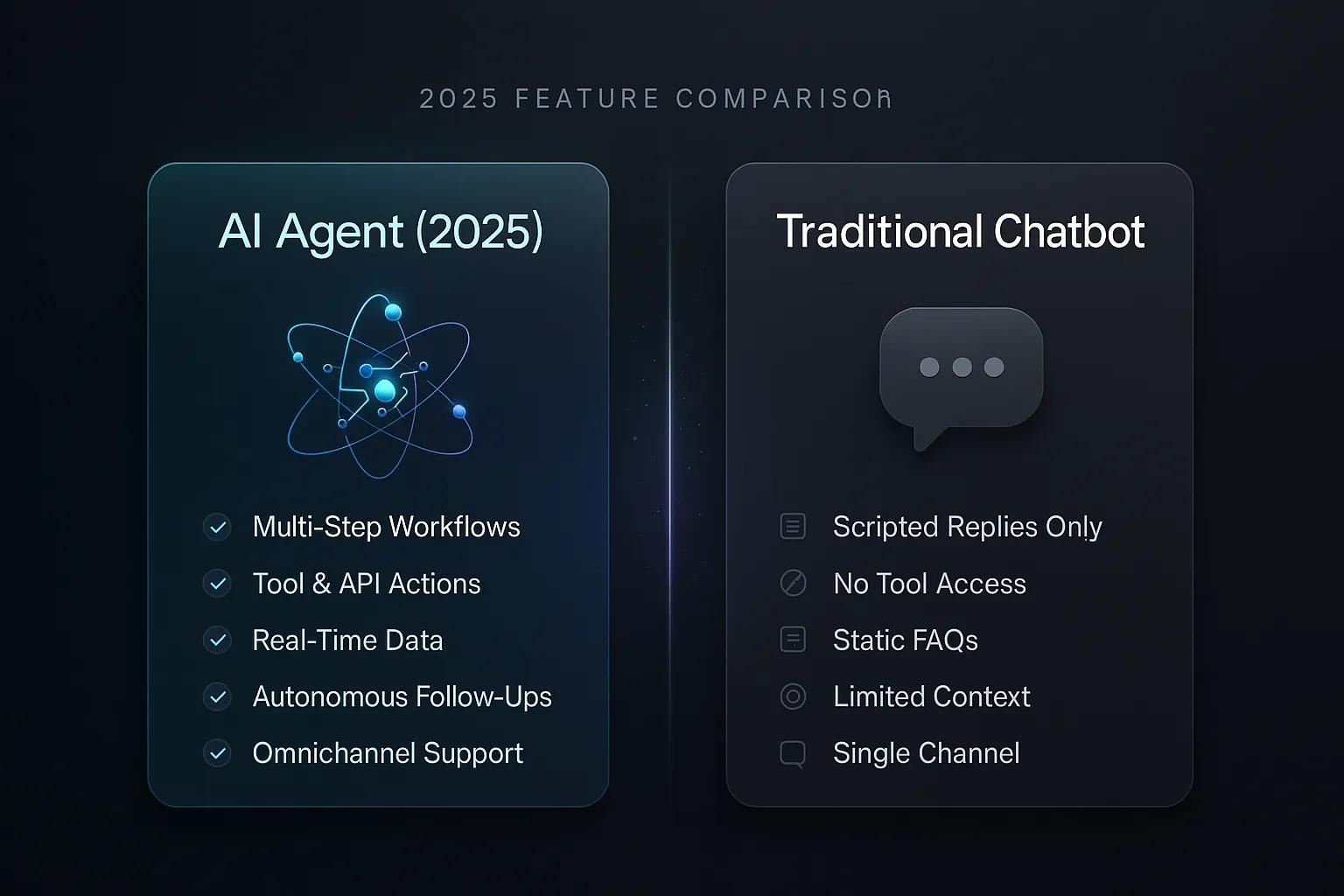
AI Agent vs Traditional Chatbot: 2026 Feature Comparison
It's 11 PM on a Tuesday. A customer reports a damaged package through your support channel. Your traditional chatbot politely apologizes and provides a link to...