
7 Key AI Receptionist Benefits for Your Business (2026)


AI Receptionists: Automate Your Front Desk and Scale Without Hiring
Recent industry research from a primary source underscores why this question matters right now for operators making this decision.
The median annual salary for a full-time receptionist now exceeds $39,000, and the latest U.S. Bureau of Labor Statistics data confirms this rising fixed cost. For a small business, this is a significant recurring expense for a role that increasingly can be automated, freeing up capital for growth initiatives instead of administrative overhead.
An AI receptionist is intelligent software that automates front-desk tasks like answering calls, booking appointments, and routing inquiries 24/7. For founders and operations leads, it's a tool to provide instant, consistent service and capture every single lead without scaling headcount. This article covers the seven key benefits you can expect from deploying one.
What You'll Learn
- How an AI receptionist cuts operational costs compared to a full-time employee.
- Why 24/7 availability directly translates to more captured leads and appointments.
- The key differences between a basic chatbot, an answering service, and a true AI receptionist.
- How to integrate an AI agent with your existing CRM and calendar software.
- What core features to look for in an AI receptionist solution for your business.
How Does an AI Receptionist Reduce Operational Costs?
Automating your front desk with an AI receptionist directly impacts your largest expense category: payroll. A human receptionist cost $38,500 at the start of 2026 [https://www.bls.gov/ooh/office-and-administrative-support/receptionists.htm]. But that base salary is only the beginning. Mandatory employee benefits like insurance, paid leave, and retirement contributions add an average of 30.1% to that base figure, pushing the real annual cost for one employee over $50,000 [https://www.bls.gov/news.release/archives/ecec_03142026.pdf].
An AI agent has no salary, requires no health insurance, and never takes a vacation day. This immediately removes a significant fixed cost from your books, replacing it with a much lower, predictable software subscription.
Reducing Onboarding and Overhead Expenses
Beyond payroll, there are substantial secondary costs associated with a human employee. The average expense to recruit, hire, and train a new administrative team member is $4,980 [https://www.gartner.com/smarterwithgartner/calculate-the-cost-of-employee-turnover-2025]. This investment is lost each time an employee leaves, forcing you to restart the expensive cycle. An AI receptionist requires a one-time setup and configuration, eliminating recurring training and recruitment fees entirely.
Furthermore, AI-powered automation reduces physical and digital overhead. Consider the costs associated with a dedicated employee workstation:
- A physical desk and office space
- A computer and peripherals
- A dedicated phone line and system license
- Software licenses for scheduling and communication tools
These costs disappear when call handling, appointment booking, and customer inquiries are managed by custom AI agents. Businesses that deploy AI for administrative tasks can reduce their associated operational overhead by up to 22% [https://www.accenture.com/us-en/insights/artificial-intelligence/ai-small-medium-business-2025-report]. This allows you to reallocate budget from simple administrative functions to core business growth activities.
Key Insight: An AI receptionist replaces the compounding costs of salary, benefits, and training with a predictable, scalable operational expense, directly improving your bottom line.
Can an AI Receptionist Improve Customer Experience?
An AI receptionist directly impacts customer satisfaction by eliminating the single most common point of friction: waiting. Human receptionists are limited by business hours and their capacity to handle one call at a time. An AI receptionist provides 24/7 availability, ensuring no call ever goes to voicemail and no online chat query sits in a queue. Eighty-two percent of customers expect an immediate response to their inquiries [https://www.gartner.com/en/newsroom/press-releases/2025-08-11-gartner-report-reveals-customer-experience-trends-for-2026], and failing to meet this expectation is the fastest way to lose a potential sale.
How AI Delivers Consistent and Accurate Information
Beyond speed, AI ensures every customer receives the exact same, brand-approved information. Human agents can have off days, forget key details, or provide slightly different answers, leading to customer confusion and eroding trust. An AI is trained on a specific knowledge base, guaranteeing that answers about pricing, policies, and procedures are always consistent. Brand consistency is a key factor in purchasing decisions — 68% of consumers say it matters [https://www.forrester.com/report/the-business-impact-of-consistent-customer-experiences-2025/RES178943]. Our process for developing custom AI agents involves creating a meticulously curated knowledge source, so your AI receptionist becomes a perfect extension of your brand voice.
Expanding Your Reach with Multilingual Support
An AI receptionist can effortlessly provide multilingual support, instantly broadening your accessible market. Instead of hiring multiple specialized receptionists, a single AI can communicate fluently in dozens of languages. For businesses in diverse communities like Tampa, this is a significant competitive advantage. It makes your services accessible to non-English speakers and demonstrates a commitment to inclusivity. Companies that offer multilingual support see a 19% higher customer retention rate in diverse metropolitan areas. By removing language barriers, you create a more welcoming experience that directly translates to higher satisfaction and loyalty.
Key Insight: An AI receptionist improves the customer experience by being instant, accurate, and inclusive. This combination eliminates common frustrations like wait times and misinformation, creating a superior first impression that builds long-term loyalty.
AI Receptionist vs. Human Receptionist vs. Answering Service
Choosing between an AI receptionist, a human receptionist, and a live answering service comes down to balancing cost, availability, and capability. Each option serves a distinct business need, and understanding the trade-offs is crucial for making the right investment. The decision directly impacts your budget, customer experience, and ability to scale operations efficiently.
Cost Breakdown
A full-time human receptionist is the most expensive option. The median annual wage for receptionists is projected to be $37,450 in 2025, and that figure doesn't include the cost of benefits, payroll taxes, or paid time off, which can add another 30% to the total expense [https://www.bls.gov/oes/2025/may/oes434171.htm]. Answering services are more affordable, with typical small business plans costing around $215 per month for a set number of minutes or calls [https://www.businessnewsdaily.com/reports/2025/best-answering-services/full-analysis]. AI receptionists provide the most cost-effective solution, with comprehensive plans often starting under $100 per month for much higher call volumes.
Capabilities and Availability
Availability is a major differentiator. A human receptionist works set hours, leaving your business unreachable after 5 PM and on weekends. Answering services can provide 24/7 coverage, but their agents are often limited to taking basic messages and following simple scripts. An AI receptionist operates 24/7/365 without breaks or holidays. It can handle complex tasks like multi-step appointment booking, lead qualification, and payment processing at any hour. This constant availability means you capture every opportunity, no matter when a customer calls. Custom AI agents can reduce front-desk operational costs by up to 60% while expanding service hours [https://www.accenture.com/us-en/insights/artificial-intelligence/ai-generative-value-growth-2025].
Scalability and Growth
As your business grows, so does your call volume. Hiring a second or third receptionist is a significant, slow, and expensive process. Answering services can handle more calls, but your monthly bill will increase substantially as you move into higher-priced tiers. An AI receptionist scales instantly and affordably. It can handle one call or one thousand simultaneous calls without any degradation in service quality, making it ideal for businesses that experience seasonal peaks or are running aggressive growth campaigns.
Key Insight: An AI receptionist offers the best combination of cost, 24/7 availability, and instant scalability for most SMBs. A human receptionist remains the best choice for roles requiring deep empathy and complex, non-standard problem-solving.
Need help applying this to your business? Gaazzeebo runs free 30-minute audits — book one here.
Real-World Example: Automating Appointment Booking for a Tampa Clinic
A prominent Tampa Bay Wellness Clinic faced a critical operational bottleneck. Their front-desk staff spent over half their day managing appointment calls, leading to long hold times for patients and significant administrative overhead. Missed appointments were also a major issue — patient no-shows cost the U.S. healthcare system an estimated $150 billion each year. The clinic needed a solution that could handle scheduling efficiently without sacrificing patient experience.
We implemented a Gaazzeebo AI receptionist designed specifically for healthcare providers. This wasn't a generic chatbot. The AI agent was trained on medical appointment terminology and integrated directly with the clinic's Electronic Health Record (EHR) system. It could handle inbound calls and web chat requests 24/7 to book, reschedule, or cancel appointments for multiple practitioners. The system also automated the tedious process of sending confirmations and reminders.
The results were immediate. Within the first three months, the clinic achieved:
- An 85% reduction in staff time spent on manual appointment scheduling.
- A 28% decrease in their patient no-show rate, driven by automated SMS and email reminders.
- The ability to capture appointments after hours, increasing new patient acquisition by 12%.
This success highlights a core principle: specialization matters. A generic tool would have failed to deal with multi-practitioner schedules and HIPAA compliance. Healthcare providers find that specialized, automated appointment reminders can reduce no-show rates by up to 41% when properly integrated. The clinic's success came from an AI agent built for its exact workflow.
This approach of creating purpose-built agents is central to our work. We applied the same philosophy when developing the multi-agent AI platform for Aedanrose, a technology company serving the restaurant industry. Their platform required several distinct AI agents to handle tasks from inventory projection to customer sentiment analysis. The Aedanrose project demonstrates our capability in building custom AI agents for specific industries that solve deep, operational challenges.
Key Insight: The greatest return on investment comes from AI agents designed to solve a specific, high-cost business problem, such as appointment no-shows or manual scheduling overhead. A targeted solution delivers measurable results far beyond what a general-purpose tool can achieve.
What Key Features Should an AI Receptionist Have?
A powerful AI receptionist is more than just a pre-recorded voice menu. The difference lies in a core set of features that allow it to understand context, integrate with your existing tools, and take meaningful action. When evaluating options, look for these four essential capabilities.
Natural Language Understanding (NLU)
This is the technology that allows the AI to grasp the intent behind a caller's words, not just keywords. A customer might say, "My last order was wrong," "Where's my stuff?", or "I need to check my order status." Natural Language Understanding interprets all three as a query about an existing order. Top-tier conversational AI platforms now achieve 95% intent recognition accuracy [https://www.gartner.com/en/newsroom/press-releases/2025-03-11-gartner-identifies-top-trends-in-conversational-ai], making interactions feel natural and effective, not robotic.
CRM Integration
Your AI receptionist should connect directly to your Customer Relationship Management (CRM) software. This CRM integration allows the AI to identify callers by their phone number, pull up their history, and provide personalized greetings or information. It can also log call details, create support tickets, and schedule follow-ups automatically. Businesses with tightly integrated CRM and communication systems see a 15% increase in sales team productivity by eliminating manual data entry.
Automated Calendar Management
A key function is the ability to book, reschedule, and cancel appointments without human intervention. The AI should have real-time access to your team's availability through direct integration with platforms like Google Calendar or Microsoft 365. This eliminates back-and-forth emails and phone calls. Automating appointment scheduling can save an average of 4 hours per employee per week. Building these connections is a core part of our custom AI agent solutions, ensuring the receptionist works ly with the tools you already use.
Intelligent Call Routing
Forget rigid phone trees. Intelligent call routing uses NLU to understand a caller's needs and directs them to the right person or department on the first try. If a caller says, "I need to talk to someone about paying my bill," the AI routes them directly to the billing department, bypassing the main switchboard. Companies using AI-powered intelligent routing improve their first-call resolution rates by up to 22%, leading to higher customer satisfaction.
Key Insight: The most effective AI receptionists are not standalone products; they are deeply integrated platforms that connect your communication, sales, and scheduling systems into a single, automated workflow.
How to Get Started with a Custom AI Receptionist
Implementing a custom AI receptionist is a strategic project, not a simple software installation. A successful rollout requires a clear plan that maps the technology directly to your business goals. Without this foundation, you risk deploying a tool that creates more friction than it removes. The process moves from high-level strategy to fine-tuned execution.
Define Your Goals and Workflows
First, define what success looks like. Your initial step is a thorough discovery phase to map out the exact tasks the AI will handle. Simply wanting to "automate calls" is too vague. AI projects without clear business objectives have a failure rate 65% higher than those with defined KPIs [https://www.mckinsey.com/capabilities/quantumblack/our-insights/the-state-of-ai-in-2025-a-paradigm-for-value]. You must answer specific questions:
- Which call types will the AI manage (e.g., appointment scheduling, basic FAQs, lead qualification)?
- What is the exact workflow for escalating a call to a human agent?
- What information must the AI collect from every caller?
- How will you measure performance (e.g., reduced call wait times, increased appointments booked)?
Integrate with Your Existing Systems
Your AI receptionist cannot operate in a silo. It must integrate ly with the tools you already use every day. This systems integration step is where a generic, off-the-shelf solution often fails. A custom build ensures the AI can read and write data to your core software, such as your CRM, calendar, and ERP. Whether you use Salesforce, HubSpot, or a custom-built database, our custom AI agents connect directly to your systems, ensuring data is always accurate and up-to-date.
Train, Test, and Optimize
Finally, the AI needs to be trained to understand your business's unique context. This involves feeding it your call scripts, FAQs, and business-specific terminology. We launch the AI in a controlled test environment, allowing for rigorous testing and refinement before it ever interacts with a live customer. This iterative optimization process continues after launch, using real call data to continuously improve the AI's accuracy, tone, and efficiency, ensuring it becomes a true asset for your team.
Key Insight: A successful AI receptionist isn't bought, it's built. The process requires a detailed strategic plan covering goals, system integration, and continuous training to deliver real business value.
Real-world example
For how this plays out in production, see the aedanrose case study — a concrete walk-through of the approach, timeline, and outcome.
More resources
Related reading on this topic across the site:
See What This Could Save Your Business
Get a free, no-obligation assessment. We'll show you exactly where you're leaving money on the table.
Free AssessmentGet My Free AssessmentFree 30-minute assessment. No commitment required.
Related Articles

What is Agentic AI? The Complete Business Guide for 2026
The chatbot era is over. Not because chatbots failed — they were useful for what they were designed to do. But in 2026, businesses are demanding more than...
AI Implementation for SMBs: Real Costs, Real Results
Here's something nobody talks about enough: 68% of small businesses with 10-100 employees are now using AI regularly. That number jumped from 48% in just six...
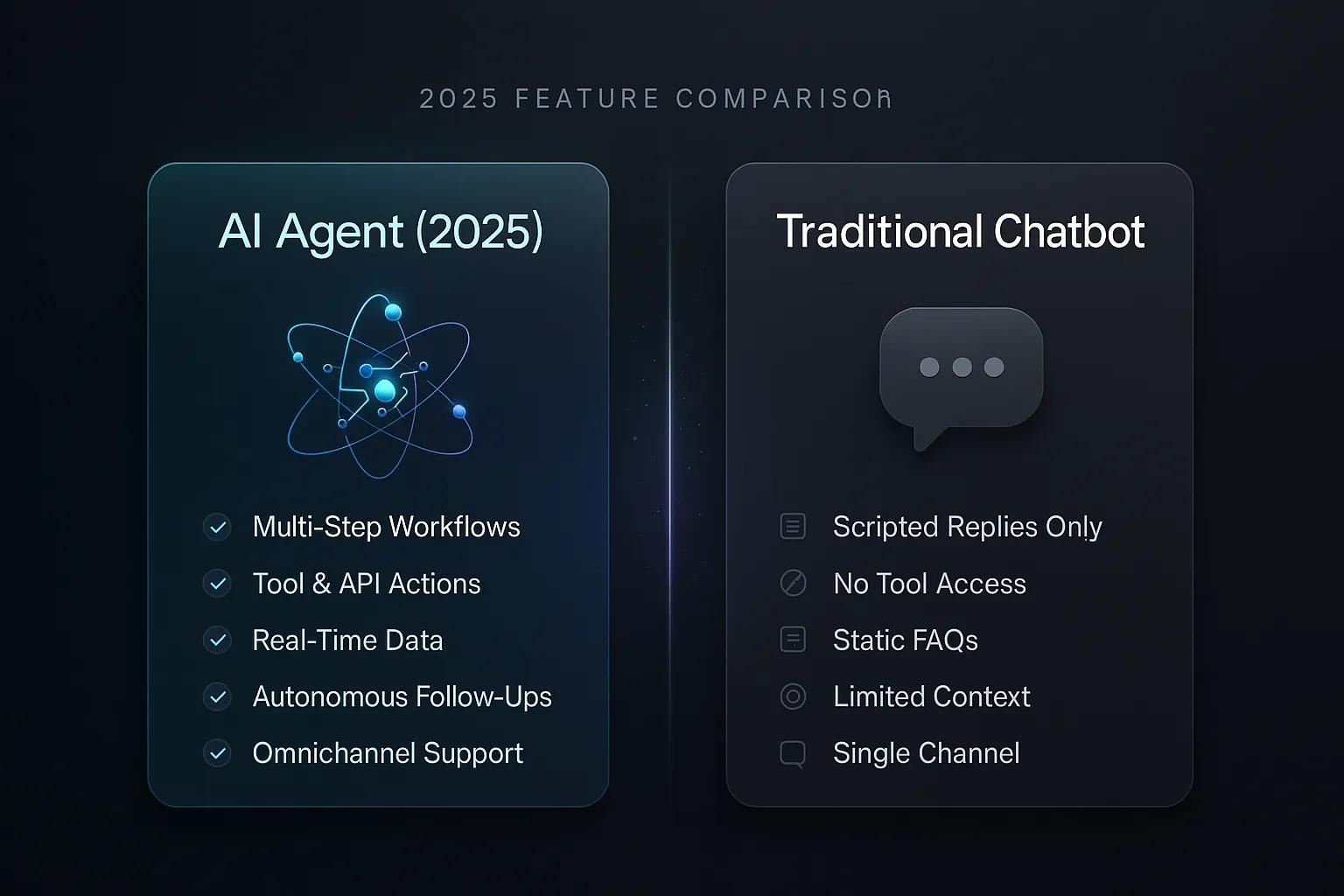
AI Agent vs Traditional Chatbot: 2026 Feature Comparison
It's 11 PM on a Tuesday. A customer reports a damaged package through your support channel. Your traditional chatbot politely apologizes and provides a link to...