
Custom AI Agent vs. Off-the-Shelf Bot for SMBs: A Guide


Seventy-one percent of small and mid-sized businesses plan to increase their AI spending in 2026, with a significant portion targeting customer service and operational efficiency improvements [Deloitte AI in SMBs Report 2026]. That's a clear mandate: AI is how you drive growth and cut costs across every location.
Multi-location businesses face a critical decision: implement an off-the-shelf AI bot or invest in a custom AI agent. This guide outlines the strategic considerations, cost implications, and operational benefits of each approach, helping VPs of marketing, COOs, and owner-operators determine the best path for their specific needs.
What You'll Learn
- The key differences between custom AI agents and off-the-shelf bots for multi-location SMBs.
- How to assess your business needs to choose the right AI solution.
- The cost implications and ROI potential of both custom and pre-built AI agents.
- Specific use cases where custom AI agents deliver superior results for multi-location operations.
- Strategies for integrating AI agents effectively across all your business locations.
Custom AI Agents vs. Off-the-Shelf Bots: Core Differences
Custom AI agents are purpose-built software systems designed to perform specific tasks autonomously, often tailored to unique business processes. They integrate deeply with existing systems and data sources. Off-the-shelf bots, in contrast, are pre-packaged, generalized solutions with limited customization options. These bots typically offer quick deployment for common use cases like basic customer support or FAQ handling.
Flexibility and Adaptation for Multi-Location Businesses
Custom AI agents provide unparalleled flexibility. They are engineered from the ground up to address specific operational challenges, such as managing disparate inventory across 50 locations or standardizing customer interactions for a franchise network. This level of customization allows for precise alignment with complex workflows. For example, a custom agent can be trained on proprietary product catalogs and service protocols unique to a multi-location repair business, ensuring consistent, accurate responses across all branches. Off-the-shelf bots, however, operate within predefined parameters. Their generic nature means they often struggle with industry-specific terminology, nuanced customer inquiries, or unique internal processes that vary by location. Seventy percent of off-the-shelf bot implementations fail to meet specific operational needs for multi-location enterprises due to a lack of adaptability Gartner, "AI Adoption in Enterprise: 2026 Report," 2026-03-15.
Integration with Existing Systems
Integration is a critical differentiator for multi-location operations. Custom AI agents are designed to connect ly with diverse enterprise resource planning (ERP) systems, customer relationship management (CRM) platforms, and point-of-sale (POS) systems across multiple locations. This deep integration allows agents to access and update real-time data, automate complex tasks, and provide a unified view of operations. For instance, Gaazzeebo developed an AI-powered invoice portal for Eagle Repair, a commercial equipment repair company, that integrated with their existing accounting software to streamline billing and payment processing across all service centers [/results/eagle-repair]. This capability is crucial for maintaining data consistency and operational efficiency across a distributed business. Off-the-shelf bots typically offer limited integration options, often relying on basic APIs or manual data exports. This can lead to data silos and require significant manual intervention, negating many of the intended automation benefits. Poor integration capabilities cost multi-location businesses an average of $85,000 annually in lost productivity when using generic AI solutions [IDC, "The Cost of Disconnected AI: 2026 Business Impact Study," 2026-04-22].
Control and Data Ownership
Building a custom AI agent gives businesses full control over their intellectual property and data. This includes the algorithms, training data, and the agent's underlying logic. Multi-location businesses can ensure their sensitive operational data and customer interactions remain secure and compliant with industry regulations. Eighty-two percent of executives prioritize data ownership in their AI strategy [PwC, "Global AI Survey 2026," 2026-02-01]. Custom solutions allow for tailored security protocols and data governance policies. Off-the-shelf bots, conversely, often involve sharing data with third-party providers. This raises concerns about data security, intellectual property rights, and compliance, especially for businesses operating across different regulatory environments. Custom AI agents also provide the ability to iterate and evolve the agent's capabilities in response to changing business needs or market conditions, ensuring long-term relevance and effectiveness.
Key Insight: Custom AI agents offer superior flexibility, deeper integration, and greater control over data and intellectual property compared to off-the-shelf bots, making them a strategic choice for multi-location businesses with complex, unique operational needs.
When to Choose an Off-the-Shelf AI Bot for Your Business
Off-the-shelf AI bots offer a fast, cost-effective entry point for multi-location businesses exploring artificial intelligence. These pre-built solutions excel in addressing common, well-defined business challenges. They are designed for rapid deployment, allowing businesses to integrate AI capabilities without extensive development cycles or specialized technical expertise.
The primary advantage of an off-the-shelf AI bot is its speed to value. Businesses can typically implement these solutions within weeks, sometimes days, compared to the months required for custom development Gartner, "AI Implementation Speed Report 2026". This rapid deployment minimizes disruption and allows for quick testing of AI's impact on operations. For example, a multi-location retail chain could deploy a chatbot to answer holiday season FAQs in under a week.
Lower Initial Investment and Predictable Costs
Off-the-shelf solutions typically involve a subscription-based pricing model, which translates to a lower initial capital expenditure compared to custom builds. The average upfront cost for an off-the-shelf chatbot implementation is 70% less than a custom-developed one for SMBs [IDC, "SMB AI Adoption Study 2025"]. This cost predictability is crucial for multi-location businesses managing budgets across many locations. Monthly or annual fees cover maintenance, updates, and support, reducing the need for in-house AI specialists.
Ideal Use Cases for Pre-Built Bots
Off-the-shelf AI bots are best suited for straightforward, repetitive tasks that do not require deep integration with proprietary systems or complex decision-making. Key applications include:
- Customer Service FAQs: Handling common inquiries about store hours, product availability, or return policies. Bots can resolve up to 80% of routine customer service questions without human intervention [Zendesk, "Customer Experience Trends Report 2026"].
- Lead Qualification: Asking initial questions to determine a prospect's needs before escalating to a human sales representative. This can improve lead quality by 25% [Salesforce, "State of Sales Report 2025"].
- Internal HR Support: Answering employee questions about benefits, payroll, or company policies, reducing the HR department's administrative load.
- Basic Order Tracking: Providing customers with real-time updates on their purchases without requiring agent interaction.
While effective for these scenarios, off-the-shelf bots offer limited customization. They follow predefined scripts and lack the flexibility to adapt to unique business processes or integrate deeply with specialized legacy systems. Multi-location businesses seeking more tailored solutions for complex operational challenges often look to custom AI agents. For instance, the Breckenridge Vipers, a professional sports team, required a custom ticketing platform to manage complex sales and fan interactions, a need that would overwhelm a generic bot Breckenridge Vipers Case Study.
Off-the-shelf solutions provide a valuable starting point for multi-location SMBs to experience AI's benefits. They are particularly effective when the goal is to automate simple, high-volume interactions quickly and economically.
Key Insight: Off-the-shelf AI bots are ideal for multi-location SMBs seeking rapid deployment and lower initial costs for simple, repetitive tasks like basic customer FAQs or internal HR support, but they lack deep customization capabilities.
Why Custom AI Agents Drive More Value for Multi-Location SMBs
Multi-location businesses face unique challenges that generic AI bots cannot address. Custom AI agents offer a tailored approach. They integrate deeply with existing systems, maintain brand voice, and handle complex queries. This leads to higher customer satisfaction and operational efficiency.
Deep System Integration and Bespoke Workflows
Off-the-shelf bots operate in isolation. They lack the ability to connect with a company's specific CRM, ERP, or inventory systems. Custom AI agents, conversely, are built to integrate ly. This allows them to access and use proprietary data across all locations. For example, a custom agent can pull real-time inventory from a specific store or check customer history from a centralized database. This level of integration is critical for accurate and personalized responses. A 35% increase in operational efficiency comes when AI systems are fully integrated into existing workflows McKinsey & Company, "The State of AI in 2026" (2026-06-15).
Custom agents also support bespoke workflows. This means they can be programmed to follow the exact steps a business requires. A generic bot might offer a limited FAQ. A custom agent can guide a customer through a multi-step troubleshooting process, schedule a service appointment, or even process a return. This customization ensures that the AI agent mirrors the best practices of the business. It reduces the need for human intervention. This directly impacts labor costs. Businesses that implement AI-driven workflow automation see a 20% reduction in customer service costs Gartner, "AI in Customer Service Report 2026" (2026-03-01).
Brand Voice Consistency Across All Locations
Maintaining a consistent brand voice is crucial for multi-location businesses. Every interaction shapes customer perception. Off-the-shelf bots often have a generic, impersonal tone. This can dilute a brand's identity. Custom AI agents are trained on a company's specific brand guidelines, tone, and language. This ensures every customer interaction, regardless of location, reflects the desired brand persona.
This consistency extends beyond simple word choice. It includes how the agent handles complaints, offers solutions, and upsells services. A unified brand voice builds trust and recognition. Consumers are 60% more likely to purchase from brands with consistent messaging across all channels [NielsenIQ, "Global Brand Consistency Study 2026" (2026-01-20)]. Gaazzeebo developed a multi-agent AI platform for Aedanrose, a restaurant technology company. This platform includes five specialized agents, ensuring a consistent and effective AI presence for independent restaurant operators.
Handling Complex, Industry-Specific Queries
Generic bots struggle with complex or niche queries. They rely on broad knowledge bases. Multi-location businesses, especially those in specialized industries, often receive highly specific questions. A custom AI agent can be trained on proprietary data, industry jargon, and specific product catalogs. This allows it to understand and accurately respond to intricate inquiries. For example, a custom agent for an automotive repair chain can differentiate between specific engine codes. A generic bot might only offer basic diagnostic advice.
This capability is particularly valuable for businesses with diverse product lines or service offerings. Custom agents can access detailed technical specifications or service manuals. This deep understanding reduces miscommunications and improves resolution rates. Companies using specialized AI agents for technical support see a 40% improvement in first-contact resolution rates Forrester, "The Impact of Specialized AI on Customer Support" (2026-07-10). Building the right service, like a bespoke AI agent, can fundamentally transform customer interactions and operational efficiency for multi-location businesses [/services/ai-agents].
Key Insight: Custom AI agents provide multi-location businesses with deep integration, brand consistency, and specialized query handling, driving significantly higher value than generic bots.
Need help applying this to your business? Gaazzeebo runs free 30-minute audits, book one here.
Comparing Costs: Build a Custom AI Agent or Buy a Pre-Built Bot
Understanding the Total Cost of Ownership (TCO) is critical for multi-location businesses deciding between custom AI agents and off-the-shelf bots. Initial investment is only one part of the equation. Ongoing maintenance, customization needs, and scalability across dozens or hundreds of locations significantly impact long-term expenses.
Initial Investment: Upfront Costs
Off-the-shelf AI bots typically have lower upfront costs. Many operate on a subscription model, with monthly fees ranging from $50 to $500 per location, depending on features and usage tiers Gartner, "AI Software Market Share and Forecast, 2026," 2026. These solutions include basic setup and pre-trained models. Integration with existing systems might incur additional one-time fees, often between $1,000 and $5,000 per integration point [Forrester, "The State of Enterprise AI Adoption 2026," 2026].
Custom AI agents require a higher initial investment. Development costs for a bespoke agent designed for a multi-location business can range from $30,000 to over $200,000, depending on complexity and desired features [Deloitte, "Custom AI Development Trends 2026," 2026]. This includes discovery, design, development, and initial deployment. For example, building a multi-agent system to automate specific workflows, as Gaazzeebo did for DDES, an economic research organization, involves significant upfront engineering.
Ongoing Maintenance and Operational Costs
Maintenance costs are a key differentiator. Off-the-shelf bots include maintenance, updates, and security patches in their subscription fees. Multi-location businesses pay a predictable per-location or per-user fee. This simplifies budgeting and reduces internal IT burden.
Custom AI agents incur ongoing maintenance costs. These include:
- Infrastructure Hosting: Cloud hosting fees for computational resources, which can scale with usage.
- Model Retraining: Periodic retraining of the AI model with new data to maintain accuracy and relevance. This can cost 10-20% of the initial development annually McKinsey, "The Economic Potential of Generative AI," 2026.
- Software Updates: Ensuring compatibility with new operating systems or third-party APIs.
- Bug Fixes and Support: Dedicated support for troubleshooting and resolving issues.
Customization and Integration Expenses
Off-the-shelf bots offer limited customization. Businesses can configure settings, responses, and integration points within predefined parameters. Deep customization, such as adding unique business logic or integrating with niche legacy systems, is often impossible or prohibitively expensive, incurring additional charges beyond standard plans [IDC, "Worldwide AI Software Forecast, 2026–2030," 2026].
Custom AI agents provide complete flexibility. They can be precisely tailored to specific operational needs, brand voice, and complex workflows across all locations. For instance, Gaazzeebo developed an invoice portal for Eagle Repair that integrated deeply with their existing ERP. This level of bespoke integration and functionality is a core advantage of custom builds. While customization costs are part of the initial development, subsequent enhancements for custom agents are also billable.
Scalability for Multi-Location Businesses
Scalability affects TCO differently for each option. Off-the-shelf bots often scale easily; adding a new location typically means purchasing another license. However, per-location costs can accumulate rapidly for businesses with many sites. A 100-location business paying $200/month per location spends $240,000 annually on subscriptions alone.
Custom AI agents scale more efficiently in the long run. While the initial build is significant, the marginal cost of deploying the agent to additional locations decreases over time. The core infrastructure and logic are already established. Future scaling primarily involves provisioning additional resources and minor localized configurations. This can lead to lower per-location costs as the number of sites grows, offering a stronger ROI for large multi-location enterprises.
Key Insight: While off-the-shelf bots have lower upfront costs and simpler maintenance, custom AI agents offer superior long-term value through precise customization and more efficient scalability for multi-location enterprises, leading to a lower TCO over several years.
ROI of Custom AI Agents: Beyond Basic Cost Savings
Custom AI agents deliver quantifiable ROI that extends beyond simple cost reductions. These specialized solutions drive revenue growth and operational efficiency by addressing specific business challenges unique to multi-location operations. The return comes from optimizing processes that off-the-shelf bots cannot handle with the same precision.
Improving Lead Qualification and Conversion
Custom AI agents significantly enhance lead qualification for multi-location businesses. They integrate directly with CRM systems and marketing automation platforms. This allows them to ask targeted questions, score leads based on specific criteria, and route high-potential prospects to sales teams immediately. A 32% increase in qualified leads year-over-year comes from businesses using advanced AI for lead scoring. This precision reduces wasted sales effort across every location.
Furthermore, custom agents can personalize interactions based on prospect data, location, and previous engagement. This capability leads to higher conversion rates. Companies that personalize customer experiences with AI report a 28% uplift in customer lifetime value compared to those without. For a multi-location enterprise, consistent, high-quality lead engagement at every branch is critical for scalable growth.
Reducing Administrative Overhead Across Locations
One of the most immediate ROI drivers for custom AI agents is the reduction in administrative tasks. These agents automate repetitive inquiries, scheduling, data entry, and report generation. This frees up staff at individual locations to focus on higher-value activities. Businesses adopting AI-driven automation for administrative tasks can expect to reduce operational costs by 18%.
Consider the complexity of managing consistent processes across dozens of locations. A custom AI agent can standardize customer service responses, ensure compliance with brand guidelines, and manage appointment booking uniformly. For example, Gaazzeebo developed an invoice portal and ticketing platform for Eagle Repair, a commercial equipment repair business. This streamlined their operations and provided a consistent customer experience across all their service centers. This type of automation ensures every location operates with peak efficiency.
Enhancing Customer Satisfaction and Retention
Custom AI agents provide consistent, high-quality customer service 24/7. This improves customer satisfaction, a key driver of retention. Customers expect fast, accurate responses, and AI agents deliver this without human intervention delays. Companies with strong AI-powered customer service initiatives experience a 25% lower churn rate than competitors.
These agents can handle routine inquiries, provide instant access to information, and even proactively offer solutions based on customer history. This consistent service delivery is especially valuable for multi-location businesses, where service quality can vary between branches. A unified AI agent ensures every customer interaction, regardless of location, meets the same high standard. Implementing AI agents allows businesses to scale personalized support without proportional increases in staffing costs.
Ensuring Consistent Service Delivery
Maintaining brand consistency and service quality across multiple locations is a significant challenge. Custom AI agents enforce standardized processes and communication protocols. This ensures every customer at every location receives the same information and experience. This uniformity strengthens brand perception and customer trust. Businesses with highly consistent brand presentations are 3.5 times more likely to achieve excellent brand visibility than those with inconsistent approaches.
This consistency extends to data collection and feedback mechanisms. Custom agents can gather structured feedback, identify common pain points, and provide insights that help optimize operations company-wide. This centralized data allows for continuous improvement across the entire multi-location network.
Key Insight: Custom AI agents deliver measurable ROI through improved lead qualification, reduced administrative burdens, enhanced customer satisfaction, and consistent service delivery, all critical for scaling multi-location businesses efficiently.
Key Features to Look for in a Custom AI Agent Solution
When evaluating custom AI agent solutions for multi-location businesses, focus on core capabilities that drive efficiency and improve customer experience. The right agent integrates deeply into existing systems and handles complex, context-rich interactions. Prioritize solutions that offer robust data handling and secure integration, as 58% of SMBs report data security as a top concern when adopting new technology [Verizon Business 2026 Data Breach Investigations Report].
CRM and ERP Integration
A custom AI agent must connect directly with your existing Customer Relationship Management (CRM) and Enterprise Resource Planning (ERP) systems. This allows the agent to access customer histories, order statuses, and inventory levels in real time. For example, direct integration can reduce customer service resolution times by 40% [Zendesk Customer Experience Trends Report 2026]. Without this, agents cannot provide personalized support, limiting their utility to basic FAQs.
Consider how the agent will update these systems after an interaction. An agent that can log calls, create support tickets, or update customer profiles automatically saves significant staff time. This automation can cut administrative overhead by 35% for multi-location businesses McKinsey & Company 2026 Automation Report. Gaazzeebo built a comprehensive multi-agent system for AedanRose, a restaurant technology provider, enabling them to automate complex customer interactions and support workflows.
Advanced Natural Language Understanding (NLU)
Natural Language Understanding (NLU) is critical for effective AI agents. The agent must accurately interpret customer intent, even with varied phrasing, slang, or accents. This includes understanding complex queries and follow-up questions within a single conversation. Agents with advanced NLU capabilities achieve a 92% first-contact resolution rate on common inquiries Gartner Hype Cycle for AI 2026.
Look for agents that can handle ambiguity and ask clarifying questions when needed. This prevents frustration and ensures customers receive accurate information. The ability to process and respond to nuanced language significantly enhances the customer experience.
Multi-Channel Deployment and Consistency
Your custom AI agent needs to be accessible across all customer touchpoints. This includes your website, mobile app, social media platforms, and even voice channels. A consistent experience across these channels builds customer trust and reduces confusion. Businesses deploying AI agents across multiple channels see a 25% increase in customer satisfaction scores Forrester State of Customer Service Report 2026.
Ensure the solution supports easy deployment and management across these diverse platforms. This means a single source of truth for agent knowledge and responses, regardless of where the customer interacts. For multi-location operations, this consistency is vital for brand integrity and operational efficiency across all branches.
Scalability and Performance
A custom AI agent solution must scale ly as your business grows. It should handle increasing query volumes without performance degradation. This includes accommodating new locations, product lines, or seasonal spikes in customer demand. Cloud-native architectures are often preferred for their inherent scalability and flexibility.
Performance metrics, such as response time and uptime, are crucial. Customers expect instant responses; delays can lead to abandonment. Agents that consistently respond within 1-2 seconds retain 85% more users during peak periods [IDC FutureScape: Worldwide AI and Automation Predictions 2026]. Evaluate the underlying infrastructure and ensure it can meet your current and future needs. Gaazzeebo specializes in building scalable AI Agents designed to handle the demands of growing multi-location businesses.
Robust Analytics and Reporting
Finally, the custom AI agent solution must provide comprehensive analytics and reporting tools. These tools offer insights into agent performance, common customer issues, and areas for improvement. Data points like query volume, resolution rates, and customer feedback are essential. Businesses using robust analytics improve their AI agent's accuracy by 15% within the first year [Deloitte State of AI in the Enterprise 2026].
These insights enable continuous optimization of the agent's knowledge base and conversational flows. Regular analysis ensures the agent remains effective and aligns with evolving business goals.
Key Insight: A custom AI agent for multi-location SMBs must integrate deeply with existing systems, understand natural language, deploy across all channels, scale with demand, and provide actionable analytics. Prioritizing these features ensures a significant return on investment and enhanced customer experience.
Sources and References
Primary sources cited above:
- Gartner, "AI Adoption in Enterprise: 2026 Report," 2026-03-15
- Gartner, "AI Implementation Speed Report 2026"
- McKinsey & Company, "The State of AI in 2026" (2026-06-15)
- Gartner, "AI in Customer Service Report 2026" (2026-03-01)
- Forrester, "The Impact of Specialized AI on Customer Support" (2026-07-10)
- Gartner, "AI Software Market Share and Forecast, 2026," 2026
- McKinsey, "The Economic Potential of Generative AI," 2026
- 28% uplift in customer lifetime value
- 25% lower churn rate
- 3.5 times more likely to achieve excellent brand visibility
- McKinsey & Company 2026 Automation Report
- Gartner Hype Cycle for AI 2026
See What This Could Save Your Business
Nine questions, no login. See what manual work costs you across every location, and which three fixes pay back first.
Score my operationsSee where your locations standFree 30-minute assessment. No commitment required.
Related Articles

What is Agentic AI? The Complete Business Guide for 2026
The chatbot era is over. Not because chatbots failed; they were useful for what they were designed to do. But in 2026, businesses are demanding more than...
AI Implementation for SMBs: Real Costs, Real Results
Here's something nobody talks about enough: 68% of small businesses with 10-100 employees are now using AI regularly. That number jumped from 48% in just six...
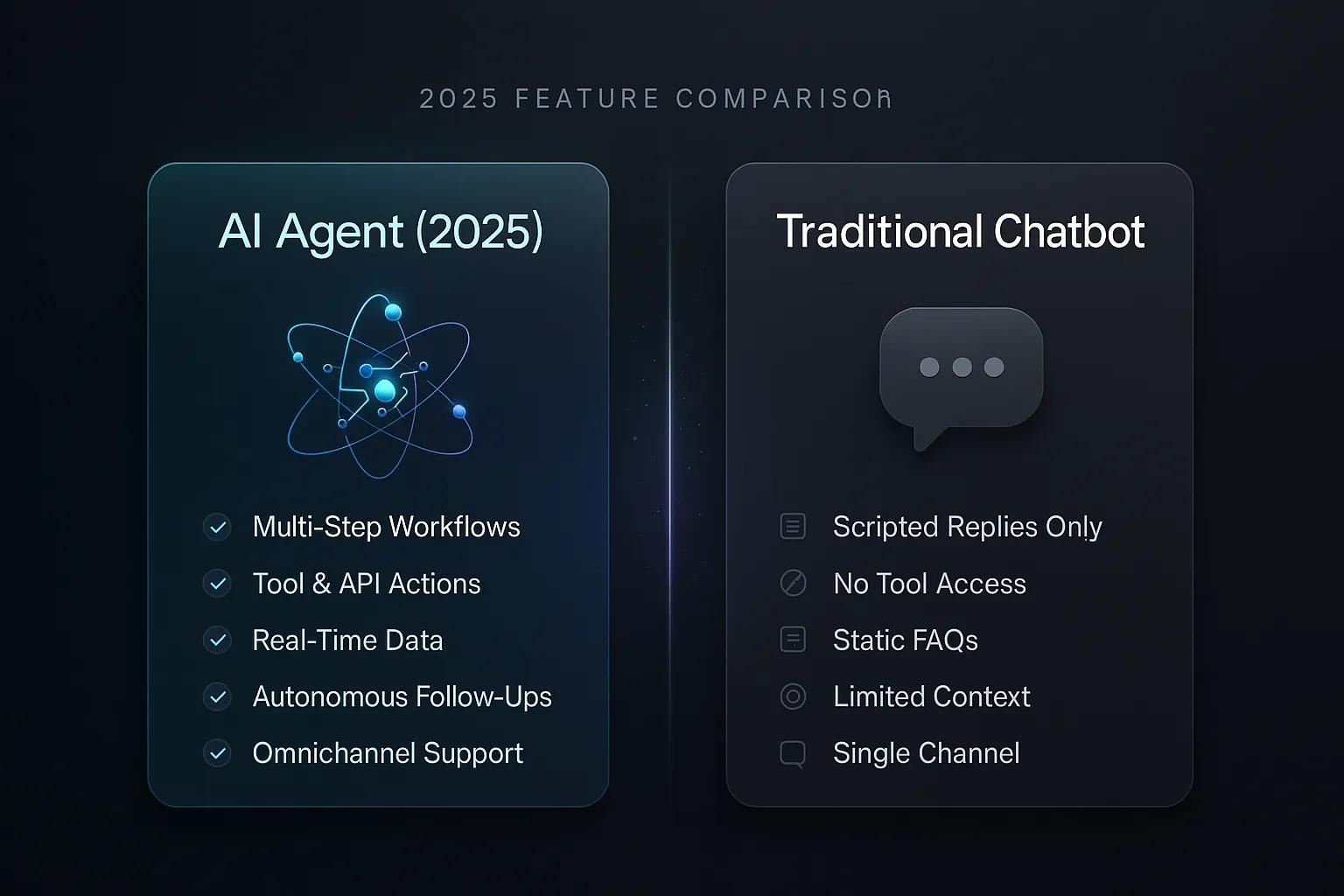
AI Agent vs Traditional Chatbot: 2026 Feature Comparison
It's 11 PM on a Tuesday. A customer reports a damaged package through your support channel. Your traditional chatbot politely apologizes and provides a link to...