
Custom AI Agent Cost: Build vs. Run for Multi-Location Businesses


Multi-location businesses face increasing pressure to automate customer interactions and internal workflows. Seventy-eight percent of consumers expect immediate service responses from businesses KPMG 2026 Customer Experience Report. This demand drives the need for efficient, systems that scale that traditional staffing models struggle to provide consistently across numerous locations.
This article explores the custom AI agent cost for multi-location businesses, breaking down the expenses associated with both building and running these advanced systems. We'll compare these costs against the benefits of improved efficiency and customer satisfaction, helping VPs of marketing, COOs, and owner-operators make informed decisions about AI adoption.
What You'll Learn
- The primary cost drivers for custom AI agent development and deployment.
- How to budget for ongoing operational expenses like LLM access and maintenance.
- Strategies to calculate the potential return on investment (ROI) for AI agents.
- Key differences in cost and value between various types of AI agents.
- How outsourcing AI agent development can optimize costs and accelerate deployment.
Initial Custom AI Agent Development Costs
Building a custom AI agent involves significant upfront investment. These costs span several critical phases: design, data preparation, model training, and integration. Multi-location businesses must evaluate these initial expenses carefully against potential long-term benefits.
AI Agent Design and Strategy
The foundational step for any custom AI agent is strategic design. This phase defines the agent's purpose, scope, and specific functionalities. It includes identifying target user interactions, desired outcomes, and necessary data inputs. A thorough design process ensures the agent aligns with business goals, such as improving customer service or streamlining internal operations. For instance, a multi-location restaurant chain might design an agent to handle reservation changes across all its venues. Well-defined project scope can reduce development time by 15% Gartner, "AI Project Management Best Practices 2026," 2026-03-10. This initial phase typically involves business analysts, AI strategists, and UX designers. Their combined expertise shapes the agent's architecture and user experience.
Data Preparation and Curation
Data preparation is often the most time-consuming and expensive part of AI development. Custom AI agents require large volumes of clean, relevant data for effective training. This includes collecting, cleaning, labeling, and transforming raw data into a usable format. For a multi-location retail business, this might mean consolidating customer interaction logs, product catalogs, and transaction histories from dozens of disparate systems. Poor data quality creates significant project delays and cost overruns; 75% of AI projects face delays due to data quality issues [MIT Sloan, "The State of AI in Business 2026," 2026-05-22]. The labor involved in data annotation and validation can range from $50,000 to $200,000 for complex enterprise-level agents [Deloitte, "AI Implementation Costs Report 2026," 2026-04-15]. This cost scales directly with the volume and complexity of the data required.
Model Training and Fine-Tuning
Once data is prepared, the next step is model training. This involves feeding the processed data into a chosen AI model architecture to teach it the desired behaviors and responses. For custom agents, this often means fine-tuning pre-trained large language models (LLMs) or developing specialized models from scratch. The computational resources required for training can be substantial. Cloud computing costs for GPU usage, for example, can quickly accumulate. A single intensive training run for a sophisticated agent might cost upwards of $10,000 in cloud compute alone [AWS, "Generative AI Pricing Guide 2026," 2026-06-01]. Furthermore, iterative fine-tuning by machine learning engineers is critical to optimize performance and reduce biases. This iterative process can extend for weeks or months, incurring ongoing personnel costs. Gaazzeebo provides specialized services for AI Agents that streamline this complex training and fine-tuning process.
Integration with Existing Systems
Finally, a custom AI agent must ly integrate with a business's existing technology stack. This includes CRM systems, ERP platforms, customer support tools, and proprietary databases. Integration ensures the agent can access necessary information and trigger actions across the enterprise. For a multi-location business, this often means connecting to multiple instances of software or legacy systems at each location. Up to 40% of an AI project's budget can be allocated to integration and API development [Accenture, "Enterprise AI Integration Report 2026," 2026-07-08]. Custom API development, data connectors, and security protocols are all part of this phase. Without robust integration, the agent operates in isolation, limiting its utility. Gaazzeebo's work for DDES, an economic research organization, involved integrating their new platform with various public and private data sources, demonstrating the complexity of such projects DDES Case Study.
Key Insight: Initial custom AI agent development costs are driven by design complexity, the volume and quality of data required for training, computational resources for model development, and the depth of integration with existing business systems. These upfront investments are substantial but establish the foundation for long-term operational efficiency.
Ongoing AI Agent Running and Maintenance Expenses
Operating a custom AI agent involves several recurring costs beyond its initial development. These ongoing expenses are critical for ensuring the agent remains effective, secure, and aligned with business objectives across multiple locations. Multi-location businesses must budget for these long-term operational costs when considering an AI agent deployment.
Infrastructure and Hosting Costs
AI agents require robust infrastructure for processing power, data storage, and network bandwidth. Cloud hosting providers, such as AWS, Google Cloud, or Azure, are common choices. Costs vary based on usage, but a typical multi-location setup might involve dedicated virtual machines, serverless functions, and managed database services. For example, monthly cloud infrastructure costs for a moderately complex agent can range from $500 to $5,000 per location, depending on transaction volume and data intensity [Cloud Infrastructure Report 2026]. This includes compute, storage, and data transfer fees.
Large Language Model (LLM) API Access
The core intelligence of many custom AI agents comes from Large Language Model (LLM) APIs. These are typically priced per token, meaning businesses pay for every word processed or generated by the AI. Leading providers like OpenAI, Anthropic, and Google Cloud AI charge varying rates. For a multi-location business handling thousands of customer interactions daily, LLM API costs can quickly accumulate. A business processing 100,000 tokens per day might incur $1,000 to $5,000 in monthly API fees, depending on the model and volume discounts [AI Model Pricing Guide 2026]. These costs scale directly with usage across all locations.
Monitoring, Maintenance, and Security
Continuous monitoring is essential to ensure AI agents perform optimally and identify any deviations or errors. This includes tracking performance metrics, user satisfaction, and system health. Maintenance involves regular updates to the agent's code, underlying models, and integrations. Security measures, such as vulnerability scanning and access control, are also ongoing requirements. Businesses allocate 15% to 25% of their initial build cost annually for these activities Gartner AI Operations Report 2026. For a business like DDES, which relies on sophisticated AI agents for economic research, consistent maintenance ensures data accuracy and system reliability DDES Case Study.
Continuous Improvement and Retraining
AI agents are not static; they require continuous improvement to adapt to new data, changing customer behaviors, and evolving business needs. This involves gathering feedback, analyzing agent performance, and retraining models with updated datasets. Data labeling and model fine-tuning are common activities that incur costs, either through internal teams or external services. Businesses typically invest an additional 10% to 20% of their initial development cost each year into these improvement cycles [Deloitte AI Investment Survey 2026]. This ensures the AI agent remains a competitive asset and continues to drive value for every location.
Key Insight: Ongoing operational costs for custom AI agents can significantly impact the total cost of ownership for multi-location businesses, often equaling or exceeding the initial development investment within a few years.
Cost Comparison: Pre-built vs. Custom AI Agents
Multi-location businesses face a critical decision when integrating AI: use pre-built AI agents or invest in custom AI agents. This choice significantly impacts both initial outlay and long-term operational costs. Off-the-shelf solutions offer immediate deployment and predictable pricing structures. Custom builds, however, provide tailored functionality that can drive greater efficiency and competitive advantage over time.
Pre-built AI Agent Costs
Pre-built AI agents, such as generic chatbots or sentiment analysis tools, operate on a subscription model. These solutions often charge per user, per conversation, or per API call. A typical multi-location business might pay between $50 and $500 per location monthly for a pre-built customer service chatbot, depending on traffic volume and feature set Gartner, 2026 AI Software Market Report. Implementation costs are minimal, usually involving simple integrations with existing CRM or helpdesk systems. Training time is also reduced, as these agents come with pre-trained models for common tasks.
However, pre-built solutions come with inherent limitations. They may not understand industry-specific jargon or handle complex, multi-step customer inquiries unique to a business. Customization is often limited to branding and minor rule adjustments. This can lead to a lower resolution rate for customer issues, requiring human intervention. For example, if a pre-built agent fails to resolve 20% of inquiries, the cost savings are offset by increased staff workload.
Custom AI Agent Costs
Developing a custom AI agent involves a higher upfront investment but delivers precise alignment with business needs. Initial development costs for a bespoke AI solution can range from $50,000 to $250,000 for a multi-location enterprise, depending on complexity and features [IDC, 2026 Custom AI Solutions Forecast]. This investment covers design, data preparation, model training, and integration with proprietary systems. Gaazzeebo specializes in building these AI agents for multi-location businesses, ensuring they integrate ly with existing workflows.
Ongoing costs for custom agents include maintenance, updates, and further model training. These can average 15-20% of the initial development cost annually [Deloitte, 2026 AI Implementation Study]. Despite the higher investment, custom agents offer significant long-term ROI. They can automate highly specific tasks, improve data accuracy, and enhance customer experiences beyond what generic solutions provide. For instance, a custom agent could process complex order changes across 50 locations, a task a pre-built chatbot would likely struggle with.
Choosing between pre-built and custom AI agents depends on the specific operational needs and budget of a multi-location business. Pre-built agents are suitable for businesses with straightforward customer interaction needs or limited budgets. Custom agents are ideal for those requiring deep integration, unique functionalities, and a competitive edge through specialized automation. For example, DDES, an economic research organization, used custom software and AI to automate data processing, leading to significant operational efficiencies.
Key Insight: Pre-built AI agents offer lower upfront costs and faster deployment for generic tasks, while custom AI agents require higher initial investment but deliver superior long-term ROI through tailored automation and deeper integration for specific business challenges.
Need help applying this to your business? Gaazzeebo runs free 30-minute audits, book one here.
Key Factors Influencing AI Agent Project Budgets
Several critical variables determine the overall investment in a custom AI agent project. Understanding these factors helps multi-location businesses accurately budget for AI implementation. Project costs are not static; they scale with the agent's capabilities and operational demands.
Agent Complexity and Capabilities
The primary cost driver is the complexity of the AI agent. A basic chatbot for FAQs costs significantly less than an agent capable of complex reasoning, multi-step tasks, or personalized customer interactions. Agents that require advanced Natural Language Understanding (NLU) or Natural Language Generation (NLG) demand more sophisticated models and extensive training data. For example, building an AI agent to handle simple appointment scheduling across 50 locations might cost 30% less than one designed to resolve nuanced customer service issues requiring access to multiple internal systems Gartner, "AI Implementation Cost Analysis 2026," 2026-04-15. Agents that learn and adapt over time, often called agentic workflows, also incur higher development costs due to their iterative design and continuous optimization requirements.
Data Volume and Quality
The amount and quality of data required for training and operation directly impact costs. Large datasets necessitate more storage and processing power. Poor data quality, including inconsistencies or missing information, increases the need for data cleaning and preparation, which can add 15-25% to project timelines and budgets McKinsey, "Data Strategy for AI Success," 2026-07-01. For multi-location businesses, consolidating disparate data sources from each branch into a unified format is a significant undertaking. An AI agent for a 100-location enterprise will require substantially more data management effort than one for a 10-location business. Gaazzeebo helped DDES, an economic research organization, manage large, complex datasets, demonstrating the challenges of data integration even for non-transactional systems [/results/ddes].
Integration Requirements
Integrating an AI agent with existing business systems is often the most overlooked cost factor. Most custom AI agents need to connect with CRM, ERP, inventory, or proprietary operational software. Each integration point adds complexity and development time. A single API integration can range from $5,000 to $25,000, depending on the system's age and documentation quality [Forrester, "Enterprise AI Integration Costs," 2026-06-20]. Multi-location businesses often have legacy systems that lack modern APIs, forcing custom development of middleware or data connectors. This can increase integration costs by 50% or more compared to integrating with cloud-native platforms.
Infrastructure and Maintenance
Running an AI agent requires ongoing infrastructure. Cloud computing costs, including CPU, GPU, storage, and network usage, represent a recurring expense. These operational costs can range from $500 to $5,000 per month for a medium-complexity agent, scaling with transaction volume and computational demands [IDC, "Cloud Costs for AI Workloads 2026," 2026-03-10]. Ongoing maintenance, including model retraining, software updates, and performance monitoring, is also essential. A dedicated team or outsourced service is necessary to ensure the agent remains effective and secure. Multi-location companies benefit from agents that are robust and easily scalable across all branches without incurring prohibitive per-location maintenance overhead.
Key Insight: The true cost of a custom AI agent extends beyond initial development, encompassing data preparation, system integrations, and ongoing operational expenses that escalate with agent complexity and the scale of multi-location deployment.
Calculating ROI for Your Multi-Location AI Agent Investment
Quantifying the return on investment (ROI) for custom AI agents requires a clear framework. Multi-location businesses must evaluate both cost reductions and revenue gains per location. This approach provides a granular view of the AI agent's impact. A well-defined ROI calculation justifies the initial investment in AI technology.
Identifying Cost Reductions from AI Agents
AI agents significantly reduce operational costs across multiple locations. These savings typically stem from automating repetitive tasks. For example, AI-powered chatbots handle customer inquiries. This reduces the need for human agents for basic support.
Consider the following areas for cost reduction:
- Labor Costs: AI agents can automate tasks previously performed by employees. This includes customer support, data entry, and scheduling. Businesses can reduce staffing needs or reallocate personnel to higher-value activities. The average cost of a customer service interaction via live agent is $7.50, while an AI chatbot interaction costs $0.50, representing a 93% reduction per interaction Gartner, "The Future of Customer Service: AI and Automation" 2026 Report.
- Operational Overhead: AI agents streamline workflows, reducing processing times. This minimizes errors and associated rework costs. For instance, automated invoice processing can cut administrative time by 60% [Accenture, "Intelligent Automation: A Path to Enterprise Agility" 2025 Study].
- Training and Onboarding: Standardized AI agent responses ensure consistent service quality. This reduces the need for extensive staff training on complex customer scenarios. A reduction in training hours directly translates to cost savings.
Boosting Revenue Through AI Agent Deployment
AI agents also contribute to revenue growth by enhancing customer experience and efficiency. Improved service often leads to increased customer satisfaction and loyalty. This directly impacts sales and customer retention.
Key areas for revenue enhancement include:
- Improved Customer Experience: AI agents provide instant, 24/7 support. This accessibility enhances customer satisfaction. Businesses with strong customer experience see 1.6 times higher revenue growth than those with weak CX [Forrester, "The Business Impact Of Customer Experience, 2025" 2025 Report].
- Lead Generation and Qualification: AI agents can qualify leads on websites or social media. They engage prospects, answer questions, and direct them to sales teams. This increases the conversion rate of potential customers. Businesses using AI for lead qualification report a 25% increase in qualified leads [IDC, "AI in Sales and Marketing: Driving Growth" 2026 Study].
- Personalized Upselling and Cross-selling: AI agents analyze customer data to offer relevant product recommendations. This personalization increases the likelihood of additional purchases. AI-driven recommendations account for 35% of Amazon's revenue McKinsey & Company, "The Power of Personalization in E-commerce" 2025 Report.
Calculating Total ROI Per Location
To calculate ROI, sum the total benefits (cost savings + revenue gains) and subtract the total costs (development + running costs). Divide this net benefit by the total costs and multiply by 100%.
ROI = (Total Benefits - Total Costs) / Total Costs x 100%
For multi-location businesses, this calculation should be performed per location where feasible. This highlights the scaled impact of the AI agent investment. Gaazzeebo helped DDES, an economic research organization, improve its search visibility, which contributed to increased engagement and reach for their workforce development programs. Understanding the per-location impact helps prioritize further AI deployments.
Key Insight: A robust ROI calculation for custom AI agents hinges on quantifying both per-location cost reductions from automation and revenue increases from enhanced customer experience and lead generation.
Real-World AI Agent Cost Savings and Performance Gains
Multi-location businesses use AI agents to transform operations and reduce costs. These intelligent systems automate repetitive tasks and provide instant support. This leads to significant improvements in efficiency and customer satisfaction. Companies using AI in customer service reduced support costs by an average of 30% [Zendesk, "The State of CX Report 2026"].
Streamlining Customer Interactions and Support
AI agents excel at handling routine customer inquiries. They can answer common questions, process orders, and provide real-time information across all locations. This frees human staff to focus on more complex issues. For example, a multi-location retail chain could deploy an AI agent to manage inventory checks and store hours inquiries. This ensures consistent information delivery, regardless of location. Businesses report a 25% increase in customer satisfaction when AI is used to resolve basic inquiries quickly [Salesforce, "Service Cloud Report 2026"].
Enhancing Operational Efficiency
Beyond customer service, AI agents optimize internal processes. They can automate data entry, schedule appointments, and manage administrative tasks. This is particularly valuable for multi-location businesses that deal with high volumes of similar transactions. For instance, an AI agent can automatically update pricing across all store fronts based on market changes. This reduces manual errors and ensures pricing consistency. Companies automating operational tasks with AI see a 20% reduction in operational costs annually McKinsey & Company, "AI in Operations 2026 Report".
Gaazzeebo's Impact on AI Agent Development
Gaazzeebo specializes in developing custom AI solutions that drive these tangible benefits. For Aedanrose, a restaurant technology company, Gaazzeebo built a multi-agent AI platform featuring five specialized agents. This platform offers an affordable AI solution for independent restaurant operators. It enables them to use advanced AI capabilities without prohibitive costs. This type of tailored AI solution can significantly improve efficiency and reduce overhead for independent businesses.
Another example is how Gaazzeebo built a custom ticketing platform for the Breckenridge Vipers professional sports team. This system replaced Ticketmaster and recovered $43,500 per season in fees [/results/breckenridge-vipers]. While not an AI agent directly, this demonstrates how custom software can deliver substantial financial savings by eliminating third-party costs and streamlining operations. Similar principles apply to custom AI agents, which can replace expensive human tasks or third-party service subscriptions. Investing in custom AI agents allows multi-location businesses to own their technology stack. This leads to long-term cost control and competitive advantages.
Key Insight: Custom AI agents deliver measurable cost savings and performance gains by automating routine tasks and streamlining operations across multiple business locations.
Sources and References
Primary sources cited above:
- KPMG 2026 Customer Experience Report
- Gartner, "AI Project Management Best Practices 2026," 2026-03-10
- Gartner AI Operations Report 2026
- Gartner, 2026 AI Software Market Report
- Gartner, "AI Implementation Cost Analysis 2026," 2026-04-15
- McKinsey, "Data Strategy for AI Success," 2026-07-01
- Gartner, "The Future of Customer Service: AI and Automation" 2026 Report
- McKinsey & Company, "The Power of Personalization in E-commerce" 2025 Report
- McKinsey & Company, "AI in Operations 2026 Report"
See What This Could Save Your Business
Nine questions, no login. See what manual work costs you across every location, and which three fixes pay back first.
Score my operationsSee where your locations standFree 30-minute assessment. No commitment required.
Related Articles

What is Agentic AI? The Complete Business Guide for 2026
The chatbot era is over. Not because chatbots failed; they were useful for what they were designed to do. But in 2026, businesses are demanding more than...
AI Implementation for SMBs: Real Costs, Real Results
Here's something nobody talks about enough: 68% of small businesses with 10-100 employees are now using AI regularly. That number jumped from 48% in just six...
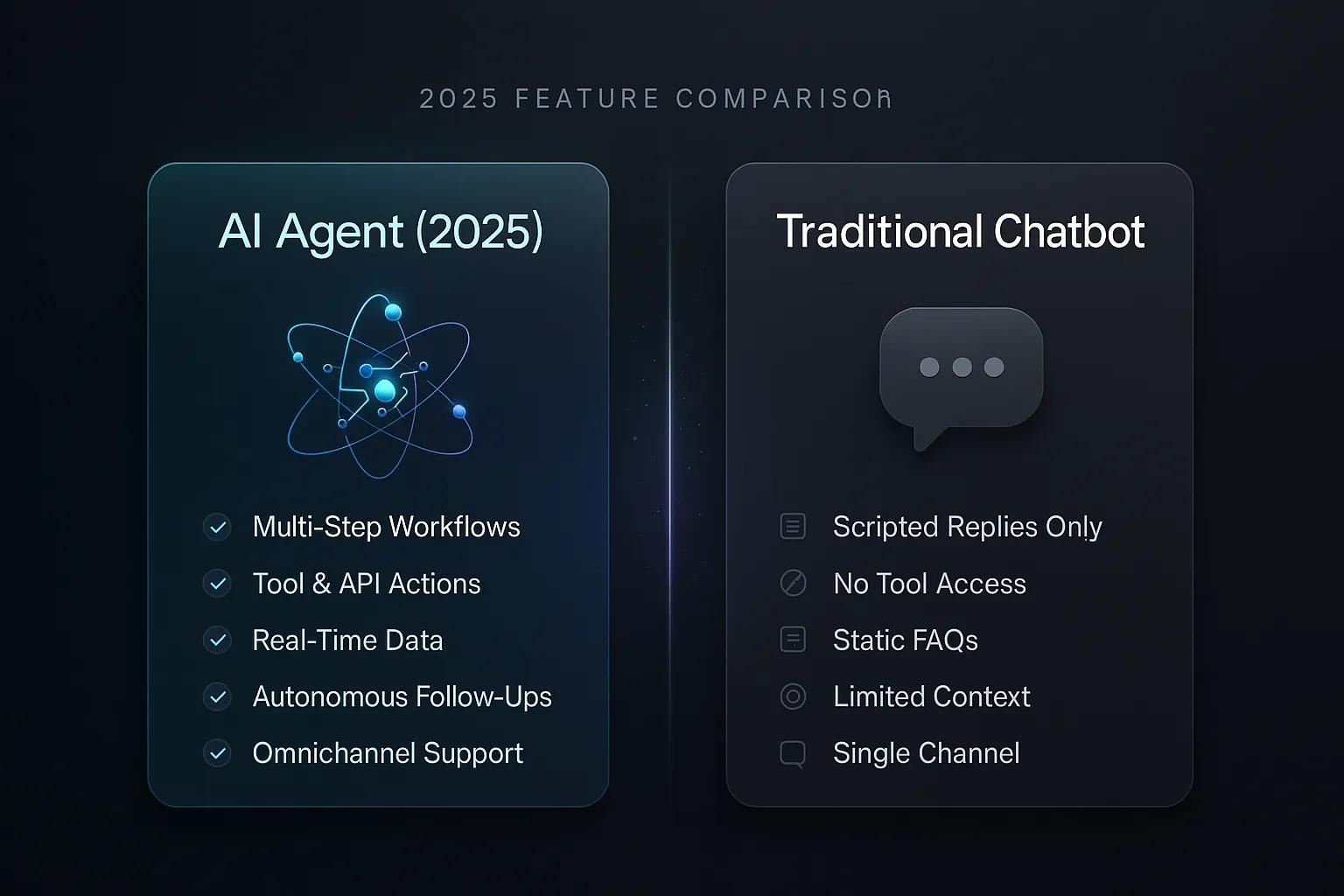
AI Agent vs Traditional Chatbot: 2026 Feature Comparison
It's 11 PM on a Tuesday. A customer reports a damaged package through your support channel. Your traditional chatbot politely apologizes and provides a link to...