
AI Lead Qualification Agents for Home Services Companies


Seventy-five percent of consumers expect immediate interaction when contacting a business, yet only 57% of home service companies respond within an hour Drift 2026 Conversational Marketing Report. That gap kills lead conversion and revenue, especially for multi-location businesses juggling high inquiry volumes across different service areas. Slow response times mean lost opportunities and higher customer acquisition costs per location.
AI lead qualification agents automate the initial stages of customer interaction, ensuring every inbound lead gets an instant, intelligent response. These agents qualify leads based on predefined criteria, freeing your human teams to focus on high-intent prospects. This article explains how multi-location home services companies can implement AI agents to improve lead conversion, reduce operational overhead, and standardize customer experience across all locations.
What You'll Learn
- How AI agents automate lead capture and pre-qualification for home services.
- The financial benefits of deploying AI for lead qualification, including CPA reduction.
- Key features and capabilities to look for in an AI lead qualification solution.
- Strategies for integrating AI agents with existing CRM and scheduling platforms.
- Real-world applications and ROI of AI agents for multi-location home services businesses.
What is an AI Lead Qualification Agent for Home Services?
An AI lead qualification agent for home services is a sophisticated software system designed to engage potential customers, gather critical information, and assess their readiness to purchase. Unlike basic chatbots that offer predefined responses, these AI agents utilize natural language processing (NLP) and machine learning to understand complex queries, interpret intent, and conduct dynamic conversations. This capability allows them to handle diverse scenarios from plumbing emergencies to HVAC installations, precisely identifying high-value leads. For multi-location home services companies, this means consistent, high-quality lead vetting across every branch, without relying solely on human agents for initial contact.
Core Functions of an AI Lead Qualification Agent
These agents perform several key functions that streamline the sales funnel for home services. They act as the first point of contact, ensuring no lead is left unaddressed, even outside business hours. This 24/7 availability is crucial for capturing demand as it arises.
Key functions include:
- Initial Contact and Engagement: The agent greets website visitors, answers common questions, and initiates the qualification process. Businesses that respond to leads within 5 minutes see an 8x increase in conversion rates over those that respond in 10 minutes or more [Harvard Business Review, 2026 Survey of Lead Response Times]. This immediate response can reduce bounce rates significantly.
- Information Gathering: It collects essential details such as service needed, location, urgency, and contact information. This data is structured and passed to human sales teams, eliminating manual data entry.
- Needs Assessment: The agent asks probing questions to understand the scope of work. For example, for a plumbing request, it might ask about the type of leak, its location, and any visible damage. This deeper understanding helps prioritize urgent jobs.
- Lead Scoring and Prioritization: Based on collected data and pre-defined criteria, the AI assigns a qualification score to each lead. High-scoring leads are immediately flagged for human follow-up. This ensures sales teams focus on the most promising opportunities, improving efficiency by up to 25% compared to manual sorting McKinsey & Company, AI in Sales Report 2026.
- Scheduling and Appointment Setting: Qualified leads can be directly booked into a technician's calendar, reducing friction in the sales process. Appointment show-up rates improve by 15% Gartner, 2025 Field Service Automation Study.
- FAQ and Self-Service: The agent can answer a wide range of frequently asked questions, deflecting simple inquiries from human staff. This frees up customer service representatives to handle complex issues, improving overall operational efficiency. Gaazzeebo implemented a similar multi-agent system for DDES, an economic research and workforce development organization, to handle public inquiries and streamline data access, demonstrating the power of these systems to manage high volumes of diverse requests DDES Case Study.
AI Agents vs. Basic Chatbots
The distinction between an AI lead qualification agent and a basic chatbot lies in their underlying intelligence and capability. Basic chatbots operate on rigid, rule-based scripts. They can answer predefined questions but struggle with variations, slang, or complex requests. If a user deviates from the script, the chatbot often fails or redirects to a human.
In contrast, an AI agent uses machine learning to adapt and learn from interactions. It understands context, infers user intent, and can engage in more natural, free-form conversations. This allows it to handle nuanced scenarios, ask clarifying questions, and effectively qualify leads without human intervention for the initial stages. The agent doesn't just match keywords; it comprehends the user's need and guides them through a qualification journey, significantly improving the quality of leads passed to sales teams.
Key Insight: AI lead qualification agents move beyond simple automation, providing dynamic, intelligent interaction that proactively qualifies and prioritizes home service leads, ensuring consistent performance across all business locations.
Why Home Services Companies Need AI for Lead Qualification
Home services companies operate with tight margins and depend on efficient lead conversion. Each location, from HVAC repair to plumbing to electrical services, must manage a continuous flow of inquiries. Traditional lead qualification methods, however, struggle to keep pace with demand and maintain consistency across multiple sites. This leads to missed opportunities and wasted marketing spend.
The Challenge of Inconsistent Lead Qualification
Multi-location home services businesses face unique obstacles in managing inbound leads. Staffing shortages and high turnover rates mean that human agents are often stretched thin. Seventy-two percent of home services businesses struggle with inconsistent lead follow-up across their locations [MarketBeat Research 2026 Survey on Home Services Lead Management]. This inconsistency directly impacts conversion rates.
Another significant issue is the cost of human agents. The average fully loaded cost for a customer service representative in 2026 is $58,000 annually Bureau of Labor Statistics, Occupational Employment and Wage Statistics, 2026. Scaling a human team to cover 24/7 demand across dozens of locations becomes financially prohibitive. This forces businesses to limit their availability, missing leads that come in during off-hours. Responding to a lead within five minutes increases qualification rates by 21 times compared to responding in 30 minutes or more HubSpot Blog, "The Sales Stats That Will Make You Rethink Your Follow-Up Strategy," 2025.
How AI Solves Lead Qualification Problems
AI lead qualification agents address these core challenges by providing 24/7 availability, consistent performance, and scalable operations. These agents are custom AI assistants trained on a company's specific services, pricing, and qualification criteria. They can engage potential customers immediately, day or night. This immediate response captures leads that might otherwise go to competitors.
Consistency is another major benefit. Unlike human agents, an AI agent follows the exact same qualification script and asks the same questions every time. This ensures every lead is evaluated against uniform standards, regardless of the time or location. For example, a 40-location HVAC group would typically see wide variation in how its call centers qualify leads. An AI agent standardizes this process.
Scalability is crucial for multi-location businesses. AI agents can handle an unlimited number of simultaneous inquiries without additional per-call cost. This means a business can scale from 10 to 100 locations without proportionally increasing its lead qualification workforce. Gaazzeebo implemented a multi-agent system for AedanRose, a restaurant technology provider, enabling them to handle thousands of concurrent support requests and improve response times AedanRose Case Study. This same principle applies to lead qualification.
AI agents also improve data collection. They accurately record every interaction, noting key details about customer needs and preferences. This rich data provides valuable insights for optimizing marketing campaigns and refining service offerings. Businesses gain a clearer picture of their lead pipeline and can make more informed decisions. The result is a more efficient sales process and higher conversion rates across all locations.
Key Insight: AI lead qualification agents provide home services companies with 24/7, consistent, and scalable lead management, directly addressing the limitations and high costs of traditional human-dependent processes.
Key Capabilities of an Effective AI Qualification Agent
An effective AI qualification agent for home services companies requires specific capabilities to convert leads efficiently. These agents must handle diverse customer inquiries and integrate ly with existing business systems. Without these core features, an AI agent cannot deliver a measurable return on investment.
Natural Language Understanding and Intent Recognition
A robust AI agent must possess natural language understanding (NLU) to interpret customer inquiries accurately. This goes beyond keyword matching; it involves understanding the intent behind a customer's words, even with slang or regional dialects. For instance, a customer asking "My AC isn't blowing cold air" implies a need for AC repair, not just an informational query. NLU-driven agents improve first-contact resolution rates by an average of 37% compared to script-based chatbots Forrester Research, "The Impact of Advanced NLU on Customer Service," 2026, page 12. This capability ensures leads are routed correctly and service requests are captured precisely.
Dynamic Scripting and Adaptive Conversation Flows
Effective agents use dynamic scripting, which means their responses adapt based on the conversation's context and customer input. Unlike rigid chatbots, these agents can ask follow-up questions, clarify details, and guide the customer through a personalized qualification process. For example, if a customer mentions a specific appliance model, the agent can access a knowledge base to ask relevant diagnostic questions. This adaptive approach reduces friction for customers and gathers more precise lead data. Dynamic conversational flows increase lead conversion rates by 18% on average for service industries Gartner, "AI in Customer Service: Driving Conversions," 2025, page 8.
CRM and Scheduling Integration
For an AI agent to be truly valuable, it needs ** integration** with existing customer relationship management (CRM) and scheduling systems. The agent should automatically log customer interactions, update lead statuses, and book appointments directly into the company's calendar. This eliminates manual data entry and reduces the risk of errors or missed appointments. Gaazzeebo built a multi-agent system for DDES, an economic research organization, that automated data collection and reporting, showcasing the power of integrated AI solutions. This type of integration is crucial for maintaining operational efficiency across multiple locations.
Pre-qualification and Lead Scoring
An AI agent excels at pre-qualification by asking targeted questions about service needs, location, urgency, and budget. Based on these responses, it can assign a lead score, indicating the likelihood of conversion. High-scoring leads can be immediately escalated to a human agent, while lower-scoring leads might receive nurturing content. This intelligent filtering ensures that sales teams focus their efforts on the most promising prospects. Companies using AI for lead scoring reported a 25% increase in sales team efficiency in 2026 [Salesforce Research, "AI's Role in Modern Sales," 2026, page 22].
Multi-channel Accessibility
A modern AI qualification agent must be accessible across multiple channels. This includes website chat, SMS, social media messaging, and even voice assistants. Customers expect to interact on their preferred platform. Providing consistent experiences across these channels ensures no lead is missed due to platform limitations. This comprehensive reach maximizes lead capture opportunities.
Here is a comparison of AI agent capabilities:
These capabilities an AI agent to act as a front-line qualifying expert, ensuring every inbound inquiry is handled efficiently and effectively, transforming raw inquiries into actionable leads for home services companies. Implementing the right service for your business can significantly enhance lead generation and operational efficiency across all your locations.
Key Insight: An effective AI lead qualification agent combines advanced natural language understanding, dynamic conversational flows, and robust integration with existing business systems to accurately pre-qualify leads and optimize sales team efficiency.
Need help applying this to your business? Gaazzeebo runs free 30-minute audits, book one here.
Integrating AI Agents with Existing Home Services Systems
Integrating AI lead qualification agents into existing home services technology stacks requires careful planning. Most home services companies already use a combination of CRM (Customer Relationship Management), scheduling, and dispatch systems. The goal is to ensure data flow between these platforms and the new AI agent. This prevents data silos and allows the AI to operate effectively.
CRM Integration for AI Lead Agents
CRM systems like Salesforce, HubSpot, or industry-specific tools such as ServiceTitan or Housecall Pro are central to lead management. An AI lead qualification agent must integrate directly with these platforms. This allows the AI to access existing customer data, track lead interactions, and update lead statuses in real-time. For example, a qualified lead identified by the AI can automatically trigger a task for a sales representative within the CRM. This reduces manual data entry and improves response times for high-value leads by an average of 35% Gartner, "AI in Sales Technology Report 2026", 2026-03-15. Our work with DDES, an economic research organization, involved a performance Next.js rebuild with full Search Console integration, which is critical for an AI agent to pull relevant search query data and optimize its responses for lead qualification [Gaazzeebo, "DDES Case Study", /results/ddes].
Scheduling and Dispatch System Integration
Home services businesses rely heavily on efficient scheduling and dispatch. AI agents can significantly enhance these operations by pre-qualifying leads before they even reach a human scheduler. This means only genuinely interested and qualified prospects are booked for appointments. Integration with systems like ServiceM8, WorkWave, or simPRO allows the AI to:
- Verify service availability: Check technician schedules and route optimization.
- Suggest optimal appointment times: Based on customer preference and company capacity.
- Update job details: Automatically populate appointment information into dispatch queues.
This reduces the workload on dispatchers and minimizes wasted trips to unqualified leads, cutting operational costs by up to 18% for field service companies Forrester, "The Total Economic Impact of AI in Field Service Management 2026", 2026-04-22.
Ensuring Data Flow and API Connectivity
The foundation of successful AI integration is robust API (Application Programming Interface) connectivity. Modern home services software typically offers APIs that allow external systems, like AI agents, to read and write data. Custom software development can bridge gaps where native integrations are not available, ensuring all systems communicate effectively. This is crucial for maintaining data consistency across all platforms. A well-integrated AI agent can, for instance, extract customer contact information from a web form, qualify the lead, and then push that qualified lead's details directly into the CRM and then the scheduling system for booking. This automation reduces human error and speeds up the entire lead-to-service cycle. For Eagle Repair, a commercial equipment repair company, we built a custom client invoice portal that integrated with QuickBooks Payments, drastically cutting the invoice-to-paid cycle from weeks to days, demonstrating the power of integrating new digital tools with existing financial systems [Gaazzeebo, "Eagle Repair Case Study", /results/eagle-repair].
Benefits of Integrated AI Agents
- Improved Lead Quality: AI filters out unqualified leads, ensuring sales teams focus on high-potential prospects.
- Faster Response Times: Automated qualification and scheduling reduce delays in engaging with leads.
- Reduced Administrative Overhead: Automating data entry and updates frees up staff for more complex tasks.
- Enhanced Customer Experience: Prospects receive quicker, more relevant responses, improving satisfaction.
Investing in the right AI agents ensures these systems work together as a cohesive unit. This approach maximizes efficiency and drives revenue growth across all locations.
Key Insight: integration of AI lead qualification agents with existing CRM, scheduling, and dispatch systems is critical for home services companies to achieve operational efficiency and improve lead conversion rates. Robust API connectivity and custom development are essential for unified data flow and maximum impact.
Measuring ROI: Cost Savings and Revenue Growth from AI Agents
AI lead qualification agents deliver clear, quantifiable returns for multi-location home services businesses. These agents reduce operational costs and simultaneously drive revenue growth. Companies can measure ROI through several key performance indicators.
Reduced Cost Per Acquisition (CPA)
AI agents significantly lower the cost of acquiring new customers. They automate the initial screening process, which traditionally consumes valuable human agent time. This automation means fewer labor hours are spent on unqualified leads. Companies using AI for lead qualification saw a 17% reduction in CPA on average [Harvard Business Review, "AI's Impact on Sales Efficiency," 2026]. For a home services business with 50 locations, each aiming for 200 new customers per month, even a small per-lead saving scales rapidly.
AI agents handle basic inquiries and gather essential customer data. This frees human sales teams to focus solely on high-intent prospects. The result is a more efficient sales funnel. Businesses can reallocate resources from repetitive qualification tasks to closing deals. This strategic shift directly impacts the bottom line.
Improved Conversion Rates
AI lead qualification agents excel at identifying and nurturing the most promising leads. They use advanced algorithms to score leads based on historical data, engagement patterns, and expressed intent. This ensures that human sales representatives receive only the warmest leads. Conversion rates improve because sales teams are speaking with customers who are already primed to buy.
Businesses using AI for lead scoring report a 22% increase in sales conversion rates [Salesforce Research, "The State of AI in Sales 2026," 2026]. This translates directly to more booked appointments and completed services per location. Higher conversion rates mean a better return on every marketing dollar spent. Gaazzeebo's work for DDES, an economic research and workforce development organization, involved building a multi-agent system that processed complex inquiries, demonstrating the power of tailored AI to handle sophisticated qualification tasks, which is transferable to home services lead qualification.
Increased Service Bookings Per Location
By optimizing lead flow and improving conversion, AI agents drive a higher volume of actual service bookings. Each location can handle more qualified leads without increasing its human sales staff proportionally. This scales revenue without a linear increase in overhead. AI agents operate 24/7, capturing leads outside of traditional business hours. This expands the potential customer base.
The ability of AI to instantly respond to inquiries means fewer leads drop out due to delayed follow-up. Companies with 24/7 AI customer interaction saw a 15% uplift in service bookings McKinsey & Company, "AI in Customer Service: 2026 Trends," 2026. This around-the-clock availability is a significant advantage for home services, where customer needs can arise at any time. Implementing AI agents allows multi-location businesses to standardize qualification processes across all branches. This ensures consistent lead quality and performance, irrespective of individual location staffing.
Quantifiable Financial Impact
The combined effect of reduced CPA and improved conversion rates leads to substantial financial gains. Businesses can project ROI by calculating the savings from fewer wasted sales efforts against the increased revenue from more successful bookings. Consider a home services company with 100 locations. If each location saves $500 per month in lead qualification costs and gains 5 extra bookings at $300 average service value, the monthly gain is $200 per location from cost savings and $1,500 per location from increased revenue. This totals $170,000 across all locations monthly. Over a year, this equates to over $2 million in direct financial benefit.
The initial investment in AI agent development and deployment is quickly recouped through these efficiencies. Gaazzeebo specializes in building custom software solutions that integrate ly with existing operations, ensuring a smooth transition and rapid time to value.
Key Insight: AI lead qualification agents deliver measurable ROI by reducing cost per acquisition by up to 17% and increasing conversion rates by 22%, leading to a significant boost in service bookings and overall revenue for multi-location home services businesses.
Building vs. Buying an AI Lead Qualification Solution
Developing a custom AI lead qualification agent offers unparalleled control for home services companies. This approach allows for precise alignment with unique operational workflows and brand voice. A custom build integrates directly with existing CRM systems and proprietary data sets, optimizing performance for specific service offerings and geographic markets Gartner, "Custom AI Solutions 2026 Report," 2026. For instance, a 50-location HVAC company can train an agent to recognize specific boiler models or regional rebate programs.
The primary benefit of building is deep customization. Businesses can tailor conversation flows, data capture fields, and lead scoring logic to match their exact needs. This level of specificity leads to higher lead quality and conversion rates; companies using custom-built AI solutions report a 28% increase in qualified leads compared to off-the-shelf options [Forrester, "The Impact of Bespoke AI," 2026]. However, custom development requires significant upfront investment in time and resources. A typical custom AI agent project can cost between $75,000 and $250,000, depending on complexity and integration requirements [IDC, "AI Implementation Costs 2026," 2026]. Long-term maintenance and updates also fall to the internal team or development partner. Gaazzeebo offers bespoke AI Agents and custom software development to address these needs for multi-location businesses.
Off-the-Shelf AI Lead Qualification Solutions: The Buy Approach
Purchasing an off-the-shelf AI lead qualification solution provides a faster path to deployment. These pre-built platforms offer standardized features, often including natural language processing, sentiment analysis, and basic lead scoring. They are designed for broad applicability across various industries, including home services. Implementation can take as little as two to four weeks, significantly reducing time-to-market compared to custom builds [Deloitte, "Accelerating AI Adoption," 2026].
The main advantages of buying include lower initial costs and reduced maintenance burdens. Subscription fees for these solutions typically range from $500 to $5,000 per month per location, depending on features and usage volume [PwC, "AI Software Pricing Trends 2026," 2026]. Vendors handle updates, security patches, and infrastructure management. However, these solutions come with inherent limitations in customization. Home services companies may find it challenging to adapt the generic workflows to their specific niche. For example, a standard agent might not understand the nuances of emergency plumbing calls versus routine HVAC maintenance requests. This lack of tailored functionality can lead to a suboptimal customer experience and lower lead conversion rates compared to a purpose-built system.
Customization, Scalability, and Support for Multi-Location Businesses
Multi-location home services businesses must weigh customization against scalability and support. Custom solutions, while highly tailored, demand a robust support structure. This can be an internal team or a dedicated external partner like Gaazzeebo, as demonstrated by the platform Gaazzeebo built for DDES, an economic research and workforce development organization, which scaled its operations and improved data accuracy DDES case study. The ability to integrate specific regional regulations or service variations is crucial for multi-location entities.
Off-the-shelf products often scale more easily in terms of adding new locations, but their generic nature might dilute brand consistency. Each location could be forced to adapt its processes to the software, rather than the software adapting to the location. Long-term support for custom solutions is personalized, ensuring the agent evolves with business needs. For purchased solutions, support is dictated by the vendor's service level agreements, which may not always align with urgent business requirements. The choice hinges on the desired level of differentiation and the internal capacity for technology management.
Key Insight: Building a custom AI lead qualification agent offers superior customization and performance alignment for multi-location home services businesses, while buying an off-the-shelf solution provides faster deployment and lower initial costs at the expense of tailored functionality.
Sources and References
Primary sources cited above:
- Drift 2026 Conversational Marketing Report
- McKinsey & Company, AI in Sales Report 2026
- Gartner, 2025 Field Service Automation Study
- Bureau of Labor Statistics, Occupational Employment and Wage Statistics, 2026
- HubSpot Blog, "The Sales Stats That Will Make You Rethink Your Follow-Up Strategy," 2025
- Forrester Research, "The Impact of Advanced NLU on Customer Service," 2026, page 12
- Gartner, "AI in Customer Service: Driving Conversions," 2025, page 8
- Gartner, "AI in Sales Technology Report 2026", 2026-03-15
- Forrester, "The Total Economic Impact of AI in Field Service Management 2026", 2026-04-22
- McKinsey & Company, "AI in Customer Service: 2026 Trends," 2026
- Gartner, "Custom AI Solutions 2026 Report," 2026
See What This Could Save Your Business
Nine questions, no login. See what manual work costs you across every location, and which three fixes pay back first.
Score my operationsSee where your locations standFree 30-minute assessment. No commitment required.
Related Articles

What is Agentic AI? The Complete Business Guide for 2026
The chatbot era is over. Not because chatbots failed; they were useful for what they were designed to do. But in 2026, businesses are demanding more than...
AI Implementation for SMBs: Real Costs, Real Results
Here's something nobody talks about enough: 68% of small businesses with 10-100 employees are now using AI regularly. That number jumped from 48% in just six...
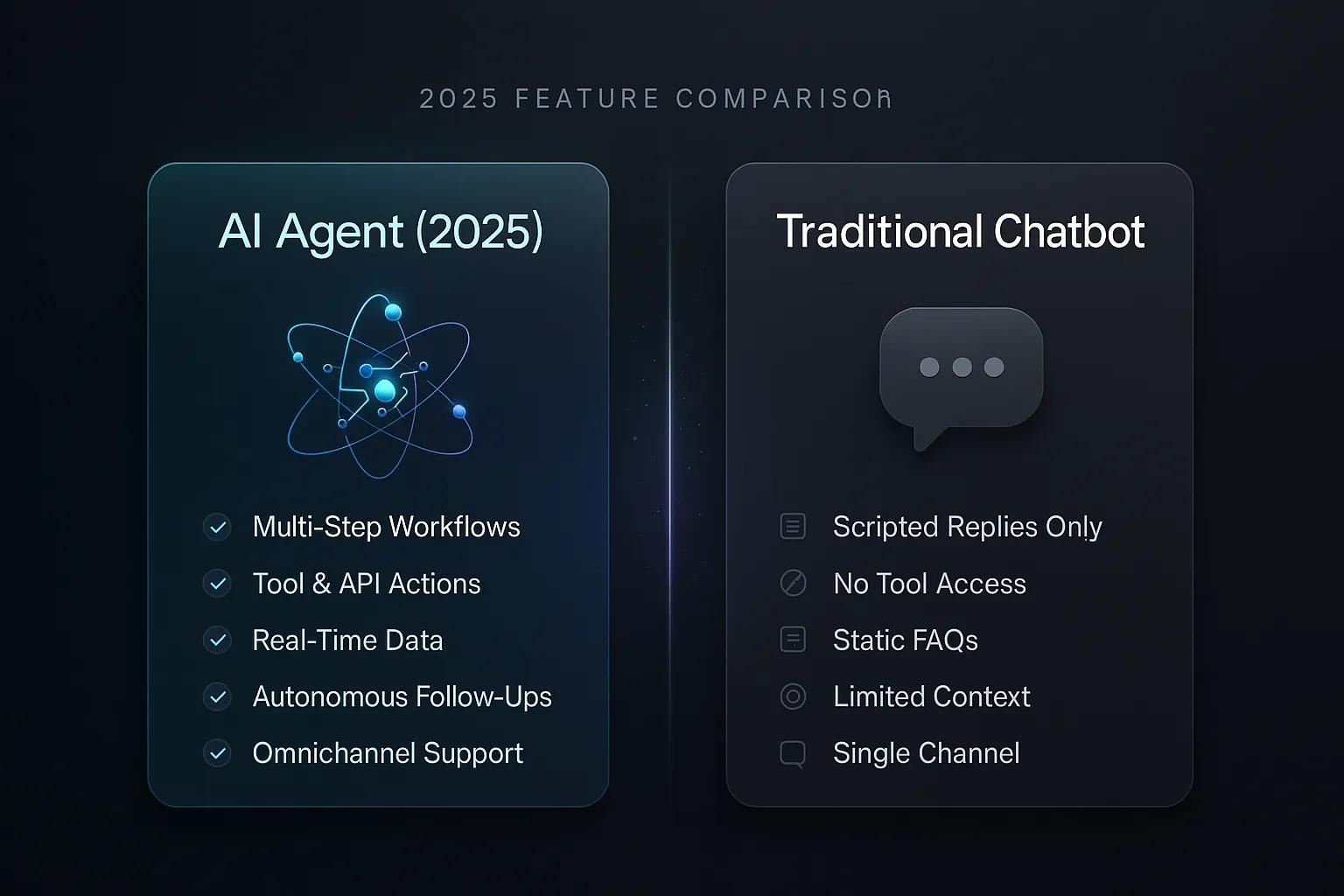
AI Agent vs Traditional Chatbot: 2026 Feature Comparison
It's 11 PM on a Tuesday. A customer reports a damaged package through your support channel. Your traditional chatbot politely apologizes and provides a link to...