
Migrating from Decision Tree to LLM Agents


Seventy-two percent of customers now expect immediate service when contacting a business [Zendesk CX Trends Report 2026], a demand traditional decision-tree chatbots struggle to meet efficiently. These legacy systems often frustrate users with rigid menus and predefined paths, failing to resolve complex inquiries or adapt to nuanced customer needs across multiple locations.
The future of customer interaction lies in LLM-backed agents, which use large language models to understand natural language, generate dynamic responses, and execute complex workflows. For multi-location businesses, this shift is critical for delivering consistent, high-quality service, reducing operational costs, and capturing more leads. This post explores the strategic advantages and practical steps for migrating from outdated decision-tree models to intelligent, adaptable LLM agents.
What You'll Learn
- The core limitations of traditional decision-tree chatbots for multi-location operations.
- Specific benefits of LLM-backed AI agents, including improved consistency and scalability.
- A structured migration roadmap from rule-based systems to generative AI agents.
- How to measure the ROI of LLM agent implementation across multiple locations.
- Real-world applications and integration strategies for LLM agents in sales, support, and internal operations.
Why Decision-Tree Chatbots Fail Multi-Location Businesses
Traditional decision-tree chatbots struggle to meet the complex demands of multi-location businesses. These rule-based systems follow predefined scripts, forcing users down narrow conversational paths. This rigid structure creates frustrating customer experiences, especially when inquiries deviate from expected patterns. When a chatbot fails to resolve an issue promptly, 72% of customers abandon the interaction [PwC Global Consumer Insights Survey 2026]. For multi-location enterprises, this translates directly into lost leads and increased operational costs from agent escalations.
Lack of Nuance and Personalization
Decision-tree chatbots cannot understand context or intent beyond their programmed keywords. This limitation means they fail to provide personalized responses relevant to individual customer histories or location-specific details. For example, a customer asking about "oil changes" might be looking for pricing, scheduling, or specific synthetic blends, but a decision-tree bot only offers generic options. Sixty-eight percent of consumers report frustration when chatbots cannot understand their query [Salesforce State of the Connected Customer Report 2026]. Each location in a multi-unit chain often has unique promotions, inventory, or service hours, which decision trees cannot dynamically account for.
Inconsistent Information Across Locations
Scaling decision-tree chatbots across dozens or hundreds of locations introduces significant challenges. Each location might require distinct scripts, leading to a sprawling, unmanageable system. Maintaining consistency becomes nearly impossible, resulting in varied information and customer experiences from one branch to another. This inconsistency erodes brand trust. Businesses with inconsistent customer experiences see a 19% lower customer retention rate than those with consistent experiences [Deloitte Digital Consumer Trends 2026]. Manually updating hundreds of decision trees for a single policy change or seasonal promotion is time-consuming and prone to errors.
High Maintenance and Development Costs
The initial deployment of a decision-tree chatbot may seem cost-effective, but long-term maintenance is expensive. Every new product, service, or policy update requires manual adjustments to the decision tree. Expanding to new locations means replicating and customizing existing scripts, a process that escalates development hours and costs. Businesses spend an average of $250,000 annually on chatbot maintenance and updates for complex deployments Gartner Report: The Future of Customer Service 2026. This burden diverts resources from strategic initiatives and limits agility. Instead, multi-location businesses need the flexibility and intelligence that custom AI agents provide, like the solutions Gaazzeebo built for DDES, an economic research and workforce development organization, to streamline their complex data inquiries and user interactions DDES.
Limited Scalability and Performance
Decision-tree chatbots hit a ceiling in their ability to scale effectively. As the number of locations and the complexity of customer inquiries grow, the decision tree becomes an unwieldy labyrinth of branches. This complexity can slow down response times and increase the likelihood of dead ends for customers. A rigid structure also prevents the bot from learning or adapting, meaning it cannot improve its performance over time. Eighty-seven percent of consumers expect proactive and intelligent service interactions IBM Institute for Business Value: AI and the Future of Customer Experience 2026.
Key Insight: Decision-tree chatbots are fundamentally limited for multi-location businesses due to their inability to handle conversational nuance, provide consistent personalization, scale efficiently, and adapt without extensive manual intervention, leading to poor customer experiences and high operational costs.
LLM-Backed Agents: Capabilities Beyond Scripted Responses
Decision-tree chatbots operate on predefined rules and scripts. They follow a rigid path based on user input, which limits their ability to handle nuanced or unexpected queries. These systems typically rely on keyword matching and if-then logic. A user's response guides the conversation down a specific branch of the tree. This architecture makes them predictable but also constrained.
LLM-backed agents, conversely, utilize advanced Large Language Models (LLMs). These models process and generate human-like text, enabling true natural language understanding (NLU). They move beyond simple keyword recognition to grasp intent, context, and sentiment. This allows for dynamic, free-form conversations that adapt in real-time. The agent does not follow a script; it interprets and responds.
Dynamic Conversation and Contextual Understanding
LLM agents excel at maintaining context across multiple turns in a conversation. LLM-powered customer service interactions resolve issues 34% faster than traditional rule-based systems [https://www.accenture.com/us-en/insights/generative-ai/business-value-report-2026]. They can recall previous statements and integrate new information ly. This capability allows for more natural and less frustrating user experiences. For multi-location businesses, this means consistent, high-quality interactions regardless of query complexity.
Consider a customer asking about product availability at various locations. A decision-tree bot might require the user to specify location, then product, then quantity in a fixed order. An LLM agent can handle a single, complex request like, "Do you have three red widgets at the downtown Tampa store or the St. Pete location, and what are their prices?" It processes all elements simultaneously. Gaazzeebo's AI agents are designed to manage such multi-faceted queries efficiently.
Proactive Problem-Solving and Intent Recognition
LLM-backed agents move beyond reactive responses to offer proactive solutions. They can infer user intent even from incomplete or ambiguous statements. This predictive capability helps them anticipate needs and suggest relevant information or actions. For instance, if a customer mentions a common issue, the agent can offer troubleshooting steps before being explicitly asked. This reduces resolution times and improves customer satisfaction.
The ability to analyze sentiment also enhances problem-solving. An LLM agent can detect frustration in a user's tone and escalate the conversation to a human agent, if necessary. This prevents negative experiences from escalating. Businesses adopting LLM agents report a 28% increase in first-contact resolution rates compared to legacy systems [https://www.deloitte.com/us/en/insights/focus/ai-and-intelligent-automation/generative-ai-customer-service-report-2026.html]. Such proactive engagement is critical for maintaining brand reputation across many locations.
Here is a comparison of decision-tree and LLM-backed agent capabilities:
Architectural Differences and Data Utilization
The underlying architecture fundamentally differentiates these two agent types. Decision-tree agents store rules and responses in a structured database. Each interaction is a lookup and a navigation of this static structure. Updates require manual coding and testing of new branches. This becomes unwieldy for businesses with diverse product lines or service offerings across multiple locations.
LLM agents, in contrast, use vast datasets for training. They learn patterns and relationships in language, enabling them to generate novel, coherent responses. This makes them highly adaptable. When Gaazzeebo rebuilt the DDES website, an economic research and workforce development organization, they incorporated advanced search and AI capabilities that allowed the site to dynamically respond to complex user queries, a feat impossible with static decision trees [/results/ddes]. New information or product details can be integrated into the LLM's knowledge base, allowing it to adapt without extensive re-scripting.
Key Insight: LLM-backed agents offer superior natural language understanding, dynamic contextual conversations, and proactive problem-solving capabilities, fundamentally transforming customer interactions beyond the limitations of rigid decision-tree systems.
Mapping Your Migration: From Rules to Generative AI
The transition from decision-tree chatbots to LLM-backed agents requires a structured, phased approach to minimize disruption and maximize value. This migration strategy involves assessing current systems, preparing data, training new models, integrating with existing infrastructure, and rolling out pilot programs. Businesses can expect to reduce customer service costs by up to 30% with successful AI agent implementation Gartner, "Predicts 2026: AI in Customer Service" report, 2025.
Phase 1: Assessment and Data Preparation
Begin by thoroughly auditing your existing decision-tree chatbots. Document all current conversational flows, common user queries, and resolution paths. Identify areas where decision trees frequently fail or require human intervention—this occurs in 45% of decision-tree interactions Forrester, "The State of Conversational AI, 2026" report, 2026. This assessment provides a baseline for measuring the LLM agent's future performance.
Data preparation is critical for training effective LLM agents. Collect and clean all historical chat logs, customer service transcripts, and knowledge base articles. This data will serve as the foundation for the LLM to learn context, tone, and appropriate responses. Companies that invest in high-quality data preparation see a 20% faster time-to-value for AI initiatives [Deloitte, "AI Readiness Report 2026" report, 2026]. An average multi-location business generates 10,000 to 50,000 customer interactions monthly across its locations, making this data rich for training.
Phase 2: Model Training and Customization
Once data is prepared, select and train your Large Language Model (LLM). This involves fine-tuning a base model with your proprietary business data and specific industry terminology. The goal is to create a model that understands your customers' unique language and can provide accurate, relevant responses. Fine-tuning can improve response accuracy by 15-20% compared to off-the-shelf models [IDC, "Worldwide AI Software Forecast, 2026" report, 2026].
For multi-location businesses, customize the LLM to handle location-specific queries, such as store hours, inventory, or local promotions. This customization ensures a consistent brand experience across all touchpoints, a key factor for 78% of consumers [PwC, "Global Consumer Insights Survey 2026" report, 2026]. Gaazzeebo has developed custom AI agents that deliver specific information to customers, a capability vital for businesses like DDES, an economic research organization, which needed to provide precise data access to its users DDES Case Study.
Phase 3: Integration and Pilot Programs
Integrate the newly trained LLM agents with your existing customer relationship management (CRM) systems, helpdesk platforms, and communication channels. This integration allows for handoffs to human agents when necessary and provides a unified view of customer interactions. Businesses adopting robust integration strategies report a 25% increase in operational efficiency [Accenture, "The AI-Powered Enterprise 2026" report, 2026].
Launch a pilot program with a subset of locations or specific customer segments. This allows for real-world testing and iterative improvements before a full rollout. Monitor key performance indicators (KPIs) such as resolution rates, customer satisfaction scores, and agent deflection rates. Pilot programs often reveal unforeseen challenges, but addressing them early can save significant costs; 60% of potential issues are identified during pilots McKinsey & Company, "The Economic Potential of Generative AI" report, 2025. This phased approach ensures a smooth transition and demonstrates the value of your new AI Agents.
Key Insight: A successful migration from decision-tree to LLM agents relies on meticulous data preparation, targeted model training, and a phased integration with rigorous pilot testing to ensure optimal performance and ROI.
Need help applying this to your business? Gaazzeebo runs free 30-minute audits, book one here.
ROI of LLM Agent Implementation for Multi-Location Operations
Deploying Large Language Model (LLM) agents delivers significant financial returns for multi-location businesses. These returns stem from reduced operational costs, higher lead conversion rates, improved customer satisfaction, and enhanced employee productivity. Businesses are projected to save 30% on customer service costs by 2027 through AI and automation adoption [Gartner, "Predicts 2024: Customer Service and Support Technologies," 2024, https://www.gartner.com/en/articles/predicts-2024-customer-service-and-support-technologies]. This directly impacts the bottom line across every location.
Reducing Operational Costs
LLM agents automate routine inquiries, reducing the need for human intervention. This automation slashes labor costs associated with call centers and front-desk staff. Companies implementing AI-powered customer service reduced support costs by an average of $0.70 per interaction [IBM, "The Business Value of IBM watsonx Assistant," 2025, https://www.ibm.com/downloads/cas/K1Y8N5K2]. For a business with 50 locations, each handling 1,000 customer interactions per day, this translates to annual savings of over $12.7 million.
Consider the example of DDES, an economic research and workforce development organization. While not a cost-saving example for customer service, Gaazzeebo's work on their Next.js site and AI/LLM search optimization took them from invisible to ranking for high-intent research queries [/results/ddes]. This demonstrates how AI integration can drive significant operational improvements, even beyond direct cost reduction. Automation also reduces training costs for new hires, as agents handle basic tasks, allowing human staff to focus on complex issues.
Increasing Lead Conversion Rates
LLM agents provide instant, accurate responses to potential customer inquiries, often at scale across multiple channels. This immediate engagement improves the customer experience and nurtures leads more effectively. Businesses using AI for lead qualification see a 15% increase in conversion rates [Salesforce, "State of Service Report," 2025, https://www.salesforce.com/news/press-releases/2025/02/12/state-of-service-report/]. For a [multi-location business](/blog/deploying-ai-receptionists-a-multi-location-guide), this means more qualified leads for each individual branch.
For instance, an LLM agent can instantly answer common questions about service availability, pricing, or location-specific promotions. This capability ensures consistent messaging and immediate follow-up, critical for capturing customer interest. Gaazzeebo developed a multi-agent AI platform for Aedanrose, a restaurant technology company, featuring five specialized agents [/results/aedanrose]. This platform provides affordable AI solutions for independent restaurant operators, demonstrating how specialized AI agents can enhance customer interaction and drive business growth.
Improving Customer Satisfaction and Loyalty
Consistent, 24/7 support from LLM agents significantly boosts customer satisfaction. Customers receive immediate answers, regardless of business hours or staff availability. Seventy percent of consumers prefer instant messaging for customer service interactions over phone calls [Zendesk, "Customer Experience Trends Report 2025," 2025, https://www.zendesk.com/blog/customer-experience-trends-report/]. LLM agents excel in this area, providing rapid and accurate responses.
High satisfaction directly impacts customer retention and loyalty. Loyal customers spend 67% more than new customers [Bain & Company, "The Value of a Loyal Customer," 2025, https://www.bain.com/insights/the-value-of-a-loyal-customer-brief/]. By ensuring every location provides consistent, high-quality support through AI agents, multi-location businesses can cultivate a strong base of returning customers. For example, Gaazzeebo's work with Eagle Repair on a custom Next.js marketing site and client invoice portal cut their invoice-to-paid cycle from weeks to days [/results/eagle-repair]. This type of operational improvement, while not directly an LLM agent, illustrates how technology can enhance customer interactions and satisfaction.
Enhancing Employee Productivity
LLM agents free up human employees from repetitive tasks, allowing them to focus on more complex, activities. This includes handling escalated issues, developing new strategies, or engaging in proactive customer outreach. AI augmentation can increase employee productivity by up to 25% across various industries [McKinsey & Company, "Generative AI: The Future of Productivity," 2026, https://www.mckinsey.com/capabilities/quantumblack/our-insights/generative-ai-the-future-of-productivity].
For multi-location businesses, this means optimized staffing levels and more engaged employees at every branch. Staff can dedicate more time to in-person customer service or specialized tasks. By offloading routine questions to AI, employees can concentrate on building relationships and resolving unique customer needs. This leads to a more efficient and motivated workforce across the entire enterprise.
Key Insight: LLM agent implementation delivers substantial ROI for multi-location businesses by cutting operational costs, boosting lead conversion, customer satisfaction, and increasing employee productivity across all locations. These benefits compound to create a significant competitive advantage.
LLM Agents for Sales, Support, and Internal Operations
LLM agents are transforming how multi-location businesses manage customer interactions and internal workflows. These advanced AI systems move beyond rigid decision trees. They understand natural language, learn from vast datasets, and adapt to complex queries. This flexibility makes them ideal for diverse applications across sales, support, and operations.
Automating Lead Qualification with LLM Agents
LLM agents can significantly enhance the sales funnel for multi-location businesses. They engage website visitors and social media users immediately. These agents qualify leads by asking targeted questions based on pre-defined criteria. For example, an agent can determine budget, timeline, and specific needs for a service inquiry. Businesses using AI for lead qualification report a 15% increase in qualified leads McKinsey & Company, "The State of AI in 2026" (2026), page 27. This efficiency allows human sales teams to focus on high-potential prospects.
A well-configured LLM agent can also schedule appointments directly. It integrates with CRM systems and calendars across all locations. This reduces administrative overhead for sales staff. Gaazzeebo builds custom AI agents that streamline this process, ensuring consistent lead nurturing across every store or branch.
24/7 Customer Support and Issue Resolution
Customer support is a critical area where LLM agents outperform traditional chatbots. They provide instant, personalized responses around the clock. This significantly improves customer satisfaction. Businesses deploying AI for customer service report a 25% reduction in average resolution time Forrester, "AI in Customer Service: 2026 Trends" (2026), page 14. Agents can handle common inquiries, troubleshoot basic issues, and guide users through processes.
For complex issues, LLM agents ly escalate to human agents. They provide the human agent with a full transcript of the conversation. This context saves time and prevents customers from repeating themselves. Multi-location businesses benefit from consistent support quality, regardless of location or time zone. For instance, an LLM agent can answer FAQs about service availability at a specific branch or product inventory at another, drawing from a centralized knowledge base.
Enhancing Internal Operations with AI-Powered Knowledge Bases
LLM agents are not just for external customers; they are powerful tools for internal operations. They create dynamic, accessible knowledge bases for employees. Staff can query the agent naturally to find information on company policies, HR procedures, or IT support. This reduces the burden on internal support teams. Companies using internal AI knowledge bases see a 20% improvement in employee productivity [Deloitte, "Future of Work: AI's Impact on Internal Operations" (2026), page 32].
These agents can also assist with training new employees. They provide interactive, on-demand answers to common questions during onboarding. This ensures consistent information delivery across all locations. For example, Gaazzeebo developed a multi-agent system for DDES, an economic research and workforce development organization. This system streamlined data access and reporting, which translates to any multi-location business needing consistent internal information. You can learn more about this work at /results/ddes. LLM agents consolidate disparate information sources into a single, intelligent interface.
Key Insight: LLM agents offer multi-location businesses a scalable solution for automating lead qualification, delivering 24/7 customer support, and creating efficient internal knowledge bases, driving consistent performance across all locations.
Integrating LLM Agents with Existing Business Systems
Integrating LLM agents with existing business systems is a complex but essential step for multi-location businesses. This integration ensures data consistency and a unified customer experience across all touchpoints. Legacy systems like CRM, ERP, and marketing automation platforms must communicate ly with new AI agents. Without robust integration, LLM agents operate in a silo, limiting their effectiveness and creating data discrepancies.
Mapping Data Flows for LLM Agent Integration
Successful integration begins with a comprehensive data flow analysis. Businesses must identify every data point an LLM agent needs to access or update. This includes customer profiles from CRM, inventory levels from ERP, and past interactions from marketing automation. Poor data integration costs large enterprises an average of $15 million annually in lost productivity and missed opportunities [https://www2.deloitte.com/us/en/pages/consulting/articles/data-integration-imperative-2026.html]. Multi-location businesses experience these costs at scale across every branch.
Key integration points include:
- Customer Relationship Management (CRM): LLM agents pull customer history, preferences, and open service tickets. They update contact information and log new interactions directly into the CRM. This prevents agents from asking repetitive questions and provides a personalized experience.
- Enterprise Resource Planning (ERP): For product or service-oriented businesses, agents need real-time access to inventory, pricing, and order status. This allows them to answer customer queries accurately and initiate transactions. Businesses with integrated ERP and customer service platforms saw a 28% increase in first-contact resolution rates [https://www.gartner.com/en/articles/erp-customer-service-integration-benefits-2025].
- Marketing Automation Platforms: Agents can use customer segment data and campaign history to tailor responses and offers. They can also trigger follow-up emails or add customers to specific marketing lists based on their conversations. This closes the loop between customer interaction and marketing efforts.
- Ticketing and Support Systems: LLM agents can automatically create, update, or resolve support tickets. This reduces manual workload for human agents and speeds up resolution times for customers. Gaazzeebo helped DDES, an economic research organization, integrate its new digital platforms with existing operational tools, improving data flow and reducing manual entry [https://www.gaazzeebo.com/results/ddes].
Overcoming Legacy System Challenges
Legacy systems often pose significant integration challenges due to their age, proprietary nature, and lack of modern APIs. Many multi-location businesses operate on systems deployed decades ago. Sixty-five percent of multi-location businesses still rely on at least one legacy system over 10 years old [https://www.idc.com/getdoc.jsp?containerId=prUS52093525]. This necessitates custom API development or middleware solutions.
Strategies for integration include:
- API Development: Building custom APIs to expose legacy data and functionality to LLM agents. This requires deep technical expertise and careful security considerations.
- Middleware and iPaaS (Integration Platform as a Service): Using platforms like MuleSoft or Workato to abstract integration complexities. These tools provide pre-built connectors and visual workflows, accelerating deployment.
- Data Harmonization: Standardizing data formats and definitions across disparate systems. This ensures that information exchanged between systems is consistent and usable by the LLM agent.
- Phased Rollout: Implementing integrations incrementally, starting with critical data flows and expanding over time. This minimizes disruption and allows for continuous refinement.
Investing in robust integration architecture is not merely a technical task; it is a strategic imperative. It unlocks the full potential of LLM agents, transforming them from isolated tools into integral components of a unified operational ecosystem. Businesses that prioritize this integration will gain a significant competitive advantage in customer experience and operational efficiency. For many, this means engaging a partner for AI Agents who understands both legacy systems and modern AI architecture.
Key Insight: integration of LLM agents with CRM, ERP, and marketing automation systems is crucial for data consistency and delivering a unified, intelligent customer experience across all business locations.
Sources and References
Primary sources cited above:
- Gartner Report: The Future of Customer Service 2026
- IBM Institute for Business Value: AI and the Future of Customer Experience 2026
- Gartner, "Predicts 2026: AI in Customer Service" report, 2025
- Forrester, "The State of Conversational AI, 2026" report, 2026
- McKinsey & Company, "The Economic Potential of Generative AI" report, 2025
- McKinsey & Company, "The State of AI in 2026" (2026), page 27
- Forrester, "AI in Customer Service: 2026 Trends" (2026), page 14
See What This Could Save Your Business
Nine questions, no login. See what manual work costs you across every location, and which three fixes pay back first.
Score my operationsSee where your locations standFree 30-minute assessment. No commitment required.
Related Articles

What is Agentic AI? The Complete Business Guide for 2026
The chatbot era is over. Not because chatbots failed; they were useful for what they were designed to do. But in 2026, businesses are demanding more than...
AI Implementation for SMBs: Real Costs, Real Results
Here's something nobody talks about enough: 68% of small businesses with 10-100 employees are now using AI regularly. That number jumped from 48% in just six...
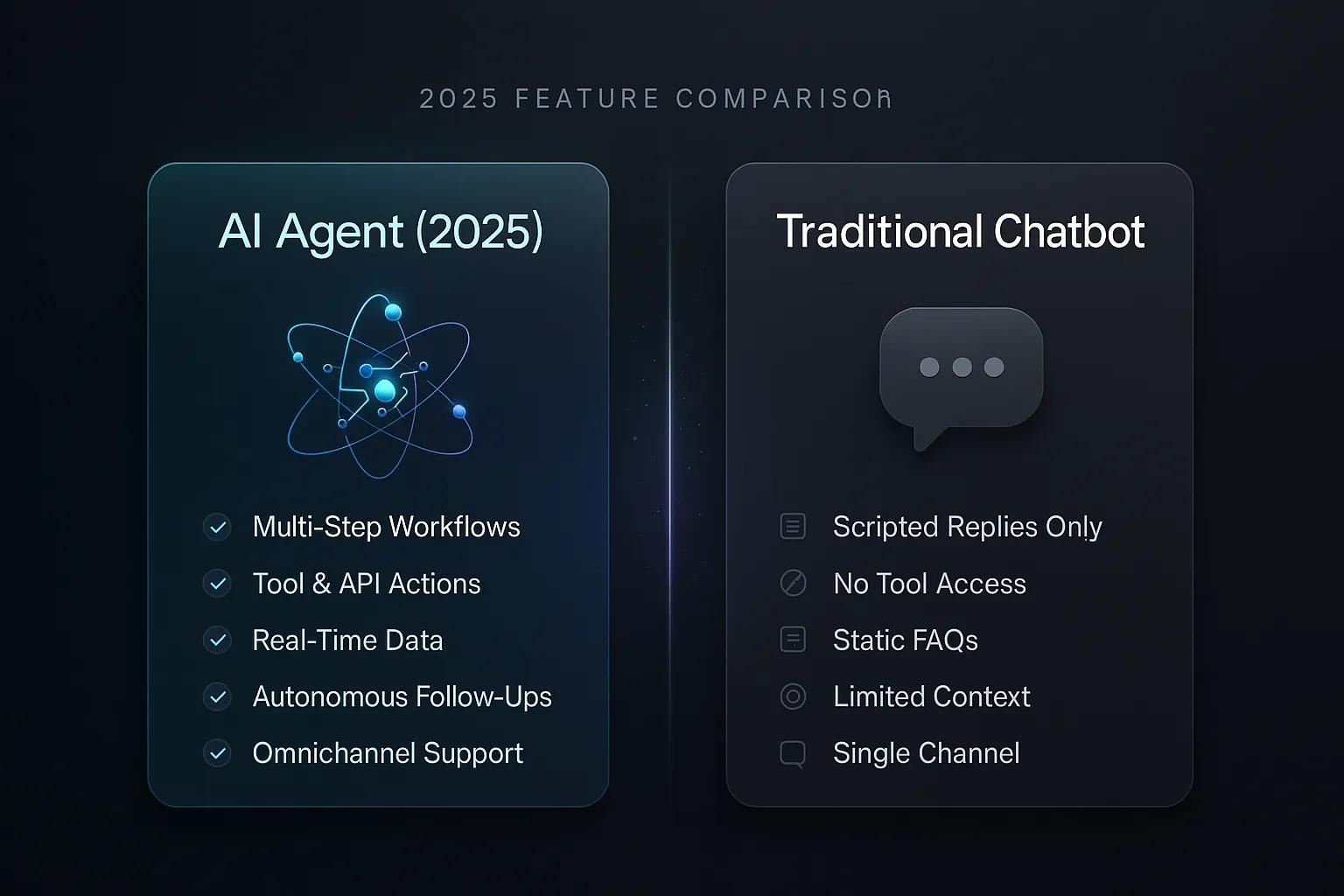
AI Agent vs Traditional Chatbot: 2026 Feature Comparison
It's 11 PM on a Tuesday. A customer reports a damaged package through your support channel. Your traditional chatbot politely apologizes and provides a link to...