
Fine-Tune AI Agents Without Breaking Production
Safely improve AI agent performance while maintaining uptime.


Gartner’s data on this remains striking, over 60% of AI projects continue to face significant challenges related to deployment and ongoing maintenance in 2026. This isn't a small number; it often represents the critical difference between an AI agent that truly delivers value and one that fails to launch or sustain impact.
Effectively fine-tuning AI agents in production is precisely what separates these two outcomes. This article will guide you through the process of continuously improving your AI agents without disrupting live operations, ensuring your business keeps running smoothly while your systems become progressively smarter.
What You'll Learn
- Why fine-tuning AI agents in production actually matters.
- Strategies for keeping your system live while you improve it.
- How to handle data management and model evaluation without the headaches.
- Tools and techniques for monitoring AI agent performance over time.
- Real examples of fine-tuning that worked.
What is AI Agent Fine-Tuning and Why Does it Matter?
AI agent fine-tuning is the process of iteratively improving an AI agent's performance after it's already live by adjusting its parameters and retraining it with new data. Think of it like a musician tuning an instrument, small adjustments can significantly improve the overall sound and performance. For SMBs, effective fine-tuning means better customer service, more accurate sales predictions, and streamlined internal processes, all powered by intelligent automation via our AI agents.
The Importance of Continuous Improvement
AI agents are not "set it and forget it" solutions. The real world is dynamic, and AI models must adapt to stay relevant. Continuous improvement through fine-tuning is essential for maintaining accuracy and effectiveness. Regular fine-tuning ensures that your AI agent remains aligned with your business goals and customer needs.
Key Insight: Continuous fine-tuning is not optional but necessary for AI agents to deliver sustained value, adapting to evolving business needs and maintaining optimal performance over time.
Need help applying this to your business? Gaazzeebo runs free 30-minute audits, book one here.
Strategies for Fine-Tuning Without Breaking Production
The key to successful fine-tuning is to minimize disruption to your live environment. Here are several strategies to achieve this:
- Shadow Deployment: Route a small percentage of live traffic to the fine-tuned model to evaluate its performance in a real-world setting without affecting the majority of users.
- A/B Testing: Compare the performance of the original model against the fine-tuned model on specific metrics, such as response time, accuracy, or customer satisfaction.
- Canary Deployments: Gradually roll out the fine-tuned model to a subset of users, monitoring its performance closely before expanding to the entire user base.
- Blue/Green Deployments: Maintain two identical production environments (blue and green). While one environment (e.g., blue) serves live traffic, the other (green) is used for fine-tuning and testing. Once the fine-tuned model is validated in the green environment, switch the traffic to it.
Data Management and Versioning
Effective data management is critical for successful fine-tuning. You should:
- Maintain a Data Pipeline: Implement a robust data pipeline to collect, clean, and prepare data for fine-tuning.
- Version Control Your Data: Use version control systems to track changes to your datasets, ensuring reproducibility and traceability.
- Data Augmentation: Increase the size and diversity of your training data by applying transformations such as rotations, translations, and noise injection.
Key Insight: By implementing shadow deployments, A/B testing, and robust data management practices, you can fine-tune AI agents without disrupting production environments, ensuring continuous improvement and reliability.
Comparing Fine-Tuning Strategies
Here's a comparison of common fine-tuning deployment strategies:
Key Insight: Choosing the right fine-tuning strategy depends on the risk tolerance, rollout speed requirements, and complexity your team can manage.
Real-World Use Cases for Fine-Tuned AI Agents
Fine-tuning [AI agents](/blog/reduce-customer-support-costs-with-ai-agents) can have a significant impact across various industries.
Aedanrose: AI-Powered Restaurant Platform
At Gaazzeebo, we developed a multi-agent AI platform for restaurants called Aedanrose, featuring 5 specialized [AI agents](/blog/reduce-customer-support-costs-with-ai-agents). This platform streamlines operations and enhances customer experiences. By continuously fine-tuning these agents, Aedanrose ensures that restaurants can adapt to changing customer preferences and market conditions, leading to increased efficiency and profitability. Learn more about Aedanrose on our case study page.
E-commerce: Personalized Recommendations
An e-commerce company uses AI agents to provide personalized product recommendations to customers. By fine-tuning the agents with real-time purchase data and browsing behavior, the company can improve the accuracy of its recommendations, leading to increased sales and customer satisfaction. McKinsey's research on this is clear, personalized recommendations can increase sales by as much as 10-15% McKinsey (2025) - The Value of Personalization.
Healthcare: Improved Diagnosis Accuracy
A healthcare provider uses AI agents to assist doctors in diagnosing diseases. By fine-tuning the agents with new medical data and patient records, the provider can improve the accuracy of diagnoses, leading to better patient outcomes. Deloitte's report on this is striking, AI-powered diagnostic tools can reduce diagnostic errors by up to 30% [Source: Deloitte (2026) - AI in Healthcare: A Practical Guide].
Key Insight: Fine-tuning AI agents enables businesses to achieve tangible results, such as increased sales, improved customer satisfaction, and more accurate diagnoses, by tailoring the AI's performance to specific real-world scenarios.
How to Fine-Tune AI Agents: A Step-by-Step Guide
Here's a step-by-step guide to fine-tuning your AI agents:
Step 1: Define Your Goals Clearly define what you want to achieve with fine-tuning. Are you looking to improve accuracy, reduce response time, or enhance customer satisfaction?
Step 2: Collect and Prepare Data Gather relevant data and clean it to ensure it's accurate and consistent.
Step 3: Choose a Fine-Tuning Method Select the appropriate fine-tuning method based on your goals and data.
Step 4: Implement a Deployment Strategy Use shadow deployment, A/B testing, canary deployments, or blue/green deployments to minimize disruption.
Step 5: Monitor Performance Continuously monitor the performance of the fine-tuned model and make adjustments as needed. Our automation solutions can help with this.
Key Insight: A structured, iterative approach to fine-tuning, combined with careful monitoring and adjustment, is crucial for maximizing the benefits of AI agents while minimizing risks.
Costs, ROI, and Business Impact of AI Agent Fine-Tuning
The costs associated with fine-tuning AI agents can vary depending on the complexity of the model, the amount of data required, and the resources needed for deployment and monitoring. However, the ROI can be significant. Businesses can expect to see improvements in accuracy, efficiency, and customer satisfaction, leading to increased revenue and reduced costs. For example, businesses automating invoice processing with systems we build can see invoice-to-paid cycles cut from weeks to days, as demonstrated in our Eagle Repair case study.
Key Insight: While fine-tuning requires an initial investment, the long-term ROI in terms of improved performance, increased efficiency, and enhanced customer satisfaction makes it a worthwhile endeavor.
Common Mistakes and Risks in AI Agent Fine-Tuning
- Overfitting: Fine-tuning the model too much on a specific dataset, leading to poor performance on new data.
- Data Bias: Using biased data to fine-tune the model, resulting in unfair or discriminatory outcomes.
- Lack of Monitoring: Failing to monitor the performance of the fine-tuned model, leading to undetected issues.
Key Insight: Awareness of potential pitfalls, such as overfitting, data bias, and inadequate monitoring, is essential for mitigating risks and ensuring the responsible and effective fine-tuning of AI agents.
The Bottom Line
- Fine-tuning AI agents is crucial for maintaining their effectiveness and relevance.
- Implementing a strategic approach minimizes disruption to live environments.
- Continuous monitoring and adaptation are key to realizing the full potential of AI agents.
Ready to optimize your AI agents? Gaazzeebo builds custom AI agents for SMBs across Tampa, Florida, and beyond. Book a free assessment or explore our AI agent services to see what's possible.
About Gaazzeebo: We are a Tampa-based technology company specializing in AI agents, business automation, custom software, websites, and mobile apps. Our team helps small and medium businesses harness technology to grow faster and operate more efficiently. Book a free assessment to see what we can build for you.
See What This Could Save Your Business
Nine questions, no login. See what manual work costs you across every location, and which three fixes pay back first.
Score my operationsSee where your locations standFree 30-minute assessment. No commitment required.
Related Articles

What is Agentic AI? The Complete Business Guide for 2026
The chatbot era is over. Not because chatbots failed; they were useful for what they were designed to do. But in 2026, businesses are demanding more than...
AI Implementation for SMBs: Real Costs, Real Results
Here's something nobody talks about enough: 68% of small businesses with 10-100 employees are now using AI regularly. That number jumped from 48% in just six...
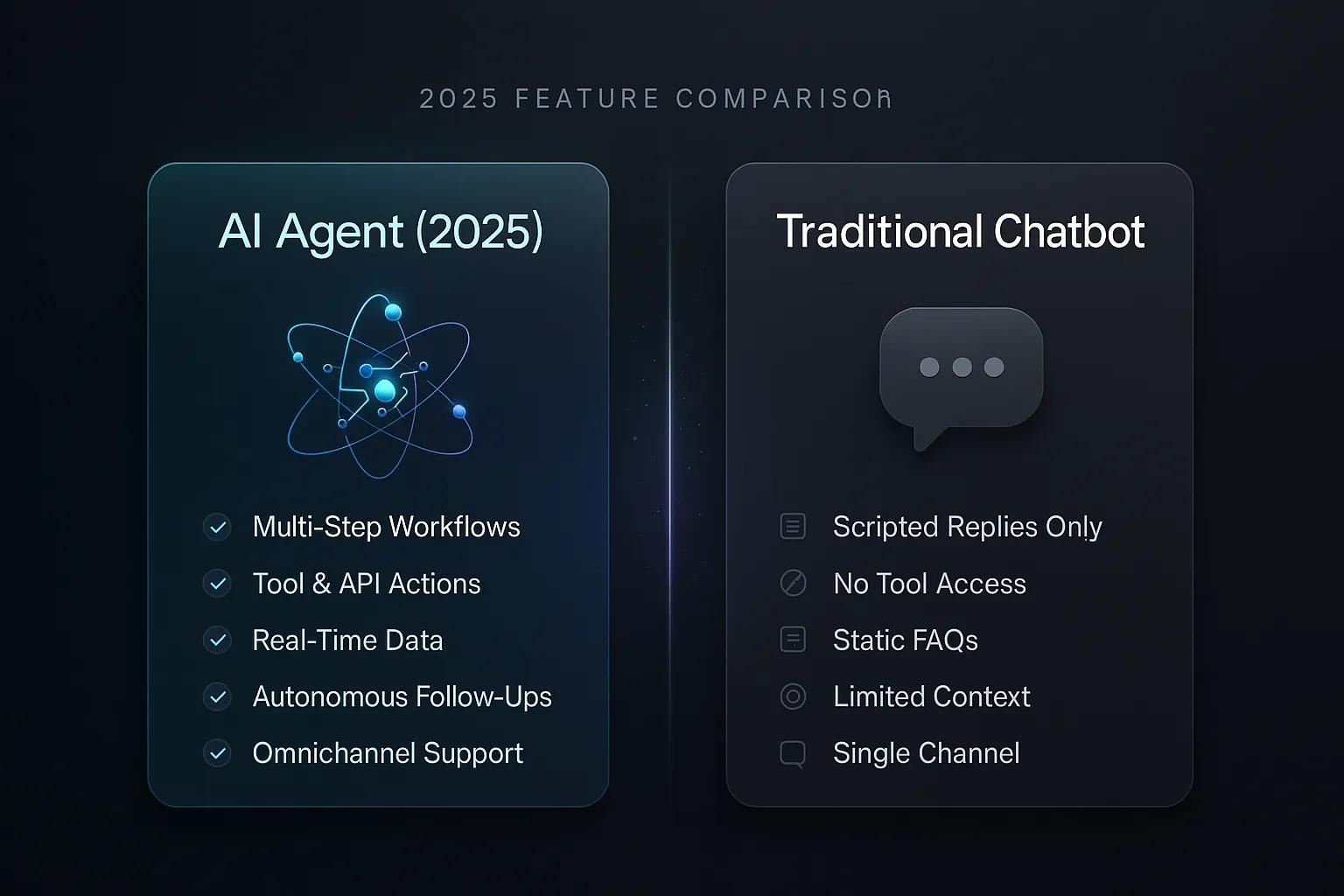
AI Agent vs Traditional Chatbot: 2026 Feature Comparison
It's 11 PM on a Tuesday. A customer reports a damaged package through your support channel. Your traditional chatbot politely apologizes and provides a link to...