
AI Agents vs. Automation: When to Use What
Choosing the right tool for your business needs


AI Agents vs. Simple Automation: Which One Your Business Actually Needs
Gartner's call on this is striking, organizations using AI-powered automation are looking at a 25% boost in operational efficiency by the close of 2027 Gartner (2026) - Predicts 2026: AI-Augmented Automation. For SMBs trying to actually on productivity, the difference between basic automation and AI agents is no longer optional knowledge. It's the decision that separates a tool that does one thing from a system that learns and adapts.
This article walks you through the real distinction between the two, and where each one actually delivers in 2026.
What You'll Learn
- The core differences between AI agents and simple automation.
- How AI agents and simple automation compare across various features.
- Real-world use cases for both AI agents and simple automation.
- How to get started with implementing AI agents and simple automation.
- The potential costs, ROI, and business impact of each technology.
- Common mistakes to avoid when implementing AI agents and simple automation.
Understanding AI Agents
AI agents are autonomous systems that perceive their environment, make decisions, and take action to hit specific goals. Unlike traditional automation, which runs the same steps every time, AI agents use machine learning and natural language processing to adapt when circumstances change and handle complex tasks without needing explicit programming for every scenario. We build custom AI agents (/services/ai-agents) tailored to how your business actually works.
Key Characteristics of AI Agents
- Autonomy: AI agents operate independently, making decisions without constant human intervention.
- Adaptability: They learn from experience and adjust their behavior based on new information.
- Goal-Oriented: AI agents are designed to achieve specific objectives, such as improving customer service or optimizing workflows.
- Context Awareness: They understand and respond to the context of a situation, leading to more relevant and effective actions.
Key Insight: AI agents excel in dynamic environments where adaptability and decision-making are critical, providing a significant advantage over rigid, pre-programmed automation.
AI Agents vs. Simple Automation: A Detailed Comparison
Simple automation, often called robotic process automation (RPA), uses software to automate repetitive, rule-based tasks. It's effective for streamlining predictable processes, but it lacks the adaptability and intelligence of AI agents.
Key Insight: Choosing between AI agents and simple automation depends on the complexity and variability of the tasks you need to automate. AI agents are ideal for dynamic processes, while RPA is better suited for routine operations.
Real-World Use Cases for AI Agents and Automation
Both AI agents and simple automation deliver real value across different workflows. Understanding where each one fits can help you pick the right tool for the job.
AI Agent Use Case: Aedanrose's Restaurant AI Platform
Aedanrose, a Gaazzeebo client in the restaurant technology space, runs a multi-agent AI platform with 5 specialized AI agents built for independent restaurant operators. The platform automates order taking, customer service, and inventory management, giving restaurants an affordable AI solution without the enterprise price tag. See how Aedanrose is building this.
Automation Use Case: Streamlining Invoice Processing
Many businesses use simple automation to streamline invoice processing. Deloitte's automating invoice processing can reduce processing costs by up to 80% [Source: Deloitte (2025) - The Robotics and Automation Impact]. The flow is straightforward: RPA extracts data from invoices, matches them with purchase orders, and automatically generates payments. It cuts errors, saves time, and improves cash flow.
AI Agent Use Case: Enhancing Customer Service
AI-powered chatbots deliver 24/7 customer support, answering questions, resolving issues, and escalating complex inquiries to human agents when needed. The payoff is real: AI chatbots can reduce customer service costs by up to 30% while improving customer satisfaction.
Key Insight: AI agents and simple automation can coexist within an organization, addressing different needs and contributing to overall efficiency gains.
Implementing AI Agents and Simple Automation: A Step-by-Step Guide
Successfully implementing AI agents and simple automation requires careful planning. Here's the roadmap:
Step 1: Identify Pain Points Analyze your business processes to identify areas where automation can have the biggest impact.
Step 2: Define Clear Objectives Set specific, measurable, achievable, relevant, and time-bound (SMART) goals for your automation initiatives.
Step 3: Choose the Right Technology Determine whether AI agents or simple automation are best suited for each task based on complexity and adaptability requirements.
Step 4: Develop a Pilot Project Start with a small-scale project to test your automation strategy and refine your approach.
Step 5: Monitor and Optimize Continuously monitor the performance of your AI agents and automation tools, making adjustments as needed to maximize their effectiveness.
Key Insight: A phased approach to implementation, starting with pilot projects, allows you to learn and adapt, ensuring a successful rollout of AI agents and automation across your organization.
Costs, ROI, and Business Impact
The cost of implementing AI agents and simple automation varies depending on project complexity and the specific tools used. But the potential ROI can be significant, increased efficiency, reduced costs, and improved customer satisfaction.
- AI Agents: Initial investment ranges from $10,000 to $100,000+ depending on complexity. ROI shows up in reduced labor costs, improved customer satisfaction, and increased sales.
- Simple Automation: Initial investment ranges from $5,000 to $50,000. ROI is typically seen in reduced processing time, fewer errors, and lower operational costs.
McKinsey's research indicates that AI-powered automation can increase revenue by 5-10% within the first year McKinsey (2025) - The State of AI in 2025.
Key Insight: While AI agents may require a higher upfront investment, their adaptability and intelligence can lead to greater long-term ROI compared to simple automation.
Common Mistakes to Avoid
- Lack of Clear Objectives: Failing to define specific goals can lead to wasted resources and poor results.
- Overlooking Data Quality: AI agents rely on high-quality data to make informed decisions. Poor data quality can compromise their effectiveness.
- Ignoring Security Concerns: Implementing automation without proper security measures can expose your business to cyber threats.
- Neglecting Employee Training: Employees need to be trained on how to use and interact with AI agents and automation tools effectively.
Key Insight: Avoiding these common mistakes can help you maximize the benefits of AI agents and automation while minimizing potential risks.
The Bottom Line
- AI agents are ideal for complex, adaptive tasks requiring decision-making, while simple automation is better suited for repetitive, rule-based processes.
- Implementing AI agents and automation can lead to increased efficiency, reduced costs, and improved customer satisfaction.
- Careful planning, clear objectives, and a phased approach are essential for successful implementation.
Ready to streamline your workflows with AI agents and automation? We build custom AI agents, automation solutions, and custom software for SMBs across Tampa, Florida, and beyond. Book a free assessment or explore our AI agent services to see what's possible. For businesses like Eagle Repair (/results/eagle-repair), automation has streamlined invoicing and payment processes, cutting invoice-to-paid cycles from weeks to days.
About Gaazzeebo: We are a Tampa-based technology company specializing in AI agents, business automation, custom software, websites, and mobile apps. Our team helps small and medium businesses harness technology to grow faster and operate more efficiently. Book a free assessment to see what we can build for you.
See What This Could Save Your Business
Nine questions, no login. See what manual work costs you across every location, and which three fixes pay back first.
Score my operationsSee where your locations standFree 30-minute assessment. No commitment required.
Related Articles

What is Agentic AI? The Complete Business Guide for 2026
The chatbot era is over. Not because chatbots failed; they were useful for what they were designed to do. But in 2026, businesses are demanding more than...
AI Implementation for SMBs: Real Costs, Real Results
Here's something nobody talks about enough: 68% of small businesses with 10-100 employees are now using AI regularly. That number jumped from 48% in just six...
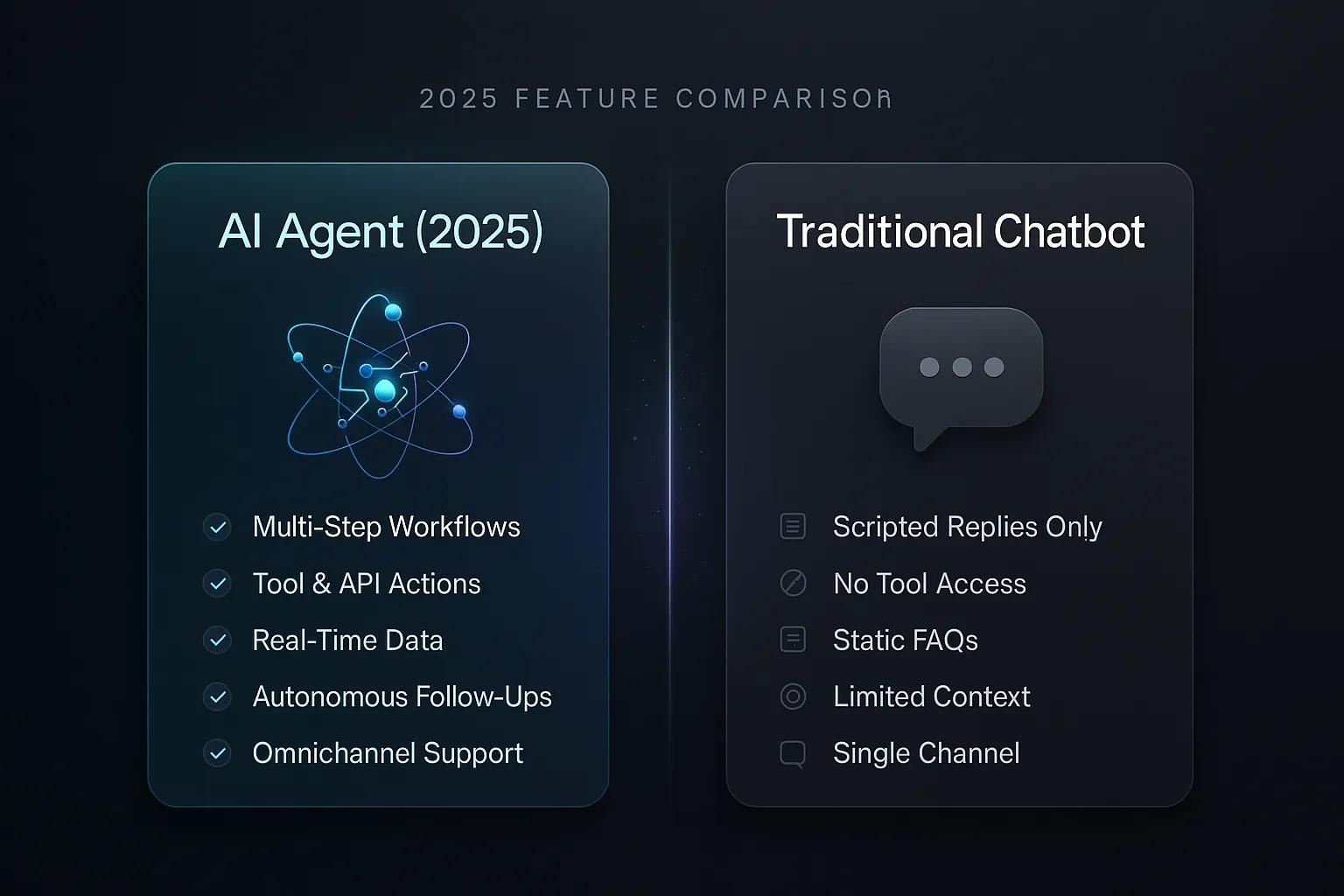
AI Agent vs Traditional Chatbot: 2026 Feature Comparison
It's 11 PM on a Tuesday. A customer reports a damaged package through your support channel. Your traditional chatbot politely apologizes and provides a link to...