
AI Agent Training on Your Knowledge Base
Unlock efficiency by training AI agents on company data


In 2026, the impact of AI-powered automation is undeniable: companies leveraging these tools are consistently reporting productivity gains exceeding 45%. Training an AI agent on your company's unique knowledge base moves beyond simple task automation. It means deploying an intelligent system ready to answer questions instantly, serve customers faster, and free your team from repetitive work. This article will guide you through effective implementation, explore the real-world impact, and show how Gaazzeebo can empower you to build such a system.
What You'll Learn
- How to define and structure your knowledge base so an AI agent can actually use it.
- The three main training methods, and which one fits your situation.
- Real-world examples of AI agents we've built and what they delivered.
- The step-by-step path to getting an agent live in your business.
- What the costs look like and where the ROI actually shows up.
Defining Your Knowledge Base for AI Agent Training
A knowledge base is the central repository of information your organization runs on. FAQs, product documentation, internal policies, training materials, customer histories; it all lives here. For an AI agent to be useful, the knowledge base has to be well-structured, current, and accessible. That's where our AI agents come in; we give your team a clean interface to manage that information and let the agent pull from it in real time.
Structuring Your Knowledge Base
A well-organized knowledge base is the foundation. Here's what matters:
- Organization: Group information logically and consistently. Don't scatter related topics across ten different sections.
- Searchability: Use keywords that your team actually uses. If your people say "onboarding checklist," don't label it "new-employee procedures."
- Up-to-date Information: Stale information is worse than no information. Set a refresh schedule and stick to it.
- Accessibility: Both your employees and the AI agent need to reach it without friction.
The reality: A well-organized knowledge base is the only thing that makes AI agent training work. Without it, you're feeding the agent garbage and wondering why it gives garbage answers.
Methods for Training AI Agents
There are three core approaches. Each has trade-offs.
- Fine-tuning: Take a pre-trained large language model and train it further on your specific knowledge. This produces highly accurate, contextually relevant responses, but it's computationally expensive and can overfit if you're not careful.
- Retrieval-Augmented Generation (RAG): The agent searches your knowledge base for relevant information, then generates a response based on what it finds. This scales well with large, complex knowledge bases and reduces hallucination, but it can be slower than fine-tuning and requires careful prompt engineering.
- Embedding-based Search: Convert your knowledge base into vector embeddings, store them in a vector database. When someone asks a question, convert the query into an embedding and find the closest matches. Feed those matches to the LLM to generate the answer. Fast, scalable, and efficient, but performance depends on embedding quality and you need a vector database to run it.
The choice depends on your constraints: How big is your knowledge base? How fast do you need answers? How much accuracy can you trade for speed? We'll scope the right method for your situation.
Want to talk through this for your business? Gaazzeebo runs free 30-minute audits, book one here.
Real-World Use Cases
Aedanrose: Five AI Agents for Restaurant Operations
What we did is we built a multi-agent AI platform for Aedanrose, a restaurant technology company. Five specialized AI agents, each trained on restaurant-specific knowledge, scheduling, inventory, customer communication, order management, staff coordination. The beauty of this setup is Aedanrose can now offer an affordable AI solution tailored to independent restaurant operators, not just chains with enterprise budgets [/results/aedanrose].
Customer Support Automation
Train an AI agent on your customer support documentation and it handles FAQs, troubleshoots common issues, and personalizes responses. Response times drop. HubSpot's 2026 report shows businesses using AI-powered chatbots report a 25% increase in customer satisfaction [Source: HubSpot State of Service Report, 2026]. That's not a small number.
Employee Onboarding and Training
New hires interact with an AI agent trained on your policies, procedures, and training materials. They get answers in minutes instead of waiting for HR. Consistency improves. The burden on your training team drops.
The pattern: Anywhere your team answers the same question repeatedly, an AI agent trained on your knowledge base can take that work off their plate.
Implementation Guide: Training Your AI Agent
Here's how we do it.
Step 1: Data Preparation, Clean and format your knowledge base. Remove noise. Ensure consistency. If you have ten different ways of describing the same process, pick one.
Step 2: Select Training Method, Choose fine-tuning, RAG, or embedding-based search based on your knowledge base size and your accuracy requirements.
Step 3: Train the AI Agent, We'll go in and train the agent on your prepared knowledge base using the method you've selected.
Step 4: Test and Evaluate, Thoroughly test. Ask it the questions your team actually asks. Does it give accurate answers? Does it hallucinate? Does it know when to say "I don't know"?
Step 5: Deploy and Monitor, Launch it. Watch it run. Update the knowledge base as your business changes. Retrain the agent periodically so it stays sharp.
The key: Structure matters. Testing matters. Maintenance matters. This isn't a set-it-and-forget-it project.
Costs, ROI, and Business Impact
The upfront cost varies based on knowledge base complexity and the method you choose. The ROI, though, is where this becomes a business decision, not just a tech decision.
You see:
- Reduced operational costs through automation, your team stops doing repetitive work.
- Improved customer satisfaction because answers come faster and more consistently.
- Increased employee productivity because they have instant access to the information they need.
- Data-driven insights from customer interactions; you see what people are asking and where your documentation is weak.
The exact ROI depends on your use case and how well the agent performs. But we've seen engagements where the agent pays for itself in three months through labor savings alone.
The math works: Upfront investment, but the payoff compounds. Fewer support tickets. Faster onboarding. Fewer repeated questions. The numbers add up.
Common Mistakes to Avoid
- Ignoring Data Quality: Train an agent on inaccurate or outdated information and you get inaccurate, outdated answers. Garbage in, garbage out.
- Lack of Clear Objectives: Don't build an agent and hope it helps. Define exactly what you want it to do. Answer customer FAQs? Onboard new hires? Reduce support tickets by 30%? Be specific.
- Insufficient Testing: Test before you launch. Ask it the hard questions. Find the edge cases. Identify hallucinations while you can still fix them.
- Neglecting Maintenance: Your knowledge base changes. Your business changes. The agent needs to be updated to stay useful. Set a maintenance schedule and stick to it.
The reality: Most AI agent projects fail because of one of these four things. Avoid them and you're already ahead.
The Bottom Line
- Training an AI agent on your knowledge base compounds your team's productivity and frees them from repetitive work.
- A well-structured, up-to-date knowledge base is non-negotiable. This is where the project succeeds or fails.
- The ROI is real. Reduced costs, faster customer response, better employee experience. The numbers add up.
Ready to build this for your business? We create custom AI agents for SMBs across Tampa, Florida, and beyond. See how we can help you turn your knowledge base into a competitive advantage. Book a free assessment or explore our AI agents to see what's possible. We also help with business automation, custom software, websites, and mobile apps. As we showed with Eagle Repair, we can integrate your AI agent with your accounting system to streamline even more of your business.
Sources and References:
About Gaazzeebo: We are a Tampa-based technology company specializing in AI agents, business automation, custom software, websites, and mobile apps. Our team helps small and medium businesses harness technology to grow faster and operate more efficiently. Book a free assessment to see what we can build for you.
Further reading
Verified primary sources on this topic:
- IBM's definition of AI agents, IBM's evergreen explainer page defining AI agents and use cases.
- AWS reference on Retrieval-Augmented Generation, AWS canonical RAG definition + when to use it.
See What This Could Save Your Business
Nine questions, no login. See what manual work costs you across every location, and which three fixes pay back first.
Score my operationsSee where your locations standFree 30-minute assessment. No commitment required.
Related Articles

What is Agentic AI? The Complete Business Guide for 2026
The chatbot era is over. Not because chatbots failed; they were useful for what they were designed to do. But in 2026, businesses are demanding more than...
AI Implementation for SMBs: Real Costs, Real Results
Here's something nobody talks about enough: 68% of small businesses with 10-100 employees are now using AI regularly. That number jumped from 48% in just six...
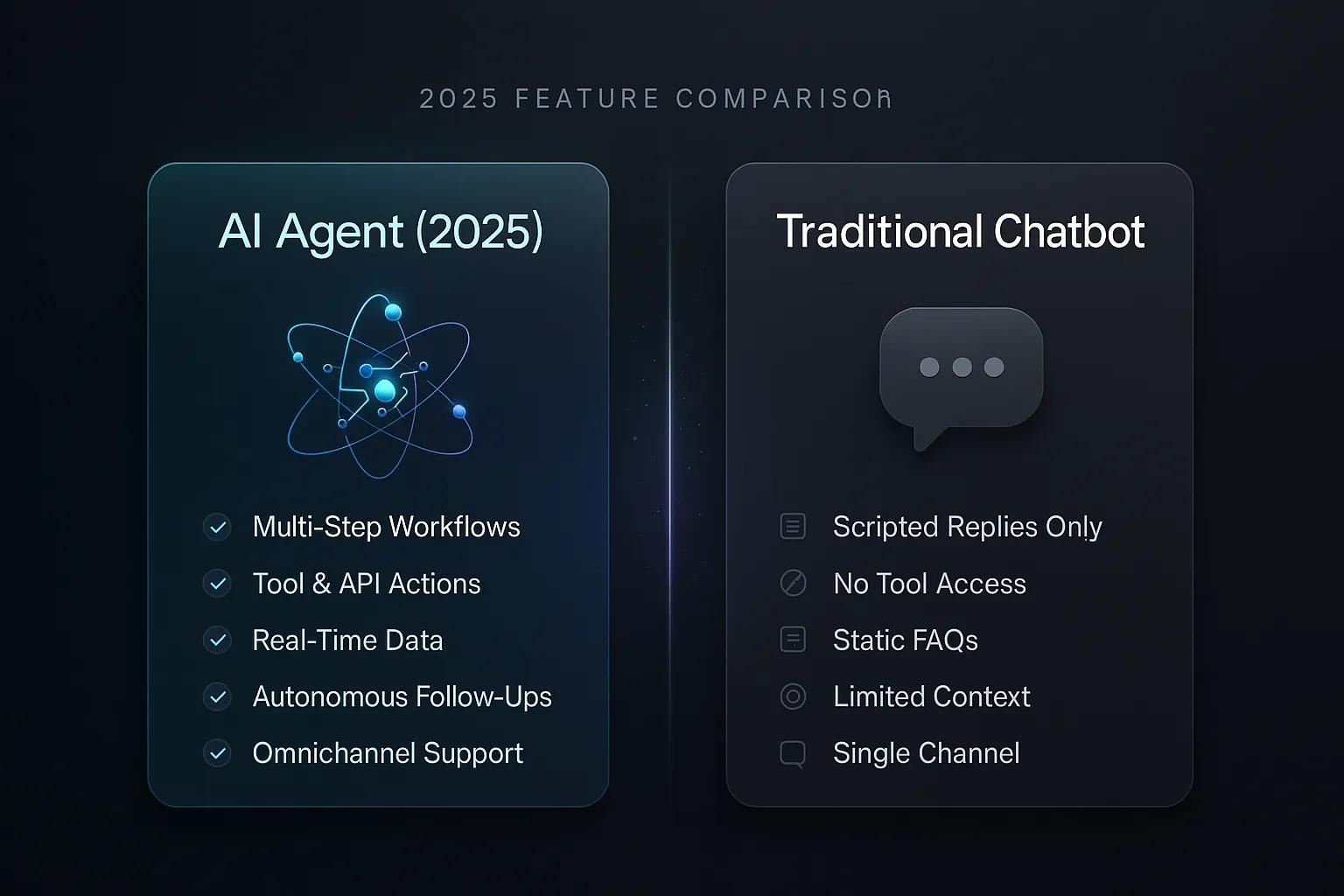
AI Agent vs Traditional Chatbot: 2026 Feature Comparison
It's 11 PM on a Tuesday. A customer reports a damaged package through your support channel. Your traditional chatbot politely apologizes and provides a link to...