
Low-Code vs Custom Development: Which is Right for Your Business?
Making the $100,000 Decision That Could Make or Break Your Digital Strategy

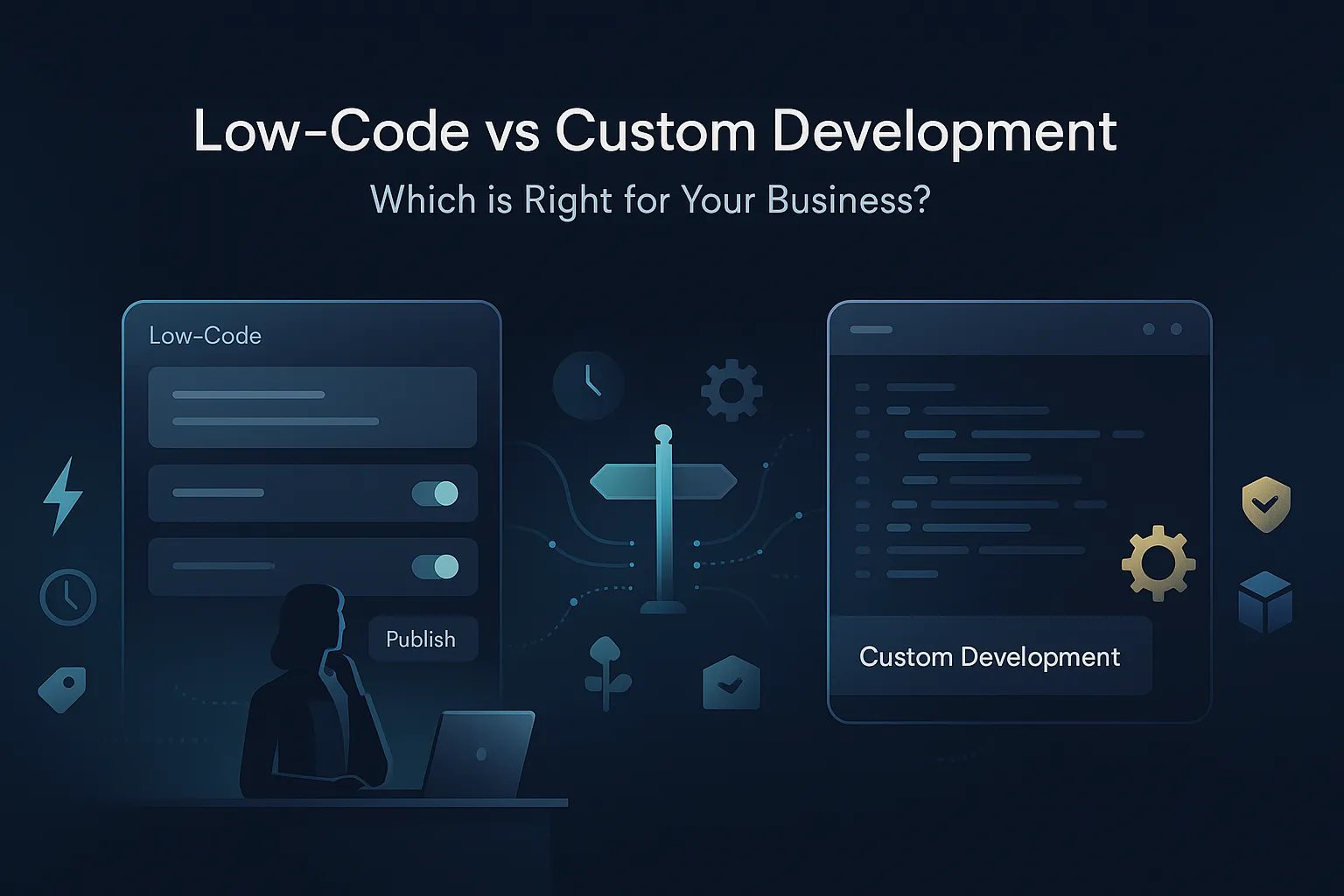
You need a new application for your business. Maybe it's a customer portal, an internal workflow tool, or something that'll give you a competitive edge. Your team is split: some want to build it custom from scratch, others swear by low-code platforms that promise results in weeks, not months.
The stakes are high. Make the wrong choice and you could waste $100,000 and six months of runway. Choose wisely, and you'll have exactly what your business needs at a price that makes sense.
Here's what makes this decision even trickier: the low-code development platform market has exploded. According to Fortune Business Insights, the market reached $28.75 billion in 2024 and is projected to hit $264.40 billion by 2032, a staggering 32.2% compound annual growth rate. Meanwhile, custom development remains the gold standard for businesses with unique, complex requirements.
So which approach is right for your business? After helping clients across a range of industries make this exact decision at Gaazzeebo, I can tell you this: it's not about which one is "better." It's about which one fits your specific situation, your budget, timeline, technical requirements, and long-term vision.
Let's break it down.
What is Low-Code Development? A 2025 Overview
Low-code development platforms let you build applications using visual interfaces and drag-and-drop components instead of writing thousands of lines of code from scratch. Think of it like using Canva for design versus Adobe Photoshop, you're working with pre-built elements and templates rather than starting with a blank canvas.
Popular low-code platforms include Salesforce Lightning, Microsoft Power Apps, OutSystems, Mendix, and Bubble. These platforms have exploded in popularity for good reason: Market.us reports that by 2024, low-code tools account for over 65% of application development globally.
Here's why businesses are flocking to low-code:
Visual Development Environment: You're dragging boxes and connecting workflows, not debugging syntax errors at midnight.
Pre-Built Templates and Components: Authentication systems, payment gateways, dashboards, someone's already built them. You're assembling Lego blocks, not carving them from wood.
Rapid Deployment: According to Joget's research, low-code platforms can speed up software development 10 times faster than traditional methods. We've seen clients go from idea to deployed application in 4-6 weeks.
Citizen Development: Gartner predicts that by 2026, 80% of low-code users will come from non-IT departments. Your operations manager can build the tool they need without waiting for the dev team's backlog.
At Gaazzeebo, we've deployed low-code solutions for property management companies, small healthcare practices, and local service businesses. When the requirements fit, it's incredibly powerful.
What is Custom Software Development?
Custom software development means building an application from the ground up, written specifically for your unique requirements. Every feature, every interaction, every line of code is crafted to match your exact specifications.
This isn't about configuring a platform, it's about architecting a solution using technologies like React, Node.js, Python, or whatever tech stack best serves your needs.
The Custom Development Process
The journey typically unfolds in phases, each critical to the final product:
Discovery & Planning (10-15% of total cost): This is where we map out your business logic, user journeys, and technical requirements. We're not just taking orders, we're challenging assumptions and finding the optimal solution.
Design Phase (10-15% of cost): User interface and user experience design. This goes beyond "making it look pretty", we're crafting every interaction to match your brand and serve your users.
Development (40-50% of cost): This is the heavy lifting. Our development team writes the actual code, builds the database architecture, implements security protocols, and creates the features that make your application unique.
Testing & Deployment: Quality assurance, bug fixes, performance optimization, and launching to production. We don't ship code that hasn't been battle-tested.
Ongoing Maintenance: Updates, feature additions, security patches, and scaling as you grow.
What Custom Development Actually Costs
Let's talk real numbers, because vague ranges don't help you budget.
According to multiple industry sources, here's what you're looking at:
Small projects (basic mobile apps, simple web applications): $20,000 to $50,000, typically taking 2-4 months
Medium-scale projects (robust features, user management, payment integrations, multi-platform support): $100,000 to $300,000, generally requiring 6-8 months
Large-scale enterprise solutions (extensive integrations, complex data processing, high-level security): $300,000 and up, often taking a year or more
For example, we recently built a custom construction bid management system for a Tampa-based contractor. Total investment: $54,000. Timeline: 4.5 months. The system handles their proprietary pricing algorithms and integrates with three different supplier databases, something no low-code platform could handle.
Low-Code vs Custom Development: The Complete Comparison
Here's what you actually need to know about how these approaches stack up:
Development Time
Low-Code: 2-8 weeks for most applications. We've deployed complete internal tools in three weeks. The speed is real, platforms handle authentication, databases, and hosting automatically.
Custom Development: 3-12+ months depending on complexity. A simple mobile app might take three months, while a comprehensive platform could take a year. You're building every component, which takes time but gives you complete control.
Cost Range
Low-Code:
- Platform licensing: $26-$500 per user per month
- Implementation costs: $5,000-$50,000 for setup and configuration
- Custom integrations: $10,000-$100,000 if you need specialized connections
- Annual maintenance: Usually included in your subscription
Custom Development:
- Development costs: $20,000-$300,000+ depending on what you're building
- Ongoing maintenance: Expect 15-20% of your development cost annually
- Hosting infrastructure: $50-$5,000+ monthly depending on scale
- Updates and new features: $5,000-$50,000 per year
Flexibility and Customization
Low-Code: You can typically customize 60-70% of your requirements. The platform dictates the other 30-40%. Need a standard CRM? Perfect. Need a CRM that calculates real-time ROI using your proprietary formula while pulling data from your custom ERP? You'll hit walls.
Custom Development: 100% of your requirements. If you can dream it and explain it, we can build it. No platform limitations, no "the system doesn't allow that" conversations.
Scalability
Low-Code: Platform-dependent. Most modern platforms handle thousands of users fine. But research reports performance limitations for compute-intensive industrial IoT applications running sub-millisecond control loops. Your platform's ceiling becomes your ceiling.
Custom Development: Highly scalable if architected correctly. We build with growth in mind, microservices architecture, optimized databases, CDN integration. When you need to handle 100x your current load, you can scale each component independently.
Technical Debt and Ownership
Low-Code: Vendor lock-in is real. If your platform provider raises prices 300% next year, your options are limited. If they discontinue a feature you rely on, you're adapting or rebuilding. You're renting, not owning.
Custom Development: You own every line of code. Full control means full flexibility. Switch hosting providers, change frameworks, modify anything, it's yours. No vendor can hold your business hostage.
Speed to Market Reality
Research from Integrate.io shows organizations report up to 90% reduction in development time with low-code. That's not marketing fluff, we've seen it. A project that would take six months custom can often be done in 3-4 weeks with low-code.
But here's the nuance: custom development allows for parallel workstreams and ultimately delivers exactly what you need. Sometimes launching perfectly four months from now beats launching "good enough" next month.
When Low-Code is the Right Choice
After deploying both low-code and custom solutions for dozens of clients, here's when we confidently recommend low-code:
1. MVPs and Proof of Concepts
Testing market fit? Low-code is your friend. We helped a Tampa startup validate their property management idea with a $12,000 low-code MVP in five weeks. They got paying customers, proved demand, and then invested in custom development with real revenue backing the decision.
Budget under $50,000 and need to test assumptions fast? Low-code.
2. Internal Business Tools
Workflow automation, data dashboards, approval systems, inventory tracking, these are low-code sweet spots. Your team needs it, but customers never see it. Why spend $80,000 custom when a $15,000 low-code solution does the job?
We recently built an internal vendor coordination system for a property management company using low-code. Six weeks, $15,000, problem solved. Custom would've cost $75,000+ and taken four months.
3. Simple Customer-Facing Applications
Straightforward user journeys with standard integrations? Low-code handles this well. Booking systems, basic e-commerce, simple portals, platforms have these patterns solved.
Key word: simple. The moment you need unique workflows or complex business logic, you're fighting the platform.
4. Rapid Digital Transformation
When your executive team says "we need digital tools NOW," low-code delivers wins quickly. Gartner predicts by 2025, 70% of new applications will use low-code or no-code technologies, up from less than 25% in 2020. This isn't a fad, it's a fundamental shift.
5. Limited Technical Resources
No dev team? Small budget? Low-code platforms enable business users to build what they need. The "citizen developer" movement is real and growing.
The Low-Code Limitations You Need to Know
Let's be honest about the downsides, because no one benefits from you choosing wrong:
❌ Vendor Lock-In: You're married to that platform. Migrating off later is painful and expensive. Treat this like a long-term relationship, you better really like that vendor.
❌ Customization Ceiling: Eventually, you'll hit a wall. "The platform doesn't support that" becomes your least favorite phrase. This typically happens when you need custom algorithms, complex business logic, or unusual integrations.
❌ Performance Constraints: Research found that manufacturing firms running sophisticated predictive models or high-frequency control loops can't sustain the throughput they need on visual builders. Some workloads simply need traditional frameworks.
❌ Scaling Costs: That $200/month might become $5,000/month as you add users and features. Per-user pricing gets expensive fast when you scale.
❌ Data Sovereignty: Where does your data actually live? Can you export it? Who really controls it? These questions matter more than most businesses initially realize.
When Custom Development is Worth the Investment
Here's when we tell clients to invest in custom development, even though it costs more upfront:
1. Complex, Unique Business Logic
You've got proprietary algorithms, industry-specific workflows, or business logic that creates competitive advantage. This is what custom development was made for.
For a construction client, we built a custom bid optimization system that analyzes historical data, supplier relationships, and project variables to generate accurate bids 3x faster than their manual process. First-year savings: $500,000. No low-code platform could handle their complex pricing algorithms.
That's custom development ROI.
2. High-Performance Requirements
Real-time processing, large-scale data operations, sub-second response times, these demand optimized custom code. A restaurant reservation system handling hundreds of concurrent bookings needs custom architecture. Low-code would crumble.
3. Complete Brand Control
Your user experience is your differentiator. You need pixel-perfect design, custom animations, unique interactions that make competitors jealous. Pre-built templates won't cut it.
We recently built a luxury transportation company's booking platform with a completely custom interface that matches their premium brand. Customers frequently compliment the experience, something they never would've said about a template-based solution.
4. Long-Term Scalability
Planning for millions of users? Evolving feature roadmap? Complex integrations that'll grow over time? Custom development is your foundation for the future.
Think of it this way: low-code is renting an apartment, custom is building your dream house. If you're planning to stay long-term and grow, building makes sense.
5. Security and Compliance Needs
Healthcare (HIPAA), finance (SOC 2, PCI-DSS), or any industry with strict compliance requirements often needs custom security protocols. You can't risk your platform provider's security becoming your vulnerability.
6. Intellectual Property Protection
Building proprietary technology that'll become your competitive moat? You need to own the code completely. No vendor dependencies, no licensing restrictions, full IP control.
Custom Development ROI Timeline
Here's the honest timeline for custom development ROI:
- Year 1: Initial investment. You're in the red, building the foundation.
- Year 2-3: Break-even as features compound and you optimize operations.
- Year 4+: Significant competitive advantages. Your custom solution does things competitors can't replicate.
Total ROI is typically 200-400% over five years for well-executed custom projects. The key phrase: well-executed.
The Best of Both Worlds: Hybrid Solutions
Here's what most articles won't tell you: you don't have to choose just one approach.
Many of our smartest clients use low-code for standard modules while we build custom solutions for their core differentiators. This hybrid approach delivers speed where speed matters and custom power where it creates competitive advantage.
For example, a Tampa healthcare practice uses Salesforce (low-code) for their CRM and patient communications, while we built them a custom React application for their patient portal and appointment scheduling. The scheduling system integrates with their specific insurance verification process and billing system, something no low-code platform could handle elegantly.
Result: 60% cost savings compared to building everything custom, while still getting exactly what they need where it matters most.
The Hybrid Architecture
Use proven low-code platforms for:
- ✅ CRM and contact management
- ✅ Basic workflows and approvals
- ✅ Dashboards and reporting
- ✅ Internal tools and admin panels
Invest in custom development for:
- ✅ Unique business logic and algorithms
- ✅ Customer-facing experiences
- ✅ Competitive differentiators
- ✅ High-performance requirements
Integration between the systems is usually straightforward via APIs. Best of both worlds.
How to Decide: A Practical Framework
After working through this decision with dozens of clients, here's the framework we use:
Step 1: Assess Complexity
Is your core requirement simple and standard? Think booking systems, basic inventory management, straightforward CRM. That's low-code territory.
Do you need unique algorithms, complex business logic, or unusual data flows? That signals custom.
Step 2: Evaluate Your Timeline
Need it deployed in 4-8 weeks because your current system is literally breaking? Low-code.
Can you invest 3-6+ months to get exactly what you need? Custom becomes viable.
But here's the nuance: sometimes "fast" today means "expensive to fix" tomorrow. We always ask: what's the cost of being wrong?
Step 3: Budget Reality Check
Under $50,000: Low-code or phased custom development (build MVP first, add features with revenue)
$50,000-$150,000: Either approach can work. Decision depends on other factors.
$150,000+: Custom development often delivers better long-term ROI. You're spending serious money either way, might as well get exactly what you need.
Step 4: Future Scalability
If you're building something you expect to use for 1-2 years and then replace, low-code is fine. The cost of vendor lock-in doesn't matter if you're not locked in long.
Planning 10x+ growth? Expecting to use this system for 5-10 years? The long-term total cost of ownership usually favors custom.
Step 5: Technical Resources
No dev team and no plans to hire one? Low-code makes sense. You can't maintain what you can't understand.
Strong technical team or planning to build one? Custom development lets them solve problems exactly the way your business needs.
Questions to Ask Your Team
Print this checklist and discuss it with your stakeholders:
- ☐ What's our realistic timeline? (Be honest, slip dates often favor custom in the end)
- ☐ What's our total budget including 3-year maintenance and scaling costs?
- ☐ How unique are our requirements? Can we describe them with existing industry terms or are we inventing new concepts?
- ☐ Do we need to own the code and IP completely?
- ☐ What's our expected user growth over 3-5 years?
- ☐ Are we comfortable with vendor dependency?
- ☐ Do we have compliance or security requirements that limit platform options?
- ☐ Is the application itself our product (favor custom) or is it supporting our product (favor low-code)?
- ☐ Will we need unusual integrations or custom workflows?
- ☐ What's the cost of being wrong? Can we pivot easily if we choose wrong?
Industry-Specific Guidance
After working across a range of industries, here's what typically makes sense:
SaaS Startups: Custom for your core product (that's your IP and competitive advantage), low-code for internal tools and admin panels.
E-commerce: Low-code works fine for basic shops using Shopify or WooCommerce. Custom development makes sense if you're building unique shopping experiences or complex inventory systems.
Healthcare: Primarily custom due to HIPAA compliance and the need for specific clinical workflows. Some low-code works for administrative tools that don't touch PHI.
Financial Services: Mostly custom due to security requirements, compliance, and the proprietary nature of financial algorithms.
Real Estate: Low-code handles 80% of real estate tech needs. Lead management, showing scheduling, basic CRM, platforms do this well. Custom makes sense for large brokerages with unique processes.
Manufacturing: Hybrid approach is optimal. Use low-code for inventory dashboards and workflow automation. Custom for production scheduling systems and supply chain optimization.
Restaurants: For basic needs (menus, reservations, ordering), low-code or off-the-shelf. For complex operations spanning multiple locations with custom workflows, custom development delivers better long-term value.
Reducing Costs for Either Approach
Regardless of which path you choose, here's how to optimize costs:
For Low-Code Projects:
✅ Start with free tiers: Most platforms offer free trials or basic free versions. Validate your concept before committing.
✅ Minimize custom integrations: Each custom integration adds cost and complexity. Use the platform's native integrations whenever possible.
✅ Train internal team: Bring expertise in-house rather than paying consultants forever.
✅ Avoid platform-specific customizations: The more you customize, the harder it is to maintain or migrate.
For Custom Development:
✅ Phased MVP approach: Build core features first, validate with real users, then add features based on actual usage patterns.
✅ Use open-source frameworks: React, Node.js, Python Django, these mature frameworks give you a head start.
✅ Build reusable component libraries: The login system we build for you today can be reused in your next project.
✅ Start small, iterate based on usage: Launch with less, add based on data.
Making Your Decision
Neither low-code nor custom development is universally "better." Context determines the optimal choice, your budget, timeline, requirements, team, and long-term vision.
The low-code revolution is real. Gartner's prediction that 70% of new applications will utilize low-code or no-code technologies by 2025 is playing out before our eyes. Businesses are moving faster than ever, and low-code enables that speed.
But custom development isn't going anywhere. When you need something truly unique, when performance matters, when you're building intellectual property, custom code remains the gold standard.
Many successful businesses use both. Shopify for e-commerce, custom for their customer portal. Salesforce for CRM, custom for their proprietary quoting engine. Low-code for internal tools, custom for customer-facing applications.
The key is understanding which problems need which solutions.
Not Sure Which Approach Fits Your Business?
At Gaazzeebo, we've helped clients across a range of industries make this exact decision. We offer both low-code automation and custom development, because we believe in recommending what's actually right for you, not what's easiest for us to sell.
Here's what makes our approach different: we start every project by asking questions, not selling solutions. What are you actually trying to achieve? What's your budget? What's your timeline? What's your long-term vision? Then we tell you honestly whether low-code, custom, or hybrid makes sense.
Sometimes we talk clients out of expensive custom development because low-code will serve them better. Sometimes we push back on low-code because we know they'll hit limitations in six months and wish they'd invested in custom.
Schedule a free 30-minute strategy call →
We'll analyze your specific needs and provide honest recommendations. We'll look at your requirements, budget, and timeline, and tell you exactly what we'd do if it was our money.
No obligation. No sales pressure. Just straight talk from people who've been in the trenches building both low-code and custom solutions for businesses just like yours.
Contact Gaazzeebo:
- Website: gaazzeebo.net
- Email: carter@gaazzeebo.net
- Phone: (813) 444-3798
Sources & References
- Fortune Business Insights - Low-Code Development Platform Market Size [2032]
- Market.us - Low Code Development Market Size & CAGR of 27%
- Joget - Low-Code Growth: Key Statistics That Show Its Impact
- Gartner - Enterprise low-code adoption predictions
- Integrate.io - No-Code Transformations Usage Trends
- Creole Studios - How Much Does Custom Software Development Cost in 2024?
- Baytech Consulting - Cost to Develop Software in 2024
- Mordor Intelligence - Low-Code Development Platform Market Report 2030
Related Reading:
About Gaazzeebo: Tampa-based technology company specializing in custom websites, mobile applications, custom software, and AI automation solutions. Serving clients since 2024.
See How Findable Your Business Really Is
Enter your website. We read it the way a search engine and an AI assistant do, then show you exactly what we found, why it matters, and the fix — with the evidence for every claim. No email, no signup.
Audit my siteSee how findable you areFree. No email, no signup.
Related Articles
Custom Website Development: 2026 Cost & Timeline Guide
Let's cut through the confusion: if you're a business owner researching custom website development, you've probably seen cost estimates ranging from a few...
Zapier vs Custom Automation: The Complete 2026 Comparison Guide
Here's a scenario we see all the time: Sarah runs operations for a growing property management company. She started with a few simple Zapier workflows, new...
Mobile App vs Web App: Which Should You Build First?
You've got $75,000 in your budget and six months until your next board meeting. Your team is ready to build. Your investors want to see traction. And everyone...