
AI Receptionist for Medical Practice
Automate front desk tasks and improve patient experience


AI Receptionists for Medical Practices: Automating Front Desk Operations
The healthcare AI market is moving fast. Accenture's 2026 report projects AI in healthcare will hit $44.8 billion by 2027, with a huge chunk going to administrative tasks like patient scheduling and communication Accenture (2026), AI in Healthcare: A roadmap for payers and providers. An AI receptionist can automate many of those front desk tasks, freeing up your staff to focus on what matters, patient care. This guide walks through how to build an AI receptionist for a medical practice, covering use cases, implementation, and the actual ROI.
What You'll Learn
- How an AI receptionist can transform front desk operations in a medical practice.
- The key features and functionalities to include in your AI receptionist.
- Real-world use cases and the benefits of implementing an AI receptionist.
- Practical steps to get started with building your own AI receptionist.
- The costs, ROI, and business impact of using an AI receptionist.
What is an AI Receptionist and Why Does Your Practice Need One?
An AI receptionist is a virtual assistant powered by artificial intelligence that handles front desk tasks, answering phones, scheduling appointments, providing information, managing patient inquiries. Think of it as a highly efficient, always-available digital employee. For medical practices juggling high call volumes and demanding patient needs, an AI receptionist streamlines operations, reduces administrative burden, and improves the patient experience. Patient expectations for and convenient communication keep rising, and an AI receptionist helps you meet that bar.
Gaazzeebo specializes in building custom AI agents tailored to the specific needs of your medical practice. Our AI agents integrate with your existing systems to provide a experience for both staff and patients.
Key Features of an AI Receptionist
- Appointment Scheduling: Automate appointment booking, rescheduling, and cancellations.
- Answering FAQs: Provide instant answers to common patient questions about office hours, insurance, and procedures.
- Patient Intake: Collect patient information and pre-screen patients before appointments.
- Call Routing: Direct calls to the appropriate staff members or departments.
- Prescription Refills: Process prescription refill requests.
- Payment Processing: Collect payments for co-pays and outstanding balances.
- Multilingual Support: Communicate with patients in multiple languages.
Key Insight: An AI receptionist can significantly reduce the workload on your front desk staff, allowing them to focus on more complex tasks and provide better patient care.
Need help applying this to your business? Gaazzeebo runs free 30-minute audits, book one here.
AI Receptionist vs. Traditional Receptionist: A Comparison
An AI receptionist offers several advantages over a traditional receptionist, particularly in terms of cost, availability, and efficiency. While a human receptionist provides a personal touch, an AI receptionist can handle routine tasks 24/7 without breaks or overtime pay. Here's how they stack up:
Key Insight: While AI receptionists excel at efficiency and cost-effectiveness, a hybrid approach that combines AI with human interaction can provide the best overall patient experience.
Real-World Use Cases for AI Receptionists in Medical Practices
AI receptionists are being implemented across various medical specialties to improve efficiency and patient satisfaction. Here are a few examples:
Aedanrose: Multi-Agent AI Platform for Restaurants
Gaazzeebo built a multi-agent AI platform for restaurants that demonstrates the power of specialized AI agents. The Aedanrose platform features 5 specialized AI agents designed to handle various restaurant tasks, from order taking to customer service. This same approach can be applied to medical practices, with specialized AI agents for scheduling, billing, and patient communication.
Streamlining Appointment Scheduling
An AI receptionist can handle the entire appointment scheduling process, from initial inquiry to confirmation. Patients can book appointments online or via phone, and the AI can automatically check for availability, send reminders, and update the schedule in real-time. Grand View Research puts AI in healthcare at a 38.4% CAGR from 2023 to 2030, driven by the need for efficient appointment scheduling and patient management Grand View Research (2025), Artificial Intelligence in Healthcare Market Analysis Report. That's the planning horizon.
Automating Patient Communication
An AI receptionist can automate routine patient communication, appointment reminders, pre-appointment instructions, post-appointment follow-ups. This significantly reduces the workload on your staff and improves patient engagement. For example, an AI receptionist can send automated text messages to remind patients of their upcoming appointments, reducing no-show rates.
Handling Insurance Verification
Verifying insurance coverage is a time-consuming task for front desk staff. An AI receptionist can automate this process by integrating with insurance databases and verifying patient eligibility in real-time. This reduces errors and improves the accuracy of billing and claims processing.
Key Insight: AI receptionists can be customized to handle a wide range of tasks, making them a valuable asset for any medical practice looking to improve efficiency and patient satisfaction.
How to Build an AI Receptionist for Your Medical Practice
Building an AI receptionist involves several key steps, from defining your requirements to training the AI model. Here's the roadmap:
Step 1: Define Your Requirements
Start by identifying the specific tasks you want your AI receptionist to handle. Consider the most common questions your front desk staff answers, the types of appointments you need to schedule, and the information you need to collect from patients.
Step 2: Choose an AI Platform
Select an AI platform that provides the tools and resources you need to build and deploy your AI receptionist. Some popular options include Google Cloud AI, Amazon Lex, and Microsoft Azure AI.
Step 3: Design the Conversation Flow
Map out the conversation flow for your AI receptionist. This includes defining the prompts, responses, and actions the AI will take based on patient input.
Step 4: Train the AI Model
Train the AI model using a dataset of relevant conversations and information. This will help the AI understand patient requests and provide accurate responses.
Step 5: Integrate with Existing Systems
Integrate your AI receptionist with your existing systems, such as your electronic health record (EHR) and scheduling software. This allows the AI to access patient information and update schedules in real-time. Integrating with systems like QuickBooks can also streamline billing processes, similar to how Gaazzeebo helped Eagle Repair cut their invoice-to-paid cycle from weeks to days by building a custom invoice portal with QuickBooks Payments integration.
Step 6: Test and Refine
Test your AI receptionist thoroughly to ensure it is working as expected. Refine the conversation flow and training data based on user feedback and performance metrics.
Key Insight: Building an AI receptionist requires careful planning, training, and integration with existing systems. Consider partnering with a technology company like Gaazzeebo to ensure a successful implementation.
Costs, ROI, and Business Impact of an AI Receptionist
The cost of building an AI receptionist varies depending on the complexity of the system and the AI platform you choose. The ROI, though, can be significant, particularly in reduced labor costs, improved efficiency, and enhanced patient satisfaction.
- Cost: $5,000 - $50,000+ (depending on complexity and customization)
- ROI: 20-50% reduction in front desk labor costs
- Payback Period: 6-18 months
Deloitte's 2026 study shows AI-powered automation can reduce operational costs by up to 30% in healthcare organizations [Deloitte (2026), AI-powered automation in healthcare]. Beyond cost, AI receptionists improve patient satisfaction by providing faster and more convenient access to information and services.
Key Insight: Investing in an AI receptionist can lead to significant cost savings and improved patient outcomes, making it a worthwhile investment for medical practices of all sizes.
Common Mistakes to Avoid When Implementing an AI Receptionist
Implementing an AI receptionist can be challenging, and it's important to avoid common pitfalls that can derail your project. Here are a few things to watch out for:
- Failing to Define Clear Requirements: Without clear requirements, your AI receptionist may not meet your needs or provide the expected benefits.
- Insufficient Training Data: If your AI model is not properly trained, it may provide inaccurate or irrelevant responses.
- Poor Integration with Existing Systems: If your AI receptionist is not properly integrated with your existing systems, it may not be able to access patient information or update schedules in real-time.
- Neglecting User Feedback: Ignoring user feedback can lead to dissatisfaction and low adoption rates.
Key Insight: Careful planning, thorough training, and ongoing monitoring are essential for a successful AI receptionist implementation.
The Bottom Line
- AI receptionists can automate many front desk tasks, freeing up staff to focus on patient care.
- Implementing an AI receptionist can lead to significant cost savings and improved patient satisfaction.
- Careful planning, training, and integration with existing systems are essential for a successful implementation.
Ready to transform your medical practice with an AI receptionist? Gaazzeebo builds custom AI agents for SMBs across Tampa, Florida, and beyond. Book a free assessment or explore our AI agents to see what's possible.
About Gaazzeebo: We are a Tampa-based technology company specializing in AI agents, business automation, custom software, websites, and mobile apps. Our team helps small and medium businesses harness technology to grow faster and operate more efficiently. Book a free assessment to see what we can build for you.
See What This Could Save Your Business
Nine questions, no login. See what manual work costs you across every location, and which three fixes pay back first.
Score my operationsSee where your locations standFree 30-minute assessment. No commitment required.
Related Articles

What is Agentic AI? The Complete Business Guide for 2026
The chatbot era is over. Not because chatbots failed; they were useful for what they were designed to do. But in 2026, businesses are demanding more than...
AI Implementation for SMBs: Real Costs, Real Results
Here's something nobody talks about enough: 68% of small businesses with 10-100 employees are now using AI regularly. That number jumped from 48% in just six...
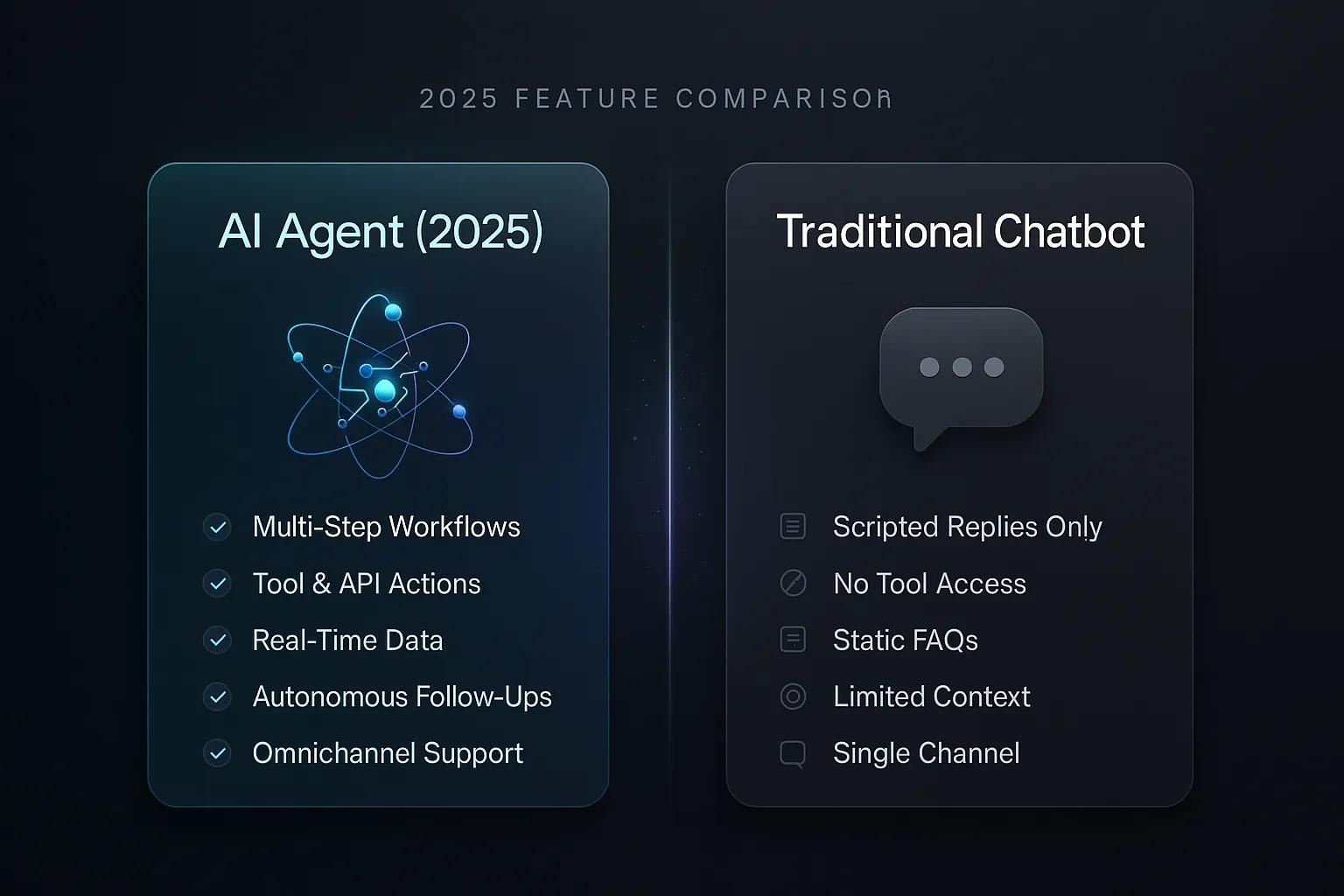
AI Agent vs Traditional Chatbot: 2026 Feature Comparison
It's 11 PM on a Tuesday. A customer reports a damaged package through your support channel. Your traditional chatbot politely apologizes and provides a link to...