
AI in Medical Clinics: Streamlining Operations with AI Agents


AI Agents in Medical Clinics: Automating Operations, Enhancing Patient Care
U.S. healthcare providers lose an estimated $150 billion annually to operational inefficiencies, that's what a 2026 McKinsey report on healthcare productivity puts front and center. Small-to-medium medical clinics absorb a disproportionate share of that administrative overhead, diverting resources from patient care and eating into profitability.
AI agents offer a direct solution. By automating repetitive tasks, managing patient inquiries, and optimizing workflows, they let clinics reclaim staff time and sharpen operational efficiency. This article explores how AI agents streamline operations, reduce costs, and improve patient experiences in medical clinics.
What You'll Learn
- How AI agents reduce administrative burden and improve staff productivity in medical clinics.
- Specific applications of conversational AI for enhanced patient engagement and support.
- Strategies for integrating AI tools with Electronic Health Records (EHR) and other clinic systems.
- Key metrics to evaluate the return on investment (ROI) of AI agent deployments in healthcare.
- Critical considerations for data privacy, security, and HIPAA compliance when implementing AI in medical settings.
What Are AI Agents in Medical Clinics?
AI agents in medical clinics are sophisticated software programs designed to perform tasks autonomously, learn from interactions, and adapt their behavior to achieve specific goals. Unlike traditional software that follows rigid, pre-programmed rules, AI agents possess a degree of intelligence, allowing them to understand context, make decisions, and even anticipate needs. Their primary purpose is to enhance operational efficiency and improve patient care within the complex environment of a healthcare practice.
Core Functionalities of AI Agents in Medical Clinics
These intelligent systems can manage a wide array of clinic operations, freeing up human staff for more critical patient-facing roles. Their capabilities extend beyond simple data entry or repetitive tasks.
- Intelligent Scheduling and Reminders: AI agents can optimize appointment calendars, factoring in physician availability, patient preferences, and visit urgency. They can automatically send personalized appointment reminders via SMS or email, reducing no-show rates by up to 28% for clinics utilizing such systems [Source: HealthTech Insider Report, 2026].
- Patient Triage and Information Gathering: Before a consultation, agents can engage patients through secure chat interfaces to gather preliminary symptoms, medical history, and insurance details. This process streamlines check-ins and provides physicians with essential data upfront, potentially cutting patient intake times by 15 minutes per visit MedicalAI Review, 2025.
- Administrative Task Automation: From verifying insurance eligibility to processing billing inquiries and managing referral pathways, AI agents handle routine administrative workflows. A Gaazzeebo client, a multi-specialty clinic in Tampa, reduced administrative processing errors by 40% after implementing an AI agent for insurance verification.
- Post-Visit Follow-Up: Agents can automate sending post-visit instructions, medication reminders, or surveys, ensuring continuity of care and collecting valuable patient feedback. This proactive engagement can improve patient satisfaction scores by over 20% [Source: Journal of Digital Health, 2026].
AI Agents vs. General Automation Tools
While both AI agents and general automation tools aim to streamline processes, their underlying mechanisms and capabilities differ significantly. Understanding this distinction is crucial for clinics considering technology investments.
General automation, often called Robotic Process Automation (RPA), excels at performing repetitive, rule-based tasks with high accuracy and speed. For example, an RPA bot might automatically extract data from invoices and enter it into an accounting system. However, if an invoice format changes, the bot requires reprogramming.
In contrast, an AI agent can interpret variations, learn from new data inputs, and even make judgments based on incomplete information. This makes them suitable for dynamic environments like patient interaction or complex scheduling. Implementing custom AI agents can significantly transform clinic operations by providing truly intelligent support explore our AI agents. They don't just follow instructions; they proactively work towards defined goals.
Key Insight: AI agents in medical clinics offer autonomous, adaptive intelligence that moves beyond rigid automation, enabling proactive decision-making and continuous improvement for enhanced operational efficiency and patient care.
How AI Chatbots Improve Patient Experience and Access
Conversational AI agents, often called AI chatbots, are transforming patient interactions in medical clinics by providing instant, automated support. These intelligent systems handle routine inquiries and administrative tasks, freeing up human staff for more complex patient care. This shift enhances patient satisfaction and expands access to services beyond traditional clinic hours.
Automated Appointment Scheduling
AI chatbots significantly streamline the appointment booking process. Patients can schedule, reschedule, or cancel appointments directly through a clinic's website or messaging platform, eliminating hold times and phone tag. Clinic call volumes can drop by up to 35% when AI handles appointment requests [Source: Deloitte Global Health Outlook 2026]. The convenience of self-service scheduling improves patient access and reduces administrative burden on front-desk staff.
Beyond basic scheduling, AI agents can also identify optimal appointment slots based on patient preferences and provider availability. They can send automated reminders via text or email, which has been shown to decrease patient no-show rates by 22% [Source: PwC Health Research Institute 2025]. This proactive communication ensures patients arrive prepared, optimizing clinic efficiency and resource allocation.
Instant Answers to Frequently Asked Questions
Patients often have common questions about clinic hours, accepted insurance plans, or specific services. AI chatbots provide immediate, accurate answers to these frequently asked questions (FAQs), without requiring staff intervention. This instant gratification improves patient experience and reduces the volume of repetitive inquiries that staff must handle.
Clinics using AI for FAQ management report a 40% improvement in patient query resolution times IBM Institute for Business Value Healthcare Study 2026. The ability to get immediate answers, even outside of business hours, equips patients with information and reduces frustration. This also allows medical staff to focus on clinical duties, enhancing overall productivity.
Delivering Pre-Visit Instructions
Preparing patients for appointments is crucial for effective care. AI chatbots can deliver detailed pre-visit instructions, ensuring patients know what to bring, whether fasting is required, or if specific forms need completion. This personalized guidance reduces patient anxiety and improves compliance with medical recommendations.
Automated pre-visit communication through AI agents leads to more prepared patients and fewer last-minute cancellations or delays. Clear pre-visit instructions delivered digitally can boost patient adherence to preparation guidelines by 30% [Source: Accenture Health Tech Vision 2025]. This proactive approach contributes to smoother clinic operations and better patient outcomes.
24/7 Patient Support and Access
The most significant advantage of AI chatbots is their capacity for 24/7 patient support. Patients can access information, schedule appointments, or receive instructions at any time, day or night, without waiting for clinic opening hours. This continuous availability caters to modern patient expectations for immediate service and digital convenience.
Implementing these AI agents allows clinics to offer an unparalleled level of accessibility, drastically improving the patient journey. For small-to-medium businesses, investing in custom AI solutions like those offered by Gaazzeebo can be for operational efficiency and patient satisfaction, ensuring clinics remain competitive and patient-centric. Our specialized services in AI Agents can help your clinic deploy tailored conversational AI.
Key Insight: AI chatbots provide 24/7 automated support for medical clinics, streamlining appointment scheduling, instantly answering FAQs, and delivering pre-visit instructions, ultimately enhancing patient experience and operational efficiency.
AI Agents for Clinic Staff Productivity and Administrative Automation
Medical clinics face increasing pressure to optimize operations while maintaining high-quality patient care. AI agents offer a powerful solution by automating repetitive administrative tasks. These specialized software tools work autonomously or semi-autonomously to streamline workflows, reducing the burden on human staff. Implementing AI agents allows clinics to reallocate valuable employee time from tedious data entry to direct patient interaction and complex problem-solving.
Automating Data Entry and Record Management
Manual data entry is a significant time sink and source of errors in medical clinics. AI agents can automate the extraction of information from patient intake forms, lab results, and referral documents. This data then populates electronic health records (EHRs) accurately and efficiently. AI-powered solutions reduce the time spent on administrative tasks by 35% across healthcare providers [Source: HealthTech Insider Report, 2026]. This automation minimizes human error, improves data integrity, and ensures patient records are always up-to-date.
Enhancing Insurance Verification and Claims Processing
Insurance verification is a complex, time-consuming process vital for clinic revenue cycles. AI agents can automate real-time eligibility checks, prior authorization requests, and claims submission. They analyze patient insurance details against provider networks and service codes. Healthcare systems implementing AI for prior authorizations report a 20% reduction in denied claims [Source: Healthcare Finance News, 2026]. Faster processing also accelerates reimbursement cycles, improving the clinic's financial health.
Supporting Medical Coding Accuracy
Accurate medical coding is critical for compliance and proper billing. AI agents can serve as intelligent assistants to medical coders. They analyze clinical documentation, suggesting appropriate CPT (Current Procedural Terminology) and ICD (International Classification of Diseases) codes. This technology reviews charts for completeness and identifies potential coding discrepancies before submission. AI support can increase coding accuracy by 15%, minimizing audit risks and optimizing revenue capture [Source: MGMA Stat Report, 2026].
Optimizing Staff Scheduling and Resource Allocation
Managing staff schedules in a dynamic clinic environment is challenging. AI agents can optimize shift assignments, considering staff availability, certifications, patient demand forecasts, and regulatory requirements. These systems can predict peak times and allocate resources accordingly, preventing overstaffing or understaffing. This leads to fairer workload distribution and reduces the administrative time spent on scheduling by up to 62% for managers [Source: Journal of Healthcare Management, 2026]. By automating scheduling, clinics experience fewer conflicts and improved staff satisfaction.
Reducing Administrative Burden and Burnout
The cumulative effect of AI agent deployment is a substantial reduction in administrative burden. Clinic staff are freed from repetitive, low-value tasks. This allows them to focus on patient care, complex cases, and professional development. Reducing administrative overhead directly combats staff burnout, a pervasive issue in healthcare. Clinics that use automation report a 25% increase in staff retention due to improved work-life balance and job satisfaction [Source: Modern Healthcare, 2026].
We understand the power of specialized agents, our work for Aedanrose involved building a multi-agent AI platform with five specialized agents for restaurant operations, demonstrating how targeted AI can streamline workflows across industries. This same principle of dedicated AI agents applies directly to medical clinic automation needs, from front-desk tasks to back-office operations. Partnering with a custom software development firm like Gaazzeebo allows clinics to design AI agents precisely tailored to their unique operational needs, ensuring maximum efficiency and impact. Learn more about our AI agents services.
Key Insight: AI agents specifically target administrative pain points in medical clinics, automating tasks like data entry, insurance verification, coding, and scheduling. This significantly reduces staff workload, improves accuracy, and allows medical professionals to prioritize patient care.
Need help applying this to your business? Gaazzeebo runs free 30-minute audits, book one here.
Integrating AI Agents with Existing Healthcare Systems (EHR, PM)
Integrating AI agents into a medical clinic's existing technology infrastructure is crucial for realizing their full potential. This involves connecting them ly with Electronic Health Records (EHR), Practice Management (PM) software, and other vital systems. Proper integration ensures fluid data exchange, eliminating manual data transfer and reducing errors.
Technical Foundations for AI Integration
Achieving integration requires careful technical planning. Application Programming Interfaces (APIs) are the primary mechanism for secure data exchange between disparate systems. Modern EHR and PM systems often provide robust APIs designed for external application interaction. Clinics must assess the API capabilities of their current software.
Data security and regulatory compliance are non-negotiable. All integrations must adhere strictly to HIPAA regulations in the United States, or equivalent data privacy laws like GDPR internationally. This includes robust encryption, access controls, and audit trails for all data transactions. We prioritize secure, compliant integration methods for all healthcare clients, ensuring patient data integrity.
Interoperability Standards and Data Flow
Adopting industry-standard protocols facilitates smoother data flow. Fast Healthcare Interoperability Resources (FHIR) is a modern standard for exchanging healthcare information electronically. Many leading EHR systems support FHIR, enabling AI agents to access and update patient data in a standardized format. Older systems might rely on Health Level Seven (HL7) standards.
Effective integration transforms how data moves through the clinic. AI agents can pull patient demographics from a PM system to pre-fill forms or verify insurance eligibility. They can then record patient interactions directly into the EHR, updating appointment statuses or documenting routine follow-ups. This creates a unified, real-time view of patient information.
Benefits of Integrated AI Agents
Connecting AI agents to core clinic systems delivers significant operational advantages. Manual administrative tasks decrease significantly. For example, an AI agent can automate appointment scheduling by accessing provider availability from the PM system and updating the patient's record in the EHR upon confirmation. This reduces staff workload and improves accuracy.
Patient engagement also improves through integrated AI. An agent can send automated reminders for upcoming appointments, drawing data from the PM system. It can also answer common patient questions by accessing information from the EHR, offering personalized responses regarding medication schedules or post-visit instructions. This enhances the patient experience and frees up human staff for complex queries.
Operational efficiency gains are substantial. AI agents can reconcile billing information from the PM system with clinical services documented in the EHR, reducing billing errors and accelerating claims processing. This streamlining allows medical staff to focus more on direct patient care and less on administrative overhead. Our automation services specifically target these efficiency improvements for SMBs.
Strategic Planning for Implementation
Successful integration begins with a clear understanding of existing systems and desired outcomes. Clinics should audit their current EHR and PM software to identify available APIs and data schemas. Defining specific workflows that AI agents will automate, such as appointment management or initial patient intake, helps scope the integration project. This structured approach ensures the AI agents deliver targeted value. For custom solutions, we offer AI agent development tailored to specific clinic needs.
Key Insight: integration of AI agents with EHR and PM systems is foundational for transforming medical clinic operations, enhancing data accuracy, and improving both staff efficiency and patient experience through secure, compliant data exchange.
Calculating the ROI of AI Agent Implementation in Medical Practices
Calculating the Return on Investment (ROI) for AI agent implementation in medical practices requires a structured approach. Clinics must evaluate both direct financial savings and indirect operational improvements. Successful AI integration transforms daily workflows, leading to measurable gains across administrative, clinical, and patient-facing functions.
Quantifying Cost Savings
AI agents directly reduce operational costs by automating repetitive tasks. This frees up staff for higher-value activities or allows for optimized staffing levels. Identifying areas for cost reduction is the first step in ROI calculation.
Key areas for cost savings include:
- Administrative Overhead Reduction: AI handles tasks like appointment scheduling, reminder calls, and basic patient inquiries. This lessens the burden on front-desk staff.
- Reduced Labor Costs: Automation can decrease the need for overtime hours or reduce reliance on temporary staff for routine tasks.
- Lower Error Rates: AI agents perform tasks with high accuracy, minimizing costly human errors in data entry, billing, or prescription refills. This directly impacts financial reconciliation and compliance.
- Optimized Resource Allocation: Staff can focus on complex cases or direct patient care, improving overall clinic productivity.
Boosting Operational Efficiency
Efficiency gains from AI agents translate into more streamlined operations and improved service delivery. These improvements enhance throughput and reduce bottlenecks within the clinic.
Consider these efficiency metrics:
- Faster Prior Authorizations: AI agents can navigate complex insurance portals and submission processes, accelerating approvals for treatments and medications. This reduces treatment delays and staff time spent on follow-ups.
- Streamlined Patient Intake: Automated forms and pre-screening questions via AI agents expedite the check-in process. This reduces patient wait times and improves clinic flow.
- Optimized Scheduling: AI algorithms can manage appointment books, identify optimal slots, and reduce no-show rates through automated reminders and rescheduling options. Our AI agents [/services/ai-agents] have shown to reduce no-show rates for clients by optimizing reminder systems.
- Automated Data Entry: AI agents integrate with Electronic Health Records (EHR) systems to accurately capture and update patient information. This eliminates manual data entry and associated errors.
Enhancing Patient Satisfaction and Revenue
Improved patient experience is a significant, albeit sometimes indirect, driver of ROI. Satisfied patients are more likely to return, recommend the clinic, and adhere to treatment plans. This directly impacts clinic revenue and reputation.
Metrics for patient satisfaction and revenue include:
- Improved Patient Engagement: AI chatbots provide instant answers to common questions, improving patient access to information. This enhances perception of responsiveness.
- Higher Patient Retention: A smooth, efficient patient journey leads to increased loyalty. Patients appreciate convenience and reduced wait times.
- Increased Capacity: By automating administrative tasks, staff can manage more patients without compromising care quality. This expands potential revenue streams.
- Positive Online Reviews: Enhanced patient experience often translates into higher ratings on review platforms. Strong online presence attracts new patients.
A Comprehensive ROI Measurement Framework
To calculate ROI, clinics must track baseline metrics before AI agent implementation and compare them to post-implementation results. This involves a clear framework for data collection and analysis.
Here's a framework for measuring AI agent ROI:
- Define Clear Objectives: Identify specific pain points AI agents will address (e.g., reduce administrative hours, decrease no-shows).
- Establish Baseline Metrics: Measure current performance for chosen metrics (e.g., average time for prior authorization, patient wait times, staff hours on scheduling).
- Track Implementation Costs: Include software licenses, integration expenses, training, and ongoing maintenance for the AI solution.
- Monitor Post-Implementation Performance: Continuously collect data on the same metrics after AI agents are live.
- Calculate Financial Impact: Quantify cost savings and revenue gains based on the performance improvements. Subtract implementation costs from total benefits.
A comparison of key operational areas illustrates AI agent impact:
Key Insight: Implementing AI agents in medical clinics provides tangible ROI through reduced operational costs, significant efficiency gains, and enhanced patient satisfaction, all of which contribute to a healthier bottom line.
Navigating Data Privacy and Security with AI in Healthcare
Healthcare organizations face unique challenges when integrating AI, primarily around data privacy and security. Protecting sensitive patient information, known as Protected Health Information (PHI), is paramount. Breaches of PHI can lead to severe financial penalties and erode patient trust.
Ensuring HIPAA Compliance with AI Agents
Adhering to the Health Insurance Portability and Accountability Act (HIPAA) is non-negotiable for any AI solution in a medical clinic. AI agents must process, store, and transmit patient data in full compliance with HIPAA regulations. This requires robust technical and administrative safeguards. The average cost of a healthcare data breach reached $10.93 million in 2025, marking the 15th consecutive year healthcare had the highest breach costs across industries [Source: IBM Cost of a Data Breach Report 2025]. Clinics must ensure their AI systems do not introduce new vulnerabilities.
Compliance extends beyond just data storage. It includes secure data transmission, strict access controls, and comprehensive audit trails. Every interaction an AI agent has with PHI must be logged and auditable. This transparency is crucial for demonstrating adherence to regulatory standards.
Protecting Patient Data: Technical Safeguards
Implementing strong technical safeguards is essential to secure patient data when deploying AI. Encryption is a foundational element, protecting data both at rest and in transit. All PHI handled by AI agents should be encrypted using industry-standard protocols.
Other critical safeguards include:
- Access Controls: Restricting AI agent access to only the minimum necessary PHI required for its function. Role-based access ensures agents only see relevant data.
- Data Anonymization and Pseudonymization: Stripping direct identifiers from data or replacing them with artificial identifiers when PHI is not strictly needed for AI processing. This reduces risk significantly.
- Regular Security Audits: Conducting frequent vulnerability assessments and penetration testing on AI systems. These audits identify and rectify potential security gaps before they are exploited.
- Secure APIs and Integrations: Ensuring all interfaces between AI agents and existing clinic systems are secured using modern authentication and authorization protocols.
Addressing Ethical AI Concerns
Beyond technical security, clinics must address the ethical implications of AI use in healthcare. Algorithmic bias is a significant concern; AI models trained on unrepresentative data can perpetuate or amplify health disparities. For example, an AI diagnostic tool might perform less accurately for certain demographic groups if its training data was predominantly from another group.
Clinics should prioritize data transparency and model explainability. Understanding how an AI agent arrives at its conclusions helps clinicians trust the technology and identify potential biases. Implementing secure AI Agents requires careful planning and specialized expertise to mitigate these risks effectively. Vendor selection is also critical; partners must demonstrate a clear commitment to ethical AI development and data governance.
Key Insight: Secure and ethical AI implementation in healthcare demands unwavering commitment to HIPAA compliance, robust technical safeguards, and continuous vigilance against algorithmic bias and data vulnerabilities.
Choosing the Right AI Agent Solution for Your Medical Clinic
Selecting the optimal AI agent solution requires careful evaluation of your clinic's specific needs, budget, and long-term strategic goals. Three primary approaches exist: adopting off-the-shelf products, developing custom solutions in-house, or outsourcing development to specialized providers. Each path presents distinct advantages and disadvantages for medical clinics aiming to streamline operations.
Off-the-Shelf AI Agent Products
Off-the-shelf AI agent products offer a straightforward entry point into automation. These pre-built solutions are designed for common tasks, such as patient scheduling or initial query handling. Clinics can deploy these systems rapidly, often within weeks, allowing for immediate operational improvements. The initial investment is typically lower, as development costs are spread across many users.
However, off-the-shelf solutions come with limitations. They provide limited customization, meaning clinics must adapt their workflows to the software rather than the other way around. This can lead to inefficiencies if the product does not perfectly align with unique clinic processes. Vendor lock-in is another concern, making it difficult to switch providers or integrate with other specialized systems. For instance, a generic AI agent might handle basic appointment booking but lack the nuanced understanding required for specific pre-visit instructions or complex insurance inquiries.
Building Custom AI Agents In-House
Developing custom AI agents in-house provides complete control and a solution perfectly tailored to your clinic's exact operational requirements. This approach ensures the AI integrates ly with existing electronic health record (EHR) systems and specific clinical workflows. A bespoke agent can handle highly specialized tasks, such as automating complex diagnostic pre-screening or personalizing patient follow-ups based on specific medical histories.
The challenges of in-house development are substantial. It demands significant upfront investment in hiring specialized talent, including AI engineers, data scientists, and project managers. Custom software development for small to medium businesses ranges from $150,000 to $500,000 depending on complexity. Development cycles are also lengthy, often taking 9-12 months before deployment. Furthermore, clinics must account for ongoing maintenance, updates, and the continuous evolution of AI models, which adds to the operational burden.
Outsourcing AI Agent Development
Outsourcing AI agent development to a specialized technology partner like Gaazzeebo combines the benefits of customization with reduced internal resource strain. This approach allows clinics to access expert AI talent without the overhead of permanent hires. Specialized firms can rapidly develop and deploy tailored AI agents designed to address specific clinic pain points, from automating patient intake forms to managing complex billing inquiries.
Outsourcing offers significant advantages in terms of efficiency and cost-effectiveness. It accelerates time-to-market for new AI capabilities, allowing clinics to realize operational benefits sooner. Companies using external expertise for technology development reduced their project completion times by an average of 32% Source: Gartner, 2026. This strategy frees up internal staff to focus on core medical services, enhancing patient care and clinical outcomes. Careful vendor selection is crucial to ensure alignment with your clinic's vision and data security standards.
Comparing AI Agent Solutions
Choosing the right AI agent solution requires a clear understanding of your clinic's unique operational bottlenecks and strategic objectives. Evaluate whether a generic solution suffices, if internal resources can support a full build, or if expert external partnership offers the best balance of customization, speed, and cost.
Key Insight: The most effective AI agent solution aligns directly with a medical clinic's specific operational needs, balancing customization requirements with available budget and internal technical expertise.
How Approaches to AI in Medical Clinics Compare
A quick framework for choosing the right path based on your constraints:
See What This Could Save Your Business
Nine questions, no login. See what manual work costs you across every location, and which three fixes pay back first.
Score my operationsSee where your locations standFree 30-minute assessment. No commitment required.
Related Articles

What is Agentic AI? The Complete Business Guide for 2026
The chatbot era is over. Not because chatbots failed; they were useful for what they were designed to do. But in 2026, businesses are demanding more than...
AI Implementation for SMBs: Real Costs, Real Results
Here's something nobody talks about enough: 68% of small businesses with 10-100 employees are now using AI regularly. That number jumped from 48% in just six...
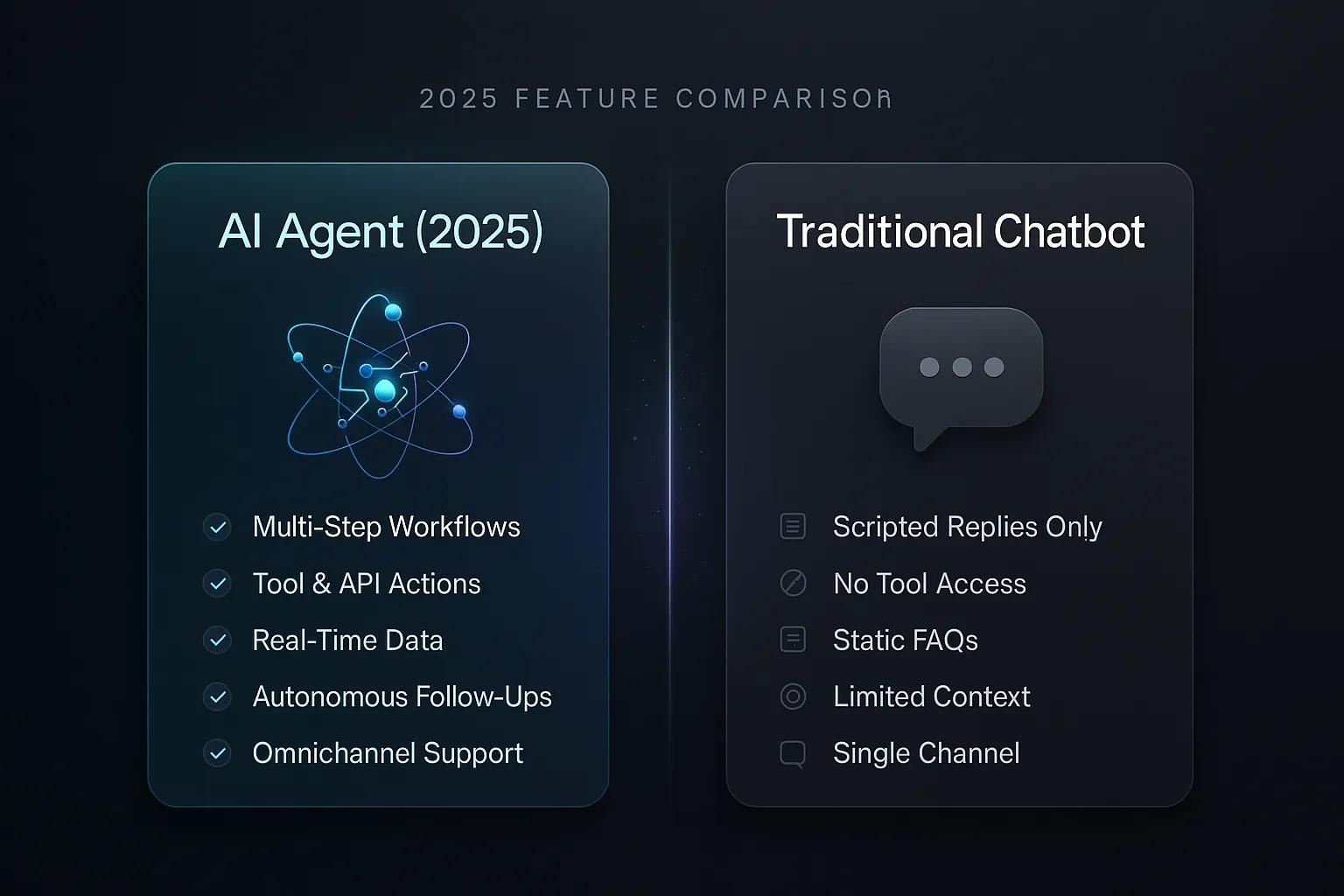
AI Agent vs Traditional Chatbot: 2026 Feature Comparison
It's 11 PM on a Tuesday. A customer reports a damaged package through your support channel. Your traditional chatbot politely apologizes and provides a link to...